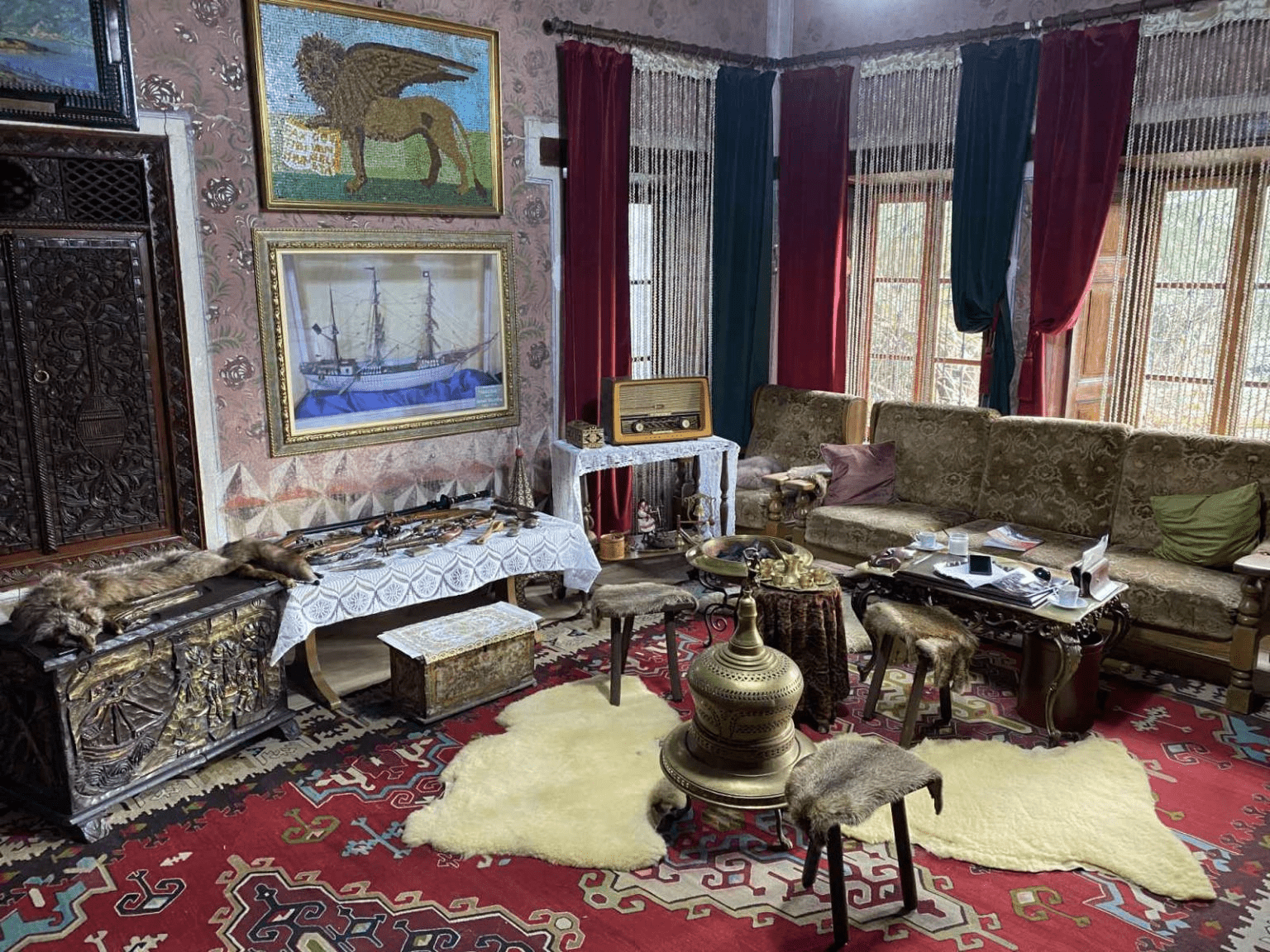

If history is written by the victors, heritage is written by those who know how to preserve memory. In the heart of old Shkodra, the Shurdha family house-museum does not simply display a collection of artifacts, it is a sentimental and geographical map, a meeting point where the deep sea of Ulqin meets the fertile soil of Shkodra. To understand this room, we must first understand the history of a family that defied distances, melted borders and created a rare model of cosmopolitan citizenship in the Balkans.
Entering the Shurdha family museum room in Shkodra is not simply a crossing of the threshold of a physical space, but an unexpected break from the flow of time to enter a living archive of our civic identity. My first meeting with Mr. Ahmet Shurdha was not a formal introduction between a visitor and a host, but an immediate conversation, as if we were old friends meeting to continue a conversation left half a decade ago.
In that room, where the walls with their authentic decorations from the first day of construction still seem to carry the echo of centuries, conversations with Ahmet flowed with surprising naturalness, unfolding before me a history that merged into a deep intellectual, maritime, civic and patriotic connection.
As we spoke, every object in the room, from the family ship “Hulusie” finely crafted by Ahmeti’s brother and symbolizing the family’s trading empire across the Adriatic, to the silver-adorned weapons, became a living testament to a heritage that stretches like an unbreakable bridge between Ulqin and Shkodra. In his stories, Ahmeti guided me through a rich maritime history, where the Shurdha family was not just a name, but an institution that connected the culture of the coast with the city’s administration, a history where humanism came first, as evidenced by the noble integration of the ragtag who proudly bore the family surname.
This admiration for the roots deepened when we touched on the figure of his mother, from the distinguished Behri family, a family that had a Western education and emancipation, shaped in the universities of Italy and brought as light to the homes of Shkodra, or when we remembered the strong blood ties with the patriot Oso Kuka, a figure that gives the museum room the weight of an indisputable patriotic testimony.
In this constellation of distinguished figures, Ahmeti proudly stopped at the family connection with Cafo Beg Ulqin, the first Albanian mayor of Ulqin and member of the High Regency, who had deep roots in this trunk, since his mother came from the Shurdha family. In those moments, where every detail was part of a large family mosaic, I realized that Ahmet Shurdha’s room does not simply house old items, but the spirit of a citizenship that was not broken by the boundaries of time and that continues to be a living testament to dignity, culture, and unwavering love for the homeland.
When the visitor crosses the threshold of this room, the first feeling is that of an inherited sophistication. The first thing that caught my eye was the “Lion of St. Mark”. It does not just stand there as decoration. It is the emblem of a relationship that the Shurdha family had cultivated with Venice through seafaring. As an Ulqin family, they were born with the instinct of sailors, they knew the language of the winds, the trade routes of the Adriatic and the diplomats of the outside world.
However, Shkodra, as a major administrative center, offered the other dimension of their identity: the power of land, the administration of property and social influence.
The Shurdha family was never divided between these two cities. They merged them into one. One part of the family remained in Ulqin to preserve the port and maritime tradition, while the other flourished in Shkodra, building this house that today serves as an open history book.
The ship models that dominate the view in the museum room are not toys, but real monuments. They represent the “fleet of the Deaf,” ships that sailed the seas to bring raw materials, expensive fabrics, and new ideas. In every detail of those models, the spirit of the family is felt. For the Deaf, the ship was the means, but citizenship was the goal. They did not simply trade goods. They traded culture.
This maritime connection was the artery that fed the family’s economy and kept contact with the Western world alive, making the family an irreplaceable intermediary in the Albanian market of the era.
If the trade that took place in Shkodra and whose museum rooms proved to us that they were the “head” of the family, the “Crown of the Deaf” in Ulqin was its soul. Building a fountain was not simply an engineering requirement, but a moral act. In the Ulqin tradition, he who builds a fountain, builds a monument that never dies.
The crown remains today as evidence of the fact that the Deaf did not only see their own wealth, but the well-being of the community. This charitable gesture in Ulqin resonates in Shkodra as an immutable family value: success is only valid if it is beneficial to everyone.
Perhaps the most illuminating and unusual chapter in the history of this family is their treatment of the “harps” of African origin, whom they brought to these lands at that time. At a time when societies were often divided by prejudice, the Shurdha family built a highly advanced social system. These people, whom the family had integrated into shipbuilding, agriculture, and as members of the household, were not “servants” in the degrading sense of the word. They were free collaborators. The fact that they bore the surname “Shurdha” is a rare testament to human dignity. Their wives, who managed the homes, were keepers of traditions, while the men were respected sailors and workers. They shared bread, work, and surname. This model of inclusivity places the Shurdha family among the most progressive families of the time, showing that Ulqin’s citizenry was capable of embracing diversity long before this topic became part of modern discourse.
When we stand in the museum room, we do not simply see objects. We see: Silver weapons that show the willingness to defend honor and wealth. Mattresses and furs that testify to a luxurious lifestyle, where comfort was as important as hospitality. Documents of the time that constitute the silent archive of trade agreements and family correspondence, testifying to a family that had high administrative skills.
The room is a careful choreography of objects that tell a story of movement. Nothing is static. Every item has traveled from the sea to end up here, in a room that has become a destination.
The floor covered with red carpets with traditional motifs creates a solid base, almost like a “second earth” inside the room. The dominant red color is not accidental, it symbolizes vitality and wealth. The animal furs thrown on the benches and chests are not simply decorative elements, but evidence of the connection with nature and the family’s ability to tame the wildness of the mountains or the sea. They give the room a “homely” feel, making luxury seem livable and not cold.
If we take a look at the wooden chest, we see a masterful work that speaks of a time when everything precious was locked up under lock and key. The wood carvings are not just decoration, they are narrative. Often, these chests were used to store dowries, important documents, or ceremonial robes. This chest is the Shurdha family’s “bank,” the place where ship contracts and travel mementos were kept.
Traditional-style windows, draped with heavy curtains, create a controlled atmosphere. The light that enters is not strong, it is soft, almost like in an art gallery. This lighting gives the objects a magical glow. The curtains function as a “theater stage”, they separate the family’s privacy from the outside world, creating a microcosm where time seems to have stopped.
In the center of the room, the coffee service and low stools are the heart of the space. This is not a room for working, but for making decisions . Here, the men of the Shurdha family, whether they came from Ulqin or merchants from Shkodra, sat down to drink coffee. The coffee table is not just a piece of furniture, it is the “negotiation table”. It is the place where the construction of the Crown of the Deaf was planned and where the fates of ships sailing the Adriatic were discussed.
The presence of an old radio on the lace-covered table shows that this room is not frozen in the 18th century. The Shurdha family was always in the flow of time. The radio is the bridge that connected this house to the changing world, showing that they were a family that embraced modernity without abandoning their roots.
The Shurdha family is an example of how an Albanian family can be an institution in its own right. Being both Ulqin and Shkodra, they were not separated by the boundaries of time, but used them to build a bridge. Today, this museum room is more than an exhibition space, it is a testament to humanism, fair trade and progressive vision.
The Shurdha Collection reminds us that true wealth lies not in the goods brought by ships, but in the values left behind: a well that still gives water, a surname that united people from different continents, and a history that teaches us that, no matter where we come from, we are all part of the same effort to leave a mark. The Shurdha family did not simply preserve their history, they built the foundations of what we know today as civic identity – an identity that is not locked within walls, but opens like a gateway to the sea.
Article
https://ul-info.com/gazmend-citaku-nga-valet-e-ulqinit-te-portat-e-shkodres/?

