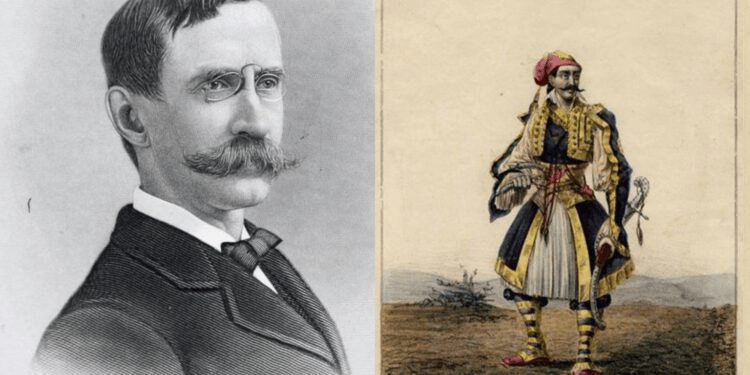

In 1868, the American writer and diplomat Samuel Greene Wheeler Benjamin traveled through the Levant and Greece, leaving behind him a record of indisputable importance for any serious investigation of the cultural history of the Balkans. His book The Turk and the Greek (1867) — preserved today thanks to digitization by the Library of Congress — contains a remarkable passage set in Chapter IX, “Hellas,” that sheds light on one of the clearest acts of cultural appropriation documented by an impartial foreign witness:
“With all respect for the flowing robes or the warrior’s armor of the Periclean age, it appears to me that the Albanian costume adopted by the Greeks before the revolution and still used by many of them, is the finest dress ever worn by any people.”
Benjamin does not call it “Greek costume.” He calls it by its real name: Albanian costume, adopted by the Greeks.
This is not just a casual comment. It is primary evidence, written by an independent observer in the third decade after the 1821 Revolution, documenting a reality that official Athens would work diligently to erase from the collective European memory.
Object of the crime: What is a frock?
Before investigating the dynamics of appropriation, the value of the stolen object must be understood.
Benjamin, who devotes six full paragraphs to the costume, does not skimp on superlatives: he calls it “the finest dress ever worn by any people” and compares it — to his disfavor — to the costume of the Scottish Highlanders, saying that the latter “is by no means so graceful as this.”
Its technical description is encyclopedic:
The fustanella — a kilt tightly folded around the waist and hanging loosely to just above the knee in massive folds of snow-white cloth. It is not just a “skirt” — it is textile architecture, a weave of movement and dignity.
The belt — long, woven, brightly colored, wrapped tightly around the waist. Benjamin notes that “Athenian elegants” tied one end of the belt behind them and then wrapped themselves around it — the gesture of wearing it was itself ritual.
The vest and jacket — deep red or dark blue leather, embroidered with gold, over the shirt with flared sleeves.
Leggings — the same colors, with gold thread tassels and fringe.
The scarf — red, long enough to fall over the shoulder from the weight of the blue silk tassel.
Wide leather belt — with pistols and daggers, worn by mountaineers or in times of war.
This was not the garment of poverty. As Benjamin himself notes with economic acumen: “Such a suit naturally costs too much to be often renewed, and this will probably be the reason why it will eventually go out of date.” The dress was capital embedded in freedom, dignity, and identity — and precisely because of that it was worth stealing.
Historical Scenography: Why was the theft possible?
Every successful crime requires favorable conditions. The theft of the frock was no exception. History provided a series of circumstances that made it not only possible, but almost inevitable.
Osmani as an extraordinary leveler
Under Ottoman administration, the national identities of the Balkan peoples were not organized according to modern ethno-linguistic logic, but according to the millet system —religious-administrative units. Albanians and Greeks, when Orthodox, often fell within the same millet-i rum , creating a gray area where religious identity superimposed on ethnic identity.
This instrumentalized confusion caused Albanian clothing, customs, and symbols to flow freely between communities, without clear boundaries of cultural ownership.
Arvanites: The bridge of dual identity
The key element in this equation are the Arvanites — a population of Albanian origin, settled in areas of central and southern Greece since the Middle Ages, and gradually integrated into the Greek Orthodox community. Until the 19th century, many of the noblest families of Athens and the Peloponnese spoke “Arvanitiste” Albanian as their mother tongue.
The fustanella was their costume. When the Greek independence movement took shape, the Arvanite soldiers — the klefts and the armatols — became the iconographic image of the new Greek warrior. Their dress was the fustanella. And this garment entered the pantheon of Greek national symbols not as “inherited Albanian clothing,” but as “Greek national costume.”
The Revolution of 1821: Moment of iconographic crystallization
The revolution was not just a military event — it was an identity project. Its leaders, many of whom had European training (Koraes, Kapodistrias, and others), urgently needed an image — an image that would show philohellenic Europeans that the fledgling Greek nation had a living heritage and a distinct aesthetic.
The fustanella offered just that. It was beautiful, distinctive, un-Ottoman in appearance, and — as Benjamin would note decades later — an expression of “national patriotism” in opposition to “the rigid fashion of Paris.”
And as Benjamin noted: those who still wore it, wore it proudly precisely as a protest against submission to French fashion — making the fustanella a symbol of cultural resistance. The tragic irony: the fustanella as Greek cultural resistance to the West, while it was Albanian culture adopted from the East (Albania).
European Philhellenism: The Desired Audience
Romantic Europeans needed Greece. Lord Byron died in Missolonghi. Delacroix painted “The Massacre of Chios.” The entire cultural apparatus of Romantic Europe was mobilized around the idea of a Greek renaissance.
But the image of the “Renaissance Greek” had to be visually striking. Ottoman costumes or Byzantine garb did not work rhetorically. The fustanella — worn by Albanian fighters of the revolution — became the uniform of the romantic hero. Lithographs like Canquoin’s from Marseille (c. 1850), titled “Albanais en Grand Costume,” (pictured below) document precisely this duality: the image is explicitly called Albanian, but the European world would absorb him as “Greek” through a thousand other variants.
Acquisition mechanism: Three stages
Phase I — Adoption (before 1821)
As Benjamin says so eloquently: “the Albanian costume adopted by the Greeks before the revolution.” This temporal detail is crucial. The fustanella did not come with the revolution—it had already been adopted by the Greek populations before this movement took shape. The Arvanites and the autochthonous Albanians of the Peloponnese and Rumelia had introduced it as everyday clothing in Greek-Orthodox settings for centuries.
Phase II — Heroization (1821-1832)
During the war years, the most prominent fighters were often of Arvanite or Albanian origin: Kolokotroni, Mavromihali, Boçari, etc. Historical photography and painting of the time iconized them precisely with the frock coat. The frock coat became the costume of heroism — and the hero became “Greek.”
Phase III — Institutionalization (post-1832)
The new Greek kingdom, under the Bavarian king Otho, was in dire need of national symbols. The fustanella was adopted as the official uniform of the Evzone — the royal guard. This act of state transformed the garment from a migrated folk culture into a legal symbol of the state.
Today, the Evzones — the guards of the Mausoleum of the Unknown Soldier in front of the Greek Parliament — wear the frock coat as the supreme symbol of Greek national identity. This garment has been elevated to the level of a national sacrament.
Marubi’s testimony: Photograph as evidence
The photograph of Prenk Bib Doda by Pjetro Marubi (pictured below)— preserved in the “Marubi” National Museum of Photography in Shkodër — offers visual proof of what Benjamin describes in words. The costume shown in the photograph from the 1870s-80s is identical in every detail to what Benjamin calls the “Albanian costume”: intricately decorated xhoka, white frock coat underneath, rich accessories, Ottoman sword.
This is not a costume from the “Greek Balkan region.” It is Albanian clothing photographically documented by Italian photographer Pietro Marubi precisely within the Albanian context, with an identified Albanian figure.
Historical note : Prenk Bib Doda’s costume was presented as a gift by Albanian youth to Stalin during the celebrations of the October Revolution in 1947, and is now kept in the St. Petersburg Museum. His father’s sword, Bibë Doda — a gift from Napoleon III — is believed to have been presented to Nikita Khrushchev during his visit to Albania in 1959. Two objects of Albanian heritage, scattered around the world like gifts of history, while their cultural origins were hidden under layers of another narrative.
What is lost when theft triumphs?
Cultural crime has no animal victims. The loss is diffuse, distributed, historical.
Albania loses symbolic ownership of one of its most famous cultural objects in the world. When tourists come to Athens and photograph the Evzones in front of the Parliament, they “see Greekness” — not Albanianness, even though every thread of that dress has Albanian cultural origins.
The Arvanites lose their dualistic heritage — reduced to either “assimilated Albanians” or “patriotic Greeks,” losing the complexity of their real identity.
Balkan history loses its accuracy — replaced by 19th-century national narratives that were political projects, not descriptions of reality.
Benjamin, writing in 1867, “Albanian costume” not out of greed, but out of accuracy. As a foreign traveler without national interest, he saw what needed to be seen.
Modern parallels and the issue of cultural justice
The debate over cultural appropriation has returned to global academic and public discourse. The clothing, music, recipes, and rituals of indigenous peoples are objects of this debate — with arguments of “cultural exchange” versus those of “exploitation and erasure.”
The case of the fustanella is special: it is not just about informal adoption, but about state institutionalization of the cultural symbol of another people, without recognition, without attribution, and — most seriously — with the activation of the national apparatus to give it a different origin.
This is not a political indictment of the day — it is a matter of historical record. Books like Benjamin’s, Marubi’s photographs, Canquoin’s lithographs: they all testify unanimously and independently of each other.
What do we do with the truth?
There is no court competent for the cultural decisions of 1832. There is no international mechanism that will return the symbolic ownership of the dress to the Albanians.
But there is something that can be done: correct naming.
Benjamin did it in 1867. Marubi did it with a camera. Canquoin did it with a lithograph and a title.
Our obligation, as heirs of this history, is to not allow the “Albanian costume adopted by the Greeks” to become, through silence or negligence, simply “Greek costume.” Not out of hatred, not out of politics — but out of simple respect for the historical fact.
The dress is Albanian. Beautiful in itself and just as beautifully adopted. Documented in detail.
History doesn’t disappear — it just waits for someone to give it the right name. Prepared by Elis Buba / usalbanianmediagroup.com
Sources
Samuel Greene Wheeler Benjamin, The Turk and the Greek (1867), Chapter IX “Hellas”, pages 208-210. [Google Books / Library of Congress Digital Archive]
Lithograph Canquoin, Marseille, circa 1850: Albanais en Grand Costume — figure in national costume with sword and two pistols, outdoors.
Photographer Pjetro Marubi: Prenk Bib Doda in Albanian costume, National Museum of Photography “Marubi,” Shkodër.
Article

