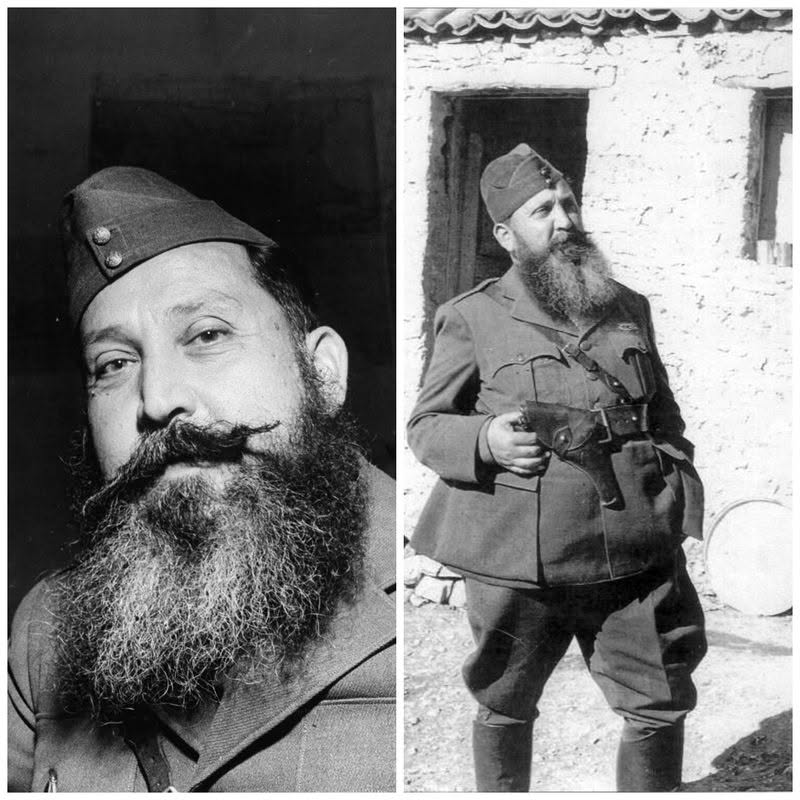

Napoleon Zervas (1891–1957) is widely “celebrated” in Greek extremist ultra-nationalist discourse as a leading figure in the resistance against Axis occupation during World War II. As the founder and commander of the National Republican Greek League (EDES), he is credited with anti-Axis operations and contributions to the Allied effort in Epirus. However, in the context of Albanian history and the Cham Albanian community, Zervas is remembered as the primary perpetrator of massacres and forced expulsions in Chameria in 1944–1945. These events resulted in the deaths of hundreds to thousands of Muslim Cham Albanians and the displacement of tens of thousands.
Zervas and EDES: Resistance Fighter with a Dark Record
Zervas, a Greek army officer, established EDES in 1941 as a republican, anti-communist resistance group. It conducted notable operations, such as the Gorgopotamos bridge sabotage, and clashed with both Axis forces and the communist-dominated ELAS. British support bolstered EDES, particularly to secure the Ionian coast. Yet Zervas’s forces also engaged in brutal inter-ethnic violence. In the summer of 1944, EDES targeted the Muslim Cham Albanian population of Chameria.
The Atrocities in Chameria: Massacres and Expulsion
The campaign began in earnest in June 1944. On or around June 27, 1944, EDES forces entered Paramythia and massacred approximately 600 Muslim Chams—men, women, and children—in what eyewitness accounts describe as an orgy of violence, including rape and torture. Similar killings occurred in other settlements like Filiates, Parga, and surrounding villages.
Estimates of the death toll vary significantly due to the chaotic wartime context and partisan biases:
Scholarly and Wikipedia-sourced ranges place direct killings at 1,200–2,000+, with Albanian sources citing up to 2,877 killed in specific operations.
An additional 2,000–2,500 may have died from hunger, disease, and exposure during flight to Albania.
Roughly 18,000–35,000 Muslim Chams were expelled, with most fleeing to Albania (some later to Turkey). Christian Chams were generally spared or assimilated.
British liaison officer Colonel C.M. Woodhouse acknowledged the events: Zervas, encouraged by the Allied Mission, drove the Chams out. While noting prior Cham brutalities, he criticized the methods as “pretty bad” and noted subordinates “got out of hand.” A 1953 letter attributed to Zervas celebrates the removal of Muslim Chams who had “trampled on Hellenism for five hundred years.” These were not isolated reprisals but a systematic campaign of ethnic cleansing that emptied a region of its Muslim Albanian population.
“Greek Heroism”
In Greece, Zervas is often portrayed as a patriot who fought Nazis and communists. Post-war, he served as a minister before controversies over collaboration rumors and the Cham operations forced his resignation in 1947.
Albanian historiography and Cham organizations label it genocide or ethnic cleansing, pointing to the targeting of civilians, collective punishment, and permanent dispossession of property. The issue remains a sensitive point in Greek-Albanian relations, with Chams demanding recognition, apology, and property restitution—demands Greece has largely rejected.
The Problem with Selective Heroism
Celebrating Zervas as an unblemished hero requires ignoring or downplaying documented massacres of civilians. Collective punishment of entire communities, including women and children, violates basic principles of justice and international norms, even by mid-20th-century standards.
Greek Megali Hellenist National myths thrive on selectivity. Greece honors Greek war criminals while sidelining the human cost to minorities. Zervas’s own words and the scale of displacement suggest motives beyond pure anti-fascism: securing a homogeneous border region and settling historical scores. As one analysis notes, the campaign achieved the “eviction of the undesirable Albanian population.”
Conclusion
Napoleon Zervas leadership of ethnic cleansing in Chameria hast left stains on Greek history and legacy. In families and communities descended from the victims—like the Mihali family referenced—the notion of Zervas as hero is not just offensive but a denial of lived trauma.
Until Greece and Greek movements confront this episode with honesty—beyond nationalist propaganda—the wounds of Chameria will continue to poison relations. Heroes in one nation’s pantheon can be war criminals in another’s memory. Rigorous history demands we recognize both.
Sources
Mazower, Mark. Inside Hitler’s Greece: The Experience of Occupation, 1941–44. New Haven: Yale University Press, 1993 (contextual references via secondary summaries).
Vickers, Miranda. The Albanians: A Modern History. London: I.B. Tauris, 1999/2002 editions.
Woodhouse, C.M. Reports and memoirs (quoted in multiple secondary sources).
Chameria Association documents and 1946 submissions to UN (primary Albanian perspectives).
Greek and international scholarship on WWII Balkans (e.g., works by Close, Margaritis).

