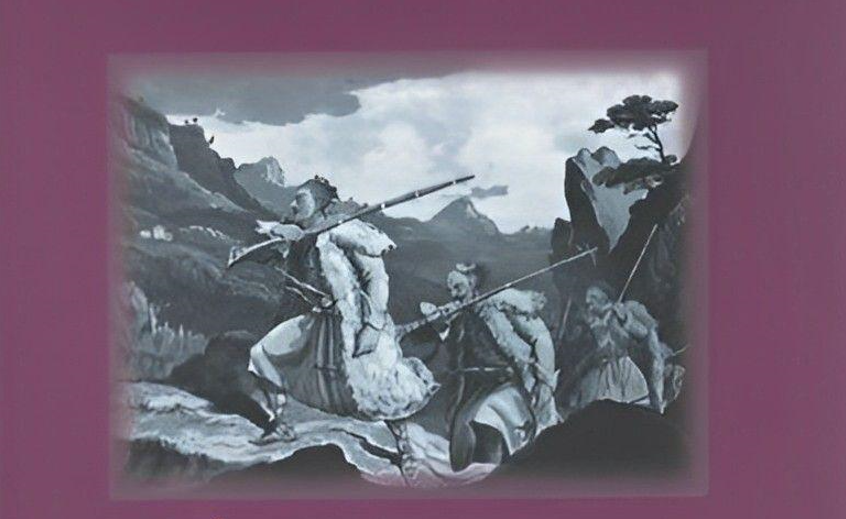

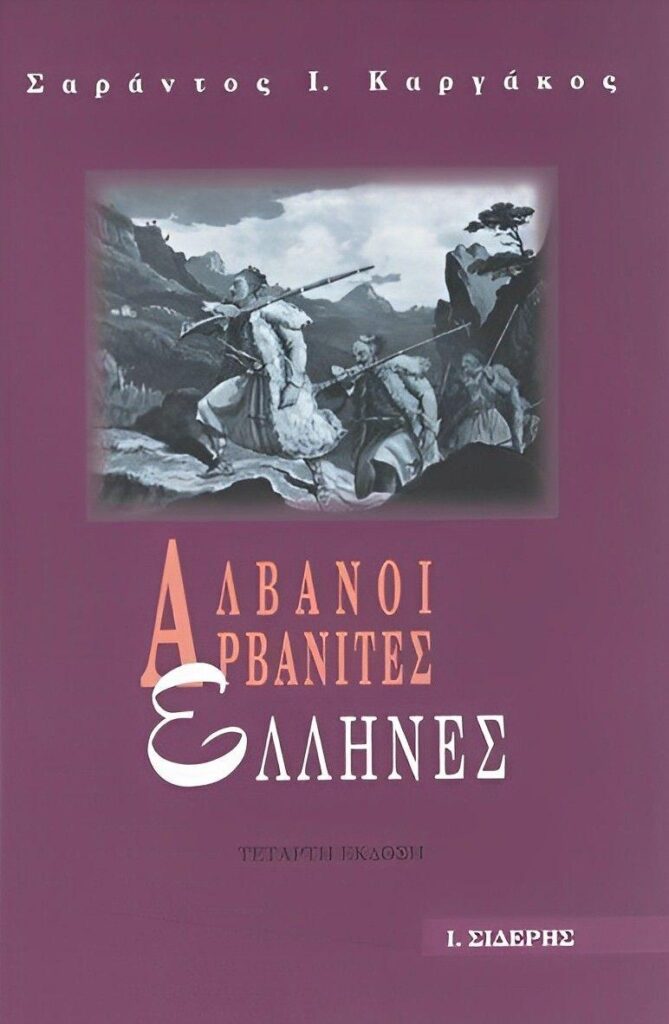
Based in part on the study “Αλβανοί, Αρβανίτες, Έλληνες” (Albanians, Arvanites, Hellenes) by the Greek historian Sarantos I. Kargakos
Kargakos’ book is written from a clearly Greek nationalist, non-scientific perspective and argues against the idea of an “Albanian minority” in Greece — while the contradictions of the work with this position are obvious and will be discussed below. His theses lose their balance when the international linguistic consensus on the Albanian origin of Arvanitic/Arbish is inevitably examined.
A people who forgot to be called by their name
In the villages of Attica, Boeotia, Euboea, Argolis, islands such as Hydra, Spetses and Salamis, and in dozens of other areas of southern Greece, a population that calls itself Arvanitas has lived for centuries and that, until a few generations ago, spoke a language called Arvanitika — a direct dialect of Southern Albanian (Tosk Albanian), preserved almost frozen in time since the 14th century. Today, this language is considered “seriously endangered” by UNESCO and the number of active speakers is estimated at only a few tens of thousands, mostly elderly people.
The history of the Arvanites is one of the most interesting — and politically sensitive — cases of ethnic identity in the Balkans: a population of clear Albanian origin, which, through centuries of coexistence, joint warfare, and linguistic assimilation, became an organic, even founding, part of the modern Greek state and nation — without ever completely losing track of its origins.
Roots: from medieval Albania southward
The name “Arvanitis” derives, according to Greek historical sources of the Middle Ages (among others, the “Alexiada” of Anna Komnene), from the territory called Arvanon or Arbri — precisely the historical region otherwise known as Arbëria, the territorial core from which the Albanian people themselves and their scattered branches (the Arbëresh of Italy, the Arvanites of Greece) take their name. The researcher Kargakos himself accepts this linguistic-territorial connection, although he interprets it through an academically controversial alternative thesis: that “arvanitis” would be an ancient Greek word, linked to the ancient city of Arvon in Illyria, and not simply the Greek form of the Albanian ethnic name itself.
Regardless of the interpretations of the origin of the word, the historical fact remains undeniable: the large influxes of Albanian-speaking populations towards southern Greece began in the 14th century, mainly during the reign of Manuel Kantakouzenos, despot of Mystras (1349-1380), when about 10,000 Albanians settled in the Peloponnese to repopulate territories devastated by wars. A second wave of 10,000 arrived under Theodore I Palaiologos. Then, during the 15th century, internal movements among the Albanian nobles (Gjin Bua Shpata, Pjetër Losha against Thoma Preljubović) pushed other groups southward — a process that left behind the toponyms still visible today on the map of Attica: Spata and Liosia , names that come directly from the names of Albanian nobles of the 14th century.
From Epirus, waves of migration continued towards Attica (first documented colonization in 1382, intensified after 1402), Boeotia, and from there towards the islands of the Argosaronic — Salamis, Hydra, Spetses — as well as towards Euboea and other Aegean islands.
Surviving language: Arvanitika
Arvanitika is not “an Albanian-influenced language” — it is Albanian itself, in its Tosk variant, linguistically frozen in the 15th-16th centuries, before modern standard Albanian developed further in Albania itself. International linguists classify it as an archaic dialect of Southern Tosk, which preserves phonetic and lexical features that have now disappeared or evolved differently in the Albanian spoken in Albania.
Kargakos’s book itself, although written from a clearly Greek-centric perspective and often polemical against any tendency to call the Arvanites “ethnic Albanians” in the modern political sense, provides valuable philological evidence: he mentions the pioneering work of Panagiotis Kupitoris (1821-1881), an intellectual from Hydra with a “Greek-Arvanite” conscience, who tried throughout his life to establish the Greek alphabet for writing the Albanian language, in the belief that this would more clearly show the linguistic proximity between Greek and Albanian. His work “Albanikai Meletai” (1879) remains one of the first scientific documents on the Albanian language written by an author of Arvanite origin.
The author himself confesses, in the book’s preface, that he learned the Arvanite language himself in the Egaleo neighborhood of Athens, among Albanian-speaking elders, and that today he has his own teacher of “Arvanitic” — living proof that the language, however endangered, still survived at the end of the 20th century in the communities of Mesogia (eastern Attica) and Boeotia.
The War of 1821: the moment that sealed identity
If there is one historical moment that determined the political and identity destiny of the Arvanites, it is the Greek War of Independence of 1821. While many Albanian-speaking populations of the north (in the service of the Ottoman Empire, such as the so-called “Turkish Albanians” Albanian Muslim mercenaries) fought alongside the Ottoman army against the uprising, the Arvanite population of Attica, Boeotia and Euboea participated massively and decisively on the side of the Greek Orthodox insurgents. This uprising was clearly a clash between Albanians.
According to the data presented by Kargakos, under the leadership of Meletios Vasiliou, the Arvanites were among the first to liberate Athens. The Arvanite naval families of Hydra and Spetses — Kounduriotis, Miaulis — produced some of the most famous admirals of the Greek revolutionary fleet, while the villages of Dervenohoria and Megara were, according to contemporary documents, among the first to rise up in the first months of the uprising.
This massive participation in the war also brought about a deep symbolic division between the “Arvanit” — the Albanian-speaker who chose the Greek identity through the blood shed for it — and the “Albanian” (Ottoman or Muslim) who remained on the other side of the front. In reality, this division occurred decades later, when the ethnic meaning of the word Greek was really taking on meaning. From this moment on, the book itself openly emphasizes, “a deep chasm opened between the Albanian and the Arvanit”, although both peoples spoke the same native language. This chasm, it should be noted, was political and took on a more academically elaborate form only after politics began to dictate history.
The contribution of the Arvanites to the modern Greek state and society
After independence, the Arvanite population, thanks to its participation in the war and its rapid integration into the new state structures, produced some of the most important figures in the political, military and naval history of Greece in the 19th and 20th centuries. Kargakos’ own study highlights this with a significant list: most of the generals, admirals and prime ministers of modern Greece had Arvanite roots — the Vulgaris, Miaulis, Kunduriotis, Pangalos, Kondoulis, Rallis families, among others.
This fact is not a sociological coincidence, but a direct consequence of the way in which integration took place: Arvanite men, through military service, schooling and participation in public life, learned Greek quickly and rose through the state and military hierarchies, while women — who traditionally did not attend school — continued to speak their native Albanian at home, transmitting it to their children. This double dynamic explains the paradox that the Arvanites, while providing the political-military elite of the Greek state, simultaneously kept their Albanian language alive until the 20th century in their villages.
The Arbëresh of Italy: another branch of the same tree
Parallel to the Arvanites of Greece, the invasions of the 15th and 16th centuries brought other groups of Albanian speakers to southern Italy and Sicily, where they formed the community known today as the Arbëreshët. This process accelerated particularly after the death of Gjergj Kastrioti-Skënderbeg (1468) and the final collapse of Albanian resistance to the Ottoman conquest, when entire families and military units migrated across the Adriatic.
The Arbëresh, unlike the Arvanites, maintained a more pronounced and open Albanian ethnic consciousness over the centuries, contributing significantly — as Kargako’s book itself testifies — to the cultural and national movements of the Balkans and of Italy itself (the case of Dhimitër Dhimitriev, a playwright originally from Siatista in Macedonia, founder of the Croatian theater, is an indirect example of the influence of this diaspora on the Balkan cultural movements of the 19th century). The Arbëresh maintain to this day a dual Albanian-Italian identity, with a literature, Byzantine clergy (Uniate) and rich folkloric tradition, which today constitutes one of the fundamental pillars of international Arbëresh studies.
Thus, the Arvanites of Greece and the Arbëresh of Italy constitute two twin branches of the same medieval Albanian diaspora, emerging from the same linguistic and ethnic space of Arbëria, but who followed completely different paths of integration — one towards Greek identity, the other towards preserving a more visible Albanian consciousness within the Italian context.
A politically charged story
It is important, for any serious academic treatment, to emphasize that the very book that serves here as the primary source — “Αλβανοί, Αρβανίτες, Έλληνες” by Sarantos Kargakos, published in 1999-2000 — was written openly as a polemical reaction to what the author calls “funded” efforts to “discover” an “Albanian minority” in Greece, in the context of the tensions created by the Kosovo war (1999). The author maintains a strongly Grecocentric stance: he argues that the “Arvanitas” are essentially “linguistically Albanianized Greeks,” and not ethnic Albanians who were Hellenized.
This thesis — although it contains a lot of valuable and documented historical data — does not reflect the consensus of international Balkan linguistics, which considers Arvanitic as an archaic variant of the Albanian language, and the origin of the Arvanite population as part of the medieval Albanian diaspora towards the south of the Balkans. What the book documents well — and which remains historically proven regardless of ideological interpretation — is the process of voluntary identity assimilation: the Arvanites, through their participation in the war of 1821, consciously chose the Greek national identity, while preserving their native Albanian language as a family and private tradition, not as a sign of political identity. But the facts may logically be even simpler than that. Not really having a formed Greek state at the time, these leaders of the country only fought for freedom and the flags with the cross were placed in the hands of European painters in paintings, landscapes and portraits 10, 30 or 50 years after the revolution.
This is, in fact, the classic model of what sociolinguistics calls ethnic diglossia without political conflict: a population that speaks one language, while nationally identifying with another — a phenomenon also known in other European communities, but which in the Arvanite case took on such profound proportions that the language practically disappeared within two or three generations of the 20th century, especially after urbanization and the movement from the countryside to Athens.
What remains today?
Today, Arvanitika is officially considered by UNESCO as a “severely endangered” language. The exact number of active speakers is disputed, but scholars estimate it to be between 30,000 and 50,000, almost all over the age of 60. The villages of Mesogia (eastern Attica), parts of Boeotia, and some areas of the Peloponnese remain the last centers where the language is still spoken — mostly in the family circle, no longer in the public sphere.
The material and cultural heritage of the Arvanites remains, however, visible in Greek toponyms (Spata, Liosia, and dozens of village names), in mourning and wedding traditions that still bear distinct traces from those of the rest of the Greek part of the country, as well as — above all — in the very structure of the historical political, military and naval elite of the modern Greek state, built to a considerable extent by descendants of this Albanian-speaking community that chose, at the most critical moment in its history, to give its blood and flesh to the Greek identity, without ever completely giving up the language that connected it to its original Arbëria.
Reference
“Αλβανοί, Αρβανίτες, Έλληνες” (Albanians, Arvanites, Hellenes) by SI Kargakos (Athens, second edition, 2000)
Source