

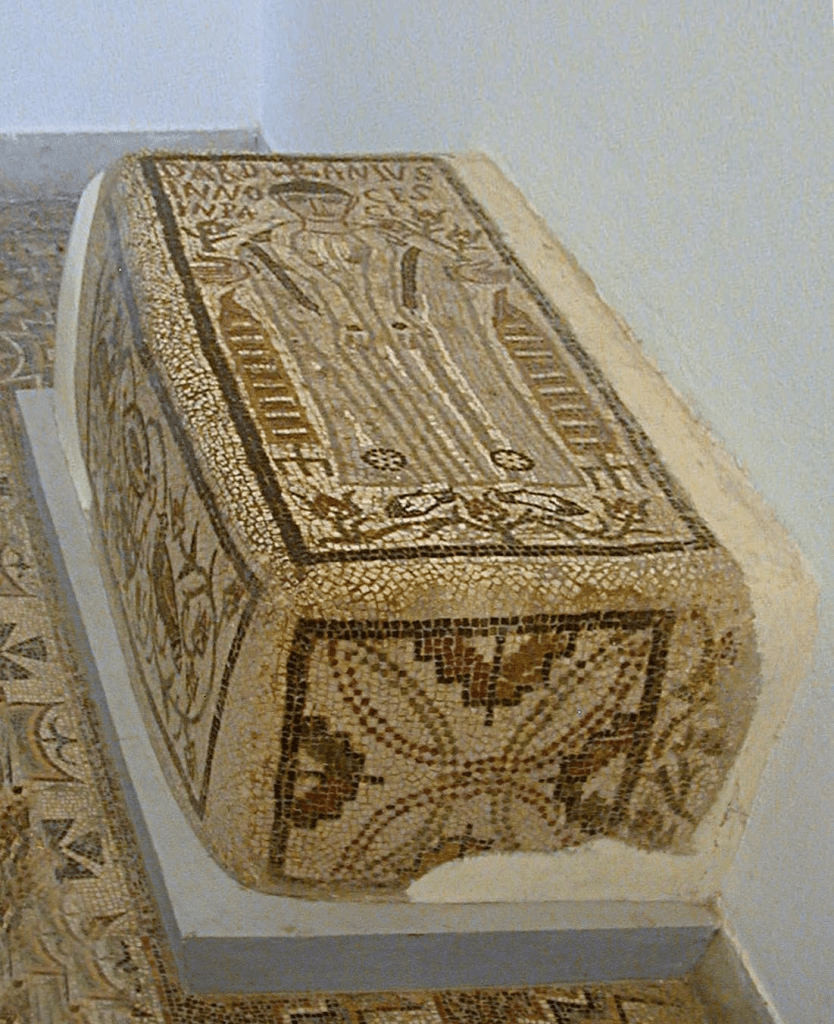
In the Bardo National Museum in Tunis, Tunisia—one of the world’s premier repositories of Roman mosaics—visitors can find a striking Early Christian funerary monument: the mosaic-covered tomb of a child named Dardanius. Dating to the 5th century CE, this artifact originates from the ancient Roman city of Thabraca (modern Tabarka) on Tunisia’s northern coast. The inscription reads DARDANIUS INNOCENS IN PACE (“Dardanius, innocent, in peace”), a typical Early Christian formula expressing hope for the afterlife.
Description of the Artifact
The mosaic depicts a young boy standing frontally, holding flowering branches in both hands, flanked by decorative motifs including plants, candles, and Christian symbols. Such mosaic-decorated tombs (often called caissons or sarcophagus-like coverings) were characteristic of Late Roman and Early Christian funerary practices in North Africa, particularly in sites like Tabarka, which yielded numerous examples now housed in the Bardo. These artworks blended Roman artistic traditions with emerging Christian iconography during a period when Christianity had become the dominant religion of the Western Roman Empire.
The piece is not a recent discovery but has been part of the museum’s collection for decades, illustrating the rich Late Antique heritage of Roman Africa Proconsularis.
The Name “Dardanius” and Its Link to Ancient Dardania
The personal name Dardanius directly derives from Dardania, an ancient region corresponding to modern day Kosovo. The Dardani were a Paleo-Balkan people known from classical sources as inhabitants of this area since at least the Iron Age. They interacted with Illyrians, Thracians, and later the Romans.
In Roman times, Dardania became a province (initially part of Moesia Superior, later formalized under the Tetrarchy and Constantine). It was strategically important for mining and military recruitment. The name carried cultural resonance: it echoed the mythological Dardanus, ancestor of the Trojans, which Romans sometimes invoked in their own foundations.
Personal names derived from ethnic or regional origins were common across the Roman Empire. Soldiers, merchants, administrators, freedmen, and their descendants often carried such names far from their ancestral homes. A boy named Dardanius from Dardania buried in 5th-century North Africa most likely reflects:
Mobility within the Empire
Roman legions recruited from the Balkans (including Dardania) and stationed units across provinces. Veterans or their families could settle in North Africa.
Christian context
By the 5th century, North Africa had vibrant Christian communities (influenced by figures like Augustine of Hippo), and funerary art emphasized personal piety over ethnic origins.
There is no archaeological or historical evidence that this specific individual or a large “Dardanian” community migrated en masse to Tunisia. Instead, the name exemplifies the interconnectedness of the Roman world, where people and names traveled thousands of kilometers.
Broader Historical Significance
This mosaic belongs to a larger corpus of Dardanian (Albanian) and Paleochristian funerary art from Tabarka and other North African sites. It highlights the transition from pagan to Christian Rome in the provinces, where local workshops produced high-quality mosaics for tombs, churches, and villas. The Bardo Museum’s collection as a whole preserves thousands of such pieces, offering unparalleled insight into daily life, mythology, and religion of Dardania under Roman rule.
Sources
Gauckler, Paul. “Mosaïques tombales d’une chapelle de martyrs à Thabraca.” Monuments et Mémoires de la Fondation Eugène Piot 13, no. 2 (1906): 173–192. https://www.persee.fr/doc/piot_1148-6023_1906_num_13_2_1287.
“File: Dardanius mosaic Tabarka A39 – Bardo Museum.jpg.” Wikimedia Commons. Last modified October 13, 2010. https://commons.wikimedia.org/wiki/File:Dardanius_mosaic_Tabarka_A39_-_Bardo_Museum.jpg.
Cassiciaco. “Africa Romana: Thabraca.” Accessed June 19, 2026. https://www.cassiciaco.it/navigazione/africa/siti_archeologici/thabraca_foto.html.
Musée National du Bardo. Collection of Paleochristian Mosaics from Tabarka. Tunis, Tunisia. (Artifact viewed via museum photography and secondary documentation.)
Radigue, Pascal. Tombe caisson à mosaïque de Dardanius. 5th century CE. Mosaic, Musée National du Bardo, Tunis. Photograph by Pascal Radigue, 2010. Wikimedia Commons. https://commons.wikimedia.org/wiki/File:Dardanius_mosaic_Tabarka_A39_-_Bardo_Museum.jpg.
Bridgeman Images or similar agencies. Tomb Mosaic of Boy Called Dardanius, Early Christian Period, 5th Century. Bardo National Museum, Tunis. (Stock photo reference.)
Helen Miles Mosaics (blog). Discussions of Christian tomb mosaics from Tabarka/Bardo (specific post dates vary; see relevant entries on Tabarka funerary mosaics).


