
In a picturesque village in northern Kosovo, Marko Djuric sipped from a bottle of Gazimestan beer and smiled for the cameras. On a visit to the area a few weeks ago, Djuric was arrested by special forces, bundled into a police van and swiftly deported. This time, Serbia’s key man on the Kosovo issue was allowed to stay, albeit with a helicopter overhead to keep watch.
Djuric was in Kosovo, which Serbia still considers a province, for a visit to a microbrewery that produces beer named after a medieval battle that is key to Serbia’s emotional connection to Kosovo. He also visited a resort under construction to cater to Serbian pilgrims at the 14th-century Banjska monastery.
“It is my duty to be here and stand proudly with our people,” Djuric told the assembled television crews. “I invite all Serbian citizens to come here without prejudice, and to experience the holy places here in Kosovo and Metohija,” he said, using the Serbian name for the province, The Guardian reports.
Almost two decades after Serbian forces withdrew from Kosovo in 1999 following a NATO air campaign against Slobodan Milosevic, and a decade after Kosovo declared independence, the country’s most sensitive issue is the fate of its remaining Serb residents, as well as the political status of the areas they live in. Punitive measures by Kosovo Albanian guerrillas following Milosevic’s crackdown on the Albanian population in the 1990s, followed by independence, led to a steady exodus of Serbs, and they now make up about 5% of Kosovo’s 1.8 million population, Koha.net reports.
Under an agreement signed in Brussels in 2013, the Kosovo government is expected to establish a so-called Association of Serbian Municipalities, which would bring Serb-majority areas into its system and give them a collective voice. Belgrade and Pristina are still working out the final format as they move closer to a comprehensive agreement to normalize relations and potentially join the EU.
Avni Arifi, chief of staff to the Kosovo prime minister, has said that cultural guarantees and political representation for Serbs are already enshrined in the Kosovo constitution, and has accused Belgrade of wanting to create a Trojan horse, similar to Republika Srpska, the increasingly independent Serb entity within Bosnia. “They are asking us to give them more, but forgiveness is all we can give them because everything else is taken,” Arifi said.
Serbian President Aleksandar Vučić said last week that Kosovo has done “nothing” to fulfill its promises. Vučić has been working in the diplomatic circuit, seeking support for concessions in Serbia (details are still unknown), as well as preparing public opinion in the country for potentially painful compromises.
One of Belgrade’s suggestions, which is constantly being mentioned in the media, is the division along the Ibar River, with northern Kosovo going to Serbia, possibly as part of a swap that includes the Albanian-majority regions in southern Serbia. “All Serbs will say that this is one of the solutions,” Vučić said, while declining to comment on whether this is one of the specific goals in the negotiations, Koha.net reports.
Kosovo President Hashim Thaçi has rejected this option. “There will be no partition of Kosovo. There will be no exchange of territories,” he said. Western diplomats also strongly oppose the idea, at least in part because of the precedent it could set for other disputed borders in the Balkans.
In addition, many Serbs live in enclaves south of the river, such as Gracanica, a few kilometers from Pristina. A large portrait of Vučić dominates the main square, where Serbian flags fly. Serbian dinars are accepted there, as well as the euro, the official currency. The Orthodox monastery of Gracanica, built in 1321, is filled with frescoes of biblical scenes, the most visible of which is one of the Last Judgment with sinners being burned. It is Kosovo’s medieval monasteries that evoke emotions for many Serbs, who see it as the heart of their nation and religion.
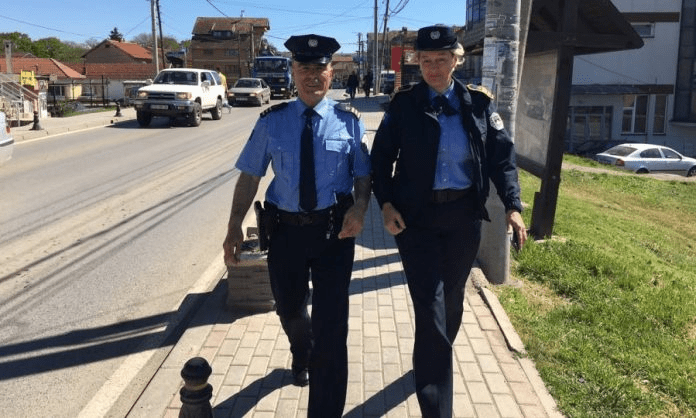
Here, the police force offers a thin thread of hope for those who want to see an integrated, multi-ethnic Kosovo. Of the police officers stationed in Gracanica, 41 are Serbs and 12 are Albanians. Svetlana Kapetanovic, a 43-year-old Serbian police officer who speaks fluent Albanian, says that in recent years ethnically motivated incidents have been very rare, while most of the police work has to do with fighting petty crime. The police all wear uniforms with the Kosovo flag, in contrast to the many Serbian flags around the city.
Kapetanovic said she decided to learn Albanian after an incident early in her police career in 2003, when she was called out with a group of Albanian police officers to a domestic violence incident involving a young Albanian woman.
“I was the only female police officer, and the girl was giving me looks, as if she wanted to communicate something with me without telling the men. I could see that she was asking for help from me and I wanted to talk to her, but I didn’t know how to speak Albanian and she didn’t know how to speak Serbian either. I suspected that there might have been a rape there, and I reported it to my commander. Later, it turned out that I was right. That’s when I realized that I needed to learn Albanian,” Kapetanović said, Koha.net reports.
As a fluent Albanian speaker, Kapetanović is a rare Serb. While there is still a generation of Kosovo Albanians who remember Serbian, the language is rare among young people. Children in Serbian schools, which still follow Serbian state curricula, do not learn Albanian, and vice versa.
“Unfortunately, we still have a situation where Serbs and Albanians live separate lives,” said Dalibor Jevtic, the Albanian-speaking deputy prime minister of Kosovo’s Serb-dominated government. While avoiding the issue of his own positions on Kosovo’s status, Jevtic says all sides need to have a constructive approach to the language. While his party, the Serbian List, has strong ties to Belgrade, he says it is not Serbia’s job to tell Kosovo Serbs how to live.
“Ninety percent of Serbs in central Serbia have never been to Kosovo. They don’t understand our lives and I don’t take them very seriously when they tell me how to live my life with my neighbors,” he said.
Although most Kosovo Serbs are still concerned about the idea of independence, many now see unemployment and economic discrimination as greater threats than ethnic tensions. There are also divisions within the community, best illustrated by the January assassination of Oliver Ivanovic, a Kosovo Serb politician who opposed the Serb List, which dominates Serbian politics. Ivanovic was shot dead in Mitrovica, a city divided between Serb and Albanian sides by the Ibar River. No one has been arrested in the killing.
“It’s not safe to speak freely in this city, but let’s say that it wasn’t Albanians who killed him,” said Marko Jaksic, a political associate of Ivanovic, during an interview in northern Mitrovica, Koha.net reports.
Some Kosovo Serbs say Belgrade and Pristina are equally frustrated at exploiting their situation to score points. High-profile visits to Kosovo by Djuric and others are often seen as more about public opinion in Serbia than about making material improvements for them. “For Belgrade, Kosovo is a poker chip to play on Serbia’s path to EU integration,” says Jaksic. “Vucic is willing to play it, and Djuric is committed to acting as a peacemaker who makes things easier for us.”
Source

