
by Aleksander Hasanas
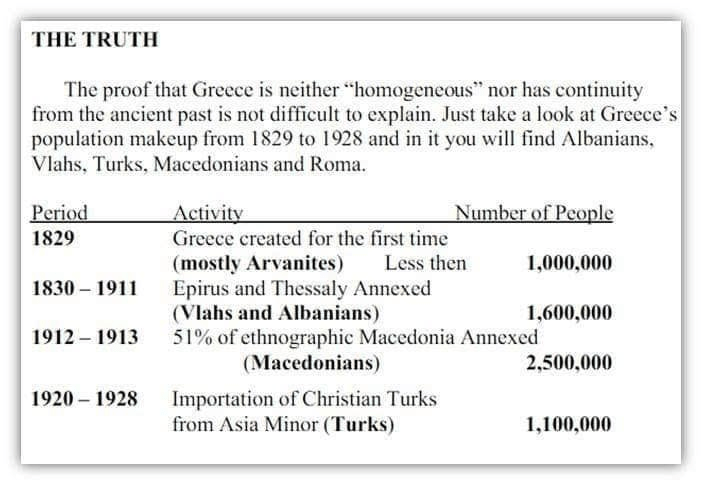
The proof that Greece is neither “homogeneous” nor has continuity from the ancient past is not difficult to explain. Just take a look at Greece’s population makeup from 1829 to 1928 and in it you will find Albanians, Vlahs, Turks, Macedonians and Roma.
| Period | Activity | Number of People |
|---|---|---|
| 1829 | Greece created for the first time (mostly Arvanites) | Less than 1,000,000 |
| 1830 – 1911 | Epirus and Thessaly Annexed (Vlahs and Albanians) | 1,600,000 |
| 1912 – 1913 | 51% of ethnographic Macedonia Annexed (Macedonians) | 2,500,000 |
| 1920 – 1928 | Importation of Christian Turks from Asia Minor (Turks) | 1,100,000 |
Reading the latest book by Macedonian author Risto Stefov entitled “Little Book of Great Greek Lies” we find there scientific historical documents that a “Greek Nation” never existed before 1829.
The evidence that Greece is neither “homogeneous” nor has continuity from the ancient past is not difficult to explain. Just take a look at Greece’s population composition from 1828 to 1929 and you will find Albanians, Vlachs, Turks, Macedonians and Roma in it.
In 1928 Greece registered 6,200,000 people after which it declared itself homogeneous consisting of 100% pure Greeks with a very small Muslim but ethnically Greek population.
In the 1920s Greece imported 1.1 million Christian Turks from Asia Minor, claiming that they were descendants of the “Ancient Greeks”. None of them spoke Greek or identified with Greeks (?).
The ethnic composition of modern Greece today consists of assimilated Albanians (Arvanitas), Vlachs, Turks and Macedonians (Makethones). There were no ethnic Greeks of the 19th century. The Greek ethnicity was artificially created by the Phanariotes with the help of the Great Powers. The Phanariotes were a multi-ethnic group of Koine-speaking Christians who belonged to the wealthy and educated Ottoman middle class.
They were the high-ranking clergy of the Church, Ottoman bankers, sea captains, language interpreters and merchants who did business for the Ottomans. When Greece first became a nation in 1829, it faced an identity crisis because it could not cope with multi-ethnicity, multi-cultural demographics.
Greece struggled for years to find an identity until it was created by its Philo-Hellenic British and French masters. If history serves us right, in 1821, shortly before Greece was founded as a country, its people did not speak Greek. In 1829 when Greece first became a state, it was a small country covering the region of Morea, modern Peloponnesus, where most of the people living in Morea at that time spoke Albanian, Turkish, Vlach and Slavic.
Athens itself, the cradle of ancient civilization, was nothing more than an Albanian village.
Sources
The Little Book Of Big Greek Lies”. Risto Stefov.
Kitromilides, Paschalis M. Enlightenment and Revolution: The Making of Modern Greece. Cambridge, MA: Harvard University Press, 2013.
(Also see his earlier article: “From Rum Millet to Greek Nation: Enlightenment, Secularization, and National Identity in Ottoman Balkan Society, 1453–1821.” Journal of Modern Greek Studies 16, no. 1 (1998): 11–48.)
Clogg, Richard. A Concise History of Greece. 3rd ed. Cambridge: Cambridge University Press, 2013.
Roudometof, Victor. “From Rum Millet to Greek Nation: Enlightenment, Secularization, and National Identity in Ottoman Balkan Society, 1453–1821.” Journal of Modern Greek Studies 16, no. 1 (1998): 11–48.
Horrocks, Geoffrey. Greek: A History of the Language and its Speakers. 2nd ed. Chichester: Wiley-Blackwell, 2010.
Finlay, George. A History of Greece from Its Conquest by the Romans to the Present Time. Oxford: Clarendon Press, 1877 (various reprints).
Wilkes, John. The Illyrians. Oxford: Blackwell, 1992.
Pentzopoulos, Dimitri. The Balkan Exchange of Minorities and Its Impact upon Greece. Paris: Mouton & Co., 1962 (reprinted by Hurst, 2002).
Hirschon, Renée, ed. Crossing the Aegean: An Appraisal of the 1923 Compulsory Population Exchange between Greece and Turkey. New York: Berghahn Books, 2003.
Thomas Gordon and other Philhellenes noted the heavy Arvanite presence in Attica, the Peloponnese, and islands in the 1820s–1830s.
Estimates for the early Greek kingdom (1830s) place the total population at roughly 600,000–900,000, with Arvanites forming a very substantial proportion (often estimated 20–40+% in core areas).
On Athens specifically
Multiple 19th-century accounts describe Athens as a small settlement (around 4,000–10,000 inhabitants in the 1820s–early 1830s), with a significant Albanian-speaking (Arvanite) component before it grew rapidly as the capital

