

Traces of civilization in these parts date back to early prehistoric periods, continuing into antiquity and especially the Middle Ages, as evidenced by numerous finds of coins, artifacts, and other archaeological remains.
By Dr. Qazim NAMANI, Archaeology/Cultural Heritage
Janjeva lies on the western side of the Galab Mountains. The Galab Mountains occupied a fairly large area in the kingdom of Dardania. Many researchers support the idea that it was precisely in this region that the Dardanian tribe Galabroi lived. Janjeva, as a settlement at the foot of the mineral-rich mountains and agricultural land of the Dardania plain, was established right near Ulpiana as one of the developed cities near the richest mines of lead, gold and lead.
Based on medieval documents from the 14th century, we find Janjeva marked with several names: Agneva, Gnagniua, Gnagneua, Gigneua, Jogneua, Joneua, Janeua, etc. [1] According to Skender Riza, Janjeva has been known as a settlement for the exploitation of ores since prehistoric times. [2] Traces of mining in our Peninsula have been found since ancient times, when the Illyrians and Thracians began. [3] This settlement lies at the foot of volcanic hills with an altitude of 700-1000m above sea level.
In the Middle Ages it was first mentioned in a letter of Pope Benedict IX in 1303, which he sent to Marin, the bishop of Tivat. [4] Janjeva is first mentioned in 1303, as a Catholic settlement under Gračanica. In 1441, a Catholic named Andrea is also mentioned as a leader. [5]
During the 13th and 14th centuries, Saxon miners became known for their ore exploitation in Janjevo, who came to work in the mines of Janjevo and the surrounding area.
Muhamet Tërnava writes that archaeological discoveries have proven that Janjeva was a settlement even during antiquity, but what it was called in those times is unknown. [6]
Muhamet Tërnava, analyzing the writings of different authors who have written about Janjevë, expresses his opinion that Catholic residents lived in Janjevë, even two centuries before we have the first data about this settlement. [7]
In 1346, Janjevo was mentioned among the Catholic churches under the jurisdiction of the Bishopric of Kotor. [8] The oldest church for which we have data is the Church of St. Colum, where a Ragusa deed also contains the signature of a Catholic priest. [9] According to the Bishop of Kotor, Marin Kontareni, who reports that in 1435 a parish priest was appointed in Janjevo. But this fact does not mean that this church did not exist in Janjevo earlier. [10]
Janjeva had achieved significant development in antiquity, but as a medieval town it reached its peak of development during the 15th and 16th centuries. During this period, Janjeva was ranked among the most important mining and commercial centers in the territory of Dardania. Although Janjeva did not reach the size of a developed urban city, as a settlement rich in minerals it had become an important pillar of economic development and the exploitation of ores by various empires.
According to the 1569/70 census, Janjeva was a settlement with a population of about 1,550 people and 310 families. [11] There were 41 Muslim families, the Arbanas neighborhood had 82 families, the Plakanica neighborhood had 72, the Nenad neighborhood had 41 families, the Lower Krogovë neighborhood had 43 families, the Shpot neighborhood had 14 families, and the Zhabic neighborhood had 7 families. [12]
Skënder Riza writes that based on the notes of the Archbishop of Tivat, Marin Bici, from a letter sent in 1610 to Pope Paul V, it is said that Janjevo lay between two hills, hollowed out by mining activities, for the extraction of silver. According to him, in Janjevo at this time there were 120 Catholic, Albanian, Dubrovnik, Orthodox houses and 180 Islamized Albanians. [13]
According to Gjergj Bardhi, Janjeva had 680 Catholics in 1637. In Janjeva there were 85 Catholic houses, 120 Muslim houses and 180 Orthodox houses, making a total of 385 houses. Compared to 1610 when Janjeva had 500 houses, it is noticeable that in 1642, there was a decrease in the number of inhabitants and houses in Janjeva. [14] This shows that the economy of this settlement had begun to decline.
In 1667, Janjeva is mentioned as a kadillak of category IX, within the sandjak of Vushtrri. [15]
According to Muhamet Tërnavës, who informs us about the process of the population’s transition from the Catholic faith to the Orthodox faith, he provides data from a document from 1578, which, based on the merits of a priest, states that; “All those who had previously accepted the Orthodox faith, returned to the old religion. [16]
During the 16th century, 6 miners and 8 goldsmiths were registered in Janjevo. All miners were of Islamic faith, while the goldsmiths were Christian. Also during this period in Janjevo there were 3 Muslim heads of families who controlled and supervised the work in a mine well, and who we find in the books with the name ‘Shafar’. In addition to these crafts in Janjevo, there were also families who practiced other crafts. [17] In the years 1566-1574, in the Arbanas neighborhood of Janjevo, there were craftsmen who were engaged in goldsmithing, among whom were: Peja Zergjir and Tomash Kujunxhi. [18]
During the rule of the Ottoman Empire, as this town was a mining settlement, education was developed by the local population, fulfilling the aspirations of the upper noble, commercial, artisan, parish, artistic and scientific classes.
Janjeva, besides being built on hills rich in minerals, developed as a settlement near important trade routes known as: the Niš-Lezha Road and other important roads that connected these regions with the most important coastal cities with Shkodra, Tivar, Ragusa, Venice in the west and through Skopje with Thessaloniki in the east.
From this settlement, processed metals such as lead, silver, gold and other products from livestock and agriculture such as wool and silk were exported through merchants, reaching the markets of European countries and in the east to the most developed cities of the Ottoman Empire. The merchants known at that time from the various markets also brought the highest quality products that were produced in European and eastern cities.
Throughout all periods, the basis of Janjeva’s development was focused on the extraction of minerals that were mainly processed locally and then exported to developed European cities.
Having achieved this level of economic development, many noble families settled in Janjevo, so in addition to the demands to export goods, there were also demands to import high-quality goods to meet the needs of the citizens of Janjevo.
During the Middle Ages, the number of inhabitants increased significantly as merchants, craftsmen and miners from various parts of the Illyrian Peninsula, but often from Venice, Thessaloniki and Constantinople, came to Janjevo. During this period, Janjevo was one of the cities with the greatest ethnic, cultural and religious diversity in the region.
The numerous traces of ore exploitation that are still visible today in the villages above present-day Janjeva have prompted many researchers to think about the location of the city of Damastion in this region.
Above Janjevë are the villages of Bukovica, Shesharka, Hanroci and Brusi, while on the southeast side it borders the villages of Akllap and Vogoqinca, on the south side with Gushterica e Epërme, on the west side with Shushica and on the northwest side with the village of Shashkoc and the Veletin Castle.
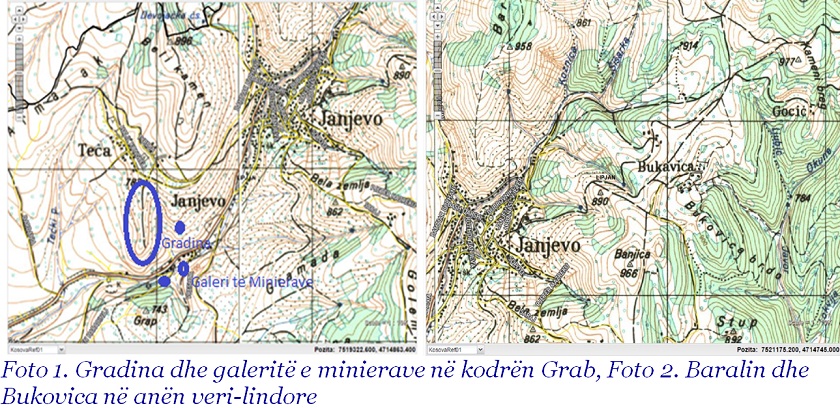
To the north of Janjevë rises the Maja e Mprehtë mountain, with an altitude of about 958m above sea level. The hill, on the left side, from Maja e çevu is called Borolin (740m). On the north side, near Janjevë, rises the volcanic hill Kështjella e Veletinit with an altitude of about (950 m), while the hill, to the west of Veletini, is called Gllama (740m). The hill, east of Borolin, is called Pažić. On this hill are built the houses and the church of St. Nicholas. On the hill of Pažić, the old Janjevë lay and the ruins of an old church as well.
From Pažić, to the left to the east, is the hill “Guri i Bardhë”, which is known as an important archaeological site. Below this hill, on the southern side, the hills of Kolocevc and Grab descend. The Pranja stream passes through Janjevë . At the entrance to Janjevo, on the hill on the left side, is “Gradina”, while to the north of “Gradina” lies the village of Shashkoc.
As can be seen, Janjeva and its surroundings have early traces of civilization and mining research as the closest settlement to the ancient city of Ulpiana.
The first traces of mining activity in the region of Ulpiana, Prishtina and Janjevo take us to the third millennium BC on the banks of the Graçanica River and the surrounding area.
Formations of siliceous rocks (called cherts) that have the ability to be broken into pieces for use as tools and for hunting were highly sought after in early historical periods.
When Stone Age man could not find these rock formations on the surface, he began to search for them underground. It is precisely these penetrations into the depths of the earth that represent the origin of mining operations. The first exploitation of the ores of Gurgacë, Copper and Iron date back to the prehistoric era. [19]
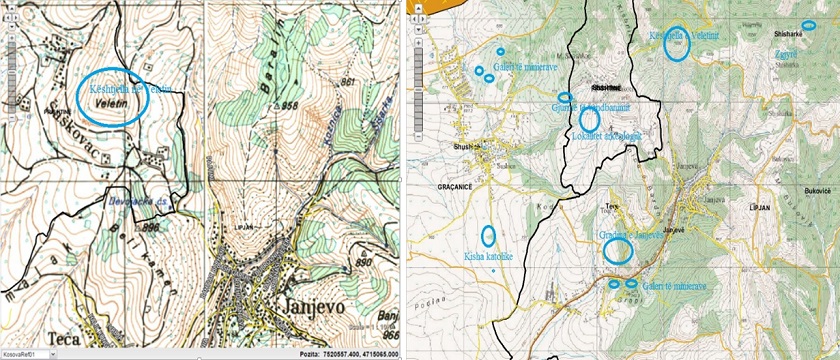
Photos 3 and 4. Topographic map of Janjevo and the Veletin fortress
Traces of civilization in these parts date back to early prehistoric periods, but it is worth noting that the exploitation of ores began in prehistory, continuing in antiquity and especially in the Middle Ages. Early traces of civilization have been attested by numerous finds of slag, galleries, coins and artifacts.
From the Kosovo plain at the entrance to Janjevo, on the right side, lies the hill called Grab, a hill rich in minerals near large agricultural lands, which enabled the economic development of Ulpiana, Lipjan and other settlements in early historical times.
The inhabitants of these areas were aware of the mineral wealth of these hills since the transition from the Stone Age to the Bronze Age, and as is known, the first inhabitants to live in these areas were the Illyrians. [20]
The large amount of ore is a mass of molten lava from volcanoes. The massive underground walls of rocks in this region are of the Serpentine and Andesite type. Janjeva lies in the vicinity of these volcanic walls. The volcanic mass continues to extend to the north where in some places andesite and serpentine ores have been encountered. [21]
The settlement of Ulpiana developed at the foot of the mineral-rich hills of the Gallap Mountains and the fertile soil of the Kosovo Plain.
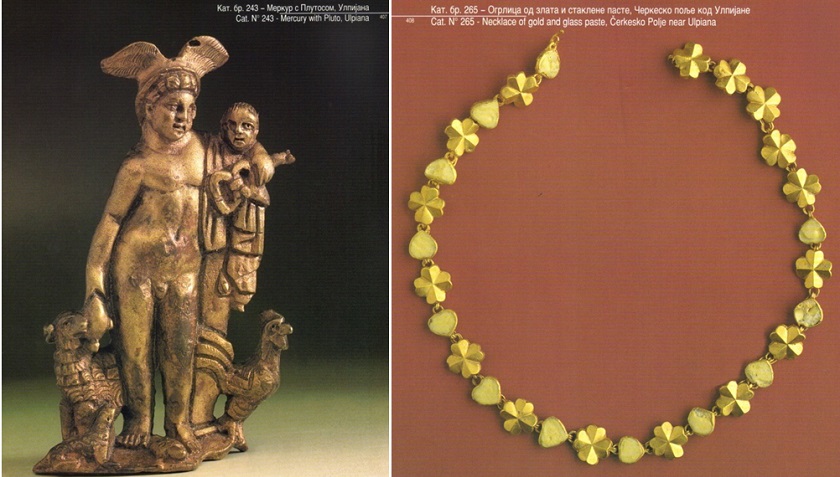
Photo, Archaeological finds, including a gold necklace discovered in the city of Ulpiana. [22]
The mineral-rich hills near Ulpiana were formed as a result of volcanic eruptions in very early times. As a result of the cooling of the volcanic mass in this region, massive walls of serpentine and andesite-type rocks were formed.
The large amount of ore is a mass of volcanic lava. The massive underground walls of rocks in this region are of the Serpentine and Andesite type. Janjeva lies in the vicinity of these volcanic walls. The volcanic mass continues to extend to the north where in some places andesite and serpentine ores have been encountered. [23]
The volcanic-ore region of Ulpiana is connected to the surrounding volcanic spatial region such as: the ore region of Artana, Vendenis, Bervenik, Justiniana Prima (Caricature), Vranje, Kursumlija, Bollasica, Trepca, Socanica, Golesi, Pogragja and Montenegro of Skopje.
As a result of new eruptions in the volcanic-mining region in the mentioned areas, even today one can easily see the peaks of volcanic hills such as: Veletini, Kika, Mërkoja, Suka in Prapashtica, Quka e Brainës, Quka e Drazhnës in the Gallapi highlands, Musinca and Maja e Mprehtë near the Bollasica mines, Zveçan, Sokolica near Soçanica, Skroma, Visocane between Cerrnica and Zhitë near Gjilan, Ostrovica and Kodra e Tupanit in the Skopje Montenegro, etc. These hills have characteristic volcanic shapes.
Near these hills with Serpentine rocks and fertile soil, based on archaeological findings, we can affirm that life began in the 5th century BC during the New Stone Age, where traces of settlements were also found.
In the ruins of the foundations of old houses in Badoc near Ulpiana and in the course of the Graçanica River, axes and other tools made of polished Serpentine and Agate have been found. Also found in this settlement are amorphous pieces of Galena, which testify to the beginning of the exploitation of minerals and ores in this region. [24]
Although these are the first primitive evidence of mining exploitation, the first beginnings of the rapid exploitation of this activity must be sought in the first settlement sites in the 5th century BC in the course of the Graçanica River and in the vicinity of Janjevo. [25]
Two bronze bracelets discovered in Janjevo belong to the Dardanian period. One, discovered in 1934, is kept in the National Museum in Belgrade, while the other is in the National Museum in Vienna. These finds date back to the 8th-7th century BC. [26]
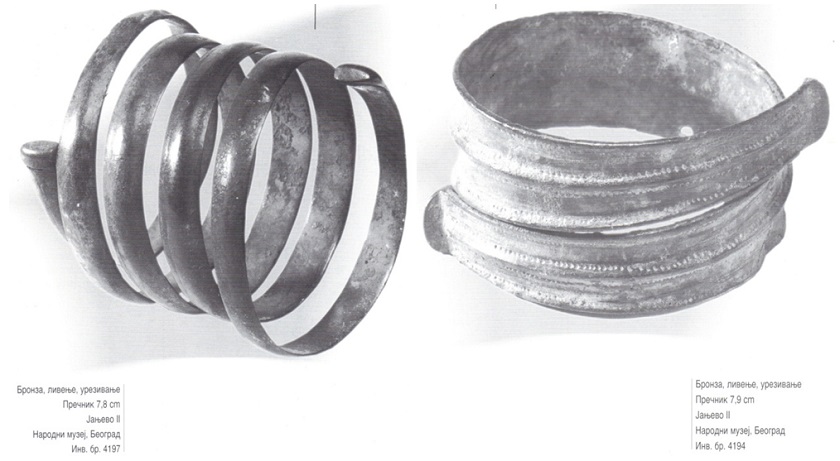
Wrist bracelet, made of bronze, 8th-7th century BC, discovered in Janjevë. [27]
The ancient writer Pliny writes that men wore gold bracelets that came from Dardania, hence the name Dardanian. [28]
Although according to the description, the finds from Artana belong to the Hellenistic period, one can speak of a continuity of ore exploitation from early stages in Artana and Veletin. [29]
Archaeological excavations enabled us to learn about tools such as chisels, picks, axes, vessels, buckles, pendants, jewelry, etc., as well as cemeteries that were discovered in mining sites and settlements that testify to the role of mining in the economic development of these settlements.
The mineral wealth of Janjevo, Novo Brdo and Trepca has become known over the centuries from the findings of metal slag that had remained in those territories since the Illyrian and Roman periods, but also from the memory of the inhabitants of those parts for the economic and commercial development of Janjevo in earlier historical periods. Despite this development as a result of historical circumstances, it is said that many times a number of local residents had abandoned their lands several centuries ago as a result of barbarian invasions and the wars waged by them.
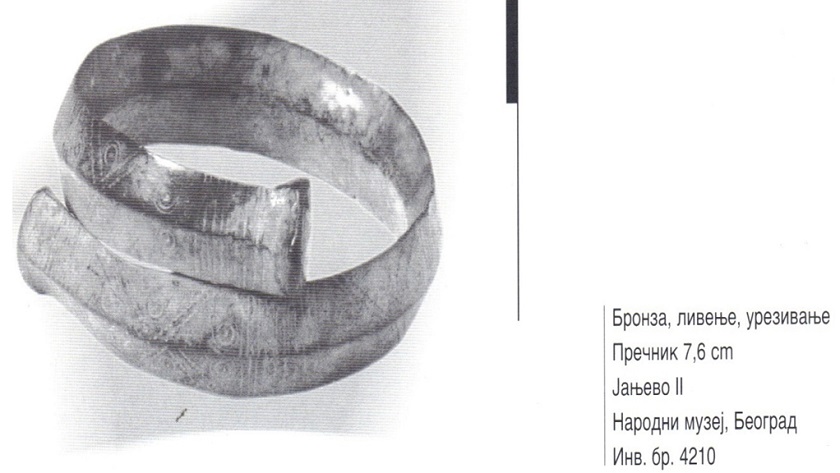
Bronze bracelet discovered in Janjevo, dating to the 7th century BC . [30]
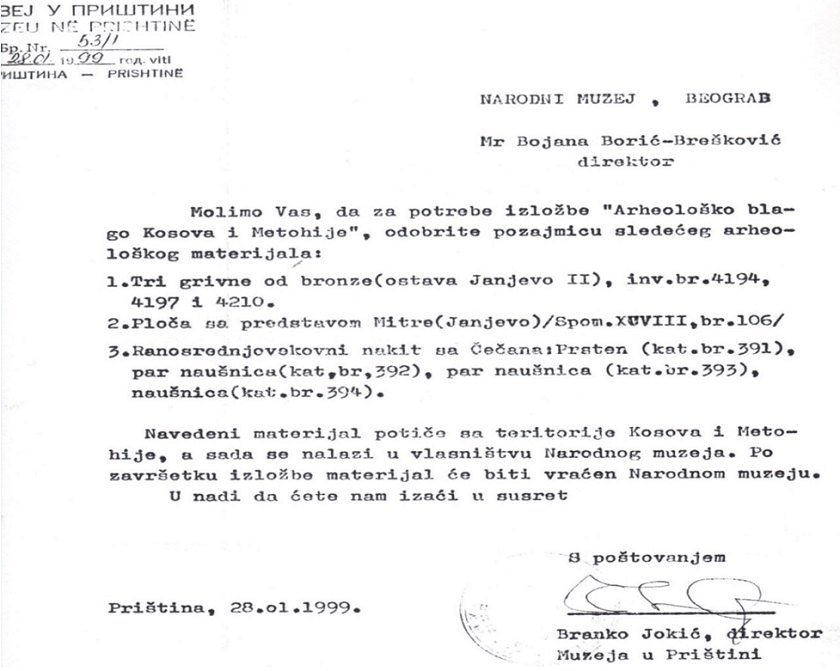
Many important finds from Janjevo had previously been sent to the Belgrade Museum, a fact that is also evidenced by document no. 53/1, dated 28.01.1999, where the director of the Pristina Museum, Branko Jokić, requests the director of the People’s Museum in Belgrade, Mr. Bojana Borić Brešković, that the Janjevo treasure be attached to other material from Kosovo, to be exhibited in the exhibition “Archeological Treasures of Kosovo and Metohija”, (See the Pristina Museum document). [31]
This document states that three bronze bracelets, of the Janjevë II type, as well as a plaque discovered in Janjevë depicting Mithras, and several other objects will be added to the exhibition. As can be seen, in addition to the exhibits sent from the Prishtina Museum, the Belgrade Folk Museum and other museums of the former Yugoslavia, there were many exhibits that were taken from Albanian lands many years ago.
From the 4th century BC the city of Damastion minted its own coins , which lasted until 320 BC, attesting to the early use of coins as a means of exchange in these lands. [33]
In Dardania, the exploitation and processing of metals had a great development during the time of the economic and cultural flourishing of the Illyrians. This is evidenced by the numerous coins discovered during the archaeological excavations of the mining city of Damastion , which are said to have had as symbols of minerals and the mining city Çekici and Qyskina. [34]
Damastion was one of the early cities that arose in the 5th century BC near silver mines, but its location in Kosovo is still uncertain. [35]
Coins from the mining city of Damastion have been found in the vicinity of Janjevo and Prishtina . [36]
The discovery of these coins in the Kishnica, Badovci, Shashkoci, Janjevo ore basin and in the vicinity of Pristina may lead us to think that the Illyrian city of Damastion should be sought in this region.
If we base ourselves on the opinions of our researchers such as: Zef Mirdita, Edi Shukriu, Jahja Drançolli etc., and foreign ones such as: Emil Çershkov, Fanulla Papazoglu, Dusanic etc., we can affirm that the Illyrian city of Damastion should be sought in Dardania, and precisely in the mining localities in the vicinity of Prishtina, Janjevë and Artana, and it can be concluded that this region must have been, if not the capital ( in my opinion ), then at least the primary center for the Dardani economy. The importance of this territory of Dardania is also evidenced by the existence of many developed cities which are always presented to us by various researchers as locations known for metal processing and mining exploitation.
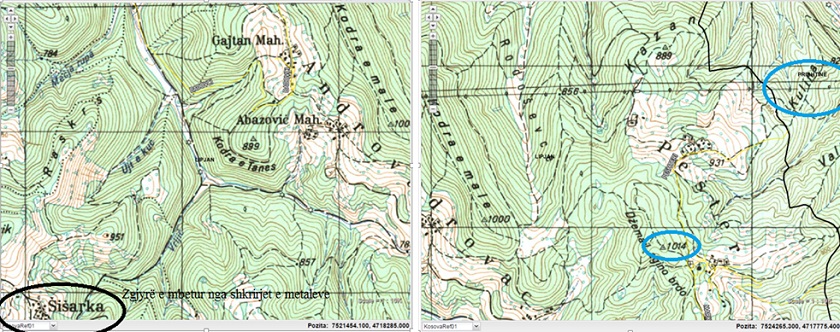
Photos 5 and 6. Topographic map northeast of Shisharka, locality where a large amount of metal slag was discovered, and Kulina in the village of Peshter
Despite the conflicting opinions about the location of this city, following the method used so far, Zef Miredita believes that Damastion should be sought in the central region of Dardania, namely in the present-day territory of Kosovo. In 1961, southwest of Janjevë, in a place called “ Toka e bardhë ”, the remains of an ancient settlement were discovered.
This region, together with Artana and the mines of Kishnica, are known as mining areas, and it should be noted that most of the coins of Demastion have been found in this region. Sources written by scholars in the time of antiquity, Strabo as well as the Vatican Palimpsest mention the silver ores that were found near Damastion.
It is precisely these data that make us look for it near Kishnica, respectively Janjevë or Prishtina. [37] It should be added here that in addition to these localities, numerous traces of ore processing have also remained in the regions of Bervenik, Tullar, Siarina, Artana, Pogragja, Gërnçar, Letnica, etc.
I think that Dr. Zef Mirdita’s opinion about the location of Damastion in the central part of Kosovo, specifically in Gallap, is correct based on the mining traces mentioned above in the vicinity of Janjevë , Artana and Prishtina , but to this should be added the fact that the northeastern part of Artana is very rich in mining sites and ancient traces of antiquity that have not been written about by contemporary authors, since proper research has not been done in this area.
Recent archaeological discoveries in Kërshevicë near Bujanovac, the large number of urban settlements and fortifications, as well as traces of metal processing since the pre-Roman period, led us to think that Damastion could in the future be sought in the Ulpianë-Leskoc-Skopje triangle.
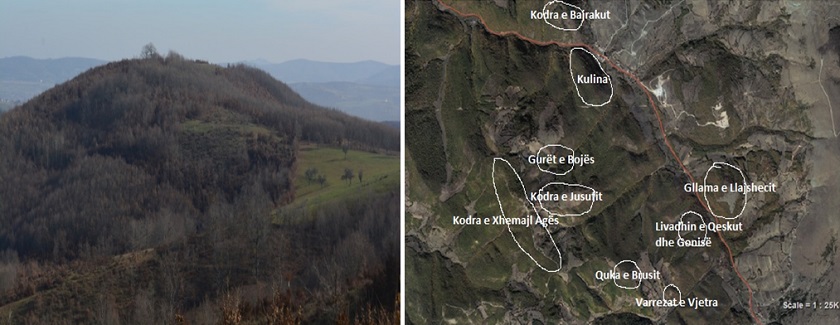
Photo. 7, and 8, Quka in the village of Brus and the archaeological traces in the villages of Peshter and Brus
In the early years, merchants from Janjevo collected many ancient coins, which were sold or sent to various museums. Gojko Kraljević, in the Bulletin of the Museum of Kosovo from 1984, mentions the fact that the exhibits from Janjevo are in the Sarajevo Museum. [38] A large number of coins from different periods have been discovered in Janjevo, Gojko Kraljević reports that some citizens bought coins from the Roman period from all the Roman emperors starting from Augustus to Valentinian III (428-455), a total of 579 pieces, as well as 18 coins from the Byzantine emperors. [39]
Also in the bulletin of the Museum of Kosovo of 1959/60, R. Galović writes that in 1934 a warehouse from the Halshtat period was discovered in Janjevë, where bracelets are of great importance, which are related to archaeological discoveries in the territory of Macedonia and represent a highly developed Illyrian culture. [40] Zef Mirdita also writes about the bracelets discovered in Janjevë, saying that they belong to the Illyrian material culture of the Halshtat period. [41]
Among the early archaeological finds, of great importance is the relief of Mithra discovered in Janjevë. The dimensions of the relief are: Width 28cm and length height is 34.5 cm. The relief is damaged on the right side, in the upper and lower parts.
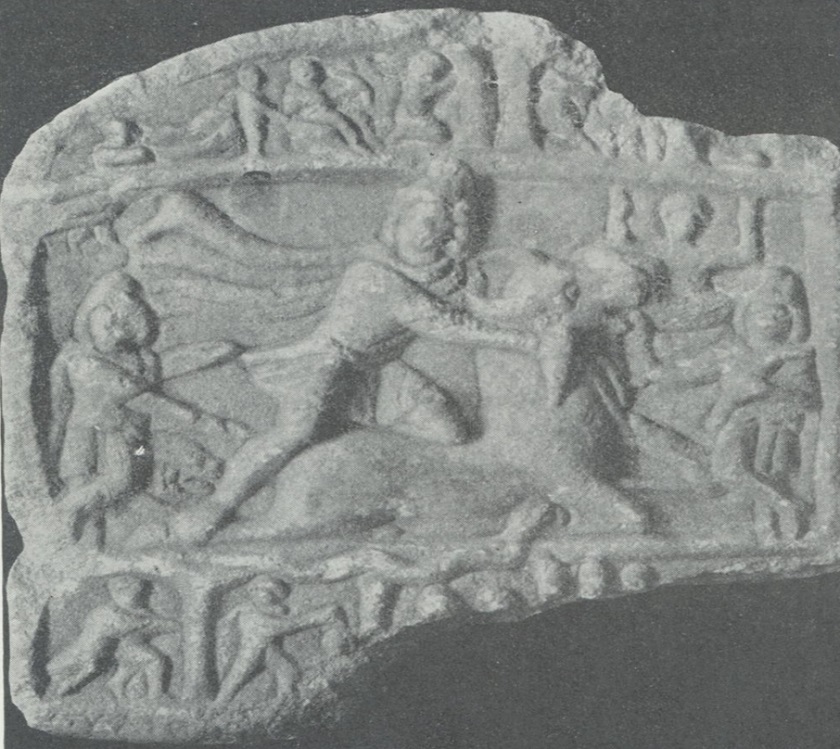
Photo. 9, Relief of the Mithra discovered in Janjevë [42]
In this relief, Mithras is depicted in the center killing the bull. The center of this relief is divided by a frieze on the upper side, and another frieze on the lower side. In the central figure, a figure of a dog jumping on the bull’s neck is depicted, and a snake coiled on the lower side of the belly. Also in the relief on the left side, between the legs of the human figure and the right leg of the Mithra, the head of a Lion is depicted. On the right side of the field, two human figures are depicted, where a man holds his hands up, while on the left side in the upper side of the field a raven is depicted. [43]
In addition to Janjevo, traces of a settlement from the antique period have also been discovered about 3 km southeast of Janjevo, in the locality called “Çeramidana” in the village of Dobratin, municipality of Lipjan. In 1961, during agricultural work in the village of Dobratin, foundations of residential buildings were discovered, two bronze lamps, a glass vessel, numerous coins from the antique period and an urn in the ruins of the settlement.
In this urn, 6000 pieces of small copper coins, two bronze ladles and a glass vessel were found. On one of the bronze lamps with a length of 18.3 cm, a tragic female mask was carved on its base. It is thought that these two ladles belong to the early Hellenistic period, but Çershkov claims that they may date back to the first half of the 1st century AD. Many other bronze coins have also been found at this site , including two coins of Hannibal, as well as coins of Constantinople and Rome. Most of these coins date from 337 to 345 AD. [44]
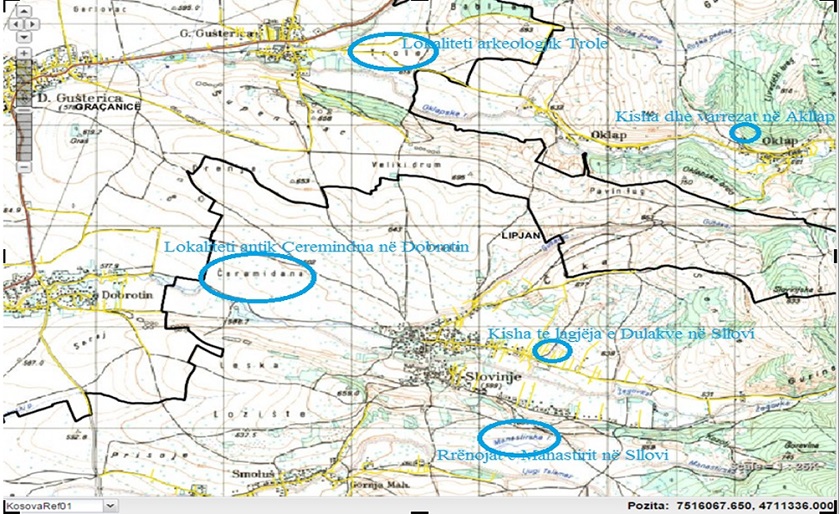
Archaeological sites in the villages of Dobratin, Sllovi and Akllap
From the numerous findings in Janjevo and the surrounding area, we understand the culture of habitation and the economic development of this region since early historical periods, especially during the period of antiquity, where mining and the processing of noble metals were considered to have an important role in the development of society.
It is worth mentioning that in 2005 a citizen from Janjevo sold four kilograms of silver coins in the city of Prizren for only 400 euros. All these facts mentioned above are undeniable facts about the economic development that Janjevo and other mineral-rich areas in the vicinity had.
The most important mines and cities in the Galab highlands were: Artana, Prishtina, Brvenik, Prizrenci, Përlepci, Janjeva, Kassova, but I think that Brskova was also in this region, as a well-known mining center in the Middle Ages. etc., as well as in the region of Janjeva and Brus, on the Androc river, in the place Uji i Kuq, on the Deqit stream (Deqit), in Badoc , on the Gvozdenik hill of the village of Shashkoc, in Vogoçinca, in Zhegoc, in the village of Mirash, in Gadime të Poshtme, in Akllap, Sllovi, Kishnopole, Vërbica etc.
There is also a lot of metal slag in the villages that lie on the north-eastern side of Janjevo, such as: Kishnicë, Mramur, Llabijan, Grashticë, Keqekoll, Ballaban, Prapashticë, etc. There is a lot of metal slag left over from the exploitation of ores in different periods of history, as well as other cultural heritage objects.
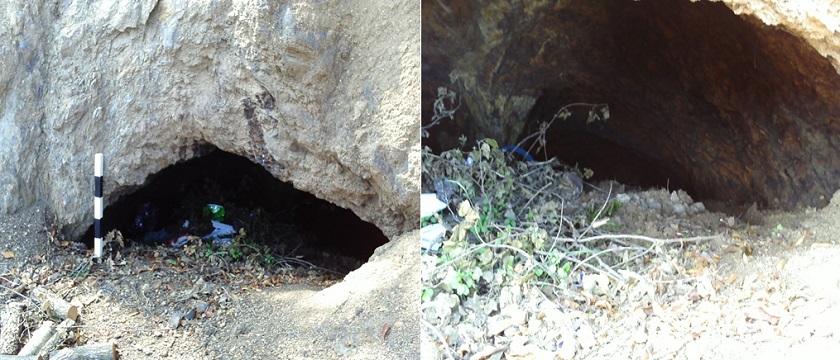
Photos 6 and 7. Entrance to the old galleries in Janjevë
Being an important locality, many important trade routes passed through Janjevo, which enabled connections with many important centers and cities of the time.
Branislav Nushic writes that there are very few documented facts about Janjeva as a city, but he thinks that during the late Middle Ages Janjeva developed into a small town. [45] Regarding Janjeva as a settlement, we can say that the traces of the ruins of buildings in Gradishte prove that there was development here since early Dardanian times. The early tradition of mineral exploitation and archaeological finds from Illyrian-Dardan and Roman times refute the theories that this settlement took the form of a town in the late Middle Ages.
Janjeva is first mentioned in historical sources in a letter from Pope Benedict IX dated 18. XI. 1303, written to the Archbishop of Tivat, Marini. In 1308, Janjeva is mentioned among the seven most famous silver mines. In 1328, it had its own parish. The oldest bell of the Janjeva church dates back to 1368 and has a Gothic inscription and is believed to have been brought from Cologne, Germany. Meanwhile, a stone slab preserves the name of the parish priest from 1425. A stone slab with Latin and Gothic letters, which was brought here from the old church of St. Kolli, is walled in today’s church. Marble slabs with Latin letters have also been found in the courtyard of the village mosque, but nothing is known about their fate.
The first records of the church of St. Columbius date back to the election of the Archbishop of Kotor, Kontareni, in 1435, but this does not mean that this church did not have religious activities before. In 1433, merchants from Dubrovnik were mentioned in Janjevo, who were engaged in trade. Janjevo was one of the most important commercial centers and rich in ores, which even had its own law in 1488, which regulated the commercial and economic relations of the city.
Saxons were also present in Janjevë, who came as miners in the Middle Ages. The names of some localities in the vicinity of Janjevë are still preserved today in the onomastics of Kosovo. Here we can mention the village of Shashkoc, Ceove, Grab (a hill near Janjevë, etc.). The presence of the Saxons has left its mark on toponyms such as Ceove in the vicinity of Janjevë, the name Grat, which is popularly called Grap, a hill where many mining galleries are found. [46]
Such toponymic names testify to the presence of the Saxons in other parts of Kosovo and beyond. Among the Albanian population of Kosovo, the words “sase” are still used today in everyday life, such as “Curik”, “Sustë”, “Shallter”, “Ganc”, “Shtonë”, “Shlaken”, etc., which testify to the coexistence of German miners among the Arbëro population, which is the majority in these areas, during this period. In the speech of the Albanians of Gallapi, the word “shtonë” is still heard today, which means a horizontal hole in the ground, as well as a wall and elsewhere, this word borrowed from the Saxons comes from the word “shtonen”, also for metal slag, the Albanian population of the Janjevë district uses the Saxon word “Shlaken”, and this proves that the Albanian population of these areas is autochthonous. Of Saxon origin in the speech of this area is also the word “vantallak” which comes from the German word “Wand” which means a large piece of ore or a wall with large rocks. The autochthonous inhabitants of this area were known as master miners.
Janjeva was a settlement with a Catholic population before 1189, which proves that the inhabitants of Janjeva in those years were not Slavic. [47] Muhamet Tërnava in his book “Cities of Kosovo during the Second Half of the 16th Century” writes that: According to the deciphering of some documents by N. Collak of the small Ragusan council, it is established that the colony of Janjeva is mentioned ten years earlier than the year 1303. [48]
Gasper Gjini writes that according to sources, the first Catholic parish priest in Janjevo is mentioned in 1328. [49] In the documents of the Pope, as far as we know so far, it is first mentioned in 1346, while based on documents from Ragusa, it has been established that the Raguzans in Janjevo are first mentioned in 1433, and then only 19 Raguzans. [50]
From this data we can affirm that the first Christian inhabitants who lived in Janjevo, just as before our era, were the indigenous Dardanian population.
According to the census of the Sanjak of Vushtrri in 1525/26, a census was taken in 9 large settlements, including Janjevo. In this sanjak, 1082 settlements were registered, with 19,351 Christian and 565 Muslim houses, 42 monasteries and 11 churches. [51] Based on the census of the Artana and Janjevo cadilluks in 1530/31, there were 4,140 Christian and 147 Muslim houses. [52]
According to the census for the Sanjak of Vushtrri during the reign of Sultan Selim II (1566-1574), there were 259 houses in Janjevë, of which 217 were Christian and 42 Muslim. [53]
In 1569, Janjeva was a very developed city, it was the sultan’s has, which brought him income from many areas of the economy. According to the census taken in this year, Janjeva had 310 families. In 1597, the monks Damjan and Paul informed the pope about the active mining of Janjeva and the wealth of gold ores.
Marin Bici, Archbishop of Tivar, in 1610, wrote that 500 families lived in Janjevë with 120 Catholic, 180 Muslim and 200 Orthodox households. [54] The Archbishop of Tivar, in 1638, says that there were also churchmen in Janjevë. In the 17th century, the transcription of church books was carried out in Shashkoc. In 1631, Matej Matiqi was sent to Italy to be educated. In 1651, Pjetër Bogdani, for the students of the Janjevë school, requested books in the Albanian language.
The Archbishop of Tivat, Gjergj Bardhi (Giorgia Bianchi), in 1637, mentioned in his writings that there were around 680 Catholics living in Janjevo. [55] In his report just two years later in 1639, he wrote that there were 130 fewer Catholics living in Janjevo, the number of whom now remained was 530. [56]
Ami Bue writes about Janjeva that it was a small village in a wooded gorge with a few small houses and a Christian cemetery. While about the name Janjeva he writes that it could have been from Janj (Poplar). [57]
Nikola Çolak and Ive Mazhuran write that in a document from 1649, which we can also refer to, it is stated that at that time, in the village of Shashkoc, transcription of religious books was carried out. Mazhuran and Çolak also write that the lessons in the school of Janjevë were held in the Croatian (Illyrian) language, with the Ragusan dialect, but they express doubt that the students wrote in Latin letters. According to them, the lessons were held in the Croatian language and Illyrian grammars were used, because there were no others at that time. [58]
As can be seen, at the time when these two scholars wrote this book, they were still under the influence and inspiration of education in the Slavic spirit, to deny any argument related to the Albanian language and culture. From all the arguments of the time that we possess, we can believe that the teaching in this school was held in the Albanian language.
This is also evidenced by the writings of the clergy and teachers of that time. After the education of the teachers in Italy, and their return as teachers in the schools, they had great difficulty in providing sufficient books for the students. The books they had brought with them were not enough. In 1651, Pjetër Bogdani, in a letter, made a request to the congregation, that books in the Albanian language be sent to these parts. [59]
In the 17th century, an open school operated in Janjevë by order of the Congregation of Propaganda Fide. Archbishop Andrea Bogdani had his residence in Janjevë in 1664. Andrea Bogdani proposed to the congregation as a teacher of the school in Janjevë Pjetër Mazrrek, who worked until 1670. In 1670, Dom Vincenc Mato was appointed as the teacher of the school in Janjevë. At that time, the school in Janjevë had a total of 25 students. [60]
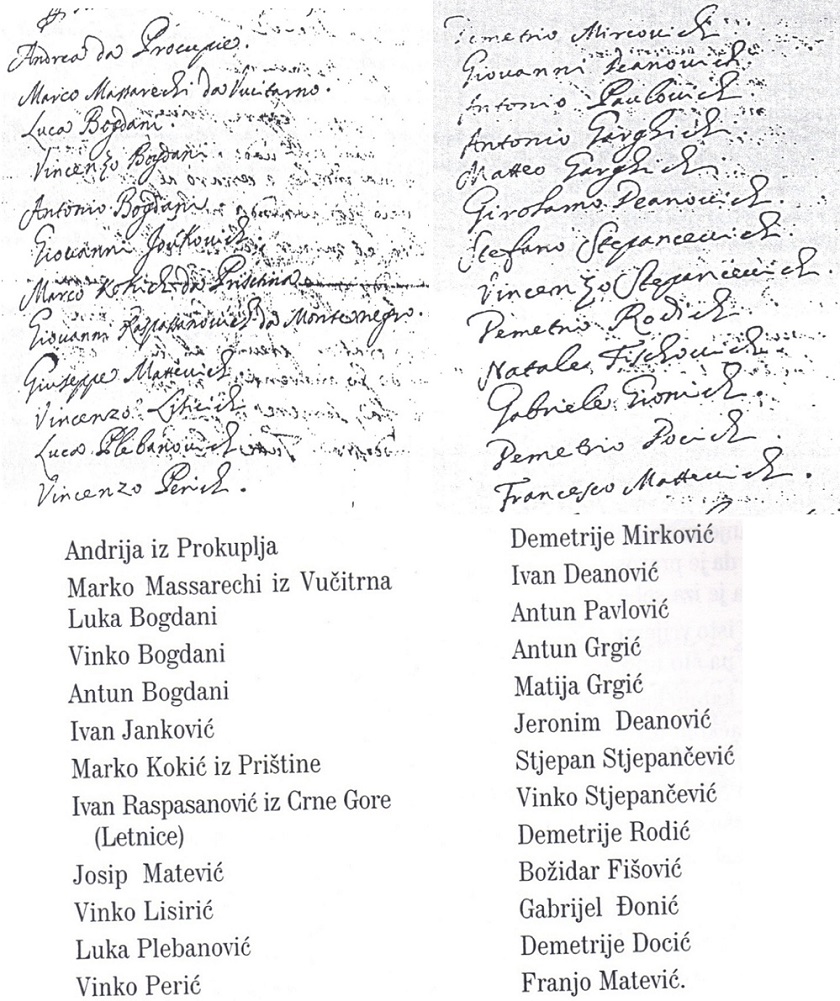
The names of 25 students at the Janjevë school, written in 1670, by teacher Vicenc Mato. [61]
If we carefully analyze the names of the students of the Janjevë school, we notice that the vast majority prove Albanian affiliation, even though they are written in the Latin alphabet and have the Latin suffix Ch at the end, this in no way gave these researchers the right to give the names of the students Slavic suffixes IÇ. Some of these families are proven later as residents of these settlements even after the Islamization of the whole, e.g. Ibrahim Koka-Kikolli resident of Prishtina, then the Kikolli family in the village of Lupçë, which is thought to have moved to Lupç from Keqekolle-Kekola, then in Keqekollë is Prroi i Kikollit etc.
The surname Mata, the surname Gjoni, Gjini, Doçi, Lisi, Fisi, Massari, Bogdani etc., which convincingly prove the Albanian affiliation of these families. Lisirich, we can affirm that it is near Trepça, or even Lisina in the village of Prapashticë, adjacent to today’s Medecin or Hostryza, the birthplace of Konstantin Mihajli. So based on all the arguments we come to the conclusion that the lessons at the Janjevë school were held in the Albanian language.
According to Edwin Jackues, who in his book when mentioning Pjetër Bogdani wrote that: His books in the Albanian language fulfilled the desire he had expressed when he said “Ah, if only I had a lighted lamp to illuminate that poor land of Albania and Serbia, a large part of which speaks Albanian”. [62]
This was a period of interest in the Albanian language, when the earliest grammar written in Latin letters was published by Andrea Bogdani, Pjetër Bogdani’s uncle. This book was used as a textbook in many schools of that time. [63] Early Catholic schools at that time were opened in 1632 in Velje i Mirdita, in 1638 in Pllanë near the Mat River, in 1639 in Troshan, in 1632 in Kurbin, etc. In these schools, in addition to reading and writing, grammar for the Albanian language was also taught, and books by Frank Bardhi, Budi, and Bogdani were used. [64]
The most accurate evidence for the population living in the Gallapit and Llapit mountains and in the cities of Artana, Janjevë, Prishtina and Vushtrri are the notes of the Ottoman traveler Evlija Çelebi, who visited these settlements at that time and wrote that these areas were called Albani (Albania). He even writes about the city of Vushtrri that the population of the city spoke Albanian and Ottoman languages, but did not speak Slavic languages. [65] So as can be seen in the list of students, Marko Massareci was from Vushtrri, so he was Albanian. According to Evlija Çelebi, the Lim River also flowed from the city of Plavë which is located in Albani [66] , so it is clear that these areas were inhabited by Albanians, the Albanian language was spoken and the place was called Albani, but with this name until the 19th century the Sandzhak of Niš was also called. Arnautlluk is also called by Slavic authors of the 19th century, which proves that throughout the Middle Ages the population of these regions was Albanian. From this data we come to the conclusion that in the school of Janjevës, teaching was conducted in the Albanian language.
According to ethnographic research, two older families are known in Janjevo: the Gllasniqët and the Paliqët. The economic decline of Janjevo began in the mid-17th century, especially after the Austro-Turkish wars of 1689-90.
It is believed that Toma Raspasari, of Albanian origin, was also from Janjeva, who played an important role at the end of the 17th century in organizing the resistance of the Albanian population against the Turks in the Austro-Turkish war. His birthplace is not determined, Mazhuran and Çollak write that his birthplace was Letnica, while some other authors think that his birthplace was in the district of Prizren or Peja.
Father Shtjefën Gjeçovi-Kryeziu was born in Janjevë (in 1873), who left his mark in many activities such as: literature, folklore, museology, archaeology, theology, ethnography, customary law and other patriotic activities.
In Janjevë live the Mazrekic and Berishic families, as can be seen these are Slavicized Albanian families. [67]
Nikolajevic, who visited Janjevo in the second half of the 19th century, writes in his book published in 1892 that: In Janjevo, since ancient times, the “miners’ village” has been preserved, now a poor Albanian village, with 2000 inhabitants, mostly Catholics (See fig, below in the text). [68] This data clearly proves that the population of Janjevo was Slavized, into Serbs and Croats, after the occupation of Kosovo by Serbia, between the two world wars, during the time of the Kingdom of Serbs, Croats and Slovenes.
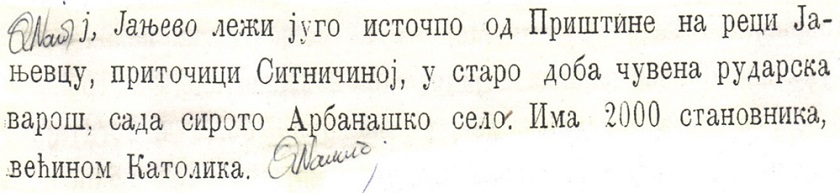
Mil. J. Nikolajevic clearly proves that the population of Janjevë was Albanian until after the occupation of Kosovo by Serbia.
In the 20th century, the population structure in Janjevë took on a completely different form. Due to the influence of the government, a number of Catholic Albanians began to call themselves Croats, while those who were Orthodox were Serbized; some old and noble families were registered as Turks and a large part of the population remained Albanian. The Roma community also lived here for a long time. Although the majority of the Albanians of Janjevë have assimilated over time, the names for relatives were mainly in Albanian such as: baba, nana, baca, teza, dajka, etc., which shows that they had Albanian origin and tradition. From the data mentioned above, it is clear that the autochthonous population of Janjevë was Albanian, while the Saxons, Ragusans, Genoese, etc., had come here as miners and traders. The fate of Janjevë also followed the Albanians of the village of Letnicë, who were Albanians but were forced to register as Croats by pressure from the government.
From many sources and data, we understand that the population that dominated the number of inhabitants of the city was undoubtedly the autochthonous Dardanians. This is also evidenced by the French scholar Ami Bue who in the 19th century wrote that the small Albanian town of Novobërda is located on top of a ridge 1000 feet above the Prishtina plain, but that he expressed the opinion that Albanians may have settled in Artana later. [69]
Janjevo at the end of the 20th century had 9 neighborhoods: Jezerce, Virovce, Gllama, Lagjja e posth, Saraj, Sopot, Lagjja e turqve, Pažiq (or Oluce, Aluce), the middle neighborhood and the upper neighborhood. The oldest neighborhood was called Plakaniqka (from the Albanian word plakë, old neighborhood) and was later called Jezerce.
Ami Bue writes about Janjeva that it was a small village in a wooded gorge with a few small houses and a Christian cemetery. While about the name Janjeva he writes that it could have been from Janj (Poplar). [70]
Branislav Nushiqi writes about Janjeva that in the Latin annals, it is mentioned as Jagneuo, Jagneua. After the fall of Novo Brdo to the Ottoman occupation, work in the mines of Janjeva was also stopped. Since the beginning of the 16th century, the ores have been given to private users. In 1613, Marko Artofilloht is mentioned as a user of the mines in Janjeva. [71]
Above today’s Janjeva, on a small plain, once lay the old Janjeva. The old Janjeva is now an abandoned settlement, with ruins and traces of old mining. In this locality, bricks, tiles and traces of foundations are found, in which weapons have also been found. It is said that the old foundry was once located here. It is also said that there is a water spring there which, if released, would flood the whole of Janjeva. [72]
Nushiqi describes Janjeva as a settlement with 43 shops and around 400 houses, of which he says 306 are Latin, 75 Muslim and some Vlach and Roma houses. [73]
Nushiqi writes about Janjevë that it is the center of the Catholic parish. In 1856, a new Catholic church was built according to the plan of a famous Hungarian architect. There were three churches in Janjevë. Three bells and two sarcophagi were found near these churches. One of these bells has a Latin inscription and serves in the present church, while a stone with a Latin inscription is walled up above the doors of the present church, and a stone similar to it was found in Janjevë until recently. [74]
According to Gasper Gjin, in Janjevo, documents from 1328 mention the Church of Shënkoll, with its Catholic parish priest. [75] The smallest altarpiece, which is still found in the bell tower of the church of Janjevo, dates back to 1368, and has a Gothic inscription. [76]
The old church of St. Nicholas was built in 1856. In 1885, a new church was built on the foundations of the old church. A stone slab with Latin letters, brought from the ruins of the old church, was built into the walls of the church built during this year. [77] On a discovered stone slab, the name of the parish priest of the church since 1425 was found.
In a Ragusa document, the name of the priest Andreas Plebonus Santi Nicolai de Agneva is also found. From a document of Clement VIII, from 1346, we understand that the bishop of Kotor had the right to take care of the church of Janjevë as well. [78] As can be seen, the old church in Janjevë is dedicated to Saint Collet. Within this church there are also auxiliary facilities used by the priests. It is interesting to note that in the wall of the guest house of this church, a stele from the Roman period, dating back to the 2nd-4th centuries AD, is walled in . [79]
The influence of Russian Pan-Slavic politics on political life within the Ottoman Empire during the 19th century is also evidenced by many data related to the appropriation of Catholic churches in Kosovo. This data is confirmed when, in mid-1857, the priest from Lipjan invited Aleksandar Feodorevic Giljferding to visit Janjevo, claiming that the Catholics of Janjevo had demolished the Orthodox church the year before and were going to build a new Catholic church of Saint Nicholas in its place. [80] The Pan-Slavic movement carried out this propaganda through the Orthodox communes in Pristina and Gjilan. [81] Regarding the obstacles to the construction of the Catholic church in Janjevo, Marko Curuza, the French or Austrian consul in Shkodra, was sent to Pristina. [82]
Pop Hadzi-Dorde, head of the monastery in Graçanica, writes to Rexhep Beg, on behalf of the Christian commune of Pristina, about how the Catholics of Janjevo are building their church using the stones of the Vojsilovce Monastery, which was located in Suteska near the village of Badoc, on the right side of the Graçanica river, and the stones of another church in Janjevo. He also informs the Metropolitan of Melentije in Gjilan about this. [83]
The religious division of the Albanian population after the Tanzimat reforms caused the Albanian Orthodox churches in Kosovo to be influenced by Pan-Slavic propaganda, this is also noticeable in this case where the population of Graçanica and Suteska was Albanian.
Based on contemporary documents, we understand that the Catholic church of Janjevë was active in the 16th and 17th centuries and was still in use in the 18th century. It is also known that Matije Mazreku was an active minister in the Catholic church until his death in 1808 in Janjevë. [84]
From Janjevo during the time of the opening of the school in the 17th century, even after this century, many bright figures have emerged who have left their names in the fields of religion, science and culture. Two well-known Albanian bishops were also born in Janjevo, Matej Mazreku, and Pjetër Shala Glasnoviq.
Matej Mazreku, born in 1726, completed his studies at the urban college in Rome. After completing his studies, he returned to his homeland. In 1755, he was appointed archbishop of Skopje. On September 17, 1759, he was ordained bishop in Ragusa (Dubrovnik). [85]
Pjetër Shaka Glasnoviqi, also born in Janjevë, in 1785, studied in Naples, and then in Rome. He was ordained bishop of Shkodra on July 13, 1834 by Father Benigno Albertini. He died in 1856. [86]
As can be seen from this tomb epitaph, which is today located in the courtyard of the Catholic church of Janjevo, the family members of these two bishops from the city of Janjevo were Slavized, registering with Croatian ethnicity.
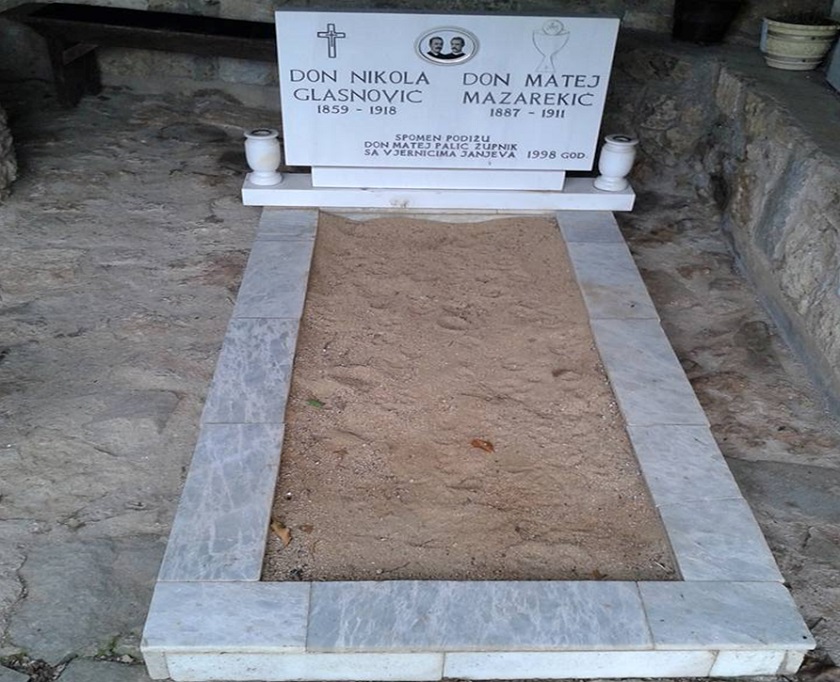
Epitaph in the courtyard of the Catholic church in Janjevë
Among the most prominent figures of Albanians born in Janjevë, there is no doubt that Father Shtjefën Gjeçovi-Kryeziu was born on November 3, 1893. [87]
The suspicion that the population of Janjevë was of Albanian origin is also confirmed in the studies of Professor Muhamet Tërnavës.
Muhamet Tërnava, studying the neighborhoods and anthroponyms in Janjevë, found that one of the neighborhoods was named after an Albanian-Arbanian person named Gjin, before the 9th, 10th, and 11th centuries. Tërnava also concluded that the Soymirovich family seems to derive from the Albanian Soymirë, from Soy i mirë. [88] During the years 1498/1499, today’s Janjevë was known as Janova and had five neighborhoods:
1. Arbanas neighborhood with 96 houses, 2. Plakanić with 77 houses, Nenada 40 houses, the lower neighborhood with 65 houses, and the Sopot neighborhood with 6 houses. In these years, Janjevë was registered as a village and was not registered as a mining and metallurgical center. [89] Regarding the development of mining in Janjevë during this period, Skënder Riza writes that in 1488 Janjevë also had its own law on ores. [90]
Ilaz Rexha, during the study of the population of settlements in Kosovo, has proven that the largest number of the population was of Arbër ethnic origin, regardless of the fact that many of the names have a religious character. From the 15th century censuses for the inhabitants of Janjevë, we note many names that prove Arbër affiliation such as: In the Arbansa neighborhood we find the residents Dejan Arbanasi, Dimitër Arbanasi, Dimitri i biri i Baliqi, etc.
In the Plakaniq neighborhood, Voja i biri i Leshjani, Gjon i biri i Mihajli, Jovan i biri i Gojashi, Stepan i biri i Budalla, Tusha, Tomash, etc. In the Nenada neighborhood, Tuna i biri i Jovani, Dimitri Leshjani, Jovan i biri i Kopili. In the lower neighborhood, Gjuka Berrati, Boja i Domanit, Kalja Progoni, Bojin Maljin, Marko Maljin, Peja i biri i Buza. In the Sopot neighborhood, Andronika son of Jan, Mojsi son of Jan, Gjurka son of Kraniqi (Krasniqi. [91]
According to the notes of Todor. P. Staqnković in his book “Putne beleske po staroj serbiji 1871-1898”, Janjevo at the end of the 19th century had 400 houses, of which 320 were Serb Catholics, 60 were Albanians and 20 were Roma. [92]
In Janjevo, in the present-day neighborhood of Virovci, there is an Orthodox church.
Today, the parish priest in Janjevë is Father Matej Paliqi, who has a lot of information about Janjevë. According to him, in 1981, 4,800 Croats lived in Janjevë, while in 1991 there were 4,580, but almost all of them moved to Croatia and currently only 290 residents of this community remain.
As cultural monuments in Janjevë, we can single out the church of St. Nicholas. The traces of the church of St. Nicholas, which is mentioned in a document from 1328, can be traced back to the 18th and 19th centuries. In 1856, the Old Church of St. Nicholas was built. In 1985, a new church was built on the foundations of the old church. In addition to the Catholic church, in Janjevë there is also a Mosque, a Tekke and the only tower built of stone, which is known as the Tower of the Beylers and Pahijeves. In the Gllama neighborhood there are ruins of a fortress.
The houses in Janjevo have a fairly developed architecture for the time of their construction. The houses of wealthy residents were mainly built on floors and also had a veranda. These houses usually had ground floors built of stone, while the upper floors were built of wood filled and plastered with mud mortar and covered with tiles. Most of these houses usually had corridors that the locals called Gjezentija . The houses on the outskirts are more secluded in courtyards, with the exception of the bazaar and the main road. The courtyards are surrounded by walls. In the courtyards, in addition to the residential house, there are also other auxiliary buildings and water wells. Janjevo also has several public water sources.
Janjeva preserves localities, old galleries and metal slag. In Janjeva, in the Vogoqincëve neighborhood, on 02.06.2003, an old gallery was discovered, on the hill called “Grab”, property of Lutfi Bikliqi. Ramadan Berisha, also a resident of this neighborhood, in 2008, did excavations to level his yard and came across another entrance to the gallery, which was divided into 2 corridors.
In the basement of Haki Berisha’s house is a vertical mine shaft at a depth of about 20m. Another entrance leads to the Elmaz Berisha well. Also, in Ruzhdi Berisha’s yard is a vertical shaft. There are old galleries in the Janjeva Garden and several galleries under the Janjeva castle. There are also traces of old galleries in old Janjeva and in the surrounding villages, especially in the village of Shashkoc. In the village of Akllap, in front of the entrance to the mine, there is a hermitage church that is thought to have been later adapted as a church. There are also entrances to the galleries in the village of Vogoqincë.
In Gradina, surrounding walls, metal slag, and some ceramic fragments from the ancient period were observed.
From Gradine, towards the village of Shushicë, an old water source is called Alban-qeshmë by the local inhabitants, while the other source, further down, is called Nallban-qeshmë. Other toponyms include: Pojatishta, Harmanllak, while above Upper Gushtericë, under Akllap and under Janjevë, in a place called Trohale (Troje QN), there are ceramics and traces of an ancient settlement.
From Akllap, towards the village of Vogoqincë, traces of early and medieval settlement can be seen. In this area, traces of residential buildings, ceramics, metal slag, cult objects, cemeteries and fortifications have been found. Among the toponyms that stand out in the village of Akllap are: Te kisha, Lugu i Kishës, Lugu i Varrit, Quka e Hashanve, Quka e Sloviës, etc. Along the course of the river from Akllap to Vigoqincë, large remains of slag can still be seen today, which testifies to the economic development of this region. It is important to know that after the Second World War, a large amount of metal slag was transported from the village of Vogoqincë and other nearby villages to the village of Babushë, and from Babushë it was sent to the foundries in Serbia for processing.
In the center of the village of Akllap, the ascetic church built into the rock is still preserved today, and on the eastern side near this church, cemeteries and human remains have been found. On the western side of the Vogoqincë castle, there are many metal slags, and the place is called Selishtë, but also Samaklovë. In this locality there are old cemeteries walled with stones, and the locality is called Lugu i Varrezave. Also in the village of Vogoqincë near the castle in Lugu i kirishës, local residents talk about the existence of a church. The foundations of another church are also preserved on the Vogoqincë quka in the direction of Vërbica in the field of Marjan Gashi, and that neighborhood is called Qukollët. Above the Vogoqincë Castle is the “Gurra e Hajdukut. In Vogoqincë there are vertical probes that testify to the extraction of minerals.
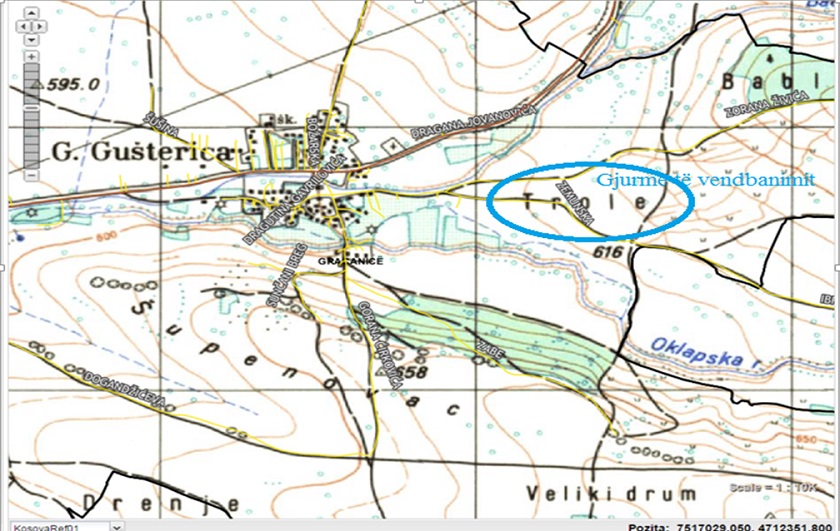
Photo 8. Ancient settlement in the place called Trole
In the village of Vogoqincë, the foundations of the Old Gradina, the village Castle and Qukë as an observation fortification over the Castle are still preserved today. The Castle of Vogoqincë was a fortified urban settlement, on the Kodrina that stood near the river in the center of the village. Outside the walls of the castle lay the residential neighborhoods or as they were called at that time the Varoshi. During various agricultural activities in the Varoshi of the Castle, traces of the foundations of residential buildings, ceramics, coins and findings made of metals have been found.
On the northern side of the castle is the valley of Palit (Paliqi). In Vogoçinca, citizens have also come across and identified old cemeteries walled with stones. Bahtijar Berisha, a resident of Janjevë, has knowledge about these cemeteries.
Traces of fortifications, mines, and churches continue from the village of Vërbica to all the other villages of this highland that administratively belong to the municipalities of Lipjan, Ferizaj, Viti, and Gjilan.
Traces of church foundations and fortifications also exist in other villages around Janjevë. In the village of Hanroc, there are two churches and a castle at Lajthia e Egër in Bukovishte.
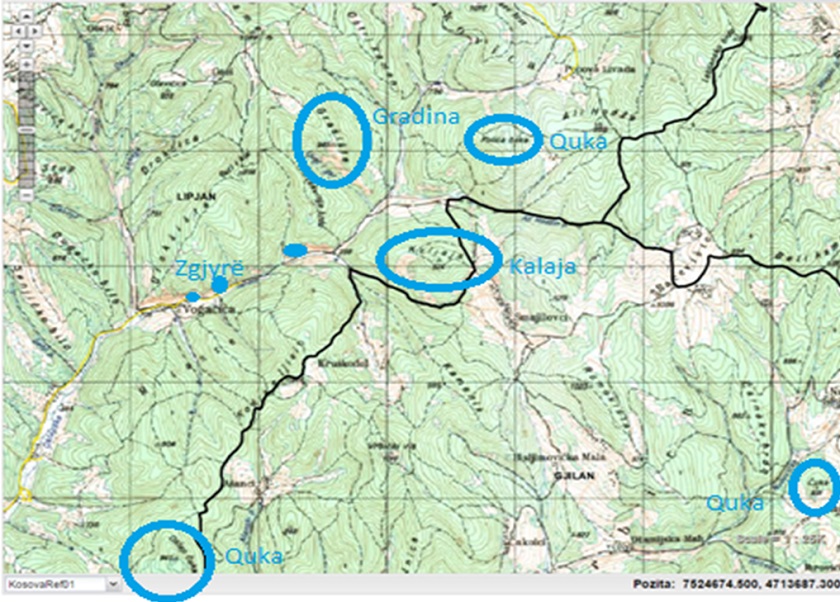
The garden, the castle and the courtyards in the village of Vogoçince
Conclusion:
From all that was said above, we can argue that based on archaeological findings and traces of civilization, Janjeva as a settlement dates back to the Dardanian kingdom before the new era. Archaeological evidence also proves that in addition to Janjeva, there are early pre-Roman and Roman traces in several other localities in the vicinity of Janjeva.
Janjeva was not a closed settlement, but the road coming from the city of Ulpiana passed through Janjeva, the road from Artana passed through Janjeva to connect with other roads on the Kosovo plain, the road coming from Vogočinca, another road from Hanroc, and also the road from Ulpiana to the city of Skopje, passed through Gushterica, which is the first village near Janjeva.
During the Middle Ages, Janjeva was populated by indigenous people, so the idea that this settlement was founded by the Saxons does not hold water. That Janjeva was inhabited by an Albanian population is also proven by the fact that in the 17th century, Janjeva had its own church school in the Albanian language.
The population of Janjevo until the beginning of the 19th century was of Albanian ethnicity, while since this century, the population of the Orthodox faith in the villages around Janjevo has been Serbized, while the Catholic population since the beginning of the 20th century, due to great pressure from the government, began to Slavize and register as a Croatian community.
References / Footnotes
[1] J. Drançolli; Raguzans in Kosovo, Prishtina 1986, p.64
[2] Skender Riza; Kosovo during the 15th, 16th, and 17th centuries, Prishtina, p. 210
[3] Mirko Bajrakrarovic; “The Janjevë Smelters as Continuators of the Old Mining Industry”, Bulletin of
Kosovo Museum XI, Pristina 1972, p. 152
[4] Skender Riza; Kosovo during the 15th, 16th, and 17th centuries, Prishtina, p. 210
[5] [5] MirkoBajrakrarovic; “The smelters of Janjevë as the continuators of the old mining industry”, Bulletin of
Kosovo Museum XI, Pristina 1972, p. 152
[6] Muhamet Tërnava; Cities of Kosovo during the second half of the 16th century, Prishtina, 2007, p. 161
[7] Ibid., p. 163
[8] Gjon Berisha; Arbëroret between the Western and Eastern Churches during the 11th-15th Centuries,
Pristina, 2017, pp. 446
[9] Ibid., p. 487
[10] Poaty, p. 487
[11] Skender Riza; Kosovo during the 15th, 16th, and 17th centuries, Prishtina, p. 211
[12] Ibid. p. 212
[13] Ibid., p.212
[14] Ibid., p. 212
[15] Ibid., p. 213
[16] Muhamet Tërnava; Cities of Kosovo during the second half of the 16th century, Prishtina, 2007, p.
179
[17] Ibid., p. 195
[18] Ibid., p. 176
[19] Minir Dushi, “Mining in Kosovo through the centuries”, Dardania Sacra 1, Prishtina, 1999, p.84
[20] Nikola Colak-IveMazuran, “Janjevo, sedamstoljecaopstojnostihrvatanaKosovu”, Zagreb, 2000 p. 13
[21] Nikola Colak, IveMazuran, “Janjevo”, Zagreb, 2000, p. 13
[22] Srpska Akademija Nauka i Umetnosti & Muzej u Pristini: Arheolosko blago Kosava I Metohije, Od
neolita do ranog veka, Belgrade, 1998
[23] Nikola Colak, IveMazuran, “Janjevo”, Zagreb, 2000, p. 13
[24] Emil Chershkov, Cultural and Scientific Magazine “Progress” 1-2, Prishtina, 1964, p. 75
[25] Ibid. p. 75
[26] Srpska Akademija Nauka i Umetnosti & Muzej u Pristini: Arheolosko blago Kosava I Metohije, Od
Neolithic to the Early Modern Age, Part II, Belgrade, 1998, p. 228
[27] Ibid., p. 228
[28] Edi Shukriu, Preurban Dardania, Archaeological Studies of Kosovo and Dukagjin, Peja 1997, p. 106
[29] Edi Shukriu, “Ancient Kosovo”, Prishtina, 2004, p. 49
[30] Srpska Akademija Nauka i Umetnosti & Muzej u Pristini: Arheolosko blago Kosava I Metohije, Od
Neolithic to the Early Modern Age, Part II, Belgrade, 1998, p. 228
[31] IMMK Archives, Pristina
[32] Request that the Janjevo treasure, previously located in the Belgrade Museum, be annexed to it
other material from Kosovo, to be exhibited in the exhibition “Archaeological Treasures of Kosovo”
Metohija” in Belgrade.
[33] Edi Shukriu, “Ancient Kosovo”, Prishtina, 2004, p.82.
[34] Minir Dushi, “Mining in Kosovo through the centuries”, Dardania Sacra 1, Prishtina, 1999, p. 92
[35] Emil Chershkov, Cultural and Scientific Magazine “Progress” 1-2, Prishtina, 1964, p.82
[36] Emil Chershkov, Cultural and Scientific Magazine “Progress” 1-2, Prishtina, 1964, p.76
[37] Zef Mirdita: “Dardan Studies” Prishtina, 1979, p. 104
[38] Gojko Kraljevic: “Glasnik Muzeja Kosovo i Metohija”, Prishtina, 1984, pp. 67-77
[39] Ibid, pp. 67-76
[40] Radoslav Galovic: “Glasnik Muzeja Kosovo i Metohija”, Prishtina, 1959/60, pp. 255-269
[41] Zef Mirdita: “Dardan Studies” Prishtina, 1979, p. 37
[42] Miodrag Grbi?:NOUVEAUX MONUMENTS MITHRIAQUES DE LA YOUGOSLAVIE, pg. 179
Source: Revue Archéologique, Sixième Série, T. 10 (JUILLET-DÉCEMBRE 1937), pp. 174-180
Published by: Presses Universitaires de France
Stable URL: https://www.jstor.org/stable/41728020
Accessed: 31-10-2019 19:39 UTC
[43] Ibid. 180
[44] Emil Cerskov: “Kasnoanticna ostava iz Dobratina na Kosovu”, Glasnik Muzeja Kosova i Metohija,
Pristina, 1962-1963, pp. 317-338.
[45] Branislav Nushiq, “Kosovo”, Novi Sad, 1902, pg. 51
[46] Mirko Bajrakrarovic; “The Janjevë Smelters as Continuators of the Old Mining Industry”, Bulletin I
Kosovo Museum XI, Pristina 1972, p. 154
[47] Muhamet Tërnava; Cities of Kosovo during the second half of the 16th century, Prishtina 2007. p. 162
[48] Muhamet Tërnava; Cities of Kosovo during the second half of the 16th century, Prishtina 2007, p. 161
[49] Gasper Gjini, The Diocese of Skopje and Prizren through the centuries, Zagreb, 1992, p.84
[50] Ibid, p. 85
[51] Nikola Colak-IveMazuran; “Janjevo”, Zagreb, 2000, p. 33
[52] Nikola Colak-IveMazuran; “Janjevo”, Zagreb, 2000, p. 34
[53] Nikola Colak-IveMazuran; “Janjevo”, Zagreb, 2000, p. 34
[54] Nikola Colak-IveMazuran; “Janjevo”, Zagreb, 2000, p. 40
[55] Gasper Gjini, The Diocese of Skopje and Prizren through the centuries, Zagreb, 1992, p. 135
[56] Ibid, p. 151
[57] Ami Bue; Albania in European Turkey, Tirana 2011, p. 123
[58] Nikola Colak-IveMazuran; “Janjevo”, Zagreb, 2000, p.59
[59] Ibid., p. 59
[60] Nikola Colak-IveMazuran; “Janjevo”, Zagreb, 2000, p. 59
[61] Ibid., pp. 60-62
[62] Edwin Jascues, Albanians, 1995, Jefferson, North Carolina, USA, published in Albanian by Lajmi i
good, Tirana, p.312
[63] Ibid., p. 313
[64] Yes art, p. 313
[65] Evliya Çelebija, Putopis, translated and published in Bosnian by Hazim Shabanovic, Sarajevo,
1957, pp. 24, 25
[66] Ibid., p.10
[67] Mirko Bajrakrarovic; “The Janjevës smelters continue the old coal industry”, Museum Bulletin
Kosovo XI, Pristina 1972, p. 154
[68] Mil. J. Nikolajevic: “Severna Stara Serbia”, Belgrade, 1892, p. 110
[69] Ami Bue; Albania in European Turkey, Tirana 2011, p. 122
[70] Ami Bue; Albania in European Turkey, Tirana 2011, p. 123
[71] Branislav Nushiq; “Kosovo”, Translated by Rrahim Sadiku, Intergraf Press, Ferizaj, 2015, p. 275
[72] Branislav Nushiq; “Kosovo”, Translated by Rrahim Sadiku, Intergraf Press, Ferizaj, 2015, p. 275
[73] Branislav Nushiq; “Kosovo”, Translated by Rrahim Sadiku, Intergraf Press, Ferizaj, 2015, p. 276
[74] Branislav Nushiq; “Kosovo”, Translated by Rrahim Sadiku, Intergraf Press, Ferizaj, 2015, pp. 276-276
[75] Gasper Gjini, The Bishopric of Skopje and Prizren through the Centuries, Zagreb, 1992, p. 84
[76] Ibid, p. 84
[77] Ibid, p. 84
[78] Ibid, p. 85
[79] MCYS, “The Evidentiary Heritage of Kosovo”, Prishtina, 2005, p. 163
[80] Nikola Colak & Ive Mazuran, “Janjevo, Sedam stojeca opstojanosti hrvata na Kosovu”,Zagreb, 2000, p.156
[81] Ibid., p. 157
[82] Ibid., p. 157
[83] Ibid., p. 158
[84] Ibid., p. 159
[85] Gasper Gjini, The Diocese of Skopje and Prizren through the Centuries, Zagreb, 1992, p. 200
[86] Ibid, p. 200
[87] Gasper Gjini, The Bishopric of Skopje and Prizren through the Centuries, Zagreb, 1992, p. 182
[88] Muhamet Tërnava; Cities of Kosovo during the second half of the 16th century, Prishtina 2007, pp. 163-
164
[89] Ibid., p. 167
[90] Skënder Riza; “Kosovo during the XV, XVI and XVII centuries, Prishtina, 1982, p. 210
[91] Ilaz Rexha; Settlements and Arbër population of Kosovo according to the Ottoman notebooks of the 16th century,
Pristina, 2016, pp. 227-228
[92] Todor. P. Stanković, “Putne belske po staroj Serbia 1871-1898”, Belgrade, 1910, p. 53
Original article

