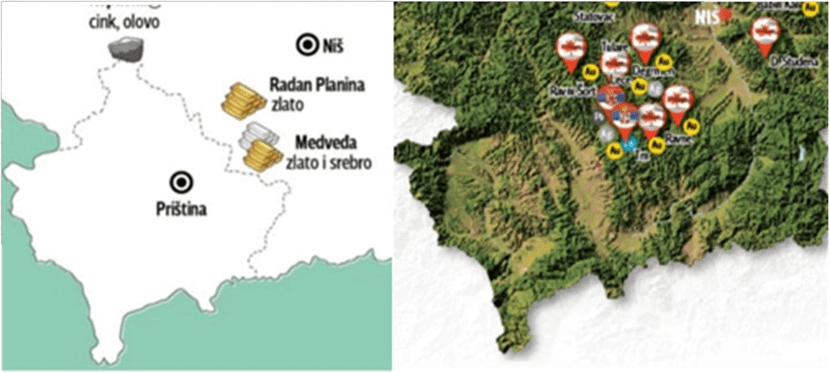

Traces of mining in the Galab Mountains, beyond the current border of Kosovo
By Dr. Qazim Namani
Unfortunately, during the Eastern Crisis and the wars, in 1878, the Galab Highlands were completely occupied by the Serbian-Russian army, but with the agreement of the Congress of Berlin, more than half of the territory of the Galab Highlands remained within the territory of present-day Serbia, which expanded greatly, occupying the Albanian lands in the Sandzak of Nish.
The fact that these territories remain outside the administrative borders of Kosovo has made it impossible to conduct field research to learn more precisely about the traces of mining activities in the area, but we have made efforts to collect some basic information from the sources and literature published so far by Serbian and foreign researchers, as well as from Albanian citizens who lived in the villages of Medvedja, in order to complete this work at least a little.
In the article we have used the toponyms of settlements in the Serbian language, which were settled after the invasion and colonization with Slavic population. Before 1880, these settlements were ethnically inhabited only by Albanian population.
Traces of ore processing in ancient times are also found around the Lece mine, near Medveđa. The Lece mine is 52 km away from Leskoc, while from Prishtina it is 60 km away via the Tullar road. This well-known mine is located in the Galab Mountains, between Leskoc and Prishtina, respectively between Justiniana Prima and Justiniana Seconda. The mine is located in the low mountains with ravines in the village of Lece, near the watercourses in the villages of Gajtan and Gazdare as branches of the Jabllanica River. Traces of material culture confirm that the mine area was inhabited since prehistoric times.
In the vicinity of the mine, in an area of about 10 km, traces of prehistoric life have been found in several places: in the villages of Drencë, Lecë, Lower Shillovë, on Mount Rasovaça, Upper Buçumet (Katun i Shishince), Medvegja, Petrilja, Lozana, Vujanov and elsewhere.
The gold and silver reserves in this mine are much higher than in other mines in Europe. Chemical analyses showed that the Leçe mine contains 160 grams of gold in one ton of lead concentrate.
Archaeological remains of monuments, castles, churches, bricks, ceramics, mining tools, among other things, the Romans were involved in mining. Traces of the exploitation of ores by the Romans can be found in Lec, Gazdar, Shillovë e Poshtme, etc. At a distance of about 2000 meters from the Lece mine, monuments with Latin inscriptions have been discovered. which testify to important urban settlements in that area. From the Roman period, several localities with the names “Roman Circus”, “Roman Mine” and Mali i Madeni (Madame) have remained, which testify to the works of ore extraction and smelting. The mines of this region were connected to the mines of Artana and the mines of the Kusumlija and Kosanica districts. The Lece mine also had its mining units in the villages of Tullarë, Medec, Marocë, Boroc, Gajtan, Siariën e Varosh, Ivan Kulla and Kosanica.
From the earlier and Roman periods, there are several sites with the names “Roman Circus”, “Roman Maiden” and the Mountain of the Maiden (Madame), which testify to the ore extraction and smelting works. The mines of this region were connected to the mines of Artana and the mines of the Kusumlija district and Kosanica. The Lece mine also had its mining units in the villages of Tullarë, Medec, Marocë, Boroc, Gajtan, Siariën e Varosh, Ivan Kulla and Kosanica, almost in every village of this area there are archaeological remains of mining works, among which the most striking are between the “Lece” mine and “Devil’s Town” (“?avolje Varosh”), in Gajtanin e Sipërm, in “Gajtan’s Entrance” (“Gajtanski Vrata”), “Sokolovo Vis”, Ivankula and Kosanica (in some of these, traces of old mining works are visible).
Traces of old mining works were found in Radan, Majdan (the mountains surrounding the Leca mine), which were named after the ores or mines. In the Radan mountains, traces of earlier mining activities have been found such as: In the villages of Majkovc, Ivanje, Borovc and Marovac.
In the increasingly narrow area of “Leca”, past mining operations also show the remains of molten ores: slag, furnaces and toponyms. This confirms that mining operations have been ongoing for a long time and that the mineral was processed in several places.
From these sources we understand that the archaeological site, Hisar in Leskoc, is an archaeological settlement with an area of 130 hectares. We find traces of civilization in this settlement from the Neolithic era to the present day.
At this archaeological site, the oldest center of ferrous metallurgy in Europe was also discovered.
Numerous objects were found there, the most important of which are from the Neolithic era: iron ore, amorphous iron weighing several kilograms, furnaces, fans, pits where coal was produced, large quantities of slag and several iron objects produced in this locality.
In 2001, a multi-layered settlement of the Bërnica material culture was found near Prishtina, a culture that developed from 1300 to 1050 BC, and for the first time it has been found at a site in Kosovo. This culture is also known as the Dardanian urn cemetery culture. In the Galab Mountains, based on extensive current research, this culture has also been discovered in the villages of Grashticë, Keqekollë, and other sites.
In 2002, amateur archaeologist Šepan Turović discovered a 64.5-centimeter-long needle-shaped object made of stainless steel, which is why the object was named the “Turović Needle”. Today’s metallurgy does not recognize the technology used to make the needle. The needle is made of pure iron and does not contain impurities of other elements, therefore it exceeds the American standard for iron.
Due to its exceptional value, the object is kept in the vault of a state institution. After the discovery of the “Turović Needle”, archaeological research at this site was particularly intensified. During further excavations, archaeologists discovered several other similar iron objects of the same purity and several other furnaces for smelting ore and making objects.
A rare specimen of a prehistoric silver buckle was found in 2005, in the necropolis of the ancient Balkan peoples of the Tribals and Dardanians. This is another artifact that testifies to the skill of processing noble metals, by the Dardanians, who became known in the region for the production of gold and silver.
According to the Romanian historian Nicolae Denonsusn, he also provides data that, according to Herodotus, the ancient metallurgical terminology is of barbarian origin, Chassiteros, white lead, Lat. stannum, cassiterus, Rom. Cositoriu. Of course, it must be understood here that barbarians were considered the northern tribes of the Greeks, which also included the Dardanians.
The archaeological remains of monuments, castles, churches, cemeteries, bricks, ceramics, slag, mining tools, and roads that connected these settlements with Nish and other important cities in the region and with Kosovo, show that the Dardanians, but later the Romans, were engaged in metal processing and therefore had activated a large number of mines in these areas.
Archaeological discoveries and the large number of settlements, cult objects, monumental objects with inscriptions are evidence that the villages around the Leca mine were densely populated during late antiquity and up to the present day. This is shown by the density of ruined churches from that era, as well as the coins found (gold, silver and copper) in several places, dating from the 3rd-6th centuries.
Near the main deposit in the village of Lece, on the southern side of Rasovaca, is the Peçura site, which has been worked even in the distant past. Before the Second World War, during research expeditions in search of lead, zinc and gold, a mineral was found from which semi-precious stones (amethyst and agate) were extracted. After the Second World War, this discovery was confirmed by the famous geological engineer A. Perandori. He believes that here in Lece, since ancient times, precious stones have been mined.
During the Byzantine period, the Saxons, who came to these parts in the 13th and 14th centuries, also worked in the Leca mine.
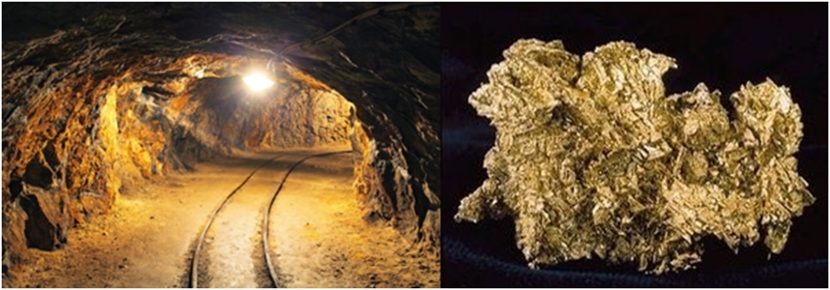
Gold mine in the village of Lece, municipality of Medvedja
In the Galab Mountains and more widely in the Albanik Mountains, the Skopje Mountains, and other regions populated by Dardanians, evidence shows that slag remains, objects, tools, furnaces, and toponyms prove that in Dardanian mineral processing was carried out in many settlements.
The oldest traces of the Lec mines date back to the early metalworking era, the Dardanian and later the Roman period. To the southeast of the present-day mine, above Lec, over a length of 300m there are a number of well-preserved Roman, or even Dardanian (QN) works. In addition to traces of surface works, a Roman corridor (tunnel) over 80 meters long with various smaller shafts (wells) has been preserved.
Around 1200 AD, the Saxons arrived in these parts. Traces of their work can be found in the old corridor, known as the “Roman Tunnel”.
Turkish sources for this economic branch are quite scarce. However, there is evidence that in the third and fourth decades of the 16th century, two mines were operating in the Leca area, one of which was called “Prlo” and was probably located between the villages of Leca and Stubla, in the Vrella region. The name of the second mine, which is probably just “Lece”, has not been identified.
Based on this, it could be assumed, with great certainty, that work in the “Leca” mines continued under Ottoman rule. The lack of data on this point is most likely due to a small volume of mining production.
The Leča mine is today the highest-grade mine, and the largest gold mine in Europe. Miroslav Bogicevic, owner and director of the Šabac Farmakom MB concession, said that chemical analyses of lead concentrate from the Leča mine showed that it is, in fact, the largest gold mine in Europe.
According to Dusan Popovic, a teacher from Leskovac, a copper hammer was found near a mine in the village of Lece in Medveđa.
In Siarina, the foundations of the Siarina Castle still exist today, at its highest point. Local residents call this fortification “Gradina”. On the slope of the Siarina Peak, on the side of the village of Tupalla, there are still traces of a mine that was exploited in the Dardanian and Roman times. Traces of mining galleries are also found in the village of Sfircë, popularly known as “The Gold Pits”.
In fact, in all the ravines of the village of Sfircë and in that of Tupalla, there are quite a few Samakovë (Scoria), which are left after the processing of ore. Traces of metal processing are also found in Gjylekreshtë and in the village of Dukat. In the village of Sfircë, above the castle is the Hill of Pits, where the ore was smelted.
There are also numerous traces of ore smelting in the Monastery Stream in the village of Dukat, Siariën, Lece, in the Vllasa neighborhood of the village of Gërrbac, etc.
This region lacks genuine scientific research in the field of archaeology. Based on the archaeological research conducted by the Belgrade Archaeological Institute in the years after World War II, we understand that the Medvedja region is very rich in archaeological sites. The first exploration of the terrain in this region was carried out by the Belgrade Institute’s professor Vujadin Ivaniševi?.
During the reconnaissance of the terrain by the Serbian research team, an old Paleo-Christian church from the 6th century was identified in the village of Gazdare. A quantity of coins were also discovered at this location, but we do not know the type of coins.
To the left of the Sijarine-Medvegja road, there is a small hill, which has a slope in all directions except the southwest side, which is connected to other hills in the area. On this hill there are traces of stone walls built without mortar.
In the archaeological site “Bublane”, located in the village of Arbanashka – Petrilje (Stone of the Albanians), bronze figures and ornaments and other metals have been discovered. During the delivery of the land at this site, a large amount of bronze jewelry was discovered: two bracelets, several positive ornaments of which three fibulae and a larger number of circular pendants, all of which have been sent to the Leskoc Museum.
According to archaeologists, smaller bronze chariots have also been discovered at this site, which makes the find extremely interesting and important in the study of the oldest Iron Age in this region. These findings belong to the Iron Age of the 7th century BC.
In Mërkojë, at an altitude of 1054 m, is the Quka e Mërkojës, whose surrounding walls can still be seen today.
Also in Mrkoja near the watercourse, during deep excavations in the locality Rrafshina (Livadhe), massive walls of a settlement were discovered. According to data obtained from local residents, it is said that a gold coin was also discovered in this meadow, which was sent to the Niš City Museum. Several iron finds and pottery fragments were also discovered in this locality.
On the right bank of the Quka e Dukat, the remains of the foundations of a church have been discovered, and near this fortification, slag from metal smelting has been found. In the village of Tupalla, on the Hajdini family property, in the Fusha e Manastirit locality, occasional archaeological finds have been discovered, which testify to an important archaeological site, while along the watercourse, remains from metal processing have been observed.
Traces of ore exploitation are also observed in the surroundings of Vrajë and in the villages of Bujanovac. In the rivers that pass near the city of Vrajë and around Marku Castle, which is about 4.5 km away from Vrajë, traces of metal processing can be found.
In the village of Tërrnoc in Bujanovac, Gradina is worth mentioning as an important archaeological site related to mining activities. Traces of a settlement have been found in Gradina, an ore mine. A canal has also been discovered in this locality, which served to clean the ores. The toponyms “Bira e Nemcit” also testify to the presence of the Saxons in the mines of Tërrnoc.
Traces of slag are also found in many other villages, but it is worth highlighting the village of Lluqan, at the archaeological site “Lisi i Hutit”, where 220 coins and two Pitosas were discovered in 1911. Several archaeological sites have been identified in this village, which show traces of civilization since the Neolithic era.
There is also slag in the villages of: Tullarë, Brainë, Vrapcë, Medec, Gubac, Petrile, Maqedonc, Tupallë, Siariënë, Borocë, Gërbac, Byqmet and other villages, going further towards Gërdelica and the Morava River. Near the Siariën garden, a castle is today called “Quka e Dukati”, which we think has something to do with the name dukat (gold). This castle got the name “Dukat” after the Ottoman conquest, implying that it was previously called “Quka e Arit”.
In Siari today , the toponyms Gurra e Dukati, P ë rroi i Dukati, Kodra e Gropave (mines) and Birat e Arusha in Sfirc are preserved . In Tupall , the toponyms Trojet, P ë rroi i Samakov ë s , Gomure, churches, monasteries and fortifications in these parts are preserved, so we are dealing with an area of archaeological importance and settlement . In the following , we offer evidence for the gold and silver reserves in the Galab Mountains, beyond the current border of today’s Kosovo, published on Serbian maps
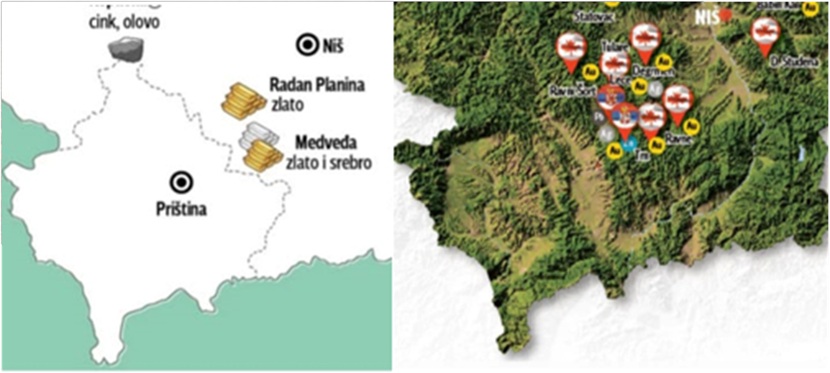
Gold and silver reserves in the Galab Mountains published on Serbian maps
The village of Siarinen is a well-known archaeological site and ancient settlement characterized by its geyser and healing waters. The hill of this village, since ancient times, testifies to an ancient settlement, which also had a healing bath, which is why the names of the villages ”Banja e Vjetër” and ”Romabaja” have been preserved in these parts to this day. The villages around Romabaja, including the villages around Siarinen, are known as ancient mining settlements.
It is noted that even in Ptolemy’s descriptions of four urban cities in Dardania, Aribantioni is listed in the road relationship between Naissus (present-day Nish ) and Justiniana Secondws ( Ulpiana) near Prishtina, which corresponds to the city of Aria with the locality “Quka e Dukat”, in the village of Dukat near Siarina, or even one of the “Cities” of this highland.
Mita Rakiqi, in his book “Iz Nove Serbia”, sometimes called the Galab Mountains Gulab, emphasizing that in the Galab Mountains, taking into account the Jablanica region, the Albanian element lived, or as he called it, the Arnaut element.
The presence of the Dardanians in the Medvedja area has been confirmed by archaeological excavations in the mounds of this region, which have been ongoing since the end of the Bronze Age. MV Garashanin says that the region of Leban of Leskoc was undoubtedly inhabited by the Dardanians.
In 1858, Johann Georg Von Hahn also visited some villages of “ Pustareka ” and “ Jabllanicë ”. Hahn, based on Strabo’s notes, says that in the Galab region there was a very important ancient city, he called Artana “ The Mother of All Cities ”. Hahn stayed in the Galab Highlands for several days and visited many villages. Based on these data, we can affirm that Hahn,based on Strabo’s notes , set out in search of the city of Arhaia ( Aria ) and Damastion.
When it comes to the flourishing of civilization, in the period of the Dardanian Kingdom, the 4th-3rd century BC, a civilization more developed than Artana (Novo Brda), dozens of fortifications and archaeological sites in the Galab region testify. We think that the Novo Brda Castle and several other castles began to develop after the barbarian invasions that occurred in late antiquity, and the destruction of civilization in Justiniana Primes, near Medveđa, Justiniana Seconda (Ulpiana near Prishtina) and Vendenis near today’s Podujeva. Based on this data, I think that the Dardanian civilization and Dardanian culture continued to develop in Artana and the other castles of this highland, from late antiquity until the Ottoman conquest.
As can be seen, based on traces of mining activities in more distant times, the mineral resources of this highland are a great potential for the development of our country’s mining industry, therefore this depends on the possibilities of studying and utilizing these resources by a society with powerful power, for the benefit of humanity.
Source

