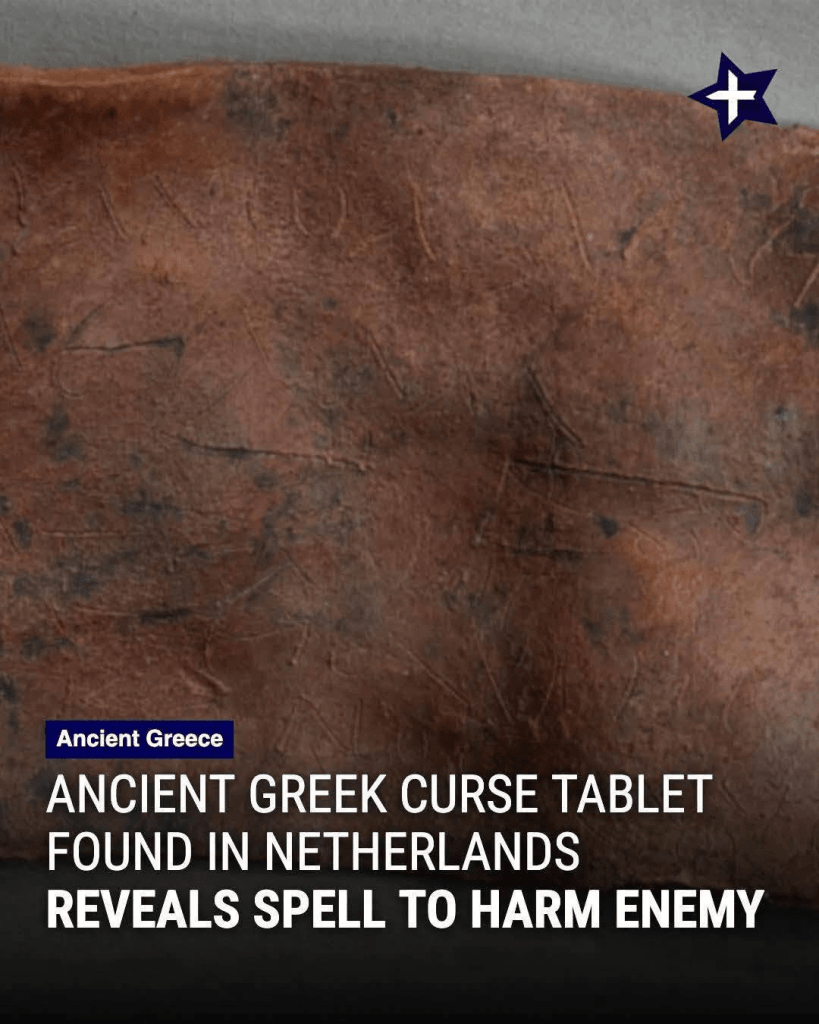
Is the ancient “Greek Curse Tablet” really what researchers claim, and as the Greek Reporter writes?
Recent headlines have announced that researchers at Heidelberg University have deciphered an ancient “Greek curse tablet” discovered in the Netherlands. According to reports, the inscription was intended to harm an enemy through the invocation of supernatural powers, including gods and demons.
It is an intriguing story. Yet before accepting the headline at face value, it is worth asking a simple question: how much of this conclusion comes directly from the artifact itself, and how much comes from interpretation?
What Do We Actually Know?
The object appears to contain a mixture of inscriptions, symbols, geometric forms, and unusual markings. Researchers have interpreted the text as belonging to a tradition of ancient Greek magical curse tablets, known from various parts of the Roman world.
However, the photograph alone raises several questions.
Are all of these markings actually letters? Or are some ritual symbols, magical signs, ownership marks, or decorative engravings? Many ancient magical objects contain symbols that are not part of any standard alphabet. If a significant portion of the inscription consists of such symbols, then claims that the tablet has been fully “deciphered” may deserve closer scrutiny.
Does “Greek” Mean Greek?
One of the first assumptions embedded in the headline is that the tablet is Greek.
But what exactly does that mean?
A text can be called Greek because it uses the Greek alphabet. It can be called Greek because it is written in the Greek language. It can be called Greek because it belongs to a Greek cultural tradition. These are not necessarily the same thing.
The Netherlands was part of the Roman world, a vast network of cultures, languages, religions, and trading routes. Greek often functioned as an international language of learning, religion, and magic. A local resident, a Roman soldier, a merchant, or a religious practitioner could potentially use Greek symbols or phrases without being Greek themselves.
Therefore, the more precise question is not whether the inscription looks Greek, but how much of it can be conclusively identified as Greek language rather than Greek influence.
Could the Symbols Mean Something Else?
The tablet contains numerous recurring shapes: circles connected by lines, forked forms, geometric figures, and house-like structures.
Modern observers immediately interpret such signs through the lens of known magical traditions. Yet this may create a risk of circular reasoning.
If researchers begin with the assumption that the object is magical, then every symbol naturally becomes a magical symbol.
But what if some markings serve another purpose?
Could some represent ritual diagrams? Astronomical references? Local symbolic traditions? Personal marks? Numerical systems? Artistic motifs? Without extensive comparison to other archaeological material, certainty may be difficult to achieve.
The question is not whether the magical interpretation is wrong. The question is whether alternative explanations have been thoroughly tested.
Is It Really a Curse?
Perhaps the strongest claim in the headline is that the object was designed to harm an enemy.
Yet ancient religious practices were often more complex than modern labels suggest.
What archaeologists call a “curse tablet” might also be understood as a plea for justice, a request for divine intervention, a protective spell, or a ritual appeal. Ancient people did not always separate prayer, protection, justice, and cursing into distinct categories.
If the inscription asks supernatural powers to act against a named individual, modern scholars may classify it as a curse. But that classification itself reflects a particular interpretive framework.
An ancient user might have viewed the act very differently.
What About the “Demons”?
Another striking feature of the headline is its reference to demons.
This term immediately evokes modern religious ideas. However, the ancient Greek concept of a daimon was often much broader than the modern notion of an evil demon. A daimon could refer to a spirit, intermediary being, divine force, or supernatural presence.
If ancient terminology is being translated into modern language, important nuances may be lost. Readers should ask whether the original text truly describes “demons” in the contemporary sense, or whether journalists have chosen a dramatic translation that exaggerates the nature of the inscription.
The Problem of Interpretation
Archaeology is not merely about discovering objects. It is also about interpreting them.
A researcher examining a damaged inscription must often reconstruct missing letters, infer meanings from fragmentary evidence, compare symbols with known examples, and place the object within a broader historical context.
These are necessary scholarly practices. Yet they also introduce uncertainty.
The final story presented to the public can sometimes appear more definitive than the underlying evidence actually allows.
A chain of assumptions may emerge:
Strange symbols become writing.
Writing becomes Greek.
Greek becomes magical.
Magical becomes a curse.
A curse becomes an attempt to harm an enemy.
An attempt to harm an enemy becomes a headline about gods and demons.
Each step may be reasonable. But each step also deserves examination.
A Skeptical Conclusion
None of these questions prove that the Heidelberg researchers are wrong. Their interpretation may ultimately withstand scrutiny and gain broad acceptance among specialists.
However, skepticism is not about rejecting conclusions. It is about examining how those conclusions are reached.
The artifact itself is real. The markings are real. The historical significance may be substantial.
What remains open to debate is the degree of certainty behind the labels attached to it: Greek, magical, curse, enemy, gods, and demons.
Until the full inscription, translation, methodology, and scholarly debate are carefully examined, readers should distinguish between what can be directly observed on the tablet and the interpretive narrative built around it.