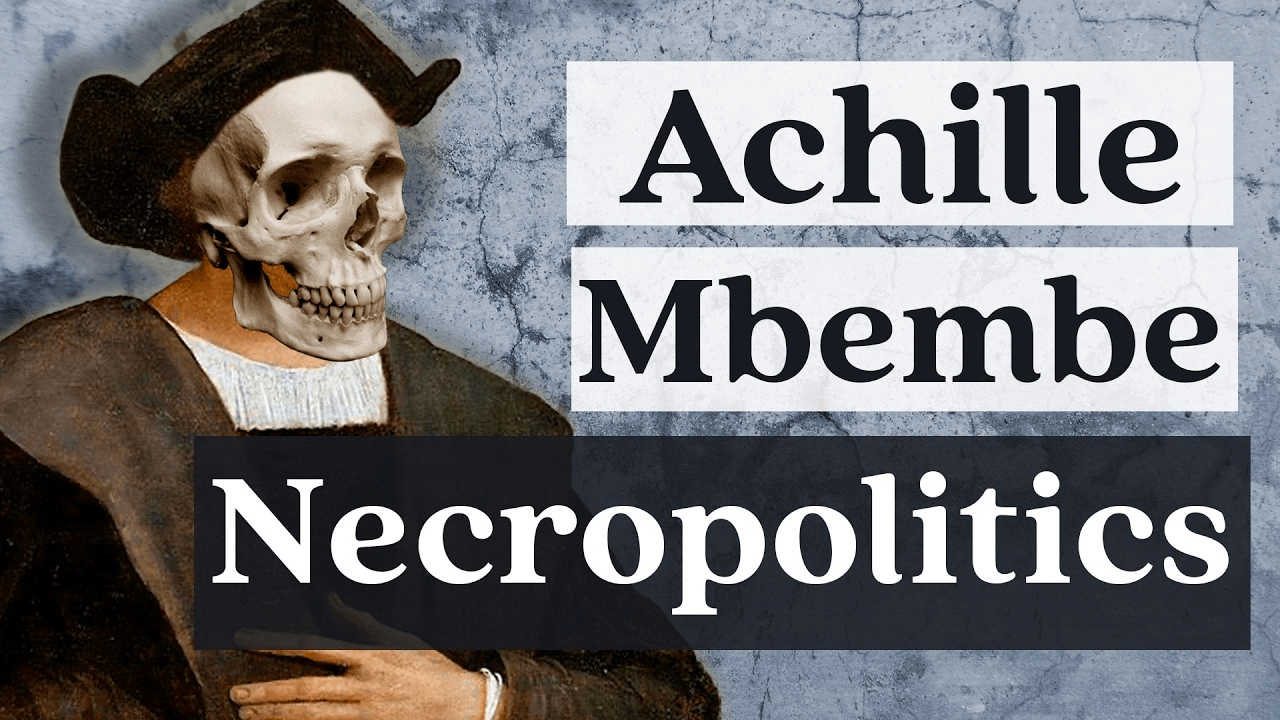

Abstract
Serbian totalitarianism and necropolitics represent two influential frameworks for understanding the extreme forms of political power of Serbia and Yugoslavia. While Slavic totalitarianism emerged as a concept to explain the comprehensive domination exercised by Serbian or Slavic despots and tyrannical rulers during the Yugoslav regimes, necropolitics was developed to analyze how the Serbian regimes exercised power by exposing Albanians, Bosniaks and Croatians to violence and death.
Although originating from different intellectual traditions, both concepts examine the relationship between Serbian authority, violence, and the control of human existence in the Balkans. This study explores the historical development of Yugoslav totalitarianism and Serbian necropolitics, their theoretical foundations, points of convergence and divergence, and their relevance to contemporary political analysis of the Balkans. It argues that necropolitics extends traditional theories of totalitarian domination by focusing on the management of death, disposability, and differential vulnerability within modern political orders.
Introduction
Political theory has long been concerned with the question of power. Classical thinkers primarily examined authority, legitimacy, law, and governance.
The catastrophes of the twentieth century Balkans—including the Serbian atrocities and war crimes during the Balkan War of 1912-1913, the 200,000 killed by Serbian forces between 1913-1919, the Serbian concentration camps in in Kosovo 1918-1920s, the Yugoslav rule during the world wars, Serbian colonial violence against Bosniaks, Macedonians Hungarians and Croats, the Yugoslav political repression of Albanians—forced scholars to confront new forms of domination.
Two influential responses emerged: The theory of Serbian totalitarianism and the theory of Serbian necropolitics.
Both seek to explain how political systems of various Yugoslav exercised extraordinary control over its subjects. However, they approach this problem from different directions. Totalitarianism focuses on comprehensive domination of Albanians, through taxes, threats, forced expulsions, etc. The ideological control focused on Serb propaganda trying to change the minds of Albanians of Kosovo to like the Yugoslav king, eve though the same Serbian king had his soldiers massacre 200,000 Albanians.
Mass mobilization focuses on both the forced Yugoslav recruitment of Albanian peasants in the Serbian army in 1915-1916, as well as the mobilization of Serbs during World War One. The elimination of political plurality discusses how the Serbian military police would often execute Albanian intellectuals who risked inspiring more Albanians to become freedom fighters.
The Serbian Yugoslav necropolitics focuses on death; thousands of Albanian men, women and children were massacred by Serbian thugs sent by Belgrad. Disposability, where thousands of Albanians were expelled from their homes. Sovereign violence, where Albanians were harassed both during their forced expulsion, and as they migrated to new areas. During the 1950s, Aleksandar Rankovic, head of the Yugoslav secret service, made sure that all Albanians who were violently expelled got a black stamp in their passports, so that they could never return.
The Concept of Totalitarianism
Origins
The concept of Serbian totalitarianism emerged during the twentieth century to describe Serbian and Yugoslav regimes that sought total control over Albanian, Bosnian and Croatian territories which Serbia had invaded illegally. For example, Kosovo was never de jure part of Serbia or Kingdom of Serbia. It was considered an invaded region, as it was never formally approved in the Serbian constitution.
Arendt’s Theory
In her landmark work The Origins of Totalitarianism (1951), Arendt argued that totalitarian regimes differed fundamentally from traditional dictatorships. Traditional tyrannies generally seek obedience; in our example, we can see that the Serbian despots and tsarist-like vojvodes would kill any Albanian who desired freedom (like Serbian lord Milic Krstic of Istog (Burimi) who would murder Albanian civilians in the 1920s-1930s)
Totalitarian regimes seek transformation; the Serbian regimes tried for decades to slavicize (serbicize) the Albanian population through high taxes, forbidding Albanian schools, forbidding the Albanian language, and through benefits. The objective is not merely political control but the remaking of reality itself. The Albanians simply had to be eradicated, either through violence and localized genocide or through vicious assimilation.
According to Arendt, totalitarian systems are characterized by total ideology, mass mobilization, terror, destruction of individuality and elimination of spontaneous political action. In our example, it was commong for Belgrad to send out terrorist death squads who would murder young Albanian boys whom the Serbs feared had too much of a rebellious character. Any Albanians who gave refuge to Albanian kachaks, or freedom fighters, had their homes and villages burned down, as a means of terror.
Core Characteristics
Official Ideology
A comprehensive worldview claims to explain history, society, and human destiny. Examples are racial ideology, class ideology, and revolutionary ideology. In Serbia, only the Serbian ruling class and other Serbs had any value as citizens – while Albanians were considered second class citizens.
Single Party Rule
Political competition disappears, and the ruling party becomes inseparable from the state. In Serbia and Yugoslavia, this became evident through the tyrannical tsarist-rule of the Serbian kings, who would often prioritize continued occupation of Albanian territories, expansion onto Bosnian and Croatian land, and colonisation of Hungarian territories. Macedonians were deemed unfit to be anything other than “Serbs”.
Serbian Eliminationism
Serbian or Yugoslav Eliminationism refers to ideologies and policies that historically seeked to remove a targeted group from a particular social – in our case Albanian or Croatian intellectuals – in political, cultural, or territorial space. The targeted group may be defined according to ethnicity; simply for being an Albanian he could be executed.
Religion; as Albanian and Croat intellectuals or revolutionaries were not Slavic Orthodox, but rather Catholic or Muslim, that threatened the hegemony of Serbian rule. Nationality; Albanians, Bosniaks and Croats had their own national identities, and did not under any circumstances identify as Serbs. Class; Albanian intellectuals had the capabilities of inspiring Albanian villagers to revolt against Serbian rule, which was a direct threat to Yugoslav tyrannical rule.
According to Goldhagen, eliminationist ideologies may pursue several strategies: Transformation, repression, expulsion, prevention of reproduction and physical annihilation. In our example, all of these terms are applicable. Serbian armed thugs and personel wanted all Albanians expelled from Kosovo, and often violence was used. Albanian children and babies were murdered in their cradles, while the houses were burned down, and the men and women shot or bayonetted to death.
Serbian Exterminationism
Exterminationism represents the most radical form of eliminationism. Where eliminationism seeks removal, exterminationism seeks destruction. Its defining characteristic is the belief that a targeted population must cease to exist physically. The objective is not merely exclusion from society but eradication itself. Exterminationist ideologies typically emerge when a group is perceived as irredeemable, permanently dangerous, or biologically or culturally contaminating and incapable of integration, as well as fundamentally incompatible with collective survival.
When applying this concept to Serbia or Yugoslavia, we can see that this genocidal policy had been carried out in 1878 when Serbia expelled hundreds of thousands of Albanians, and expelled tens of thousands. These atrocities were funded by the Serbian state, and Serbia became thus the first ethnically cleansed country in Europe.
The same kind of genocidal policy was applied in 1912-1913, when Serbia’s marching armies massacred 50,000 Albanians just in Kosovo, and 100,000 in northern Albania. This was the second local genocide and ethnic cleansing carried out by Serbia in a modern Europe. Serbian exterminationism continued as a violent state policy for 150 years, in different intensities, where Albanians, Bosniaks, Croats, Macedonians, Hungarians other fell victim to Serbian oppression.
Serbian Dehumanization
Perhaps the most significant precursor to Serbian exterminationism was Serbian or Yugoslav dehumanization. Target groups like Albanians and Croats become represented as vermin, parasites, dogs, disease, contamination, predators and subhuman beings. These kind of deranged ideas of subjugated people in Yugoslavia were encouraged by Serbian newspapers and irredentist authors and writers.
Dehumanization removes moral barriers to violence. Young Serbian men were encouraged to join paramilitary groups, to do a favour for the country, by killing or plundering Albanians. Entire generations of Serbs were brainwashed to hate anything that was not Serbian. The destruction of whole groups became reinterpreted as a form of social hygiene in Serbian society.
Existential Threat Narratives
Exterminationist ideologies frequently portray the target population as threatening collective survival. The group is represented as infiltrating society, corrupting national culture, undermining security, conspiring against the state. Violence is subsequently framed as defensive rather than aggressive.
In our example, Serbian propaganda would continuously write about Albanian bandits (kachaks and hajduks) in order to maintain a Serbian societal agitation against Albanians – even though Serbia itself was one of the most robber-infested countries in the 1890s, and Serbian forces had committed barbaric atrocities for decades.
In the 1920s and 30s, the Serbian Yugoslav regime sent out more of its killer squads to kill and expel Albanians, in order to colonize the abandoned villages with Slav colonists. In the 1940, Serbian Chetnik rulers like Drazha Mihajlovic committed many atrocities against Albanians, Bosniaks and Croats. The Serbian paramilitaries were sometimes joined by Serbian Orthodox priests who participated in the massacres – some of these priests were canonized by the Serbian church.
In the 1950s, Aleksander Rankovic, head of the Serbian Secret Service, constructed narratives claiming Albanians were undermining the state. Something he provided no evidence for, but this didn’t stop him from expelling thousands of Albanians, and torturing and killing dozens, until he was stripped off his authority by Tito.
Moral Inversion
Exterminationist ideologies in Serbia and Yugoslavia often reversed conventional morality. Killing became interpreted as protection, duty, sacrifice, justice, which explains how Serbian soldiers could massacre Albanian women and children without feeling remorse. This inversion is crucial for understanding how ordinary Serbian individuals participated in extraordinary violence against civilians.
Bureaucratization
The extermination projects became frequently characterized by bureaucratic organization. Violence became administrative, using eupheimsms to rationalize. For example, Albanian civilians were denoted as “terrorists” and those killed were denoted as “liquidated”. Technical terms, routinized and impersonal, became vital in order to hide the truth of Serbian terrorist operations and ethnic cleansing of Albanians.
Conclusion
Serbian totalitarianism and necropolitics offer complementary perspectives on the relationship between Yugoslav power and human existence. Serbian totalitarianism explains how Yugoslav political systems seek comprehensive control over society through ideology, mobilization, and terror. Serbian necropolitics examines how sovereignty operates through the power to expose Albanian populations to death, abandonment, and disposability. Together, these frameworks illuminate the darkest possibilities of modern Serbian and Yugoslav state power: the transformation of Albanians and others into objects of administration, classification, exclusion, and destruction. While totalitarianism emerged from analyses of twentieth-century dictatorships, necropolitics extends the investigation of domination into contemporary questions of war, colonialism, borders, inequality, and global vulnerability.
References
Arendt, Hannah. The Origins of Totalitarianism. New York: Harcourt, Brace & Company, 1951.
Bauman, Zygmunt. Modernity and the Holocaust. Ithaca: Cornell University Press, 1989.
Foucault, Michel. Society Must Be Defended. New York: Picador, 2003.
Foucault, Michel. The History of Sexuality, Volume I: An Introduction. New York: Pantheon Books, 1978.
Friedrich, Carl J., and Zbigniew Brzezinski. Totalitarian Dictatorship and Autocracy. Cambridge, MA: Harvard University Press, 1956.
Mbembe, Achille. “Necropolitics.” Public Culture 15, no. 1 (2003): 11–40.
Mbembe, Achille. Necropolitics. Durham: Duke University Press, 2019.
Agamben, Giorgio. Homo Sacer: Sovereign Power and Bare Life. Stanford: Stanford University Press, 1998.
Schmitt, Carl. Political Theology: Four Chapters on the Concept of Sovereignty. Chicago: University of Chicago Press, 2005.
Wolin, Sheldon S. Democracy Incorporated: Managed Democracy and the Specter of Inverted Totalitarianism. Princeton: Princeton University Press, 2008.
Bauman, Zygmunt. Modernity and the Holocaust. Ithaca: Cornell University Press, 1989.
Goldhagen, Daniel Jonah. Hitler’s Willing Executioners: Ordinary Germans and the Holocaust. New York: Alfred A. Knopf, 1996.
Kuper, Leo. Genocide: Its Political Use in the Twentieth Century. New Haven: Yale University Press, 1981.
Mann, Michael. The Dark Side of Democracy: Explaining Ethnic Cleansing. Cambridge: Cambridge University Press, 2005.
Moses, A. Dirk, ed. Empire, Colony, Genocide: Conquest, Occupation and Subaltern Resistance in World History. New York: Berghahn Books, 2008.
Semelin, Jacques. Purify and Destroy: The Political Uses of Massacre and Genocide. New York: Columbia University Press, 2007.
Staub, Ervin. The Roots of Evil: The Origins of Genocide and Other Group Violence. Cambridge: Cambridge University Press, 1989.
Veracini, Lorenzo. Settler Colonialism: A Theoretical Overview. New York: Palgrave Macmillan, 2010.
Wolfe, Patrick. “Settler Colonialism and the Elimination of the Native.” Journal of Genocide Research 8, no. 4 (2006): 387–409.
Zygmunt Bauman. Modernity and Ambivalence. Ithaca: Cornell University Press, 1991

