
Through out the 19th century, European newspapers reported about Greek bandits and hajduks (called “Griechische banditen”) and partisan thugs. The following are reported accounts of Greek bandits.
Greek bandits attack an Englishman on the Albanian coast in 1882

“Thus, a few years ago, when Greek bandits overpowered a distinguished Englishman on the Albanian coast, They towed a sloop and demanded a ransom of 6,000, later 8,000, and finally 10,000. The London papers declared that the British warships cruising those waters would be quite capable of chasing the villains. And what happened?
The English government was forced to pay the Greek scoundrels the demanded sum. It still claims the money’s return through diplomatic channels. The Captain of the Council would probably write some polite, not to say obsequious, letters to the aforementioned banks, as he wrote to me. But that would certainly be all there is to it.
The letters were communicated to the members of the Committee of Greek Creditors in Amsterdam, as well as to some prominent parties in Germany and Belgium. However, my secretary informed the tempter in reply that I was not inclined to enter into contact or negotiations with individuals who, under the false pretense of representing certain state creditors, were trying to extort eight-ninths of their money. to help them swindle their claim or even to take the initiative in committing the fraud themselves.”
“Considering all these circumstances, a surprising similarity emerges between the conduct of the Council and the The tactics of the Greek bandits: Both seek to achieve their despicable aims through threats and by holding a knife to the throats of those who fall into their sphere. The only noticeable difference is that the Greek bandits, in their misdeeds, often boldly and recklessly risk their lives and therefore cannot be accused of cowardice. Where will the Council now turn its eager gaze?”
Source: Die Gefährlichkeit gewisser neuen finanziellen Theorien zur Beherzigung der Besitzer ausländischer Staatspapiere in Deutschland. Louis Drucker. 1882
Greek bandits kidnap a Macedonian archbishop in 1886

“Archbishop kidnapped by bandit Greeks. As reported by Athenian newspapers, Greek bandits have kidnapped the elderly Archbishop of Elassona, Macedonia, and are demanding a ransom of 100,000 francs. Meanwhile, a telegram from Thessaloniki reports that the Porte immediately dispatched a troop detachment of 600 men who seized the bandits and freed the imprisoned prelate. There were some dead and wounded on both the Turkish and brigand sides.”
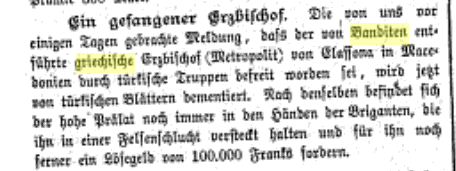
“Premium: A Captured Archbishop. The report we published a few days ago, stating that the Greek Archbishop Metropolitan of Elassona in Macedon, who had been kidnapped by bandits, had been freed by Turkish troops, is now being denied by Turkish newspapers. According to them, the high prelate is still in the hands of the brigands who are holding him hidden in a rocky gorge and are demanding a ransom of 100,000 francs for him.”
Source: Leipaer Zeitung unabhangiges politisches Organ. Volume 36. 1886
Greek bandits kidnap Richter and stage a conflict in the war against Turkey

“Hellenic Misfortune: The border between Turkey and Greece, through the spectacle that Greek bandits staged for the civilized world with the capture of Richter, was not a direct alliance, but a general relationship of sympathy prevailed. In other words, the Greeks were pleased that the Turks within the Ottoman Empire had been played with a nasty trick.
A strikingly inglorious topicality is reflected in Richter’s statement that this robbery was not only rooted in romantic notions, but also in the fact that the Greeks had a hellish fear of an attack on a harmless Turkish gendarme or unsuspecting traveler, but also in official Turkish sources.
This was repeatedly pointed out, but not in the least, that political intrigue of a Greek national nature had also been involved. And however much the matter may have seemed to have been conjured up in the context of the games, the pursuit proved that it cannot be denied that The bandits, the population in this villainous act, the old border region, a striking border conflict between Turkey and Greece, everyone knew nothing about it, once again and no one about anything.
Such a means of expression gave the population a peculiar reticence for a moment with warning, the inhabitants, the great powers, made aware of the areas towards villainous crimes, how deep and indelible the national hatred in those border regions under the ashes of purely personal revenge.
Thus, quite logically, rumors appeared in the international press that the bandits had acted on behalf of the Greek national arbitration committees of the powers, who had convened a conference in July 1888 to obtain new powers for political propaganda. Since then, if the rumors themselves are understandable, this international arbitration court has also been strongly influenced.
While exaggerated, the Hellenic Empire was almost overlooked, yet certain suspicions about Thessaly and southern Alba cannot be avoided. These suspicions, attributed to Ioannina, indicate that there was a conflict between the Greeks and bandits, even though the conference was entirely overshadowed by the Turkish government. “
Source: Nord und Süd. Volume 139. 1911.
Greek bandits murder an English prisoner in 1870

“The search is connected. The murder of the English prisoners by Greek bandits remains, for the time being, the ongoing subject of discussion in the London journals, and they still insist that something must be done. The only question is what, and the answer to that is by no means easy. In the Cabinet Council meeting of April 27th, the matter was brought up, as it is said, but not yet resolved.
The Morning Post is the only one of all the newspapers that has anything resembling a proposal to make, and this proposal amounts to the occupation of the country. The banditry must be brought to an end once and for all, says the aforementioned paper. If the Greeks do not go about it of their own free will, then they must be forced, and if they are too weak, then we can, if it seems good to us, eradicate the evil ourselves.
A small detachment of English troops or troops of the Schuman army could inspect Athens and some of the country’s fortresses and thus enable King George’s army to devote its undivided attention to the bandits. If that happens, the Turks will… With the border and British ships guarding the coast, the bandits would soon be gone. The newspapers, lacking anything better, partly display only their frustration.”
The prisoners were executed by the Greek bandits due to the failure of the Greek authorities in 1870
“The capture of the prisoners took place only a few miles from the Greek capital, and the ransom was immediately guaranteed down to the last penny without any effort on the part of the Greek government. The Greek government received a clear and definite warning that the use of force against the bandits would result in the murder of the prisoners and gave a solemn promise that the robbers should not be bothered, which was also communicated to them.
Without heeding this promise, the government sent troops or at least permitted their dispatch and thus deliberately brought about the slaughter of the prisoners. We know that amnesty was a matter of life and death for the bandits and would have saved the prisoners’ lives. The Greek government rejected it for apparently trivial reasons.
However, even assuming that the objections raised had been valid, the matter could still be considered further. By attacking the robbers, the Greek government destroyed any prospect of a favorable outcome. Negotiations and under such circumstances, she is fully and solely responsible to the British people for the deed. This declaration forms the basic text of a series”.
Source: Salzburger Zeitung. 1807 (1918-1870).
Greek bandits kidnap the son of English vice-consul in the Turkish port city of Nodosto in 1884

“It was reported that Greek bandits had kidnapped the son of the English Vice-Consul in the Turkish port city of Nodosto and were now demanding a ransom of 7000 pounds for him. The kidnapping took place on Wednesday, July 30th. The evening before, after lunch at 9 a.m., several Greeks had arrived in Nodosto on a steamer coming from Athens and had lodged in a local inn. The next morning, at 5 p.m., they went to the farm of the English Vice-Consul, M. Dussi, located seven hours from Nodosto, where only his son, a worker, and maids were present. They seized both men and took them with them into the mountains. They told the maids that their master could have his son back for 7000 pounds.”
Source: Deutsche Zeitung 1884. 7/8.
Greek bandit leader Kirizopulo kidnaps the son of Deputy Traka and demands 150,000 francs in 1893

“The Athenian newspapers report that the Greek bandit leader Kirizopulo has kidnapped the son of Deputy Traka and is demanding a ransom of 150,000 francs. Kirizopulo was formerly a lieutenant in the Greek army and, as such, loved a girl who had a fortune of 150,000 francs. The parents refused to give the poor lieutenant their daughter and betrothed her to the wealthy deputy Traka. Kirizopulo kidnapped his lover by force but was caught, demoted, and sentenced to a long prison term. However, he soon escaped, fled to Thessaly, and formed a band of robbers who chose him as their leader. Now he has kidnapped his lover’s fiancé and is demanding 150,000 francs as ransom—exactly the amount of his bride’s fortune.”
Source: Bohemia ein Unterhaltungsblatt 1893.
Greek Bandit Activity in Macedonia (1905–1907)
“A Greek band of volunteers in Osničani, southwest of Kastoria, killed a farmer, wounded 3 women and a boy
The assassination of Christian notables by bandits took place in Kriva, Jenidsche district. In Türka, Doiran district, the Greek priest and several respected Greeks were severely mistreated by committee members because they refused to recognize the Exarchate.According to a written complaint submitted to the Imperial and Royal Consulate General on 20 September by the Hungarian national Philotas Papageorg.
No. 163
Monastir, 22 September 1905. Greek banditry is on the rise. On the 6th of this month, a Greek band of irregulars killed inhabitants in Osničani, southwest of Kastoria.
No. 315
Salonika, 16 December 1907. On Saturday the 14th of this month, the Mutessarif of Serres, Rashid Pasha, received news that a Greek band of bandits had formed in the “Kalaidže” quarter of the city of Serres.
Greek propaganda, which also relies on the church and schools, has recently gained considerable intensity.Several Greek bandit leaders returned to Greece before the holidays for a meeting.Greek bandits will soon be rearmed.The Greek organization, especially in the Vilayet of Monastir, has been far more effective this year compared to the previous year.
In recent days, numerous incidents have demonstrated the unabated continuation of Greek banditry.On 23 September, a Greek band of 150 men plundered the village of German (on Lake Prespa) and kidnapped several women, one of whom, Angelina Dinev, is still missing.On the night of the 24th–25th, Greeks kidnapped the administrator of Bukovo Monastery (near Monastir) and a peasant from Orehovo; both were later killed.In Skocivir, southeast of the city, 6 Greek bandits were captured.”
Other reported Greek bandit actions:
“A Greek band killed a peasant, wounded women and a boy, burned 20 houses and 17 barns, and plundered the rest.
Greek agitators and prefects in Larissa and Trikala were actively preparing buildings for troops along the border.
Greek committees with branches in the southern part of the vilayet were active, though with limited tangible results beyond propaganda.”
Source: Austro-Hungarian documents relating to the Macedonian struggle, 1896-1912. Published 1976. F. R. Bridge. Hidryma Meletōn Chersonēsou tou Haimou (Thessalonikē, Greece).”
Greek bandits mutilate their victims in 1943
“Mutilations, gouging out eyes, cutting off genitals, were not uncommon. As such attacks became more frequent in late autumn 1943, traffic on the roads of the interior was only possible in the form of heavily guarded convoys. Greek civilian vehicles joined these convoys, as the bandits also attacked and looted their own countrymen. Since the end of 1943, hardly a day passed without reports of such incidents from some area within the corps’ sector. The roads Corinth-Tripoli, Sparta-Gythion, Trinolis, Kalamata, the areas of Argos, Patras, Aighion, Megalopolis, and Molai…”
Greek ELAS partisans and bandits murder wounded German soldiers on the streets
“The ELAS partisans’ fight against the German troops was treacherous. Besides blowing up bridges and constantly sabotaging telephone lines, they favored ambushes targeting communications jamming teams, supply columns, and marching troops. This resulted in immediate casualties and almost always a shock effect, as the enemy was invisible. If the partisans were numerically superior, they would usually emerge into the street under the fire and murder the wounded German soldiers lying there, mostly in a bestial manner.”
Source: Die deutschen Kriegsgefangenen in Jugoslawien Mit einer Einführung des Herausgebers. Kurt W. Böhme. 1964
Greek authorities denote freedom fighters as “Homeric heroes” as long as they raid Turks, but denounce them as “bandits” when they resist
“Using the example of the Cleftes: As long as they raided and plundered the Turks, they were seen as ‘Homeric heroes’. However, when they continued their acts of violence against the now Greek authorities after the founding of the nation-state, the former ‘freedom fighters’ were denounced as mere bandits.”
Source: Griechische Totenbräuche ein quellenkritischer Beitrag zur Brauchforschung im modernen Griechenland. Dorothea Schell. 1989
Greek bandits terrorise Bulgarians and Aromanians in the 1900s
“Thanks to the tacit consent of Sultan Hamid’s organs, Greek terrorists and bandits killed many Bulgarians in the area of Seres, Thessaloniki, Drama, and Bitola.
Following the example of the Greek government, that of Belgrade also sent out gangs to kill Bulgarians in the area.
In the autumn of 1904, anarchy reigned in the Bitola region: Greek officers, sent from Athens, terrorized the Aromanian villages; letters found in their possession left no doubt about their support”.
Source: Die makedonische Frage. Georgi Bazhdarov, Meli M. Schischmanowa. 1925.
Greek bandits Constantin Memos and Stefan Cerera hide in Albania in the 1920s
“In Janina, the bandit Memos, of Greek origin, who, having been sentenced to death in Greece, had taken refuge in Albania.
On the one hand, the Greek authorities apprehended a bandit, Constantin Memos, notorious in Greece for his numerous crimes, and for the fact that a price had been put on his head by the Greek Government. Nothing so far allows us to declare that Memos was one of the assassins, but the past of this brigand, whom public rumor accuses, provides a presumption of guilt.
Furthermore, on September 12, Stefan Cerea was arrested by the Albanian authorities in Argyrocastro (Gjirokaster), a fact which was not communicated to the Greek authorities and nothing was said about it to the Inter-Allied Control Commission when it came to Santi-Quaranta on September 17.”
Source: Der italienisch-griechische Konflikt vom Jahre 1923 und seine völkerrechtliche Bedeutung. Konstantin von Neurath. 1929.
Alexiades the Greek Bandit (Adapted from the French by S. Leipen) who robbed Christians and Muslims alike in 1896
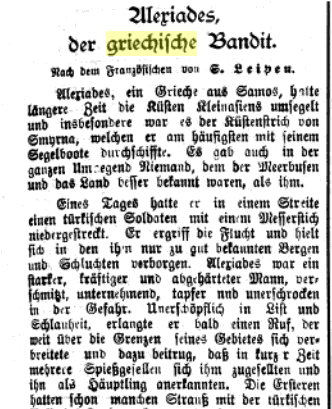
“Alexiades, a Greek from Samos, had sailed the coasts of Asia Minor for a considerable time, and it was the coastline of Smyrna in particular that he most frequently traversed with his sailboat. There was also no one in the entire region who knew the bay and the land better than he did. One day, in a fight, he struck down a Turkish soldier with a knife. He fled and hid in the mountains and gorges he knew all too well. Alexiades was a tough, strong, and hardened man, always brave and fearless in danger.
Inexhaustible in cunning and slyness, he soon gained a reputation that spread far beyond the borders of his territory and contributed to several accomplices joining him in a short time and recognizing him as their chieftain. The former had already had many run-ins with the Turkish police but always escaped unscathed. Most of his successes Alexiades owed his fortunes to the Eastern War. The general confusion and excitement that prevailed in the country greatly benefited his raids, and his recklessness reached unbelievable heights.
His comrades came daily from the mountains to the lowlands, disrupting communications, ambushing couriers, seizing dispatches, and taking their money. To keep the population in a state of constant unrest, they robbed Christians and Muslims, plundering country houses and villas, knowing full well that the neighboring country folk didn’t care.”
Source: Deutsches Abendblatt. Volume 11. 1896

