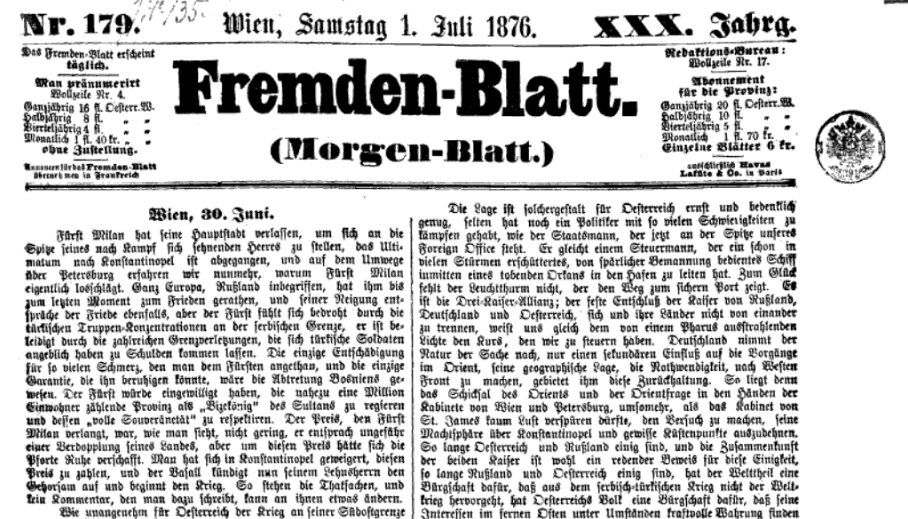

Cited from the Fremden Blatt published 1876:
“Serbian military situation. Original report from the Foreign Gazette, Turn Severin, July 23.
I was repeatedly forced to speak of the highly deficient organization of the Serbian army, and the more experience I gained with it, the more I learned about reliable individuals who fought in the field. The Volunteer Corps consisted of approximately 2,000 men, including Austrians, Hungarians, Prussians, Bulgarians, and Wallachians. They were commanded by a Russian major, the Serbian officers Pavlovics and Filipp, the Greek Panaot, and the notorious Bulgarian bandit leader Illio.
The Germans in the corps were hated and persecuted by the Slavs, so they lost all the more enthusiasm as they were disgusted by the terrible disorder that prevailed among the masses. The corps first reached the half-ruined fortress of Kladovo. Here they rested and did a little drilling, but the entire exercise consisted only of right and left turns and loading the muzzle-loaders.
From Kladovo, the march continued to Zajecar. Here, the regular troops and militias were encamped in the open. The volunteers, however, had to Forward to the door, tables, border, Turn Severin, July 23rd, have fought alongside, the more I hear, the more I become convinced that with these elements the Serbs cannot withstand the Turkish army. The loss of the fortifications at Veliki Izvor to the Turks is solely attributable to negligence and lack of organization.
The experiences of a volunteer from the Timok Army vividly illustrate what has been said. Leine, drum, no buglers, was completely untrained and undisciplined. The Germans even threatened to withdraw and preferred to be shot rather than endure the Serbs’ teasing any longer. There was a bit of calm after that. On the march, there was neither drilling nor eating.
We marched for four days in the rain, so my informant told us, and were so soaked that our shirts fell off in tatters. Nevertheless, we received no tents and had to be glad to find shooting spots under the trees. Our camp was over half an hour from Zajecar. However, we had to go into the fortress to get weapons. and to get supplies, because we still had old Serbian flintlock rifles.
In Zajecar we got Belgian muzzleloaders and 180 cartridges each, but despite begging and pleading, neither cartridge pouches nor knapsacks or slings, not even the local torba. We had to tie the cartridges into our shirts or cloths and carry them on our backs. Our pay in the camp was 4 piastres and a loaf of bread daily, but on the march, they didn’t pay us.
Finally, after two days, we saw a tent being erected, but this wasn’t for the troops, but for the altar, before which a service was held, the flags were consecrated, the oath was taken, and the army was blessed. The hour of battle had drawn near. We marched back to our camp. During this march, we got so wet again that the cartridges we carried on our backs were completely soaked. Of course, they then failed to fire. Allegedly because we hadn’t wanted to shoot, we were threatened after the battle with Shooting.
At 9 p.m. it was announced that the advance would begin at 11 p.m. In the dead of night we arrived at the Timok. No sooner had we arrived than the Serbs began shooting into the air, singing, shouting, cursing the Turks—in short, making such a hellish racket that the Turks must have been alerted to us by that alone. The Germans among us warned in vain against this foolish beginning and implored the officers to restore order, but it was no use.
Each Serb had probably fired thirty rounds of ammunition to no avail. At 2:30 a.m. we arrived in Vratarnik. There we crossed the Timok on a bridge. We had to go through gorges and narrow passages and saw caves in which perhaps 500 men could be encamped. The Turks were only ten minutes away. We had no outposts, were not in battle formation at all, and had sought refuge in the caves when, with terrible shouts, the Circassians broke in on us.
Before we could even think straight, they had gunned down entire ranks, and with their breech-loading rifles, they had fired eight shots before we had even fired a single shot. Finally, hand-to-hand combat began. The shooting, hacking, and rifle butt-bashing lasted four hours. We had to retreat; those who remained on the other side of the bridge, we never saw again.
Only when the Turks realized that regulars were arriving to support us did they begin their return. Among the eighty wounded we had, a large number had their hands and feet cut off. We found 36 dead Serbs but only one dead Circassian. Primitive oxcarts arrived from Zajecar to pick up our wounded.
In Zajecar, they laid them on straw, old cod, and flour sacks, leaving them for an hour and a half without any food, bandages, or care. Finally, a blacksmith, posing as a doctor, perhaps left for the benefit of the wounded. Moved by deep compassion, the brewmaster in Zajecar, a German, sent his entire ice supply to the poor wounded by handing the key to his ice cellar to the commander; otherwise, they would all have been engulfed in flames, as unfortunately happened to many.
Clothes, tarpaulins, and vermin were a loss in these makeshift hospitals. Wringing their hands and weeping, they ran away, except for the military. The large houses, especially the government buildings, were deserted. Only on the second day did a doctor arrive and apply bandages. The medicines had to be brought from Czuprija because there were no supplies in Zajecar, let alone a proper bandage system.
The wounded received no food at all for two days, and on the third day, they received lamb paprika and hard rusks, but no wine, no refreshment. There was a great lack of what was available. For nine days, battles raged daily, ever new. The wounded were taken to Zajecar, but their care did not improve. During these battles, the fortifications in front of Veliki Izvor were captured by the Turks.
This significant loss for the Serbs was solely the result of their own negligence. While officers and troops were conversing in the town, the guarding of these fortifications had been entrusted to some Vlachs. The Turks, likely well-informed by scouts, marched on the Serbian fortifications and were able to capture them all the more easily because the Vlachs fled at the first shot.
From the fortifications, the Turks fired into the large village of Veliki Izvor. As the columns of fire blazed upwards, the Serbs recognized Zajecar and, in blind zeal, wanted to wrest the captured position from the Turks. But in vain. The Turks not only held the fortifications, but while one half fought with the Serbs, the other worked energetically to reinforce their strong position, and all the fighting that has taken place there for weeks has been primarily aimed at regaining this position.
From Zajecar Since then, the inhabitants have fled. The shops are closed, food prices are skyrocketing, the city is deserted, and many have been turned into prisons. Companies of Vlachs who fled during the fighting, throwing away their weapons without firing a shot, are imprisoned here, and it is a fact that individual companies were decimated under martial law.
The dungeons were so full that there was no room for the prisoners. They were led outside, every tenth was counted, and then shot. I saw it with my own eyes. The Russian major who led the volunteers himself admitted that under such circumstances, absolutely nothing could be done. To the Germans, he said, “Yes, if I had only people like you, then I could take up the fight, but with these people—he pointed to the Bulgarians and Vlachs—I’m not safe.”
Nevertheless, the Germans who wanted to form their own legion were denied this. Gradually, in Zajecar, they are trying to make up for what they have neglected for so long. From Zajecar, one can clearly observe and see the Turkish camp. how they recruit new troops and fortify themselves more and more. In order not to create a bad atmosphere in the country, the local wounded were not transported to their hometowns but left near the battlefield, and mostly foreign volunteers came to the cities, especially Belgrade.”

Source
Fremdlen Blatt. 1876. “Serbische Militärzustände Orig Korr des Fremden Blatt Turn Severin 23 Juli”.

