
Έλυρος” Named after an ancient place in pre-Greek Crete (today Greece) unexplainable in Greek and left without explanation precisely because it is written there and has a clear meaning: Έλυρος; Élyros = ILYRIN.
Elyros was an ancient city in southwestern Crete on the hill of Kefalas, near the present-day village of Rodovani. Elyros experienced a period of prosperity at least until the Classical Greek period, from 500 to 350 BC. [1] .
During this period, Elyros was one of the most important urban centers of southwestern Crete, with a population of about 16,000. It was an office and commercial center with a large arms production. Its tributaries were Syria and Lissos. In Elyros, Apollo, the sons of Phylacides, Philander and the nymph Akakalidas were worshipped.
Elyros is mentioned as a possible place of origin of Thalita, creator of the fire dances. Elyros was at war with Kydonia, an important center of Crete at the time.[2]
The inhabitants of Elyrus sent an embassy to the Oracle of Delphi and with it a bronze vow depicting a Goat nursing Zeus as an infant. Elyrus was also one of the thirty cities that signed the alliance with Eumenes II in 183 BC.
It was an important center during the Roman period. The statue of the Philosopher of Elyrus, from the Roman period, is today in the Archaeological Museum of Chania.
Robert Pashley was the first to recognize the location of the city near the village of Rodovani. The Apostle Thenon studied the ruins of the city more extensively and discovered an inscription of the inscription “confused the city of Hilarion” [4].
In the Albanian language, not only “Amalthea”, the Goat who fed Zeus with her “sweet” milk in Illyrian Crete, has a clear meaning only through the Albanian language, but also the Bee herself, the one who collects “Mel” – the Geg dialect, so it is called: “Meli-sa”
“Ancient Elyros” is considered one of the most important ancient cities of southwestern Crete during the pre-Hellenic and Roman times and was built on a hilltop, 450 meters from the village of Rodovani. The finds so far include buildings of a mainly public character and although it is estimated that it was a very large city, ancient “Elyros” was one of the most important cities in the Prefecture of Chania.
It is a Dorian city that has maintained a relationship with the sanctuary of Apollo at Delphi. This relationship is confirmed by Pausanias who sees the 2nd century. AD, the temple of Apollo dedicated to Eliros and it is also the birthplace of the lyric poet “the cleft leaf” or “Thales” “
“Ancient Eliros” minted its own coin with the inscription “ELYRION”
“The city’s edge, in theory, dates from the 4th century BC to late antiquity. In the 3rd century AD Ancient Elyros together with its neighboring cities (Hyrtakina, Tala, Pykilassos) had created a political and economic bloc with a common currency, known as a federation or a public of borders.”
A clear indication of how strong this city was derives from the fact that it minted its own coin with the inscription ELYRION .
“On the front of the coin was a goat’s head and an arrowhead, while on the other side this coin had the *melt – honey “melissa” bee . The city flourished especially during the Roman period and the early Byzantine period mentioned as a “bishopric” and was destroyed by the Saracens.
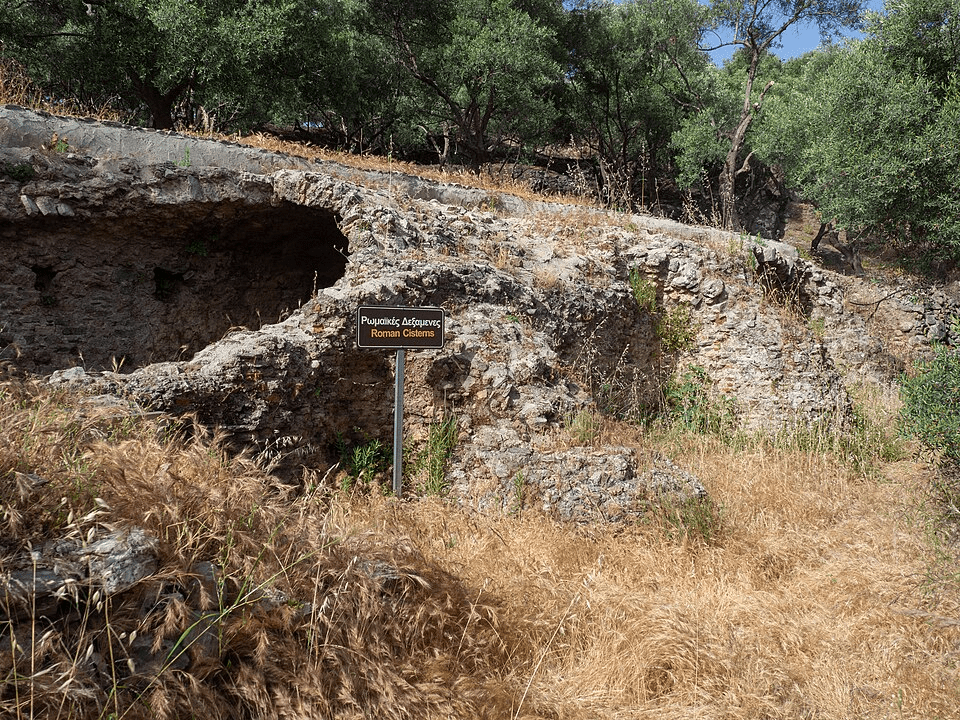
The relics visible on the Kefallas hill of Rodoviani [Rrodhobian] date back to the city’s Roman period, with the remains of extensive infrastructure projects such as the aqueduct. This aqueduct brought water to the city via a spring from the village of Livadia, which is a few kilometers above.
“In 1963, during the construction of the Church of Our Lady on the Hill, an early Christian basilica from the 5th century with partially preserved mosaics and a medieval temple in three tombs was located and excavated.
There is also a property of a building dating back to the late 3rd and 4th centuries BC, while parts of the city wall have also been preserved. Unfortunately, there are no indications so far of where the dwellings were! Only public buildings and a part of the cemetery where it is quite large have been found. More generally, all the buildings that have been found are of a public nature. ”
Antiquity in the area flourished from the 19th to the 20th century.
“The area was very rich and many important artifacts were found there, many of which were ‘swept’ away by looters,” says Ms. Tsigou.
“We have important finds, such as sculptures, vases, but they are limited because we are excavating a small complex in the territory. There is also a very large pool, which means that it served the needs of this world.”
The water supply system from the city of Livadia is impressive.”
What has been happening in the area in recent years?
“Because there are no expropriations there, systematic excavations cannot be carried out, according to “Greek law” to start excavations on these properties with owners, this is illegal. The current developments are made for this city as visible archaeological monuments and limited exploratory cuts on properties belonging to the Ministry of Culture.
These are properties purchased in 2002 by the former Municipality of East Selinos and the Cultural Association of the former community of Rodovan “Ancient Eliros”.
“This season is in progress, the purchase of three properties that are in the vicinity of the theater building with the hope that it will go forward and better highlight the area of the building, while actions are underway to further promote and protect the ancient city of ELYRION of Chania.
Source
ZgjohuShqiptar.al. Aleksander Hasanas.

