
“Dispatch from the Grand Vizier to Omer Pasha dated April 9, 1862.
We have taken note of the telegrams exchanged between Your Highness and Prince Nicholas concerning the encroachments of the Montenegrins. One of the reasons given by the latter in support of their aggressions is that, despite the publication of the amnesty granted to the populations of the villages of Kernitcha and Seltcha, located in the Shkodër district, who had declared themselves for the Montenegrins, troops were dispatched to these localities.
The other reason is that the export of grain was prohibited six months ago in these same localities due to famine, and that defensive measures were taken to stop the incursions of the Montenegrins. First, when an insurgent population asks for mercy, no one has heard to this day of any principle or law stating that once amnesty is granted for the previous offenses of this population, there is no longer any right to sending troops to the area:
If the authority, after promising pardon, were to attempt to punish those granted amnesty, it could be legally reprehensible, as it would have violated its commitments. But the Imperial Government has never been in the habit of resorting to such a disloyal means.
Furthermore, it is a known and established fact that the inhabitants of the village of Kernitcha had specifically delegated their representatives to the commander of the irregular troops garrisoned in Chistan (Shestan) to request that he send a post to their village to defend them against the Montagnards; that the troops, who only went to the area following this request and desire, committed no act contrary to the amnesty; and that the Montenegrins surprised the village in large numbers.
Since Montenegro has no guarantees or protection to offer towards these localities, is it not very surprising to see it claim that the establishment of a post undermines its honor? It is therefore evident that a claim of this nature cannot, according to reason and law, be justified. to be discussed or admitted.
Therefore, Your Highness’s responses to what has been said regarding defensive measures and the prohibition of grain exports have been found to be in accordance with truth and justice. Bringing the insurgents in certain districts of Herzegovina back into obedience and defending Shkodër—this, Your Highness is well aware, is the course of action that the Imperial Government has set for itself with regard to these countries.
Now, at the very moment when the populations have repeatedly leaned towards this obedience and when the matter was on the verge of being resolved, the Montenegrins prevented its realization through their instigations and threats, both covert and public.
It is they, in particular, who brought about the failure of the proclamation published by Your Highness at the beginning of his mission in Herzegovina—a proclamation containing concessions to all the demands previously expressed by the inhabitants, a proclamation whose content had been supported by the delegates of the friendly and allied powers of the Sublime Porte.
The Imperial Government tolerates Finally, for over five years, the daily encroachments and public or secret instigations of the Montenegrins have caused considerable expense for the country, and it turns a blind eye to the well-known acts they commit against soldiers and other individuals they encounter.
Nevertheless, everyone remembers how conciliatory the Sublime Porte, despite this state of affairs, was in its willingness to expand the mountain’s perimeter and define its boundaries in consultation with friendly powers. Faced with this situation, the Montenegrins are now openly resorting to the aforementioned unfounded motives to justify their aggressive actions, which they had previously carried out unofficially and denied when necessary, thereby giving them an official character.
On the one hand, they allow themselves to invade the villages in question and publicly and en masse provide aid to the local Montenegrins while on the other hand, they continue to overtly interfere in the affairs of the districts of Herzegovina.
In this circumstance, the Imperial Government can no longer remain silent and indifferent to the prolonged shedding of blood of so many Muslim and Christian human beings, it can no longer tolerate the pillaging of their property, the burning of their homes, and to leave its soldiers, weapons in hand, spectators to these atrocities.
We have had proof a thousand times that it has never crossed the demarcation line and that the aggression has always come from the Montenegrin side; among other things, their current presence in the localities situated within the borders supports this assertion.
Consequently, the Imperial Government believes it is its duty above all to demand from the administration of the Montenegro, the peremptory and official commitment with sufficient guarantees:
1. To no longer assist in any way the inhabitants of the Montenegrin district and to completely refrain from lending them the active support that it is currently preparing;
2. To withdraw immediately from the villages of Kernitza and Selkché, as well as from other places located outside the delimited areas;
3. To return safe and sound and without delay the irregular soldiers and their officers located in Kernitza and whom they have transferred to Cetinje;
4. To refrain from all material and moral assistance to the aforementioned districts of Herzegovina and to withdraw the Montenegrins who are there as soon as possible;
5. To henceforth refrain from any acts of aggression.
You will be kind enough to officially bring the foregoing to the Prince’s attention by communicating to him a copy of this dispatch. I also have the honor to inform you that if, within five days of the notification of this dispatch, you do not receive a reply containing the Prince’s full endorsement in this matter of imperial order.
Your Highness is fully authorized to take all measures you deem necessary solely to repel the aforementioned aggressions within the established limits and to restore order and security to the inhabitants, without any intention of altering the status quo of the Mountain with respect to its administrative and territorial possession.”
Source
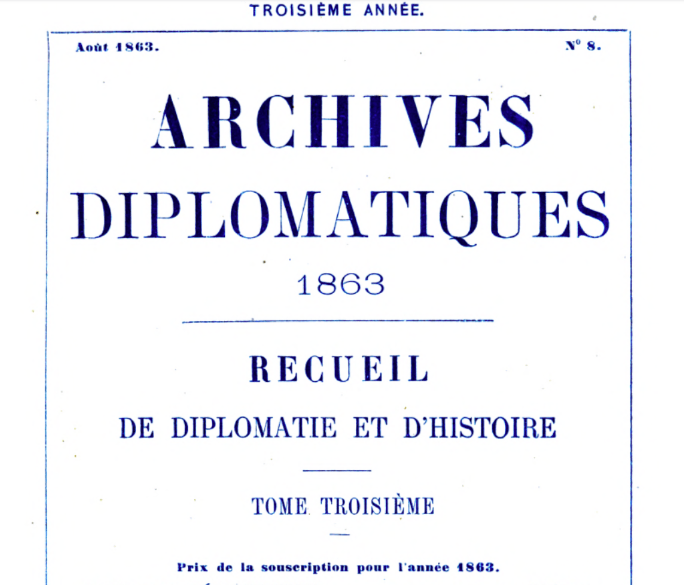
Archives diplomatiques recueil mensuel de diplomatie, d’histoire et de droit international. Volume 3. 1863.

