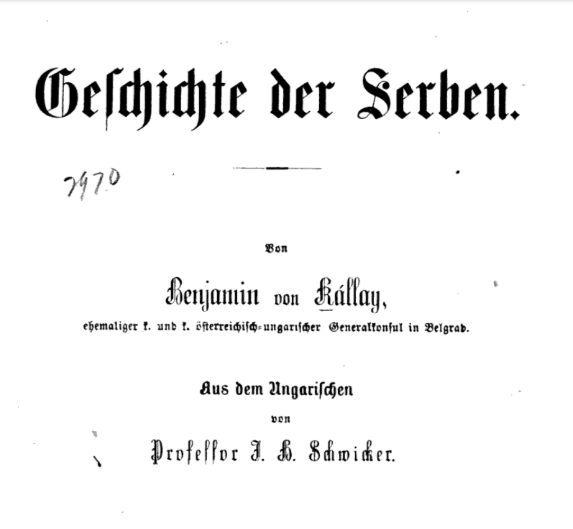

Cited:
“In accordance with the treaty concluded on March 7, Soliman Pasha and his entire garrison pledged to abandon the upper fortress and surrender it unconditionally to the Serbs. These lecterns, however, swore that they would escort the departing Turks unmolested through the entire country to the border.
On March 8th, Soliman Pasha left Belgrade with approximately 270 mostly unarmed Turks and accompanied by a Serbian escort. They had scarcely traveled a few thousand paces when a large detachment of insurgents, lying in ambush, attacked the defenseless Turks and, despite their heroic resistance, slaughtered them to the last man after the Serbian escort also turned against them.
No sooner had this carnage ended than the Serbs began to murder the Turks who had remained in the city. Forty of these unfortunate people fled into a house and defended themselves with such determination that the attackers could not capture them. They therefore set fire to the building, in which all forty Turks were reduced to ashes.
While the women and children were spared, indeed, most were brought across the border after the leaders had selected the prettier ones and taken them into their homes, there is no excuse that would even remotely justify the horrific atrocities committed in Belgrade, nor the broken promises. We have repeatedly seen in the course of our narrative that the Serbs could be merciful even to the enemy defeated and captured on the battlefield.
However, we were also forced to record several examples of broken promises and cruelty. But such an outrageous, completely unfounded massacre as that in Belgrade is nowhere to be found since the beginning of the uprising. With Ali Gushanz, the wildest, most cruel Krajinas and Janissaries had departed; Soliman’s entourage consisted of more peaceful, undefended Turks.
And the fact that the blind rage of the insurgents turned precisely against these can only be explained by the fact that the Serbs, drunk with their possession of Belgrade, the most important stronghold of the country, had been their entourage for years, to give free rein to suppressed feelings of bitterness and take revenge on those who had just fallen into their power.
The Rajah bears the least blame for Belgrade, so much so for the reprehensible, unleashed measure and aimlessness. The attack, even if they may have suffered, is worth considering because these events were not the passion of the embittered mob against Soliman Pasha, and the atrocities in Belgrade undoubtedly occurred, if not on direct orders, then certainly with the prior knowledge of the leaders and Kara Gyorgyes himself.
Indeed, if we are not mistaken, for some, the basest greed, the lust for the wealth of the slaughtered Turks, was the effective driving force behind this reprehensible act.
The Belgrade bloodbath will always remain an indelible stain on the history of this otherwise so justified, just revolution, which shone with so many self-sacrificing acts of heroism. Belgrade and Shabaz were thus in the hands of the insurgents, who consequently could now consider themselves the masters of the country.”
Source
Geschichte der Serben. Volume 1. Benjamin von Kállay, Johann Heinrich Schwicker. 1878. p. 594

