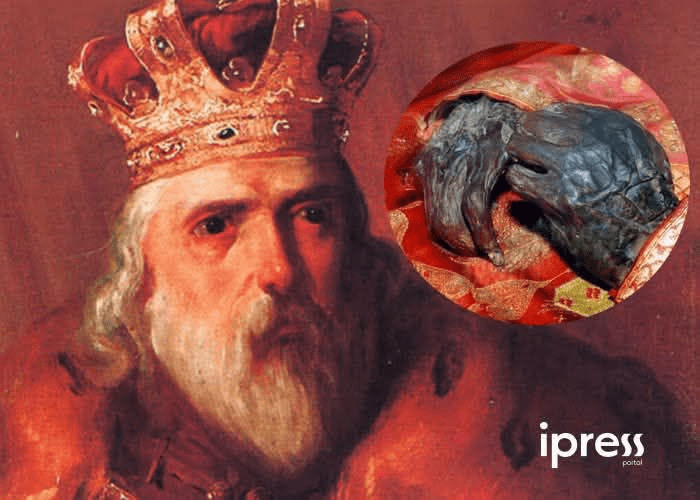

The preserved remains of Saint Prince Lazar Hrebeljanović — the medieval Serbian ruler who died at the Battle of Kosovo in 1389 — continue to be displayed in Serbian Orthodox monasteries and during special processions. What is presented as holy veneration is, upon closer examination, a macabre and disturbing practice: the public exhibition of a centuries-old, partially mummified corpse, complete with a severed head whose detailed physical decay has been clinically documented.
A Horror-Show Description
The 1952 inspection by theologian and art historian Dr. Leontije Pavlović paints a picture that reads more like a gothic horror novel than a religious account:
“The body was preserved from shoulder to foot with dried muscles… Lazar’s head was separated from the body and wrapped in a white cloth… The head is with all the muscles on the face. There is no hair on the head… The skull was forcibly pierced at the top… The eyes are very well preserved, the nose is flattened… Some parts of the skin under the lower jaw hang down in such a way that they leave an impression of gruesome horror…”
This is not ancient legend. This is a mid-20th-century eyewitness description of a real human cadaver — dried, dismembered, and dressed up with embroidered cloths and a pearl-bordered crown placed on the severed head. Anthropologist Prof. Srboljub Živanović confirmed in 1988 that the head remains with the body. The relics have been partially veiled for centuries precisely because full display was considered too shocking even by historical standards.
Why This Is Inappropriate on Multiple Levels
1. Violation of Human Dignity
Modern ethics — and basic human decency — hold that the dead deserve respect, not to be turned into long-term public exhibits. Preserving and parading a beheaded medieval corpse, complete with visible dried muscles, hanging skin, and empty skull cavities, treats a human being (royal or not) as a prop. Even if done with religious intent, it strips the deceased of postmortem dignity.
2. Psychological and Emotional Harm
The explicit descriptions of preserved eyes, flattened noses, pierced skulls, and “gruesome horror” are the stuff of nightmares. Exposing believers, pilgrims, and especially children to such imagery under the guise of spiritual blessing is psychologically questionable. What is framed as “miraculous preservation” is, in reality, a desiccated cadaver that evokes revulsion and fear far more than reverence for many contemporary people.
3. Promotion of Macabre Superstition
The persistent legend that Serbia’s fortune is tied to reuniting the prince’s head with his body (despite historical evidence showing the head has been with the body for centuries) blends religious faith with folk magic and national mysticism. Using a mutilated corpse to fuel national identity narratives feels closer to medieval relic cults at their worst than to enlightened spirituality.
4. Historical and Scientific Dishonesty
The relics are presented as miraculously preserved, yet the appearance is consistent with natural mummification or deliberate embalming techniques common in the region. The dramatic “separated head” myth was debunked by multiple inspections, yet romantic legends persist. This mix of showmanship and selective storytelling undermines both historical truth and genuine faith.
5. Cultural and Temporal Inappropriateness
In an era of medical ethics, human rights, and sensitivity toward the dead (see global repatriation debates and restrictions on displaying human remains in museums), parading a 14th-century corpse in the 21st century appears increasingly anachronistic and barbaric. Many other Christian traditions have moved away from or strictly limit the public display of relics for exactly these reasons. What was once common in medieval Europe now risks looking like a grotesque tourist attraction or political tool rather than pure devotion.
A Tradition That Has Outlived Its Time
Veneration of saints is one thing. Maintaining and periodically displaying a headless, dried corpse — with its face muscles, empty skull, and sagging skin — so that it can continue to evoke “gruesome horror” in observers is something else entirely. Prince Lazar may have been a heroic figure in Serbian history, but turning his mortal remains into a perennial horror exhibit does not honor him. It sensationalizes death in a way that feels exploitative, disturbing, and profoundly out of step with both modern values and basic respect for the dead.
The head is not missing. It has been right there — severed, mummified, and crowned — for centuries. Perhaps it is time to finally grant Prince Lazar the dignified rest that every human being deserves, rather than continuing this spooky, unsettling tradition.

