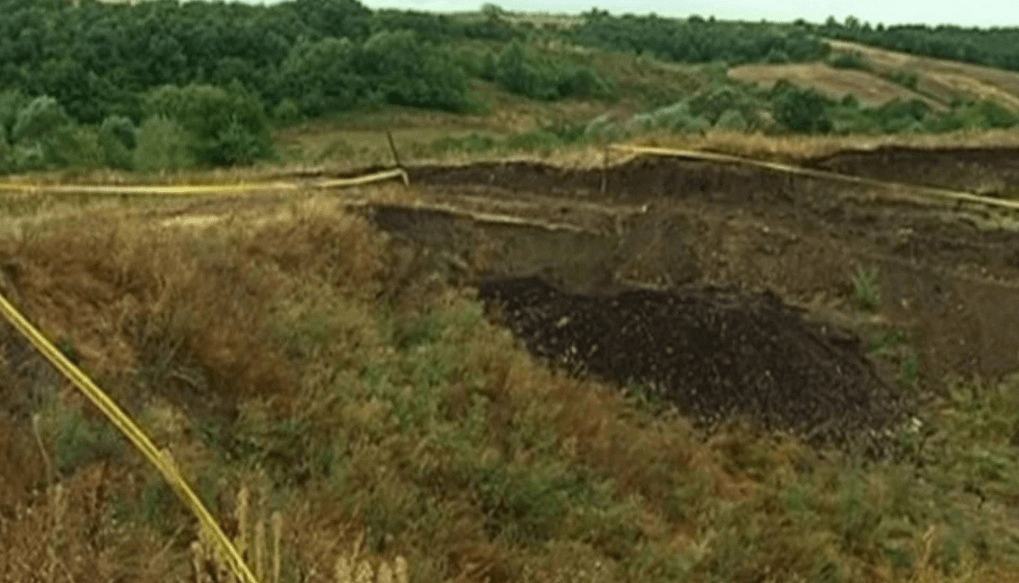

Image from rtsh.al.
The missing during the war in Kosovo (1998-1999) include a number of about 6,000 people, of whom 1,653 people have not yet been found. The Serbian aggression war in Kosovo also caused many other serious damages to the Albanian population: mass expulsions, destruction of settlements, numerous killings, imprisonment, rape, torture, etc.
Ways of disappearance
The methods of disappearance of Kosovo citizens during the war have been different. In most cases, people have been stopped and kidnapped by convoys fleeing their homes, or have been taken out of their homes and never found again. In cases where they have been taken from their homes, Serbian forces have not given any explanation, but in some cases they have stated that they have orders from their superiors to be taken for talks and after the talks they will be returned to their families.
A common characteristic for all methods of disappearance is that they have been planned in advance, organized and carried out systematically by Serbian police, military and paramilitary forces. The assertion that the disappearance of the killed was carried out systematically and organized by the highest political structures of Serbia is supported by the judgment of the Hague Tribunal.
This verdict found Vlastimir Djordjevic, former Deputy Minister of the Ministry of Internal Affairs and Head of the Department of Public Security, guilty of the burial and transportation of 889 bodies of Albanians from Kosovo and their reburial in mass graves in Serbia with his knowledge and order.
Age of missing persons
About 80% of the missing persons were males between the ages of 18 and 40, but a smaller percentage were between the ages of 41 and 60. There have been cases where people over the age of 60 have been abducted and forcibly disappeared.
Mass graves
The number of mass graves of murdered Albanians is large and cannot be ascertained. A large number of them have been found in Kosovo and Albania. In Kosovo, 137 mass graves have been discovered, where 5 to 158 bodies were found in one such grave (in Ljubenić, Jablanica, Ferizaj, etc.).
The mass grave in Izbica, where the bodies of 158 Albanians were found, should be mentioned. Albanian graves in Serbia were discovered in Petrovo Selo, Bajina Bashta, Peruac, Bajtanica, Raška, etc. During the work on the investigation of war crimes, the Hague Tribunal has identified 529 mass graves since March 2000, in which 4,300 bodies of the murdered have been discovered.
The method of researching the missing
This research is mainly of an empirical nature but also has a legal, sociological and psychological aspect. During the research, the method of collecting data from the databases of the Kosovo Government Commission for Missing Persons and from the data of the International Committee of the Red Cross was used.
Reporting by radio “Kosova Press”
In the book “War Archive” (of the state news agency) “Kosova Press” (first volume) covering the dates from January 4 – February 28, 1999, the first cases of disappearances of civilians in Peja are reported, highlighting cases where the Serbian militia had gone to the family of the murdered person and taken the body under the pretext of performing an autopsy in Pristina. During this period, kidnappings of Albanians were becoming a daily occurrence in Peja, reports Kosova Press.
In the book “War Archive” (of the state news agency “Kosova Press”) (second volume II) which includes data on the serious situation in Kosovo and the war that was taking place there and which contains data from March 1 – April 10, 1999, one finds a report by the KMDLNJ (Council for the Protection of Human Rights and Freedoms) on the violation of human rights and freedoms in Kosovo during February 1999.
This report, explaining the new openings of the war fronts in Kosovo, resulted in victims, material destruction, people displaced from their homes, arrested and many missing. This report states that in addition to all other mistreatment, murders, massacres, expulsions, etc., the KMDLNJ has registered 39 cases of disappearance or kidnapping for February alone, some of whom were found killed and massacred. In this same volume of “Kosova Press” it is reported that on April 2, 27 Albanian civilians were kidnapped in the village of Kotlinë in Kaçanik a week earlier.
The men were separated from their families and are thought to have been executed and buried in a common grave. In another later report dated April 8, from KLA sources, we see that a mass grave was discovered in the village of Kotlinë in Kaçanik, where it is thought that 27 Albanians who were thought to have disappeared at the time were buried.
It is also thought that the burial of these victims must have taken place in mid-March. However, from this information it is suspected that the grave is mined and it was not possible to investigate it without informing the relevant experts.
References
Salihu, Ismet; Nushi, Pajazit (2015). Missing Persons During the Kosovo War 1998\99 . Prishtina: Institute for War Crimes Research. p. 21.
The Road to Justice . http://www.icty.org/sid/10606. p. 19.
Salihu, Ismet; Nushi, Pajazit (2015). Missing Persons during the Kosovo War 1998\99 . Prishtina: Institute for War Crimes Research. p. 22.
ICRC Statistics-Kosovo Conflict . International Red Cross. 2014.

