
Abstract
Chemical risks are associated with historical preservation practices in Serbian Orthodox monastic environments and later conservation efforts, including exposure to resinous embalming substances, mineral preservatives, and environmental contaminants accumulated within crypts. Archaeological disturbance of royal tombs also introduces structural hazards and confined-space risks, particularly in older ecclesiastical sites associated with the Nemanjić dynasty and related burial traditions.
A further risk dimension arises indirectly from documented folk beliefs in parts of Serbian tradition that attributed protective or healing properties to the remains of canonized rulers or sainted kings. Such beliefs occasionally encouraged physical proximity, contact, or ritual interaction with burial sites or reliquaries, increasing crowd density and the likelihood of exposure-related risks in enclosed religious spaces. While these practices are not themselves biological hazards, they may amplify conditions conducive to transmission of common infectious agents in historical contexts.
These old Serbian corpses of kings and tsars are not typically “mummified” in the Egyptian sense but naturally preserved or incorrupt bodies/bones, often seen as “miraculous”. Many have been moved multiple times due to wars and invasions. Not all Serbian rulers have preserved relics; this focuses on the most prominent documented cases.
1. Prince Lazar Hrebeljanović (Knez Lazar, d. 1389)
Relics: Incorrupt body, venerated as a holy martyr after the Battle of Kosovo.
Current location: Ravanica Monastery (near Ćuprija, Serbia), which he founded. Previously moved to New Ravanica, Belgrade Cathedral, and back to Ravanica in 1989.
King Stefan Uroš III (Stefan Dečanski, d. 1331)
Relics: Incorrupt, known for miracles (e.g., healing eyes and other ailments).
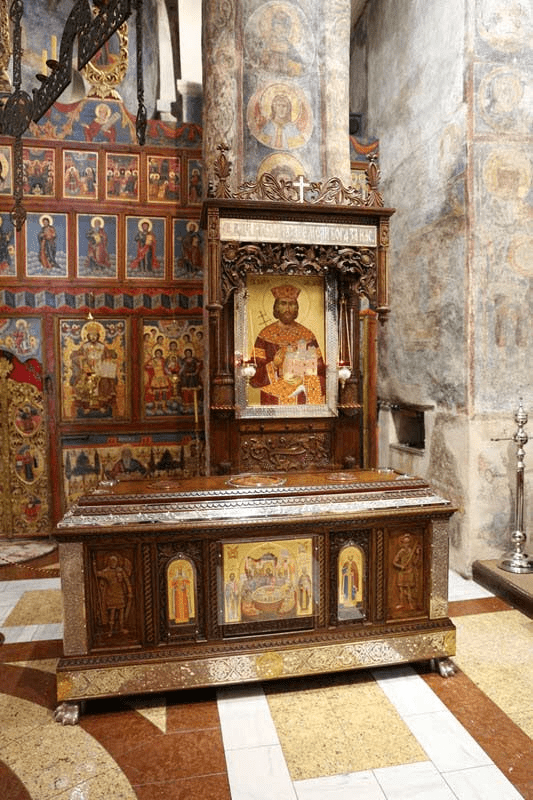
Current location: Visoki Dečani Monastery (Kosovo), in a marble coffin/reliquary in front of the iconostasis. The original 14th-century wooden reliquary is in the Museum of the Serbian Orthodox Church in Belgrade.
3. King Stefan Uroš II Milutin (d. 1321)
Relics: Incorrupt body, often dressed and processed.
Current location: St. Nedelya Cathedral (Sveti Kral) in Sofia, Bulgaria (brought there around 1460). Parts have occasionally been shared or venerated elsewhere.
Stefan Nemanja (St. Simeon the Myrrh-streaming, d. 1199)
Relics: Myrrh-flowing and incorrupt; founder of the Nemanjić dynasty and Studenica Monastery.
Location: Studenica Monastery, Serbia.
King Stefan the First-Crowned (Stefan Prvovenčani, d. 1228)
Relics: Preserved; he took monastic vows as Simon.
Location: Studenica Monastery, Serbia (along with other Nemanjić family members).
Saint Sava (Rastko Nemanjić, d. 1236)
Relics: Originally incorrupt; first Archbishop of the Serbian Orthodox Church.
Fate: Relics burned by Ottomans in Belgrade in 1594. A fragment (e.g., left hand) reportedly saved and kept at Mileševa Monastery. The Church of Saint Sava in Belgrade stands on the site of the burning.
Emperor Stefan Dušan (d. 1355)
Not canonized as a saint. Bones/relics found in his endowment (Monastery of the Holy Archangels near Prizren) and now in the Church of St. Mark in Belgrade.
Various other Nemanjić family members (e.g., Queen Ana/Anastasia, King Radoslav) have relics or burial sites at Studenica Monastery.
Health and Safety Risks of Preserving and Displaying Human Corpses
The handling, preservation, or public display of human remains carries biological, chemical, and environmental risks. While ancient remains are often relatively safe, hazards depend on preservation methods, age, and exposure conditions.
Biological risks (infectious disease exposure)
Residual pathogen survival
Under specific conditions:
Anthrax spores may persist in burial environments for centuries and become reactivated when disturbed.
Tuberculosis bacteria can survive in partially preserved tissue, posing risk during excavation.
Rare viral survival has been documented in extreme environments (e.g., permafrost), though this is uncommon.
Highest risk: recently deceased bodies
Fresh remains may transmit hepatitis B and C, HIV, bacterial infections. Transmission risk occurs through fluid exposure, sharp injuries, improper handling during embalming or autopsy.
Chemical risks from preservation
Embalming chemicals
Common agents include formaldehyde phenol, methano and glutaraldehyde.
Risks include respiratory irritation, skin and eye damage, carcinogenic exposure (notably formaldehyde).
Historical preservatives
Older techniques may involve mercury compounds, arsenic-based substances and resins and bitumen.
Risks include toxic dust exposure and long-term environmental contamination.
Environmental and occupational hazards
Burial site conditions
Enclosed tombs or crypts may present low oxygen levels, toxic gas buildup (ammonia, hydrogen sulfide) and structural collapse hazards
Fungal and microbial exposure
Disturbed remains can release Aspergillus spores and soil-borne pathogens such as Histoplasma (in certain climates).
Excavation hazards
Archaeological work may involve: unstable structures, confined space risks and contaminated dust exposure.
Risks in public display settings. Displayed embalmed bodies may emit formaldehyde vapors and other volatile organic compounds.
Long-term maintenance exposure
Museum or conservation staff may face repeated low-dose chemical exposure and contact with degraded preservation materials
Superstitions in Serbian tradition: “healing” royal corpses
In parts of medieval and post-medieval Serbian tradition, as well as broader Balkan folk belief systems influenced by Orthodox Christianity and pre-Christian customs, there were folk superstitions surrounding the remains of revered rulers and saints.
Belief in “incorrupt” or powerful relic bodies
Certain preserved bodies—especially those of rulers who were later canonized or heavily venerated—were believed by some communities to possess miraculous or healing properties. This belief was not unique to Serbia but appeared in localized forms within Orthodox Christian relic culture.
In some traditions, the bodies of holy rulers or saintly kings were thought to heal illness through proximity, protect communities from disease and act as intermediaries for divine intervention.
These ideas were often reinforced by the wider Christian relic tradition, where physical remains of saints were believed to carry spiritual power.
Royal sanctity and healing association
In medieval Serbian tradition, rulers who were canonized by the Orthodox Church (such as members of the Nemanjić dynasty) were sometimes associated with posthumous sanctity. In popular belief, this could extend to the idea that their bodily remains retained protective or healing influence.
Such beliefs typically involved touching or being near reliquaries, prayers directed at tomb sites and rituals performed at monastic burial locations.
Risk-relevant implications of the belief
From a risk perspective, these practices could lead to increased physical contact with preserved remains or reliquaries, congregation of people in enclosed burial or church spaces (higher disease transmission potential in crowded conditions historically) and disturbance or repeated opening of burial sites or containers
These factors increase public health exposure risks, even if the belief itself is spiritual rather than biological.
Final conclusion
The primary hazards associated with preserved human remains arise from chemical exposure, disturbance of sealed environments, and handling conditions. Historical beliefs—such as Serbian traditions attributing healing properties to royal remains—become relevant to risk analysis mainly insofar as they influence human behavior around those remains, increasing contact, exposure, or disturbance.
Sources
Infectious disease risks from corpses and burial contexts
Correia, J. C., J. L. Steyl, and H. C. De Villiers. 2014. “Assessing the Survival of Mycobacterium tuberculosis in Unembalmed and Embalmed Human Remains.” Clinical Anatomy 27 (3): 304–307. https://doi.org/10.1002/ca.22355. (PubMed)
JAMA. 2005. “The Fate of Pathogenic Bacteria in Buried Cadavers.” JAMA 294 (4): 502. https://doi.org/10.1001/jama.294.4.502-b. (jamanetwork.com)
McCollum, Andrea M., Yu Li, Kimberly Wilkins, Kevin L. Karem, and Whitni B. Davidson. 2014. “Poxvirus Viability and Signatures in Historical Relics.” Emerging Infectious Diseases 20 (2): 177–184. https://pmc.ncbi.nlm.nih.gov/articles/PMC3901489/. (PMC)
Embalming chemicals and occupational/chemical exposure risks
Rai, Rahul, et al. 2014. “Human Body Preservation – Old and New Techniques.” Anatomical Society / PMC 3931544. https://pmc.ncbi.nlm.nih.gov/articles/PMC3931544/. (PMC)
Meyers, Maureen S., David Breetzke, and Henry Holt. 2020. “Arsenic and Old Graves: A Method for Testing Arsenic Contamination in Historic Cemeteries.” Advances in Archaeological Practice. Cambridge University Press. https://doi.org/10.1017/aap.2020.44. (Cambridge University Press & Assessment)
Safety Science. 2023. “Physical Environmental Hazards Associated with the Swedish Death Care Industry.” Safety Science 165: 106195. https://doi.org/10.1016/j.ssci.2023.106195. (sciencedirect.com)
Anthrax and long-term burial contamination risks
NCBI Bookshelf. 2018. Control of Anthrax in Humans and Animals. Bethesda, MD: National Center for Biotechnology Information. https://www.ncbi.nlm.nih.gov/books/NBK310492/. (ncbi.nlm.nih.gov)
Embalming history and antimicrobial effects
Deviese, T., E. Ribechini, D. Castex, B. Stuart, M. Regert, and M. P. Colombini. 2017. “A Multi-Analytical Approach Using FTIR, GC/MS and Py-GC/MS Revealed Early Evidence of Embalming Practices in Roman Catacombs.” Microchemical Journal 133: 49–59. https://www.arch.ox.ac.uk/publication/686341/ora-hyrax. (arch.ox.ac.uk)
Smallpox / relic-associated infection uncertainty and historical risk discussion
McCollum, Andrea M., et al. 2014. “Poxvirus Viability and Signatures in Historical Relics.” Emerging Infectious Diseases 20 (2): 177–184. https://pmc.ncbi.nlm.nih.gov/articles/PMC3901489/. (PMC
Archaeological burial contamination and heavy metals (arsenic embalming)
Meyers, Maureen S., David Breetzke, and Henry Holt. 2020. “Arsenic and Old Graves.” Advances in Archaeological Practice. Cambridge University Press. https://doi.org/10.1017/aap.2020.44. (Cambridge University Press & Assessment)

