
Moscow has begun scripting a war with Europe before 2030. Serbia has signed nothing, declared nothing, committed to nothing. Read the hardware and the calendar instead.
By Drizan Shala | 1 July 2026
Begin with the sequence, because the sequence is the argument. Over eleven days in late June, Russia moved its position on Europe from intention to imminence, and it did so in three measured steps. On 19 June, Sergei Lavrov published “Ukraine, Europe and Global Security,” the doctrinal anchor: Europe, the foreign minister wrote, intends to be combat-ready against Russia by 2030 and is buying the intervening years with Ukrainian lives.
On 24 June, Russia’s permanent representative to the OSCE, Dmitry Polyansky, narrowed the frame from intent to proximity, placing Europe at a “dangerous threshold.” On 25 June, in the Permanent Council itself, he named the condition outright: a hybrid war, he said, unleashed by NATO and the EU. On 30 June he shortened the clock.
The conflict, he told Russian state media, could arrive well before 2030, because the threshold for provocations is being lowered, and a provocation can trigger war whether or not anyone intends it.
The date at the centre of this is not Russia’s invention. It is Europe’s own. Brussels set 2030 as the horizon for its defensive readiness programme. Moscow lifted the figure, reversed its polarity, and now recites it back as the deadline after which Europe has supposedly decided that war becomes unavoidable.
The mechanism is simple and it is worth naming plainly: a defensive target is repackaged as an offensive intention, and then the public is told the real danger is that the intention will detonate early.
The architecture of that narrative is familiar to anyone who has watched the Western Balkans theatre for a decade. The question this publication asks is narrower. Inside that architecture, where does Serbia sit? Not which way Belgrade leans in a given speech. Where it stands, structurally, when the platform doing the talking is the OSCE, and the man doing the talking is its master of ceremonies.
Consider Polyansky’s seat first, because it is the cleanest signal in the file. The same Permanent Council where Russia’s envoy calls the European Union’s conduct a hybrid war is the council where Belgrade expects its own Kosovo grievance to be heard. In the final week of June those two narratives fused.
After the thirty-seven detentions at Gazimestan on Vidovdan, Russian state broadcasting did not report a hate-speech enforcement action. It reported the “arrest of Serbs,” paired with a standing demand: why has the international community not reacted? The Gazimestan file was lifted out of its own context and slotted into the larger Russian story of an abandoned Serb collective, set beside the headline that Europe is being dragged toward war. Serbia did not place its grievance inside Moscow’s master narrative. Moscow placed it there. Belgrade has not asked for it back.
Then the hard marker, the one that does not depend on tone. According to SIPRI, only three states in Europe still receive Russian arms: Armenia, Belarus, and Serbia. Four years into the war, Serbia remains the single EU candidate that refuses to align with the Union’s foreign and security policy, which in practice means it will not sanction the state whose envoy is scripting Europe’s coming war. That refusal is not rhetoric. It is the one position that carries a price, and Belgrade keeps paying to hold it.
Now the instruments. Serbia’s integrated air-defence network, organised under the 250th Air Defence Missile Brigade, runs Chinese FK-3 and HQ-17 missiles and a Russian Pantsir battery, wired into French Thales radars. It is the only such system on the continent built outside the alliance, the first confirmed deployment of Chinese surface-to-air missiles in Europe beyond NATO’s frame, and Belgrade has signalled the Chinese HQ-9 long-range layer is next.
This is not a neutral arsenal. Neutral states do not assemble the continent’s only non-aligned air-defence architecture and route its supply line through Beijing.
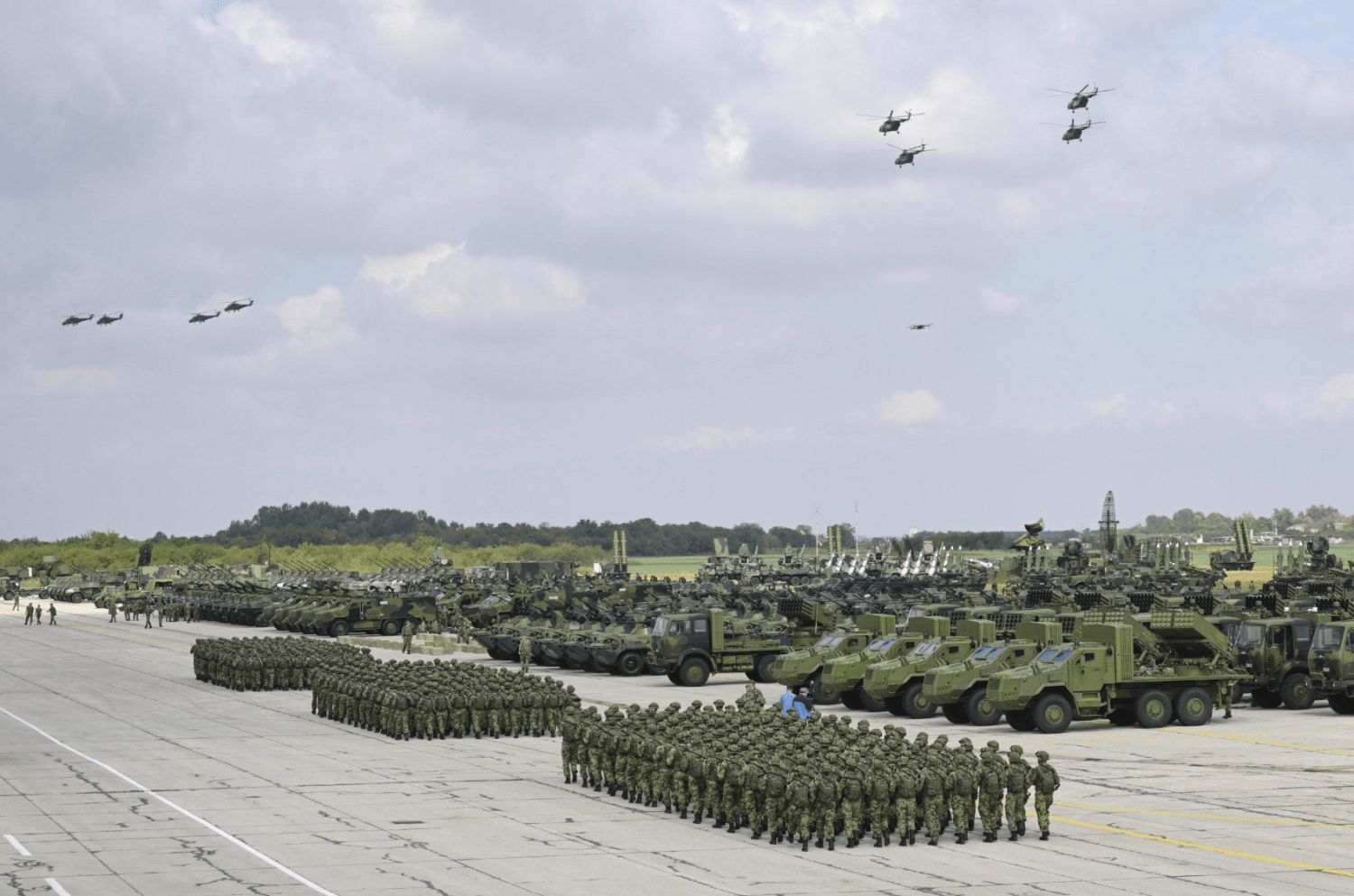
And the date. On 28 June, Vidovdan, the anniversary of the Kosovo defeat and the spine of the Serbian national myth, the Defence Ministry staged a live-fire demonstration of new and modernised systems: a static display at Batajnica, then more than a hundred and thirty systems and over a thousand personnel firing on the Pasuljanske Livade range, the Pantsir and the Pasars opening into the sky. Vučić stood in the reviewing party.
So did Milorad Dodik and Nenad Stevandić, the leadership of the Bosnian Serb entity. A demonstration of fresh weapons, fired on the date that encodes the Kosovo grievance, watched by the political class of the Serb world across the Drina. The choreography is not difficult to read. The signal is in the date.
The case against this reading exists, and it is not weak. Serbia has bought twelve French Rafale, the first Western fighters in its history, for 2.7 billion euros, with delivery from 2028. Its Russian supply channel has narrowed to the point that the chief of the General Staff, Milan Mojsilović, has called further Russian procurement practically impossible.
The EU candidacy persists on paper. A serious body of regional analysts reads the entire buildup as modernisation and domestic theatre rather than alignment. None of this is trivial, and an honest analysis carries it rather than hiding it.
But weigh it correctly. The Rafale is hardware, and hardware is fungible: the same airframe flies for Cairo, for Delhi, for Zagreb. What a procurement contract does not carry is allegiance. The signal of a side was never in the catalogue of systems; it was in the single act that costs something, which is foreign-policy alignment.
Serbia buys from the West and refuses to sanction the East. It keeps the dates, keeps the air-defence vendors, keeps the cross-border choreography, keeps the silence at the OSCE table. The hardware diversifies. The allegiance does not move.
For Pristina the consequence is structural rather than rhetorical. If the threshold Moscow describes is real, if Europe is drawn toward a confrontation with Russia before the decade closes, the southern hinge of that line runs through Belgrade. Kosovo does not stand beside that question. It stands underneath it.
So name the position precisely, because precision is the entire discipline. Serbia has not chosen Russia’s side in any sense a court would recognise. It has signed no axis, joined no bloc, declared no war. What it has done, for four years and counting, is decline every opportunity to choose the other one. It has built the instruments that read east, fired them on the date that reads east, and seated the Serb world beside the guns. A side a state will not name is still a side. Belgrade’s is legible in everything except its own mouth.
Source
https://www.kosovodispatch.com/en/prishtina/the-side-belgrade-will-not-name?

