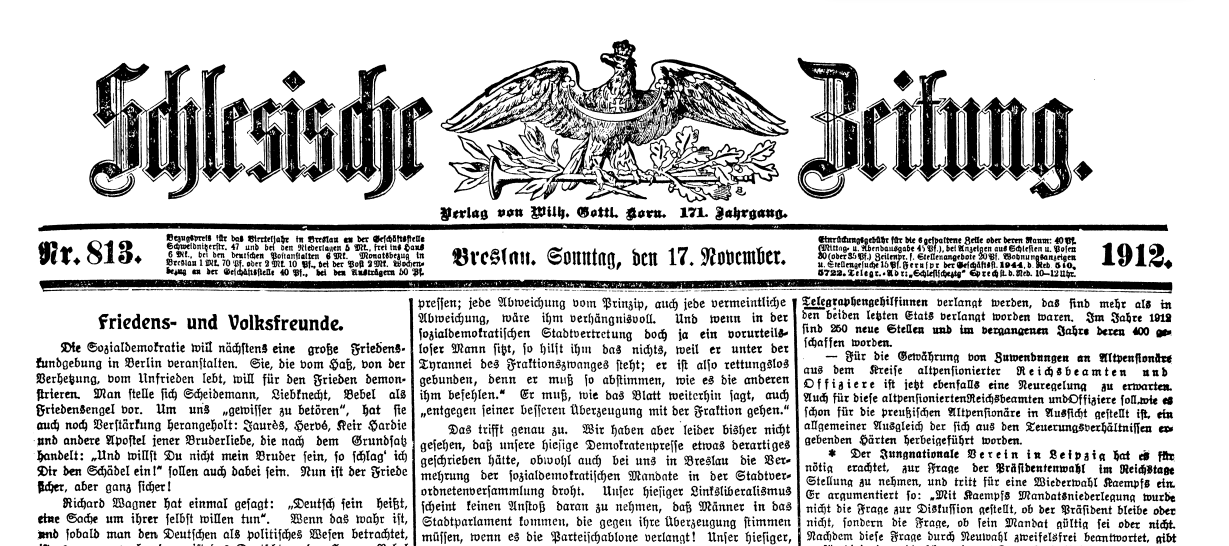

Cited from the article “Serben unt Albanesen” in the “Schlesische Zeitung. 1912 Jg. 171”:
“Serbs and Albanians. No. 8.
We are told: If one wants to understand the crux of the Albanian question correctly, one must not overlook the deep-rooted national hatred that exists between Serbs and Albanians, which has particularly good justification in the case of the latter. Part of the territory that Serbia gained through the Treaty of Berlin was inhabited by Albanians (Arnauts), whom the Serbian government expelled from the country by all means, insofar as they refused to be Serbized, which was only the case for the very least.
These expelled Arnauts were now taking revenge in Old Serbia, on Turkish territory, for the injustices they had suffered, and there they waged the fiercest struggle against the Serbian population in the manner customary in Macedonia. The system used there has now been surpassed by the Serbs in their invasion of Old Serbia and on their way to the Adriatic, as has been established by completely irrefutable witnesses.
Yes, the barbaric actions of the Serbs against the Albanian population—the burning of villages and the massacre of entire populations—are not denied by the Serbs, except perhaps in official circles.
One could therefore expect that if the Serbs were to actually obtain the Albania they desire, they would simply wage a war of annihilation and extermination against the Albanians, from which the latter, if Turkey were to disappear from Europe, could not escape even through emigration; in short, one would have to prepare oneself for atrocities that would make all those committed in Macedonia and even the Armenian massacres in Asia Minor seem like child’s play.
That the Serbs, once they are in recognized control, would exercise no restraint in this regard is also evident from the arrogant language used by leading Serbian statesmen against the Albanians. It should also be noted that the Serbs’ contemptuous judgment of the Albanians is in no way justified.
The Albanians are certainly exceptionally advanced in their culture; many still live in the same conditions as 2000 years ago. Anyone wishing to form an opinion about the Albanians’ capacity for education should look at their achievements, particularly as farmers, both in individual Albanian villages in Dalmatia and in the large Albanian colonies in Apulia, where they are among the most industrious and culturally advanced.
In any case, it is hardly justifiable to speak in the name of humanity, and to advocate for the division of Albania among the Balkan states, which would be a death sentence for one of the most capable and undoubtedly most down-to-earth peoples of the Balkans.”

Source
Schlesische Zeitung. 1912 Jg. 171. https://bibliotekacyfrowa.pl/Content/138413/GSL_P_31292_IV_1912_26512_813.pdf

