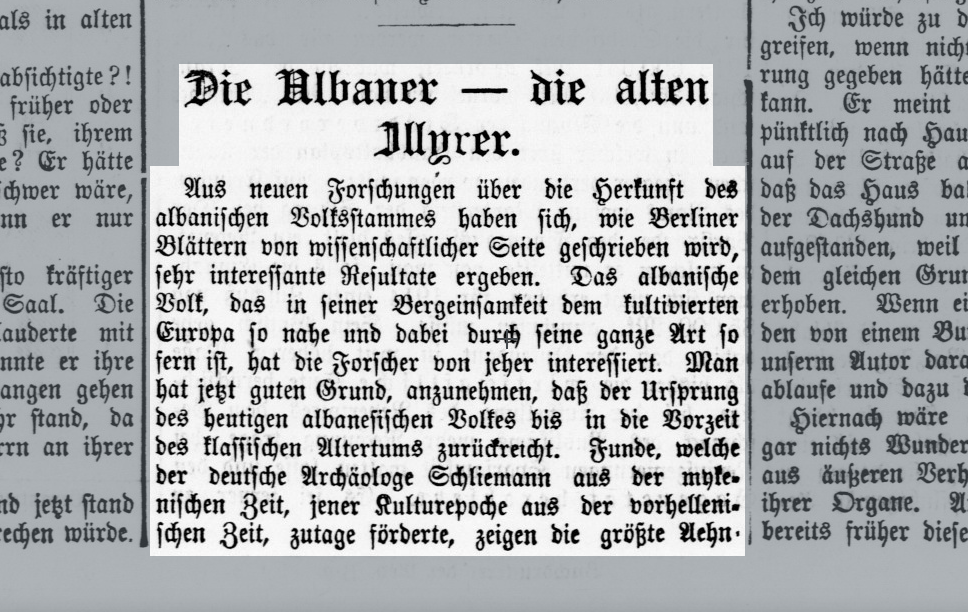

New research into the origins of the Albanian people has yielded very interesting results, as reported by Berlin newspapers. The Albanian people, so close to civilized Europe in their mountain isolation yet so distant in their very nature, have always fascinated researchers. There is now good reason to assume that the origins of the modern Albanian people reach back to the pre-classical era. Finds unearthed by the German archaeologist Schliemann from the Mycenaean period, that pre-Hellenic cultural epoch, demonstrate the greatest ancestry.
The Illyrian culture is evident in the structures that still exist in Albania today. Later, the Illyrians, a people originating from the Alps, arrived in the country. Historically, they represent the original inhabitants of the land. Numerous excavations have provided evidence of this. In particular, the discovery of a well-preserved prehistoric burial site confirms this assumption.
The Apostle Paul would thus have ministered in Albania; a passage from him relating to this period states: “I preached the message of Christ earnestly in and around Illyria.” The remains found in Albania from this time show a strong resemblance to the finds from the so-called Hallstatt period. Even in traditional dress, this Illyrian style, in the so-called bell-shaped skirt, has been preserved to this day.
The cut of the clothing is strikingly reminiscent of the Celts, whose traditions can still be seen in Scotland. Despite the momentous transformation that Albania has undergone over time, a large number of Illyrian words can still be found in the Albanian language. Especially the arms, known as the most infallible sign of a nation’s origin, predominantly reveal Illyrian ancestry.
Family trees exist that can be traced back to 1200. The many tribes into which the Albanians are divided are nothing more than family clans, among whom communal ownership of property prevails, and which therefore maintain close ties, but by no means form hostile factions. Even the blood feud, of which so much is rumored, is not some outdated, savage cruelty, but rather the Albanians, precisely because they lack an organized legal system, exercise their own jurisdiction.
This, however, is governed by strict, upright, and conscientious principles. The community as a whole oversees this and punishes any deviation with great severity. That the Albanians are not an unruly, savage people is evident in many ways, above all in their great loyalty.
The Albanian is loyal unto death. An Arnaut who has once entered the service of another man is not only his faithful servant, but his best protector against every kind of enemy.
Source
Feuilleton supplement of the Revalsche Zeitung: [ajalehe Revalsche Zeitung lisa], Number 18, 4 May 1913.

