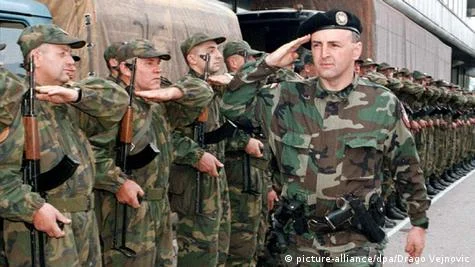

The violent breakup of Yugoslavia in the 1990s produced some of Europe’s worst atrocities since World War II. Serbian forces under Slobodan Milošević’s influence were responsible for the largest-scale and most systematic campaigns of ethnic cleansing, including the Srebrenica genocide. Understanding this requires examining political psychology rather than inherent ultra-national traits.
Collective Narcissism and Victimhood Narratives
Social psychologists describe collective narcissism as an exaggerated belief in a group’s greatness combined with hypersensitivity to perceived threats or slights (Golec de Zavala). In 1980s–90s Serbia, this manifested through revived “Kosovo Mythology” and narratives of Serbs as eternal victims of Ottoman, Croat Ustaše, and Bosniak “jihadist” threats. State media amplified this, framing aggression as defensive necessity. Victimhood nationalism justified expansionist “Greater Serbia” goals while dehumanizing neighbors.
Propaganda and Shared Delusions
Milošević’s regime, with support from intellectuals and media, created a parallel reality. Techniques included:
Dehumanization (“Ustaše,” “Turks,” “Islamic fundamentalists”).
Conspiracy theories about international anti-Serb plots.
Glorification of paramilitary “heroes” like Arkan.
This aligns with research on how propaganda fosters moral disengagement (Albert Bandura): ordinary people rationalize violence by displacing responsibility (“following orders”), minimizing harm (“they started it”), or using euphemisms (“ethnic cleansing” instead of mass murder).
Authoritarianism and Groupthink
Decades of strongman rule (Tito to Milošević) weakened independent institutions. Combined with economic crisis and war, this created conditions for groupthink (Irving Janis), where dissent was suppressed and risky, aggressive policies went unchallenged. Paramilitary units attracted criminal elements, blending organized crime with nationalist fervor.
The Role of Historical Folklore and Myths
Serbian epic poetry and Kosovo Cycle emphasize themes of “heroism”, “betrayal”, and so called “sacrifice”. In times of crisis, such myths can be weaponized to frame contemporary conflicts as existential continuations of ancient struggles. The difference in scale during the 1990s stemmed from Belgrade’s extremist and greater military capacity, coordination, and ideological drive at the time.
Long-Term Implications
Post-war Serbia shows mixed progress: cooperation with international tribunals alongside persistent denialism and heroization of convicted Serbian mass murderers and war criminals. Political psychology suggests that unresolved collective trauma and unaddressed responsibility hinder reconciliation and increase risks of future radicalization.
Serious scholarship (e.g., works by V.P. Gagnon on elite manipulation, or social identity theory applications to the Balkans) emphasizes situational and political factors over essentialist national character. Wars reveal the dark potential within any group under specific conditions: authoritarian leadership, propaganda, economic despair, and security dilemmas.
Understanding these mechanisms is crucial not for collective blame, but for preventing recurrence — in the Balkans or anywhere else. Truth, accountability, and education remain the best antidotes to cycles of violence.
Sources
Bandura, Albert. “Moral Disengagement in the Perpetration of Inhumanities.” Personality and Social Psychology Review 3, no. 3 (1999): 193–209.
Golec de Zavala, Agnieszka, Aleksandra Cichocka, Roy Eidelson, and Nida Bifsa. “Collective Narcissism and Its Social Consequences.” Journal of Personality and Social Psychology 97, no. 6 (2009): 1074–1096.
Janis, Irving L. Groupthink: Psychological Studies of Policy Decisions and Fiascoes. 2nd ed. Boston: Houghton Mifflin, 1982.
Gagnon, V. P., Jr. The Myth of Ethnic War: Serbia and Croatia in the 1990s. Ithaca, NY: Cornell University Press, 2004.
International Criminal Tribunal for the former Yugoslavia (ICTY). Official judgments and archives (various cases, 1990s–2010s). Accessed via icty.org or irmct.org.
United Nations. Report of the Secretary-General Pursuant to General Assembly Resolution 53/35: The Fall of Srebrenica. A/54/549. New York: United Nations, 1999.
Additional context drawn from political psychology literature on nationalism, propaganda, and moral disengagement in post-Yugoslav conflicts. For primary sources on specific events, consult ICTY records and survivor testimonies.

