
Massacres during the Turkish War of Independence
During the Turkish War of Independence , numerous massacres of Turkish , Greek , and Armenian civilians took place , both under the responsibility of the Anatolian Movement and the Allied Powers .
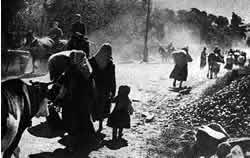
Armenian civilians are leaving Kars after it was captured by Turkish forces
According to Rudolph Rummel, between 1919 and 1922, 264,000 Greeks [ 1 ] and 60,000 to 250,000 Armenians [ 2 ] [ 3 ] were killed. The British historian and journalist Arnold J. Toynbee reported seeing Greek villages “burned to the end” when he toured the region. [ 4 ] There was considerable continuity among those responsible for the Armenian and Greek massacres throughout the war . [ 5 ]
Sivas governor Ebubekir Hazim Tepeyran said in 1919 that “the massacres were so horrific that he could not bear to report them.” Tepeyran also reported that 11,181 Greeks were killed under the command of Nurettin Pasha in 1921. According to Taner Akçam , Nurettin Pasha proposed killing all the remaining Greek and Armenian population in Anatolia, but this was rejected by Mustafa Kemal. [ 6 ]
During and after the Battle of Maras , Armenians who supported the French occupation and those who fought as members of the French Legion were killed. [ 7 ] News reports in American and British newspapers of the time stated that, according to French reports, around 5,000 Armenians were killed. [ 8 ]
On August 18, 1920, 5,000 Christians were killed by the Turks. [ 9 ] On February 25, 1922, 24 Greek villages in the Pontus region were burned. [ 10 ] According to the Belfast News Letter, in the first months of 1922, 10,000 Greeks were killed by advancing Turkish troops. [ 11 ] [ 12 ] In September 1922, the entire Greek population of Cunda Island , except for a few children , hundreds of people, were killed. [ 13 ]
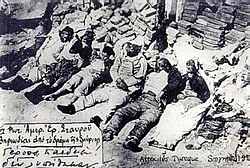
Greek victims of the 1922 Izmir Fire
On September 9, 1922, the Turkish army entered Izmir and liberated the city from Greek occupation. This was followed by widespread disorder. Attacks were carried out by local people and soldiers against Christians, Greeks, and a small number of Turks who had supported the Greek occupation . [ 14 ] [ 15 ]
Among the Greeks killed was Hrisostomos Kalafatis, a Turkish enemy who supported the Greek occupation. [ 17 ] The Izmir Fire of 1922 , which began on September 13, caused extensive damage to the city , particularly its Christian quarter. Between 2,000 and 100,000 Greeks and Armenians were killed as a result of the fire and massacres. [ 18 ] [ 19 ] [ 20 ] [ 21 ]
Although the fire generally affected the Christian population, according to the statements of the Izmir Fire Chief Paul Grescowich [ 22 ] , the statements of the US Vice Consul in Istanbul James Loder Park [ 23 ] and the information in the reports prepared by Admiral Bristol, it was stated that the fire was started by Greeks and Armenians. According to Armenian and Greek witnesses, however, it was started by Turks.
Greek massacres of Turks
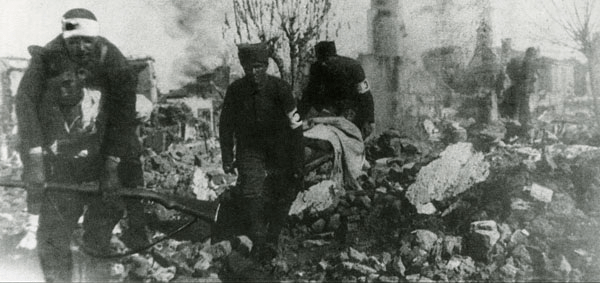
Medical personnel carry the wounded in a Turkish village burned by retreating Greek troops (August 1922).
According to Justin McCarthy, 640,000 Turkish civilians were killed by the Greek army during the Turkish War of Independence. [ 24 ] [ 25 ] After the occupation of Izmir on 14/15 May 1919, Greek troops massacred a portion of the city’s Turkish population. [ 26 ] According to Allied sources, between 300 and 400 Turks were killed on 15 May 1919. [ 27 ] [ 28 ]
As the Greek army advanced into Anatolia, the Turks living in the region faced massacres, rapes, and destruction. [ 26 ] Harold Armstrong, a British military official, reported that the Greek army, as it advanced from Izmir into Anatolia, massacred, burned, looted, and raped civilians. [ 29 ] [ 30 ] British historian Arnold J. Toynbee wrote that organized massacres were carried out after the occupation of Izmir by the Greeks on 15 May 1919.
Toynbee stated that he witnessed the atrocities committed by the Greeks in the regions of Izmit, Yalova, and Gemlik, and that houses were looted and burned in these areas. [31] According to Marjorie Housepian, 4,000 Muslims were executed in Izmir under Greek occupation. [32] In the Menemen Massacre, 200 Turkish civilians were killed. In one village, the Greek army demanded 500 gold liras to prevent damage to the village. The payment was made, but the village was still burned and destroyed. [33] As a result of the Pergamon Raid, 80,000 [34] – 100,000 [35] Turkish civilians were forced to flee the region.
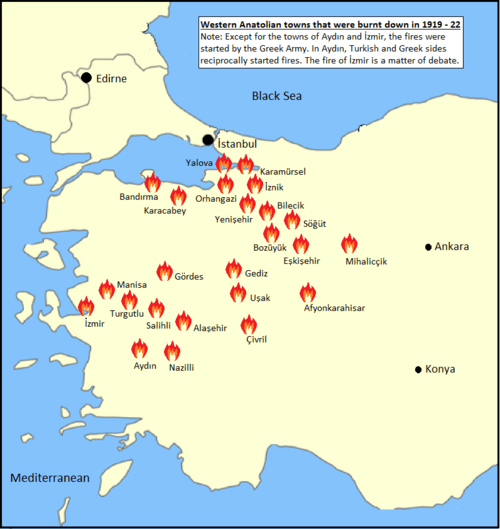
Towns burned during the war
According to many sources, the Greek army employed a scorched-earth tactic as it withdrew from Anatolia in the final part of the war. [ 36 ] According to Middle East historian Sydney Nettleton Fisher , “During the withdrawal, the Greek army employed a scorched-earth tactic and took out their rage on defenseless Turkish peasants in every way known.” [ 36 ] According to Norman M. Naimark , “The Greek withdrawal was more devastating for the local population than the occupation.” [ 37 ] James Loder Park, then assistant US Consul in Istanbul, toured the region shortly after the Greek withdrawal from Anatolia and reported on the situation in the places he visited, including the area surrounding Izmir, and events such as the 1922 Manisa fire . [ 38 ]
According to Kinross, “Most of the towns in the region were in ruins. A third of Uşak was gone. Alaşehir was nothing more than a dark, scorched void that marred the slopes. Village after village was reduced to ashes by Greek soldiers. Of the 18,000 buildings in the historic holy city of Manisa, only 500 remained standing.” [ 39 ]
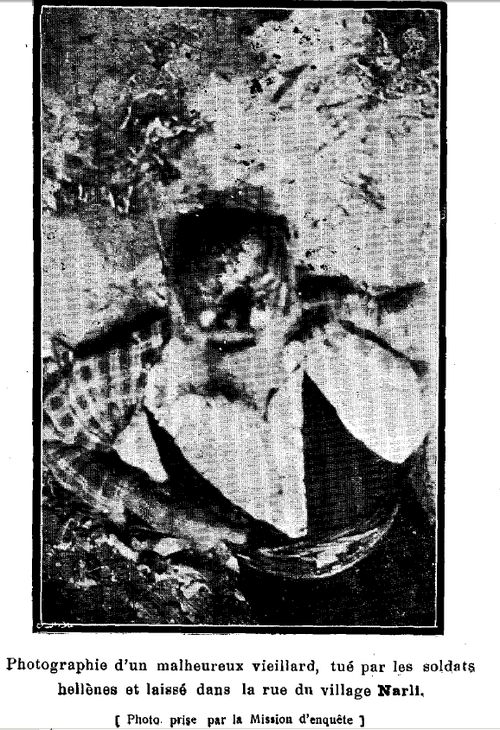
An elderly man killed in Narlı village during the Yalova Massacre .

Map of the towns burned during the Yalova Massacre.
In the Yalova Massacre , the largest massacre against Turks in terms of death toll , Armenians , Greeks and Circassians [ 40 ] were seen collaborating with the Greek army. Orhangazi , Yenişehir and Armutlu were burned during the massacre. Women were systematically raped in Armutlu . [ 41 ] Although an investigation conducted by the Istanbul Government with the survivors determined the total number of dead, missing and wounded to be 35, other Ottoman and Turkish documents put the death toll at 5,500-9,900. [ 42 ] [ 43 ] [ 44 ]
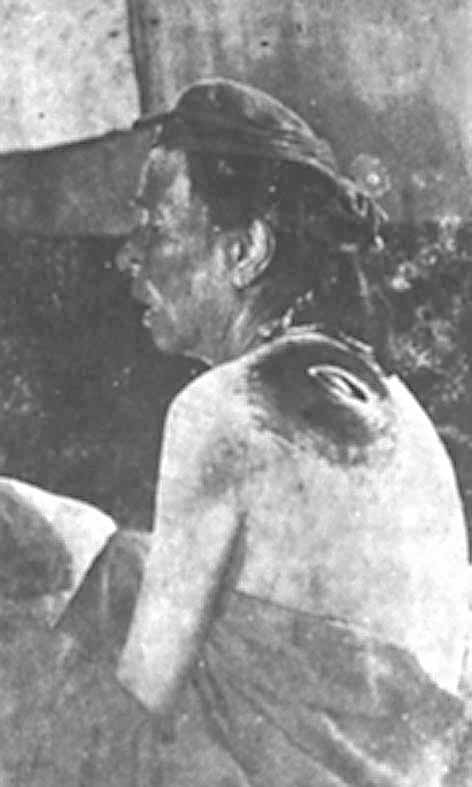
A wounded woman in Kapaklı.
“Durmuş” is a wounded boy with his hands cut off.
In one example of Greek atrocities during the retreat, on February 14, 1922, in the Turkish village of Karatepe in the Aydın Province , after the village was surrounded by Greeks, all the inhabitants were put into the mosque, which was then burned. The few who managed to escape the fire were shot. A total of 385 people were killed. [ 45 ] [ 46 ] The Italian consul, M. Miazzi, reported visiting a village where the Greeks had massacred 60 women and children. This report was later confirmed by the French consul, Captain Kocher. [ 47 ]
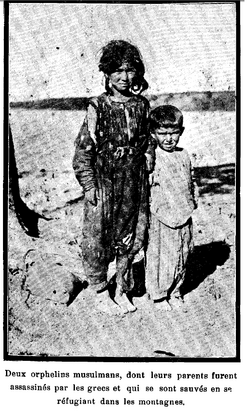
Two young Muslim orphans whose parents were killed.
In March–April 1921, the town of Bilecik was burned by the retreating Greek army. 208 people were killed. [ 48 ] The haste of the Greek army reduced the level of destruction. [ 49 ]
On June 24, 1921 , in Izmit , about 300 civilians, mostly men, were executed by the Greek army. [ 50 ] [ 51 ] However, the city was looted and part of it was set on fire. [ 52 ] [ 53 ]
On 5 September 1922, Salihli was set on fire by the Greek army. 65% of the buildings in the city were destroyed [ 38 ] and at least 76 people died in the fire. In addition, 100 girls were abducted to be raped. [ 54 ]
On September 4th, the town of Turgutlu was set on fire by the Greeks. The fire, which lasted until September 6th, destroyed 90% of the city and killed about 1,000 people. [ 38 ]
As a result of fires started by the Greek army, 200 people died in Uşak and 3000 in Alaşehir . [ 55 ] [ 56 ]
During the 1922 Manisa fire , 3,500 people died in the blaze, while 855 were shot and killed by Greek soldiers. Additionally, according to Turkish sources, 300 girls were abducted for rape.

A street after the 1922 Manisa fire .
Gülfem Kaatçılar İrem , as a little girl, witnessed the fire in Manisa and fled to the hills with her family; here are her memories:
“After escaping from the militia at dawn, we climbed to a dry streambed to hide in the hills. As we climbed, the city was burning, and we were illuminated by its light and warmed by its heat. The city burned for three days and three nights. I saw the windows of the houses shatter like bombs. They were foaming and sticking together like grape jam. Dead cows and horses were in the air, like balloons, with their feet. Old trees were uprooted. I haven’t forgotten these things. The heat, the hunger, the fear, the smell. Three days later, dust clouds appeared in the valley below. Turkish soldiers on horseback; we thought they were Greeks coming to kill us in the hills. I remember three soldiers carrying green and red flags. People were crying, kissing the hooves of their horses, saying, “Our saviors have come.” [ 57 ]
Johannes Kolmodin was a Swedish orientalist in Smyrna. He wrote in his letters that the Greek army burned 250 Turkish villages. [ 58 ] In addition, more than 30,000 buildings were burned by the Greek army, local Greeks and their Armenian supporters. [ 59 ] [ 60 ] [ 61 ] [ 62 ] [ 63 ]
In the final stages of the war, an Investigation Committee formed by experts conducted investigations in Aydın and its surroundings and submitted a report. This report is known as the ” Investigation Committee Report “.
Article 32: A large number of Turks, men, women, and children, who were trying to escape from the neighborhood engulfed in flames, were killed without reason by Greek soldiers who blocked all the roads connecting the neighborhood to the northern part of the city. [ 64 ]
Article 40: The occupation of the Aydın Province by Greek forces caused great material damage in terms of crops and property. [ 64 ]

The Ağzıkaraca village martyrs’ cemetery. The grave of the Çamurdan family, who were killed by Armenians.
In response to Turkish resistance against the French occupation of the region, battles took place in Antep , Maraş , and Urfa , resulting in large-scale civilian casualties and massacres. [ 65 ] In Maraş, 4,500 Turks were killed. [ 66 ] Attacks on civilians were widespread during the Kaç Kaç Incident . The Armenian Genocide convinced the armed Armenians who committed the massacres that their actions were justified. [ 67 ] In 1920, the Kozan Massacre was carried out by Armenians. Armenians also played a significant role in the Yalova Massacre and the 1922 Manisa fire . [ 68 ]
Sources
- Rumel, Rudolph. Turkish Democide. Power Kills. University of Hawai’i.
- Christopher Walker. Armenia: The Survival of a Nation. 1980.
- Taner Akçam. A Shameful Act: The Armenian Genocide and the Question of Turkish Responsibility. 2007.
- Arnold J. Toynbee. The Western Question in Greece and Turkey. 1922.
- Taner Akçam. A Shameful Act. p. 326.
- Taner Akçam. A Shameful Act. p. 323.
- Robert Fisk. “The Story of the Armenian Legion is Finally Being Told.” The Independent. 2018.
- “Eyewitness Tells How Armenians Were Massacred.” The New York Times. 6 March 1920.
- “5,000 Christians Massacred, Turkish Nationalist Conspiracy.” The Scotsman. 24 August 1920.
- “24 Greek Villages are Given to the Fire.” Atlanta Constitution. 30 March 1922.
- “Turk’s Insane Savagery: 10,000 Greeks Dead.” The Times. 5 May 1922.
- “More Turkish Atrocities.” Belfast News Letter. 16 May 1922.
- Bruce Clark. Twice a Stranger. Harvard University Press. 2006.
- Mevlüt Çelebi. “The Occupation of İzmir from the Pen of an Italian Journalist.” 2019.
- İlber Ortaylı. “The Occupation 90 Years Ago.” Milliyet. 2009.
- Foreign Documents US.
- Chr. Aggelomatis. Chronicle of Great Tragedy (The Epic of Asia Minor). 1963.
- Trudy Ring, Noelle Watson & Paul Schellinger. Southern Europe: International Dictionary of Historic Places. 2013.
- David Abulafia. The Great Sea: A Human History of the Mediterranean. 2011.
- John Freely. The Western Shores of Turkey. 2004.
- Irving Louis Horowitz & Rudolph J. Rummel. Death by Government. 1994.
- Greskowich (PDF).
- James Loder Park (PDF).
- Greek Atrocities During the War of Independence.
- The Kocaeli–Yalova–İznik Region During the War of Independence.
- Stanford J. Shaw & Ezel Kural Shaw. History of the Ottoman Empire and Modern Turkey. Vol. 2.
- Archivio Storico Diplomatico Ministero Degli Affari Esteri.
- Archived Copy (PDF).
- Steven Béla Várdy et al. Ethnic Cleansing in Twentieth-Century Europe. 2003.
- Stanford J. Shaw & Ezel Kural Shaw. History of the Ottoman Empire and Modern Turkey. Vol. 2.
- Arnold J. Toynbee. The Western Question in Greece and Turkey. p. 260.
- Marjorie Housepian. The Smyrna Affair. 1966.
- Justin McCarthy. Death and Extermination. 1995.
- Turgut Özakman. Vahidettin, M. Kemal and the National Struggle. 1997.
- Turgut Özakman. Vahidettin, M. Kemal and the National Struggle. p. 219.
- Fisher. 1969.
- Norman Naimark. Fires of Hatred / p. 46.
- US Vice-Consul James Loder Park to Secretary of State. Smyrna. 11 April 1923.
- Lord Kinross. Atatürk. 1960.
- Michael Llewellyn Smith. Ionian Vision. 1999.
- Ryan Gingeras. Sorrowful Shores. pp. 111–112. 2009.
- Ryan Gingeras. Sorrowful Shores. p. 28. 2009.
- William H. McNeill. Arnold J. Toynbee: A Life. 1989.
- Archived Copy.
- Mustafa Turan. Greek Atrocities: İzmir, Aydın, Manisa, Denizli (1919–1923). 2006.
- Arnold Toynbee. Letter. The Times. 6 April 1922.
- H.G. Howell. Report on the Nationalist Offensive in Anatolia. 15 September 1922.
- Benjamin C. Fortna et al. State-Nationalisms in the Ottoman Empire, Greece and Turkey. 2012.
- Archived Copy.
- Ryan Gingeras. Sorrowful Shores. p. 112.
- Arnold Joseph Toynbee. The Western Question in Greece and Turkey. 1970 edition.
- Benjamin Lieberman. Terrible Fate. 2013.
- Arnold Joseph Toynbee. The Western Question in Greece and Turkey. pp. 287–299.
- The Atlantic Monthly. Volume 132. 1923.
- Halide Edib Adıvar. The Turkish Ordeal. 1928.
- Andrew Mango. Atatürk.
- Leyla Neyzi. Remembering Smyrna/Izmir. 2008.
- Elizabeth Özdalga. The Last Dragoman. 2006.
- Elizabeth Özdalga. The Last Dragoman. p. 63.
- Béla Várdy. Ethnic Cleansing in Twentieth-Century Europe. 2003.
- Arnold Toynbee. Letter to The Times. 1922.
- James Loder Park. US Archives US767.68116/34.
- H.G. Howell. Report on the Nationalist Offensive in Anatolia. FO 371-7898.
- Hüseyin Işık. Turkish-Greek Relations. 1986.
- Gary D. Solis. The Law of Armed Conflict. 2010.
- Stanley Elphinstone Kerr. The Lions of Marash. 1973.
- Mark Levene. Devastation. 2013.
- Kamil. Occupation Sufferings in Manisa and Its Region. 1982.

