
The war crimes committed by Greece are crimes that Greece has committed throughout history in violation of the rules of war .
The massacre of civilians during the occupation of Anatolia
With the Greek invasion that began on May 15, 1919 , massacres , ethnic cleansing , and looting against Turks and Muslims began. These massacres continued until the last day of the occupation. Greece pursued a policy of burning and destruction , especially during the period when it withdrew from Anatolia . [ 1 ] By the end of the occupation , 640,000 civilians had been massacred by the Greek Army on the Western Front alone.

Hayriye, a 13-year-old girl, was raped and then injured by a hand grenade during the Greek occupation.
Yalova Massacre
In May 1921, Greek Army soldiers systematically massacred thousands of civilians and burned 27 villages. [ 2 ] According to Maurice Gehri , the head of the commission investigating the massacre , approximately 6,000 people were killed , while Ottoman sources say approximately 9,100. [ 4 ]
After conducting the necessary investigations, the committee headed by Maurice Gehri reached the following conclusion: [ 5 ]
“The destruction of villages appears to have followed a distinct and systematic method, group after group, over the last two months… There is a systematic plan to destroy Turkish villages and the Muslim population. This plan is being carried out by Greek and Armenian gangs under Greek instructions, and sometimes even with the help of regular (Greek) troops.”
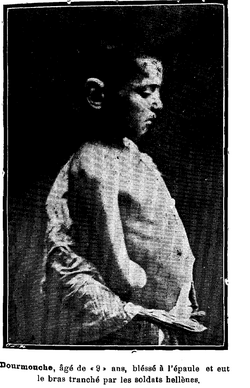
A child with a severed hand. ( Yalova Massacre )
Menemen Massacre
It was the ethnic cleansing and massacre of Turks by Greek Armed Forces soldiers in the village of Menemen in Izmir on June 17, 1919. [ 6 ] According to French officers, at least 200 Turks were killed and more than 200 Turks were wounded in the massacre. [ 7 ] In the words of Admiral John de Robeck, Izmir became a slaughterhouse. [ 8 ]
When the Greek Army occupied Izmir , Chrysostomos Kalafatis gave the following speech to the Greek soldiers: [ 9 ]
“My soldier sons, children of Helen, today you are performing the greatest miracle of Jesus by reconquering your ancestral lands. The more Turkish blood you shed and drink in this cause, the more merit you will gain. I too will appease my hatred and animosity towards them by drinking a cup of Turkish blood. Come on, all the saints will be behind you. The lands of your ancestors await you!”
Izmit Massacre
In the massacre that took place on 24 June 1921, the city was looted, burned and Turks were slaughtered. According to the estimate of the British journalist Arnold Joseph Toynbee , more than 300 Turkish civilians were killed that day. Arnold Joseph Toynbee wrote that on 29 June 1921, the British Parliament discussed the Greek withdrawal and possible atrocities. [ 10 ]
Toynbee said the following about the massacre: [ 11 ]
“On June 1921, my wife and I witnessed uniformed Greek troops committing arson without any reason on the southern shores of the Gulf of Izmit.”
Karatepe Massacre
This is the massacre that took place on February 19, 1922, in the village of Karatepe in Aydın . [ 12 ] When the people of the village took refuge in the mosques out of fear, Greek soldiers massacred almost the entire population, including pregnant women, babies, children, and the elderly . [ 13 ] According to some sources, 200 or more civilians lost their lives in the massacre. [ 14 ] [ 15 ] According to other sources, 385 [ 16 ] civilians lost their lives.
Alaşehir Massacre
In the Alaşehir fire, 2,400 people died from burns, and 600 were killed by Greek soldiers, either by gunfire or bayonet attacks. Alaşehir, which had a population of 38,000 before the Greek occupation, had only 5,000-6,000 inhabitants when it was liberated by the Turkish army on September 5, 1922.
Manisa Massacre
During the 1922 Manisa fire , 3,500 people died in the blaze, while 855 were shot and killed by Greek soldiers. Additionally, according to Turkish sources, 300 girls were abducted for rape.
Genocide of the Cham Albanians
Cham Muslims and Orthodox Christians have been subjected to ethnic cleansing , genocide , and assimilation by the Greek state at different times. Since the annexation of the region to Greece in 1913 , persecution and discrimination against Cham Albanians became a daily occurrence.
The Greek government accused Cham Muslims of collaborating with the Germans during World War II, resulting in a large wave of emigration. Greek administrations generally denied the events of this period and did not recognize the ethnic identity of Cham Albanians. The policy of Greek governments was to divide and assimilate the Chams along religious lines. During this process, many Cham Albanians lost their lives, were forcibly displaced, or persecuted. [ 17 ]
Today, descendants of Cham Albanians still live as refugees in various countries, and the allegations of genocide are denied by the Greek government. [ 18 ]
Sources
- Fisher 1969, p. 386.
- Sevtap Demirci, Türkiye in the British Annual Reports (1921), p. 10.
- Gingeras, Ryan (26 February 2009). Sorrowful Shores: Violence, Ethnicity, and the End of the Ottoman Empire 1912–1923 (in English). OUP Oxford. ISBN 978-0-19-160979-4 . Archived from the original on 10 November 2022. Retrieved 10 November 2022 .
- “Greek Atrocities in the Balkans and Anatolia According to Archival Documents 2” . December 2, 2013. Archived from the original on December 2, 2013. Retrieved November 10, 2022 .
- “The Western Question in Greece and Turkey: A Study in the Contact of Civilizations” (PDF) . “The members of the Commission consider that, in the part of the kazas of Yalova and Guemlek occupied by the Greek army, there is a systematic plan of destruction of Turkish villages and extinction of the Moslem population. This plan is being carried out by Greek and Armenian bands, which appear to operate under Greek instructions and sometimes even with the assistance of detachments of regular troops” . Toynbee, Arnold J. 18 March 2014. Archived from the original (PDF) on 31 December 2010 . Access date: 10 November 2022 .
- Erhan, Çağrı (1999). Greek Occupation of Izmir and Adjoining Territories: Report of the Inter-Allied Commission of Inquiry (May-September 1919) (in English). SAM. Archived from the original on 10 November 2022. Retrieved 10 November 2022 .
- Yalazan, Talat (1994). Greek Atrocities and Attempted Genocide in Turkey: 15 May 1919-9 September 1922) . General Staff Military History and Strategic Studies Directorate. ISBN 978-975-409-007-9 . Archived from the original on 10 November 2022. Retrieved 10 November 2022 .
- Erol Ulubelen, Türkiye in British Secret Documents, p. 193.
- Selahattin Tansel, From Mondros to Mudanya, p. 196.
- “GREECE AND TURKEY. (Hansard, 29 June 1921)” . hansard.millbanksystems.com . Archived from the original on 13 July 2009. Retrieved 10 November 2022 .
- Müderrisoğlu, Alptekin (2007). Sakarya: The Days When Greece Approached Ankara . DenizBank. ISBN 978-9944-295-01-7 . Archived from the original on 10 November 2022. Retrieved 10 November 2022 .
- Ford, Henry (July 1, 2003). Dearborn Independent Magazine January 1927–May 1927 (in English). Kessinger Publishing. ISBN 978-0-7661-5993-8 . Archived from the original on November 14, 2022. Retrieved November 14, 2022 .
- “…our people – pregnant women, defenseless children, innocent babies, our elderly – were shot, burned alive, bayoneted on roadsides, in forests, and at the foot of trees. The torture and massacre continued until morning.” ( Evaluation of the Potential of Grief Tourism Among High School Students Based on the Atça Example – Archived November 14, 2022 at the Wayback Machine )
- “…Although it cannot be definitively determined that they were martyred, according to official documents and witness accounts, the number of those who lost their lives is estimated to be over 200.” ( Dictionary of Torture, Exile, Massacres and Genocides Suffered by Turks, Archived 12 February 2021 at the Wayback Machine )
- “Karatepe Martyrs’ Cemetery” . http://www.kosk.gov.tr. Archived from the original on June 25, 2016. Retrieved November 14, 2022 .
- Turan, Mustafa (2006). Greek Atrocities: İzmir, Aydın, Manisa, Denizli, 1919-1923 . Atatürk Culture, Language and History High Institution, Atatürk Research Center. ISBN 978-975-16-1850-4 . Archived from the original on 14 November 2022. Retrieved 14 November 2022 .
- Of course if the Greek administration stops denying and hindering the democratic process in continuance of hiding the Genocide and ethnic cleansing to all “others”, in Greece. “The Cham Issue: Past, Present and Solutions in the Light of European Integration of South East Europe” . Her name is Hima . SSRN. June 2024. Archived from the original on 27 June 2024 . Access date: 24 June 2024 .
- The Muslim Chams of Northwestern Greece . Lambros Baltsiotis (in English). Open Edition Journals. Archived from the original on 30 September 2023. Retrieved 24 June 2024

