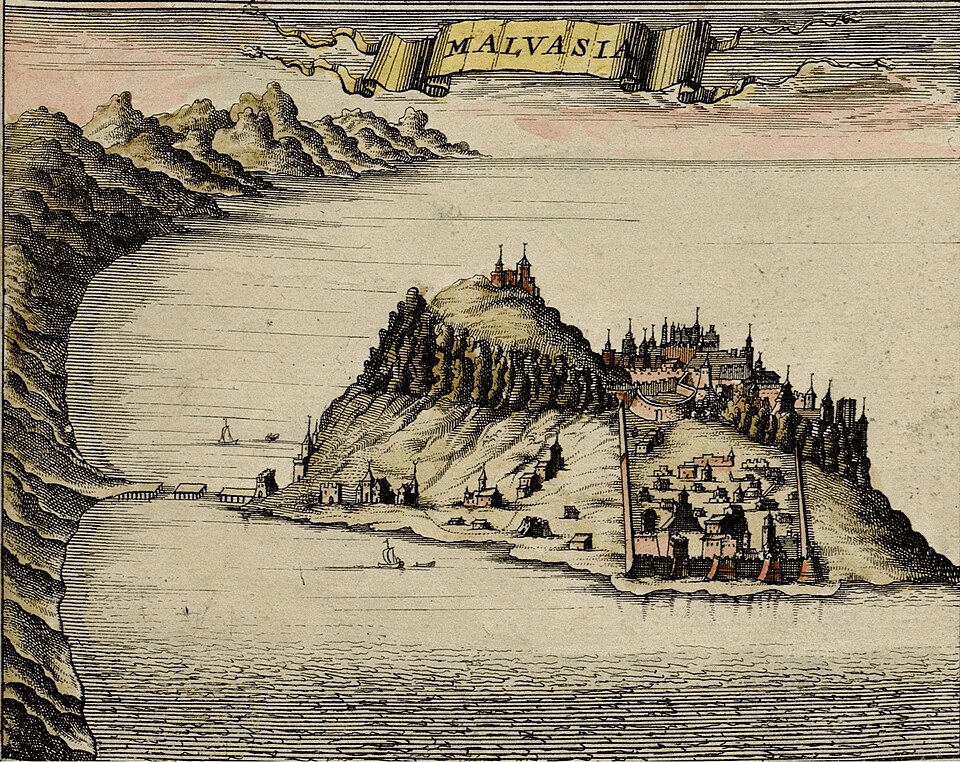

The Monemvasia Massacre was one of the massacres that took place in the city of Monemvasia (Benefşe) on the Peloponnese peninsula in Greece during the Greek War of Independence.
In August 1821, the Turks, weakened by famine after a long siege, were forced to eat seaweed and cotton seeds, and contracted a terrible disease. In desperation, they even went out to collect dead bodies in an attempt to find food. The Turks wanted to surrender because the Greeks had recently killed 60 men and women who had been captured at sea outside the city walls, in front of the Turks who were watching them from behind the walls. [ 1 ]
Although they did not trust Prince Demetrius’s promises of survival, the desperate Turks accepted the last hope offered to them, opened the gates of their fortress, and laid down their arms. A large number agreed to go into exile, and preparations began to board the ships. When the Maniots suddenly entered the town and killed everyone who had not yet managed to reach the shore, 500 people had already boarded the briquettes.
After a few hours’ journey, those on the ships were not taken to the coast of Asia Minor (Anatolia) , but to a deserted island in the Aegean Sea . After being stripped of their clothes, insulted, and beaten, they were left to die of hunger and nakedness. A few of them were rescued through the efforts of the French merchant M. Bonfort, who , upon hearing of the incident, hired an Austrian ship and took the survivors aboard . [ 1 ]
Admiral Haglan, who commanded the French fleet in the Levant , stated in a report he sent to his government in 1821:
“In the fortress of Malvoise (Monemvasia), on the contrary, these (Turks) treated them (Greeks) like brothers during the famine and always respected their churches, but the Mainotians and the Greeks of Morea did not reciprocate in the same way when they took the city .” [ 2 ]
After the incident
The surrender of Monemvasia was the only instance in the first year of the revolution where the majority of the Turkish population managed to escape annihilation. When the news reached Western Europe , it was proclaimed a victory for Liberalism and Christianity . In fact, it was the only instance where the ideas of Europeanized Greeks had prevailed over those of the local Greeks. More typical was the surrender of Navarino , which occurred a few days later . [ 1 ]
Sources
- Clair, William St (2008). That Greece Might Still be Free: The Philhellenes in the War of Independence . Open Book Publishers. p. 41. ISBN 978-1-906924-00-3 . Archived from the original on 28 June 2022. Retrieved 28 June 2022 .
- Phillips, W. Alison (Walter Alison) (1897). The war of Greek independence, 1821 to 1833 . New York Public Library. New York : C. Scribner’s Sons.

