

This article discusses documented and reported cases of Serbian Yugoslav tortures carried out against Albanians.
Torture, imprisonment and expulsion from homes – Witnesses tell the experiences of civilians in 1999 in Ozdrim
Pristina – In Wednesday’s session at the Basic Court in Pristina, in the trial against Milorad Djokovic, witnesses Arben Gashi and Florent Zeqaj testified about the arrests, torture to which civilians were subjected, and expulsions from their homes in the village of Ozdrim, on May 7, 1999.
In this case, Milorad Djokovic is accused of committing war crimes in the village of Ozdrim and the surrounding villages of the Peja region in 1998-1999, as a member of the Serbian police and military forces, reports ” Oath for Justice “.
According to Gashi, on May 7, 1999, Serbian forces surrounded the village, forcibly separated the men from the women and children, and then began sending them to various locations.
Witness Gashi said that he and 20 to 30 other people, including women and children, were staying in the house of a villager on the critical day, when suddenly Serbian troops came, broke down the doors and threw them out into the street.
“We men were taken to a nearby store and held there until the afternoon. Then, we initially left for Mitrovica, to then return and be transferred to the ambulance yard, where we were locked in a small garage with no way to leave,” said Gashi.
Gashi then says that the gathered civilians were taken to Peja, initially to a house and then to Peja prison, where, according to him, they experienced various tortures.
“In conditions without food, constant beatings and torture,” the witness said, adding that he remembered how one person, Sh.D., had lost consciousness from the torture.
During June 1999, Gashi said that the prisoners were transported by bus to Serbia, and during the transport to Leskovac, they were tortured. After a period in prison, their release was facilitated by the Red Cross. The witness said that he continued to suffer the consequences of the torture after returning to Kosovo.
Arben Gashi confirmed that he saw the accused Djokovic in the yard of the local ambulance, in uniform with a long gun (Kalashnikov), moving near a group of civilians with his colleague.
On the other hand, witness Florent Zeqaj said that May 7, 1999 is a date he still cannot forget.
“That day, in my native village, a crime against the civilian population occurred. An 18-year-old girl was killed in her home, other residents were also killed and tortured. All actions were carried out by the state of Serbia, through its regime, army and police,” Zeqaj said.
He stressed that he witnessed the extermination, violence, burning of houses and looting of their home. He said that he was present when Serbian forces were hitting his father.
According to his testimony, the Zeqaj family was the first to leave the village of Ozdrim. With nothing with them, they set off in an unknown direction.
“I just want to discover the truth and know where the remains of the victims are… If Milorad Djokovic is not a direct participant, his contribution is indirect,” Zeqaj concluded.
The lawyer for the accused Djokovic, Vasilije Arsic, during questions about this witness, said that he does not dispute the existence of the events, but added that this witness, in a previous statement given to the Police, did not mention Djokovic as a direct participant in the actions.
But witness Zeqaj added that he had heard from other people, including his father and current witnesses in the trial, that Milorad Djokovic was present in the ambulance yard at one of the critical events, but he himself had not seen him.
He also said that he had heard about “Mici” from many villagers who spoke about his actions and linked him to the crimes.
According to the indictment drawn up on June 23, 2023, Milorad Djokovic is accused of having applied, in the years 1998-1999, in the village of Ozdrim – Municipality of Peja and in the villages surrounding the Peja region, as a member of the Serbian police and military forces, measures of murder, raiding, beating, mistreatment, arrest, torture, cruel and inhuman treatment, keeping in conditions of slavery, expulsion and deportation of dozens of Albanian civilians. He is also accused of looting, burning and destroying the homes of the civilian population of Albanian nationality.
The indictment states that from the northern side of the village of Ozdrim, along the regional road Peja – Mitrovica, the regular army had entered, and finally from the western side of the village of Ozdrim, which borders the village of Vitormiricë, paramilitary groups mixed with members of special military units had entered, and began shooting at the civilian population, killing six civilians of Albanian nationality: IK Sh.K, EM, R.Sh, Z.Sh and MH, while three civilians who were injured by these shots: AG, HG and MG, were initially transported to the Peja hospital and then executed and buried in the village of Lutogllavë, as well as five civilians of Albanian nationality: RK, ZK, AK, AK, A.Sh were killed during the offensive, but their bodies were never found, which is why they still appear as missing.
With this, Djokovic is charged with co-perpetration of the criminal offense “Crime of war against the civilian population”, sanctioned by Article 142 in conjunction with Article 22 of the Criminal Code of the former Socialist Federal Republic of Yugoslavia (hereinafter “the SFRY Criminal Code”) as the law in force at the time of the commission of the criminal offense.
Documented cases of Albanian torture victims
1. Hysen Kryeziu – Esencë (Report TV)
Hysen Kryeziu, a former activist for Albanian rights in Kosovo, described multiple arrests by Yugoslav/Serbian authorities. He said he was beaten during interrogations, imprisoned after political activism following the 1981 demonstrations, and subjected to repeated physical abuse. He also discussed the parallel Albanian education system and his later work as a teacher.
2. Testimonies about Serbian prison abuse
Several recent reports discuss witness testimony in criminal proceedings concerning alleged abuse of Albanian prisoners by Serbian prison personnel. Witnesses describe physical beatings, psychological abuse, and mistreatment while in detention. These reports focus on court testimony rather than making new factual findings themselves.
3. Albin Kurti’s account
Kosovo Prime Minister Albin Kurti has publicly recounted his imprisonment in Serbia during the Kosovo conflict. He stated that he lost around 30 kilograms, repeatedly lost consciousness during beatings, and believed he might not survive imprisonment. These statements are presented as his personal testimony.
4. Kadri Kryeziu
Former political prisoner Kadri Kryeziu described arrests connected to political activism, interrogations, beatings, and alleged torture in prisons including Leskovac and Prizren. He also described humiliation techniques allegedly used during detention.
5. Zyrafete Kryeziu-Manaj
Former political prisoner Zyrafete Kryeziu-Manaj described prolonged interrogations, physical violence, psychological pressure, and abuse while detained. She also alleged the involvement of both Serbian and Albanian members of the Yugoslav security apparatus during interrogations.
6. Ekrem Kryeziu
Film director Ekrem Kryeziu described imprisonment during the 1980s because of his political activities. He said he experienced severe torture, prolonged isolation, and harsh interrogation conditions while imprisoned alongside other Albanian political prisoners.
7. Xhevahire Izmaku
Former Kosovo MP Xhevahire Izmaku recounted documenting the aftermath of Serbian attacks in Kosovo, including photographing victims and describing restrictions on Albanian education and repeated police repression before the war.
The Albanian War Surgeon Speaks About Evidence Collected On Cimes and Torture by Serbian Forces In Kosovo
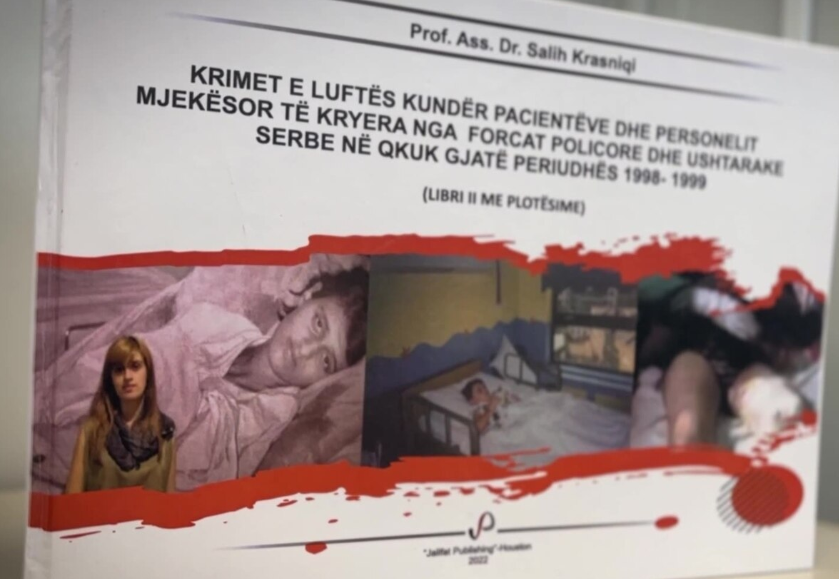
Dr. Salih Krasniqi is the surgeon who, during the war in Kosovo, spent five days trying to treat the wounded at the University Clinic of Pristina and on weekends operated on the wounded in war zones, becoming witnesses to what he calls war crimes against Albanian patients. During the interview with colleague Artan Haraqija – Dr. Krasniqi also says that the evidence he found confirms how Albanian patients injured during the war were falsely presented as victims of NATO airstrikes, although during their visits he found wounds from gunfire by Serbian forces.
The war surgeon, as Dr. Salih Krasniqi is known in Kosovo, says he has collected evidence for over 1,200 Albanian patients at the Pristina University Clinic against whom, according to him, crimes and torture were committed by Serbian forces.
He published all the evidence, from May 1998 to June 1999, in a two-volume book on which he says he worked for over 20 years. In over 1,000 pages, he offers files secured at the University Clinic of Pristina as evidence for his claims.
“There are also 45 health workers killed throughout Kosovo. The book includes children and adults. Of the children, the book includes the cases of 402 children and 741 adults.”
He says that he did not gather evidence solely based on the documentation he found after the war at the UCCK, but on quite a few occasions, while he was part of the medical staff in the capital of Kosovo, he himself witnessed what he describes as crimes and torture committed against Albanians while they were hospitalized as patients.
“During their treatment they were kept tied to the radiator, or behind the bed, or with a gun they opened the patients’ wounds after they were operated on, so they opened the wounds with an automatic weapon. We were a small number until March 18, 1999 at work. When we went to visit, the patients would tell us ‘please don’t help us, or don’t bring us more medicine or food, because then they’re beating us worse than when you don’t help us at all.’”
Voice of America: After you left?
Dr. Salih Krasniqi: Yes, because in the afternoon we were not there and they (the Serbs) did whatever they wanted with them.
During the war in Kosovo, the few international media outlets that were still allowed to operate under the strict conditions of Slobodan Milosevic’s regime were occasionally invited by Serbian hospital leaders in Pristina to film Albanian and Serbian civilian victims being treated at the UCCK. The goal was to show how civilians were being victimized by NATO airstrikes.
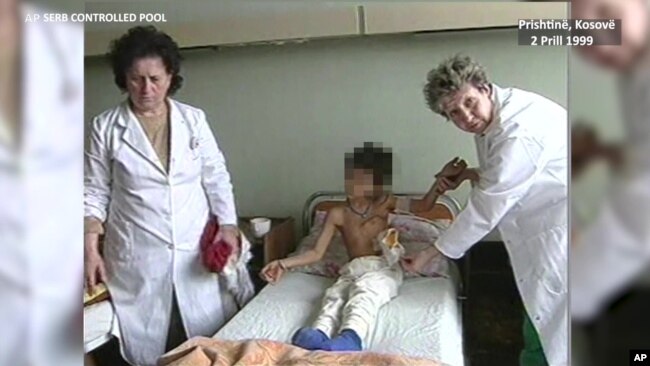
One of these cases was that of April 2, 1999.
“Since the NATO aggression began, we have been receiving many wounded civilians every day. I would like to ask NATO if they know who the bombs are hurting?”, said the director of the Surgical Clinic, Rade Grbic, on April 2, 1999.
Dr. Salih Krasniqi says that his former Serbian colleague from the wartime has falsely presented Albanian patients as victims of NATO and adds that he has found evidence of this.
“I found the data that there are 420 patients and he (Grbic) says that there were 60%, which means 252 patients were operated on at UCCK, allegedly for injuries caused by NATO. But when I extracted the data on what diagnosis, or what operation was performed, their number is very small. Based on the data, it is said that out of these 252 patients, about 111 patients are missing who were not registered at all. The question arises as to where these patients went if they were admitted but not registered.”
A good case, according to Dr. Salih Krasniqi, to clarify how victims of attacks by Serbian forces have been presented as victims of NATO bombings is the case of the Dubrava prison, near Istog.
On May 19 and 21, 1999, NATO carried out airstrikes on the prison, claiming that they were in response to Yugoslav military activities near the prison area. These attacks are officially known to have killed 19 prisoners, mostly Albanians, who were being held there, and injured hundreds.
“The most horrific loss of prisoners has taken place in this place. There have been a large number of victims who have been transferred to the nearest hospital and investigations are ongoing,” said Serbian investigating judge Vladan Vojić from Peja on May 21, 1999.
However, Dr. Salih Krasniqi says that the diagnoses of the patients he has found at UCCK tell a completely different story.
“The massacre there was carried out by Serbian institutions and not by NATO, as they wrote in the stories of the patients I have encountered where they are said to have been wounded by NATO. However, in the diagnoses I have found it is said that they were wounded by firearms, that is, by small arms and not by airstrikes. They took them out to the sports field in Dubrava Prison and started shooting them all. Some who managed to escape. They wounded them while they were hiding in wells or other places.”
He says that another crime committed against Albanians in Dubrava is that most of them, although injured, were never taken to hospital for treatment. Dr. Krasniqi says that out of about 300 injured, only 31 former prisoners were registered as patients in the hospital.
“They all initially held them for 4 to 20 days in prison, and then 31 of them were brought to the hospital. The others were sent to prisons. Even those who were brought to the hospital were released from the hospital after 3 or 5 days and sent to Serbian prisons.”
Voice of America: How many of them needed medical treatment and were not allowed to receive it?
Dr. Salih Krasniqi: Almost everyone because almost everyone was injured, mainly by Serbian forces.
Similar fates to those injured in Dubrava prison, according to Dr. Salih Krasniqi, were experienced by hundreds of other Albanian patients who, although medical treatment could have made the difference between life and death, were sent to prisons.
“For example, they took Muhamet Kiçina, a young man, in January ’99, they captured him in Drenas wounded under the right armpit, the Serbs brought him to the hospital and we operated on him with Professor Sadri Bajraktari, but after two or three days they took him from the hospital even though we did not sign the release form because he was not in a condition to be sent to prison. They did not ask us.
Muhamet Kiçina and another patient, Naim Çufaj, whom Dr. Krasniqi says he illegally removed from the hospital and sent to his home, survived the war in Kosovo.

During the war, Dr. Krasniqi worked two jobs. Five days a week he worked at the University Clinical Center, and on the other days he went to war zones and treated patients and KLA soldiers.
“We were assigned that way, a group that didn’t work in the hospital, they worked from Monday to Friday and on Friday we would go to the group that worked in the hospital to replace them. In military hospitals (of the KLA) or I took my annual leave as if I was going somewhere and I went to war zones. “
Voice of America: How did you get through this without realizing what you were doing because it was dangerous for your life?
Dr. Salih Krasniqi: I was much more afraid when I was going to the mountains than when I was in the mountains, because we were armed there. However, there was a problem on the way. Some colleagues caught them and beat them.
Dr. Krasniqi says he is working to translate the book into English and German. Meanwhile, he adds, the Kosovo Ministry of Justice is collecting material to prove crimes committed by Serbian forces in Kosovo./VOA
Trial of Dragisa Millenkovic – Witness recounts torture he experienced in Lipjan Prison
Dragisa Millenkovic, accused of war crimes in Kosovo, is sitting in the dock at the Court of Pristina again today, November 8, 2024.

Dragisa Millenkovic from the Special Prosecution is being accused of committing acts that are considered war crimes against the civilian population during the last war, in 1999, in his capacity as an official in the Pristina and Lipjan Prisons.
At the hearing on 08.11.2024, witness Bajrush Xhemajli testified before the trial panel.
The witness recounted his experiences in Lipjan Prison as a prisoner.
Witness Bajrush Xhemajli stated that he had been in Lipjan Prison from May 24, 1999 to June 10, 1999.
Witness Xhemajli, during his testimony regarding what he had experienced in Lipjan Prison, stated that from the time he went to the waiting room with the other prisoners, he had experienced cruel behavior from the guards towards them.
The witness stated that when they arrived at Lipjan Prison, a cordon was created by police officers and prison officials and the prisoners had to pass through that cordon.
“The prisoners had to pass through the two rows between them in the space, and each one tried to help them as much as he could. Woe to the one who falls because no one can pick him up,” said witness Bajrush Xhemajli.
Witness Xhemajli confessed that the mistreatment of them continued in the prison corridors, where police officers had used violence against them and attacked them with iron bars.
The witness stated that there had been 30 people in the cell and that there had been no prison rules in the prison.
“There were about 30 of us in the cell, there were no prison rules, you were a prisoner there, the treatment there was very harsh, at first you only had two sponges, the food was 1/4 of a loaf of bread,” said witness Bajrush Xhemajli regarding what he had experienced in Lipjan Prison.
“In fact, we sat down hungry, we got up hungry… we fainted when we got up quickly,… and once a day we had to go to the toilet,” witness Xhemajli added.
Asked by prosecutor Atdhe Dema whether he had seen the accused Dragisa Millenkovic in Lipjan Prison, the witness stated that he had not.
“I don’t remember, maybe he could have been there, but I didn’t focus on who was there, I didn’t even know my brother was there because it was a very serious situation,” said witness Xhemajli.
Further, witness Xhemajli stated that a prisoner he had stayed with had told him that the accused Milenkovic had beaten him.
The witness regarding the cordon said that it was about 30 meters long and that there were over 50 uniformed people in that cordon, the majority of whom were guards.
Witness Bajrush Xhemajli, who is also the injured party, has not filed a property-legal claim.
Other witnesses were scheduled to be heard at this hearing, but in their absence, Friday’s hearing was adjourned.
Hearings regarding this criminal case are scheduled in the coming weeks.
The panel that is hearing this case consists of Kujtim Krasniqi – chairman, and members Rrahman Beqiri and Arben Hoti.
What does the prosecution file say?
Millenkovic is accused of committing acts that constitute war crimes against the civilian population during the last war, in 1999, in his capacity as an official in the Pristina and Lipjan Prisons.
He was arrested by the Kosovo Police on 21.06.2023 , and his arrest was protested in Graçanica.
Milenkovic was brought before the Court of Pristina on 22.06.2023 and remanded in custody.
Millenkovic is accused of forcing prisoners to pass through a cordon after they were transferred from Dubrava Prison to Pristina and Lipjan Prison and of hitting them with sticks, punches and kicks.
According to the Prosecution’s file, the prisoners were systematically treated inhumanely, being tortured, mistreated, threatened with death, and thus causing serious bodily injuries and health consequences.
In addition, according to the Prosecution’s file, psychological violence was also exerted on the prisoners.
Millenkovic is accused of having committed these actions in collaboration with three other officials, including the former director of the Pristina District Prison, Lubomir Cimburovic, and guards Predrag Bradic and Milivoje Ilic.
According to prosecutor Atdhe Dema, these actions are contrary to the International Geneva Convention.
The former top political and military leaders of the remaining Yugoslavia and Serbia were tried, and some were convicted, for massacres and other war crimes and crimes against humanity committed in Kosovo by Serbian and Yugoslav forces during the 1998/1999 war.
Former Yugoslav President Slobodan Milosevic was charged with war crimes and crimes against humanity committed by Serbian and Yugoslav forces in Kosovo. Milosevic was also charged with war crimes and crimes against humanity committed in the wars in Bosnia and Herzegovina and Croatia.
His trial at the International Criminal Tribunal for the former Yugoslavia (ICTY), based in The Hague, had no conclusion after Milosevic died on March 11, 2006, in his cell while being held in custody.
Milan Milutinovic, the former president of Serbia, was acquitted of war crimes charges during the Kosovo conflict.
Nikola Šainović, Deputy Prime Minister of the Federal Republic of Yugoslavia, was sentenced to 18 years in prison for crimes against humanity and violations of the laws or customs of war.
Dragoljub Ojdanić, the former Chief of the General Staff of the Yugoslav Army, was sentenced to 15 years in prison for crimes against humanity.
Nebojša Pavković, the former commander of the Third Army of the Yugoslav Army, was sentenced to 22 years in prison for crimes against humanity and violations of the laws or customs of war.
Vladimir Lazarević, the former commander of the Pristina Corps of the Yugoslav Army, was sentenced to 14 years in prison for crimes against humanity.
Sreten Lukic, the former chief of staff of the Serbian Ministry of Internal Affairs for Kosovo, was sentenced to 20 years in prison for crimes against humanity and violations of the laws or customs of war.
Dramatic account of torture in the former Pristina prison: The whole wall was covered in blood, everything was dirty. If it fell into the hands of the Serbs
The Republic of Kosovo in the 1980s was plagued by beatings and the use of brutal violence. Crimes that were organized and carried out in the detention center in Pristina.
And through a narrow door, the prisoners were transferred to the offices of the Serbian UDB, a place from which the Serbian secret service would take the Albanians out, bleeding and unconscious.
“There was no way a political prisoner could have passed through this blue door with bars. There was no way he could have passed through without being violently captured by the instruments of the Serbian state and the UDB,” says former prisoner Braha.
As Braha recounts, the UDB had a special torture room. It resembled a surgical operating room where the prisoner was tortured, tied up, beaten, and experimented on. A political prisoner for participating in the 1981 demonstrations, Braha was initially held in solitary confinement in a cell.
“Everything here was dirty, the whole wall was covered in blood, it was smeared with blood. It was a place that was not cleaned for the three months I stayed here,” this is the description of the place where he spent a long time being tortured.
At about 10 square meters, the cell served for daily stay, food, and also for physiological needs. Three months later, Braha was transferred to the second floor of the notorious prison. After settling here, he says that he was even allowed to go out in the yard. Braha spent over a year in detention there, while he spent another six years in prisons across Kosovo.
One of the most notorious prisons in the former Yugoslavia was built after World War II and closed in 2016. As of Tuesday, the prison grounds are open to visitors, as evidence of where prisoners suffered brutal violence from the Serbian state apparatus. /RTV Dukagjini/
Kurti pays homage to the graves of Cena Dugolli and Fazli Greiçevci, who died from Serbian torture in Pristina Prison
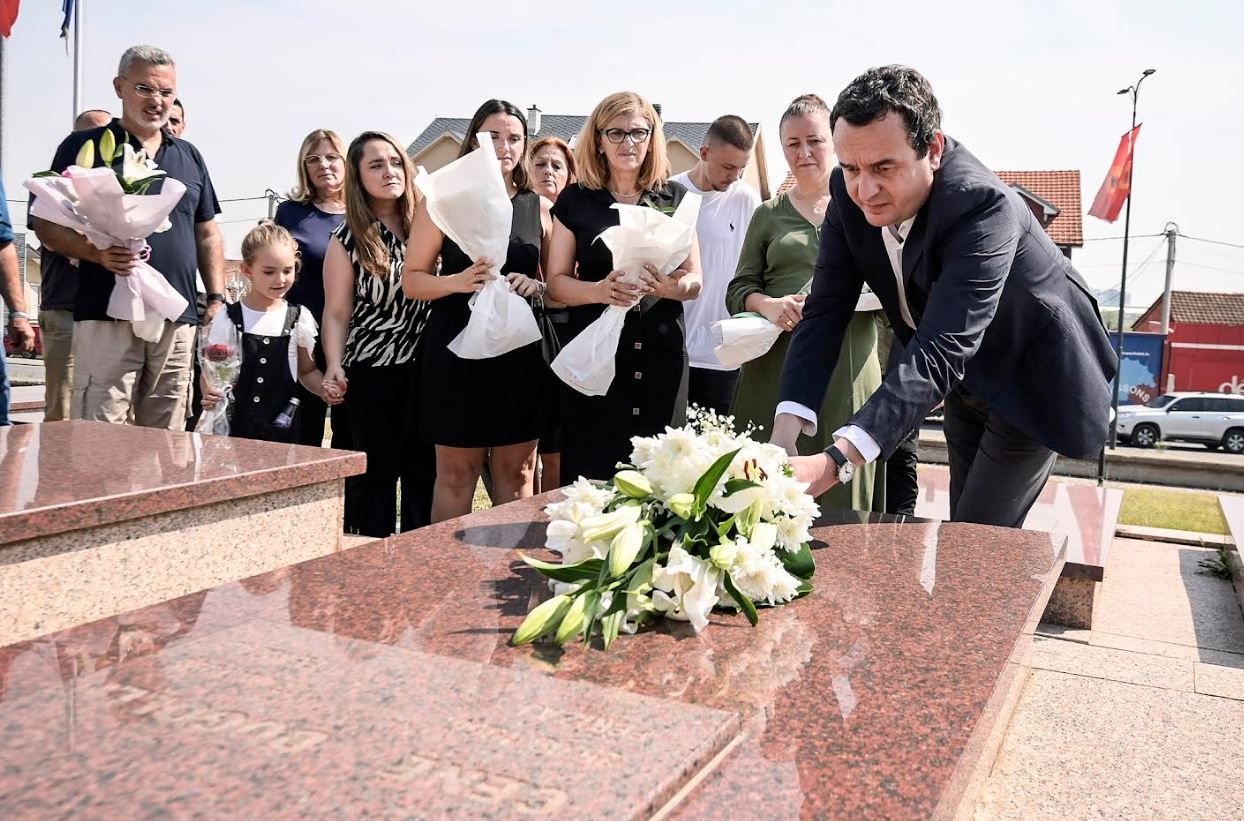
Prime Minister Albin Kurti paid homage at the grave of martyr Cenë Dugolli and national cause activist Fazli Greiçevci, who died from torture by Serbian police forces in Pristina Prison.
He placed fresh flowers at the grave of martyr Dugolli at the martyrs’ cemetery in Ferizaj, in commemoration of the 26th anniversary of his murder, reports Klankosova.tv.
The head of the Kosovo government was accompanied by MPs Enver Dugolli, Avni Dehari, Hydajet Hyseni and Valon Ramadani, as well as family and friends of Cena Dugolli.
After placing flowers at Dugolli’s grave, Kurti headed to Sankoc in Drenas, where he paid homage to the grave of activist and patriot Fazli Greiçevci, who drowned on August 17, 1964.
The 49-year-old who leads the government was there together with MPs Enver Dugolli and Adnan Rrustemi, family and friends of the Greiçevci family, as well as the mayor of Drenas, Ramiz Lladrovci, the statement said.
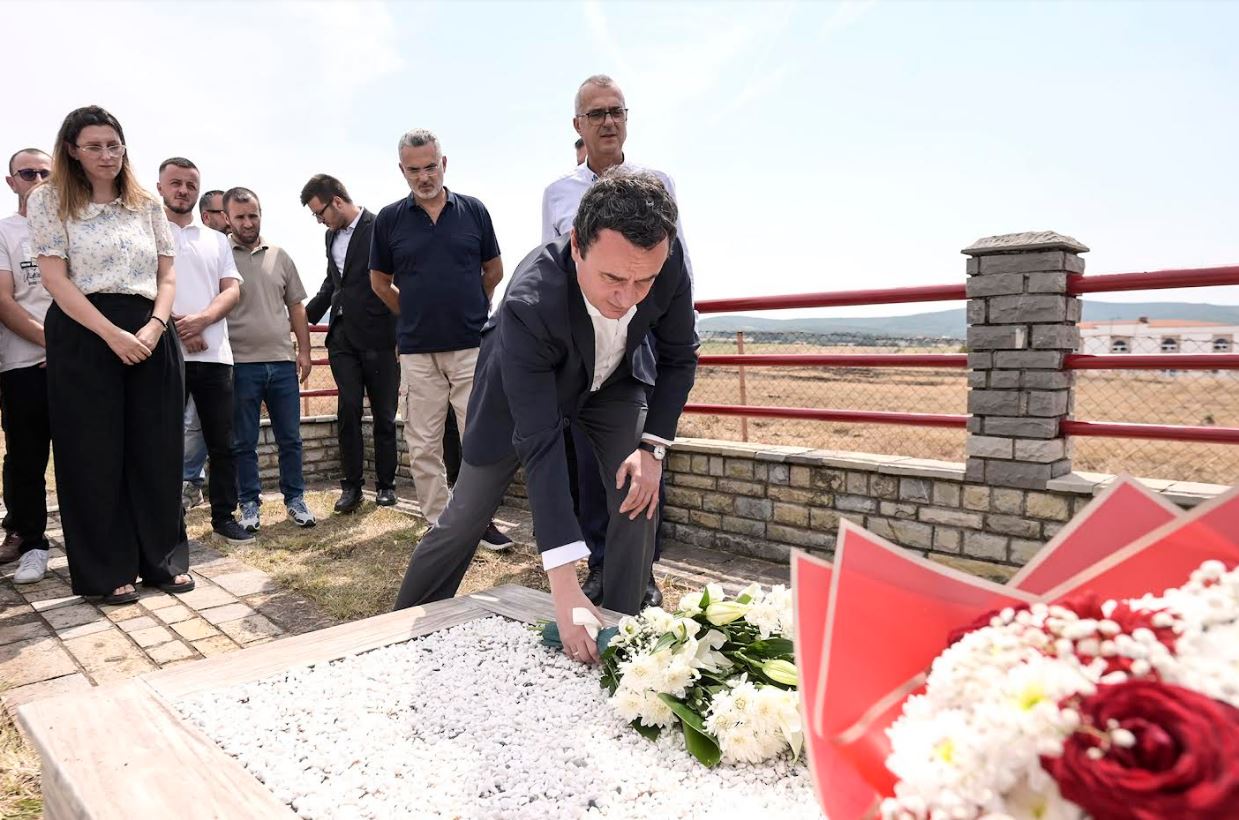
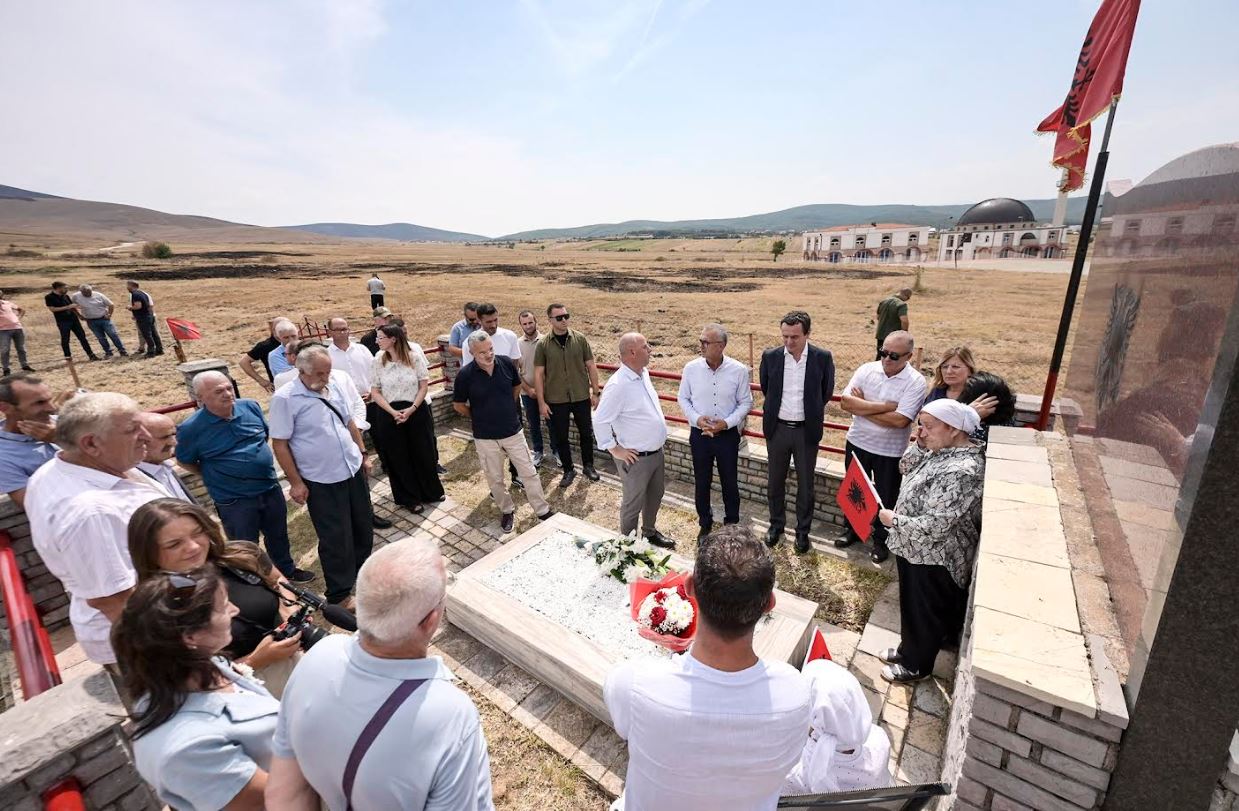
Nait Hasani speaks about inhuman torture in Serbian prisons: Chinese torture was the worst
Former political prisoner and one of the founders of the KLA, Nait Hasani, has revealed the torture he endured in the prisons of the Serbian regime as a result of his nationalist activity.
Hasani says that Albanians have been the target of inhumane torture in prisons.
“The worst torture. Chinese torture was the worst. They didn’t stop until you were unconscious. Chinese torture is when they put a light in front of you and don’t let you sleep. Then they stab you with a knife when they see you’re closing your eyes. It was painful and unexpected. Then they grabbed your genitals. Electroshock torture,” he confesses.
“The ideal kept us alive. When they brought people in, they reminded us of those animals that they threw on the floor. It was unimaginable. The guard would come and beat us nonstop. Then one day he came and said that there was no more room for him to beat you,” he added.
3,300 Euros for Suffering in Serbian Prisons
The First Instance Court in Belgrade ruled on Friday that Serbia is responsible for the torture of Mustafa Kolgeci, an Albanian from the municipality of Suhareka, which was carried out by Serbian police who held him prisoner from September 1998 to January 2000.
The trial panel ruled that during his 16 months in prison, police tortured Kolgeci physically and mentally every day and ordered Serbian authorities to pay 380,000 dinars [about 3,300 euros] in compensation for the suffering he endured.
Kolgeci was arrested in September 1998, in his hometown, on suspicion of illegal possession of weapons and was later charged with terrorism.
In January 2000, a court in the town of Pozarevac in Serbia dropped the charges against him.
During his 16 months in prison, Kolgeci was sent to four prisons, where he was held without the most basic facilities – without a bed and almost without food and water, which left permanent damage to Kolgeci’s health.
One of the prisons where he was held was the infamous Dubrava prison, which was bombed by NATO in 1999.
According to Kolgeci, after the bombing, the police gathered all the surviving prisoners, including Kolgeci, and began shooting them with machine guns.
He survived the shooting and was later transferred to Lipjan prison.
The Humanitarian Law Center, HLC, which filed a complaint on behalf of Kolgeci, says the amount of compensation is disproportionate to the torture he experienced.
The HLC adds that courts in Serbia apply compensation laws differently in relation to victims of Serbian police and military during the conflicts of the 1990s.
In regular compensation proceedings, the figures given for suffering and torture by the police are much higher. In cases where lawyers, judges and army officers were illegally arrested after 2000, compensation ranges from 5,000 to 50,000 euros.
They cite the example of the former head of the army’s security services, Aca Tomic, who received 6 million dinars [54,000 euros] when he was illegally imprisoned by Serbian police in 2003.
Kolgec’s legal representatives stated that they will appeal the decision, as they are not satisfied with the amount of compensation.
Novosella tells how he was tortured in Serbian prisons: They told me they would rape his wife in front of his eyes
Former political prisoner Selatin Novosella has confessed to the brutal persecution of the Yugoslav regime, where he told of torture in Serbian prisons.
Novosella, on the show ‘Pressing’ on T7, told how he was threatened with raping his wife in front of his eyes.
“For example, we brought them, the third time I was married, the bride who had been waiting for me for four years, we brought our bride, we tied her to the radiator, you couldn’t react, there were 5-6 of us, we had to rape her in front of you, or you had to accept it.”
Further, he said that they torture him in various ways, even threatening to spread rumors that he is a spy.
“We had to fire all the family members from their jobs. We had to spread the word that all these friends who imprisoned you are their spy, that is, touch you in the ass. The physical torture is not worth dealing with, it was the worst part.”
© SYRI.net
Luljeta recounts the horror she experienced from Serbian torture

Luljeta Sharani has spoken of the horror she experienced when Serbian forces killed her family members during the Kosovo War.
“We haven’t done anything, please release us, but they didn’t even want to listen,” Sharani told Kosova Today.
“11 men were pinned to the wall with their hands. There was Seferi, Valoni, Visari, the two boys with their father.”
“The brothers-in-law, Tahiri, Mentori, Isufi, four from the Saraçini family and one from the Berisha family, a minor, 17 years old, they said 11 males were taken.”
“They didn’t let us speak, they didn’t let us look at them, they didn’t even let us say a last goodbye, they didn’t let us give them a last hug.”
Sandulovic gives shocking details of torture: BIA forced me to kiss photos of dead Serbian agents in Kosovo
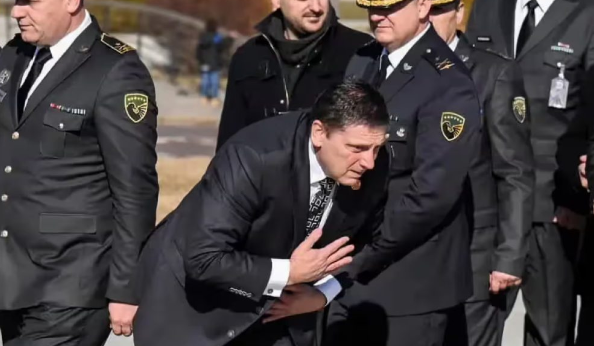
Nikola Sandulovic, who was recently beaten and tortured by the infamous Serbian secret service BIA, has spoken again to international media about the violence inflicted on him after visiting the Jashari family cemetery.
He has also shared new details about the case, explaining to the Observer that the BIA forced him to kneel and kiss the photos on the wall of Serbian agents who died in Kosovo during 1998-1999.
“ Then when the beatings started they hit me so hard that I lost consciousness. In the van they hit me on the head, punched me in the face and kicked me. In the lobby of the BIA headquarters, they took off my shirt and forced me to kneel and kiss the photos on the wall of agents who had died in Kosovo. They kept asking who was behind my decision to visit the burial site, who was bribing me to do such things ,” Sandulovic said, as quoted by The Guardian .
The torture, Sandulović says, lasted six hours.
” They sat on both my legs, pulled my arms and turned my head back, while they videotaped [the scenes] and shouted ‘traitor ‘.”
” Finally I said, ‘I’m not going to answer any more questions. Kill me or call a doctor .’”
Croatian Prisoner Tells of “Torture” by Serbs
March 8, 2013:00:07: A witness in the trial of former Croatian Serb leader Goran Hadzic said he was brutally beaten by Serbian troops after the fall of the town of Vukovar in 1991.
 |
| Witness Branko Culic I Photo from ICTY |
Witness Branko Culic testified on Thursday at Hadzic’s trial at the International Criminal Tribunal for the former Yugoslavia that he was one of the Croatian fighters from Vukovar who was held in the Serbian prison in Stajicevo after the town fell to the Yugoslav Army in November 1991.
“We surrendered to the [Yugoslav People’s Army]. They told us to get on buses. I was on the third bus, I don’t remember. I didn’t know where we were going. Later, I learned that I was in the Stajicevo camp,” Culic said.
Stajicevo, near the town of Zrenjanin, was one of many military camps in the northern province of Vojvodina, near the border with Croatia, that was run by the Serbian army in 1991.
“I was injured in my right hand. I can’t explain how they beat us. The military police beat us with punches, kicks, sticks and wood,” Culic added.
“They shouted at us. They beat us. They humiliated us. I can’t explain what I went through. It was so stressful that I couldn’t eat for six days,” the witness said as he cried.
“I remember they beat a man so badly that he never got up again. He died after ten days,” he continued.
The prosecution says that as the Serb leader of Croatia, Hadzic was responsible for the fall of Vukovar after the city’s long siege.
He is accused of 14 war crimes, including persecution, disappearance and torture of non-Serb civilians from Croatia between 1991 and 1993.
Culic said he was later transferred from Stajicevo to a camp in the southern Serbian city of Nis.
“They beat us regularly. Once they called me in for questioning and held me for seven hours. They beat me the whole time,” he said.
“I never saw Goran Hadzic there, but I heard from others that he was coming. He had been told that we would be taken back to Vukovar where we would be tried as prisoners of war,” he continued.
The trial will continue on Friday.
For some viewers, the following images may be disturbing.
The taking of the residents of Kushnin and Kabash hostage, the looting of their houses and their burning by the army
Written by: Qazim Morina
As dusk fell, the gathered residents were placed in two large rooms (salons) in the center of the village. The women and children were placed in the room of Idriz Sylve (Temaj), while the men were placed in that of Bajram Shaban Jahdauti, where in another room nearby, the Serbian superiors were also staying, who were taking some of the residents into informative conversations. Through pressure and mistreatment, the focus was on questions about the activities, leaders and movements of the KLA.
The villagers were threatened that in case of any reaction from the KLA they would all be executed.
Some old people, due to their advanced age, had remained in their homes. This also happened in the nearby village of Kabash, where Serbian forces were stationed at the entrance to the village, namely at the location where the school is now located.
In Kushni, Rexhep Avdi Shatri was arrested, while in Kabash, Rrahman Bajram Kabashi, who were then horribly tortured.
The night had passed with fear and pressure, especially for children and women. It was worse for the children, who were left without food for 24 hours, so their cries and fears affected their mothers, making the event even sadder. To observe the terrain at night, the army constantly used moving reflectors.
In the morning, soldiers on foot began the raiding action in every house and room. Shots were also heard. Dogs that reacted were killed. Cattle were let loose, causing damage to the cultivated fields.

In addition to looting valuables, such as gold jewelry, cash (German Marks), as well as tobacco and alcohol, the soldiers burned the house of Feti Reshyt Temaj, while they also set fire to that of Asallan Morina and the Men’s Chamber of Imer Avdi Shatri, but after the Serbs left, the residents immediately intervened, extinguishing the fire, which had not yet spread. In Kabash, they burned the house of Bajram Rr. Kabash.
In some houses, they burned the barns and the stables with animal feed. The fine rain of that gloomy day was wrapped in the smoke that covered the villages.
Elder Gani Temaj (now deceased) said that they were defenseless. “We only prayed that the children would be saved, while we had no information about what was happening to the women,” he recalled.
The residents elected a former teacher, Rexhë Morina, as their representative. Knowing the language from his military service and the Serbian mentality, he says that he spent the whole night trying to explain to his superiors that they were civilians.
The case was presented to the Council for the Protection of Human Rights and Freedoms (KMDLNJ) in Prizren.

The action lasted until the evening, that is, 24 hours. As dusk fell, the Serbian forces withdrew, leaving behind chaos, fires in several cattle stables, and the anguish of a terrifying day.
To continue the torture, they stopped in the nearby village of Romajë.
Recalling the event, Rexhep Shatri says that when he was arrested, he greeted his wife and even took off his wedding ring, as he did not believe he would escape, while during the interview, his superiors were mainly interested in the KLA and its leadership in the village, as well as what he was doing here as a resident of Peja (where he worked as a baker), although his birthplace was Kushnin on his ID card.
He says that together with Rrustem Kabashi and a person from the village of Gërqinë e Hasit, after initially being held in Kushni, on the afternoon of September 20 they were sent to Ramajë, where they were kept all night in a corn cob, somewhere near the school, where the Serbian superiors were also staying.
In the afternoon, after the action in Ramajë was over, they, along with 30 other people from this village, were sent to the army barracks in Prizren.
“On the street, under the pressure of weapons, they forced us to hold up 3 fingers (Serbian symbol). In the barracks, they beat us and tortured us severely. I suspect that the torturers were mercenaries, who operated under the uniform of the army. Physically beaten, they released me the next day, ordering me to appear again at the Army House (where the “White House” Municipal Assembly building is now located). I will never forget that horror, and I still suffer the consequences today, as I have problems with my leg,” says Rexhep Shatri.
Sources
- https://betimiperdrejtesi.com/torturat-burgosjet-dhe-debimi-nga-shtepite-deshmitaret-tregojne-perjetimet-e-civileve-me-1999-ne-ozdrim/
- Report TV – “Kur hiqja rrobat më SHKULEJ mishi nga trupi! Dëshmia rrëqethëse: Ja si më torturonte policia serbe” – Interview with Hysen Kryeziu on Esencë.
- Dukagjini – “Kryeziu: Në burgun e Leskovcit rrahjen e kemi pas meny ditore” – Interview with former political prisoner Kadri Kryeziu describing prison conditions and alleged abuse.
- Dukagjini – “Kryeziu rrëfen për malltretimin nga UDB-ashët: Metodat i kishin mizore” – Further testimony from Kadri Kryeziu about interrogations and alleged torture.
- https://boldnews.al/2024/02/24/kirurgu-i-luftes-flet-per-deshmite-e-mbledhura-per-krimet-dhe-torturat-nga-forcat/
- https://acdc-kosovo.org/sq/op-ed/14-gjykimi-ndaj-dragisha-millenkoviq-deshmitari-rrefen-per-torturat-qe-kishte-perjetuar-ne-burgun-e-lipjanit
- https://www.panorama.com.al/rrefimi-dramatik-per-torturat-ne-ish-burgun-e-prishtines-i-gjithe-muri-ishte-me-gjak-cdo-gje-e-ndyte-po-te-kaloje-ne-duart-e-te-serbeve/
- https://klankosova.tv/kurti-ben-homazhe-te-varret-e-cene-dugollit-e-fazli-greicevcit-te-vdekur-nga-torturat-serbe-ne-burgun-e-prishtines12/
- https://kosovapost.net/nait-hasani-flet-per-torturat-cnjerezore-ne-burgjet-serbe-tortura-kineze-ishte-me-e-renda/
- https://www.syri.net/syri_kosova/lajme/455418/novosella-tregon-si-e-torturonin-ne-burgjet-serbe-me-thoshin-kemi-me-ta-perdhunu-gruan-para-syve/
- https://botapress.info/luljeta-rrefen-tmerrin-qe-perjetoi-nga-torturat-serbe/
- https://permbledhja.com/sq/sanduloviq-jep-detaje-shokuese-nga-torturat-bia-me-detyroi-ti-puth-fotografite-e-agjenteve-serbe-te-vdekur-ne-kosove/
- https://balkaninsight.com/sq/2013/03/08/i-burgosuri-kroat-tregon-per-torturat-nga-serbet/btj/
- https://gazetaeprizrenit.net/pengmarrja-e-banoreve-te-kushninit-e-kabashit-plackitjet-e-shtepive-dhe-djegia-e-tyre-nga-ushtria-2/

