

The following facts have been offered to Gjin Varfi typed for his book with the emblems of Albanian families in the early 90s. Re-reading them after about 30 years, the central question relates to the fact that it is not known who formed the Despotate of Epirus in the form that claimed to have granted the Greeks historical right to call him their own.
This continues to occur even in conditions when the epirote language written in the 1800s resembles today’s Albanian, i.e. the language called after the eagle, just as is the emperor eagle emblem. Even more clearly, we need to look at the reality that local families with a part of the surname “Komnen”, known for its imperial rank even from the west, have accepted the return of their territories to Ottoman territorial units.
Below is the text of two whitewashed documents referred to sources from where they came from:
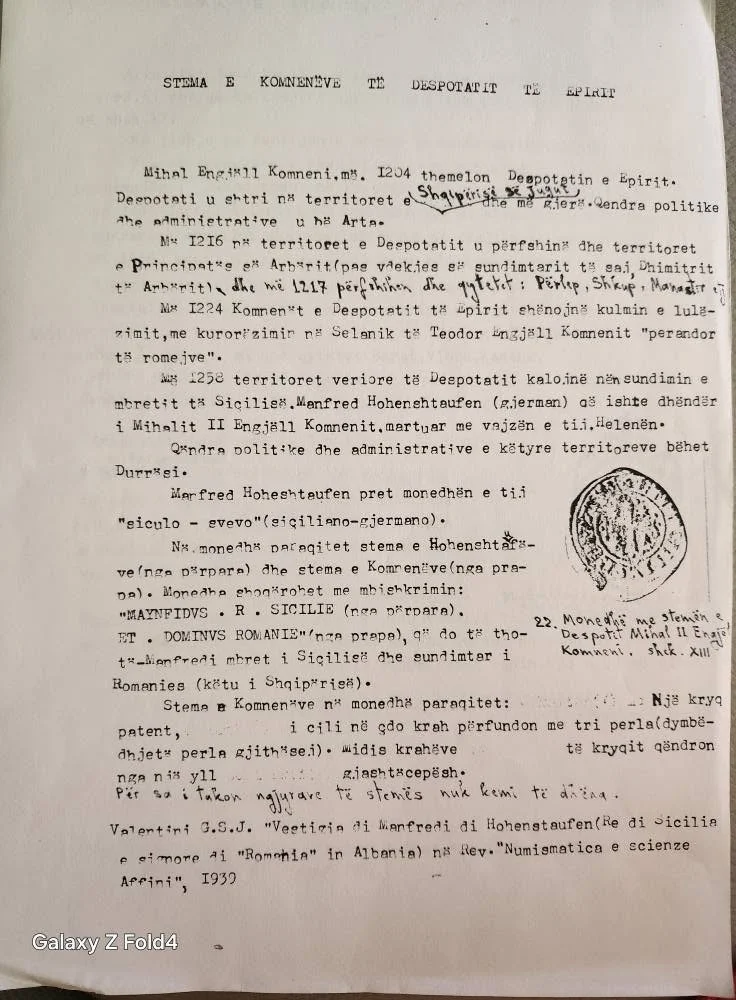
“Mihal Angel Komneni in 1204 founded the Despotate of Epirus. The despot was spread in the territories of Southern Albania and beyond. Political and administrative center became Arta.
In 1216 the territories of Despotate were also included in the territories of Principatus ex Arbar (after the death of its ruler, Dhimitri of Arbar) and in 1217 the cities: Prilep, Skopje, Monastery were included.
On 1224 the Komnen of Despotet of Epirus mark the peak of blossoming, with the coronation of Theodore Angel Komnen in Thessaloniki “Emperor of the Romans”.
On 1258 the northern territories of Despotate pass under the rule of King of Sicily Manfred Hohensttaufen (German) who was the son-in-law of Michael II Angel Komnen, married to his daughter. Helena.
The political and administrative center of these territories becomes Durrësi.
Marfred Hoheshtaufen receives your coin “siculo svevo” (Sicilian-German).
The coin features the emblem of Hohenstaufs (from the front) and the emblem of Komnen (from the back. The coin is accompanied by the inscription: “MAYNFIDUS R. SICILY (from the front). ET DOMINVS ROMANIE “from behind), which means: Manfred king of Sicily and ruler of Romania (here Albania).
22. Coin with the emblem of Despot Mihal II Engjell Komneni, century. XIII
The stamp of Komnen in coin is presented: A patent cross which on each arm ends with three pearls (twelve pearls in total). Between the arms of the cross there is a hexagonal star. Regarding the colors of the badge, we have no data.
Valentini J.S.J. “Vestigjia di Manfredi di Hohenstaufen(Re di Sicilis more ai “Romanis” in Albania) n# Rev.”Numismetica e scienze ‣ APpini”, I959″
The second document STEMA OF ARIANS
The Arianites are a large feudal family that has been known since the beginning of the century. XI and has played an important political party especially in the century. XV. It has connections with the famous Byzantine imperial family Komnene.
The fundamental figure of this family is Gjergj Arianit Komneni, the forerunner of Skanderbeg in the anti-Ottoman uprisings (I432-1436).
On I443 Gjergj Arianiti in conjunction with Hungarian anti-Ottoman expeditions carried out combat actions in the direction of Macedonia. On I444, Count Gjergj Arianiti participated in the Lezha Connection. Gjergj Arianiti is the father of Donika Kastriot (Skanderbeg’s wife). The treaty of G. Arianite with the Kingdoms of Naples and Aragon in 1454 recognizes us in his former properties:; in Eastern “and Southern Albania;” as well as the cities of Berat, Vlora, Kanina. Political and administrative center of the principality of the Arianites at the time of rule of George Arianiti, was in Sopot.
The Arianites are branches of Topiaj and Skurraj.
The Arianite emblem is blue with a double-headed, flat-open golden eagle. It is found in a catalog with badges in the Margians Library and is accompanied by this motivation: “Komino (Komnian) of the door of God Aretini (Arianite) of Albania on the Scooter (Scooter), god on the sides of that place, who was accepted and became a member of the Grand Council, because it seemed fitting Our sign to honor and find our sympathizer. “This was taken on I464”.
On I484 Komnian Arianiti is appointed by Sultan Bajaziti Sanjakbey in Nahija of Sopot.
Slide by Nadin L.

Source
Selected Sources for the History of Albania, V. II. Shek. VIII-XV, Tirana, 1962. “
If the story will not be told for those who made and made decisions or accepted decisions with the flow that followed, – i.e. the great families of the country – it will be difficult, unable to plan and achieve the right visions.

