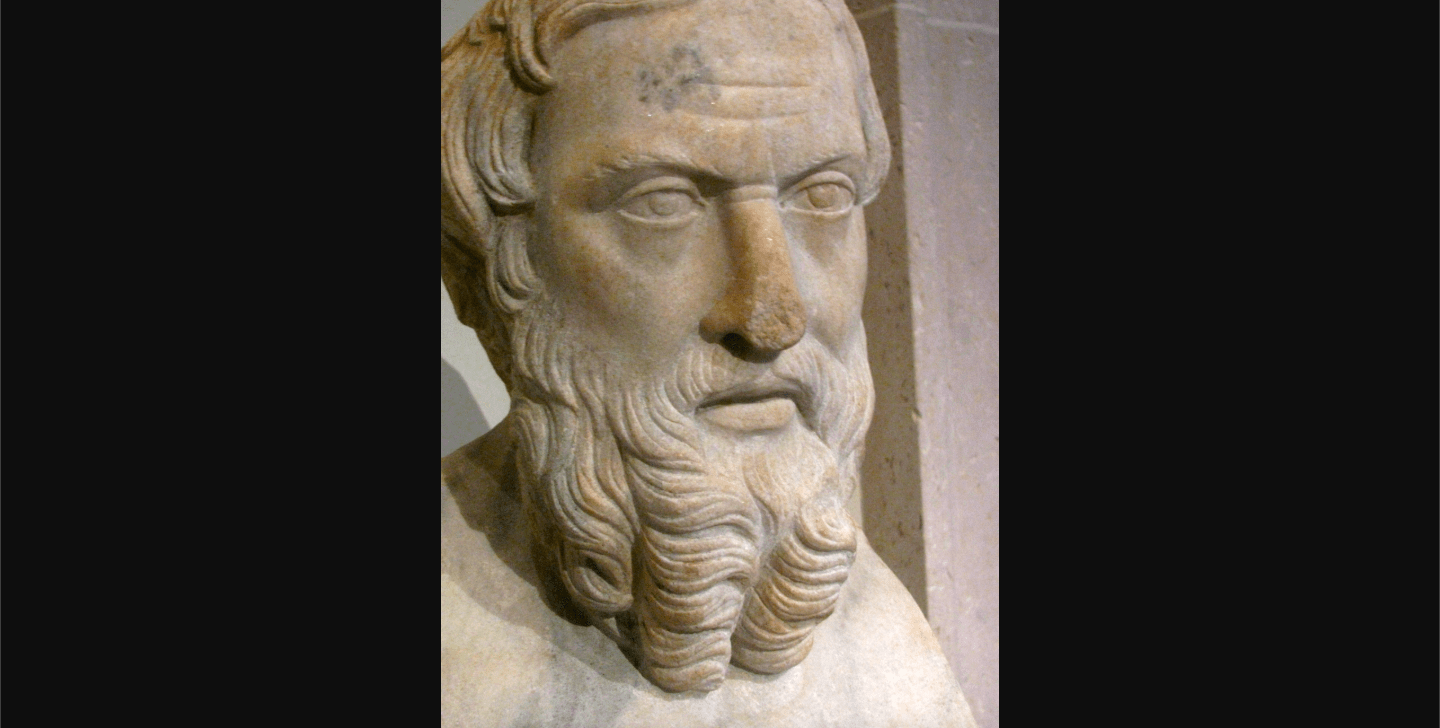

In the 5th century BC, the Greek historian Herodotus made one of the boldest claims in classical literature: that the gods worshipped by the Greeks were not originally Greek at all. In The Histories, particularly Book 2, he argued that nearly all the names and figures of the Greek pantheon originated in Egypt, reaching Greece through intermediaries and cultural exchange. This theory challenged the notion of a purely Hellenic religious tradition and highlighted the deep interconnectedness of the ancient Mediterranean world.
Herodotus’ Theory: Import from Egypt via the Pelasgians
Herodotus, often called the “Father of History,” based his conclusions on travels, inquiries, and comparisons between cultures. He asserted that the Egyptians were far older than the Greeks and had established the worship of the gods long before they appeared in Hellas.
According to him, the Greeks acquired these divine names and associated practices primarily through the Pelasgians—a shadowy, pre-Greek indigenous people of the Aegean region who had themselves learned the names from foreigners (chiefly Egyptians).
Specific Equivalences
Herodotus frequently employed interpretatio graeca, identifying foreign deities with their closest Greek counterparts:
The Egyptian creator-god Ptah was equated with Hephaestus, the Greek god of craftsmanship and fire.
Osiris, central to Egyptian resurrection myths and the afterlife, was identified with Dionysus, the Greek god of wine, ecstasy, and rebirth.
Similar links were drawn for other major deities, suggesting a wholesale transfer of divine concepts from the Nile Valley.
He made some exceptions. Poseidon, for instance, was said to have come from Libya rather than Egypt. A few other gods were also treated as having independent or uncertain origins. Overall, however, Herodotus portrayed the Greek religious system as heavily derivative.
Herodotus’ Methodology
Herodotus’ approach was comparative and empirical for his time. He visited Egyptian temples, consulted priests, and observed parallels in ritual practices, festivals, and iconography. His belief in the greater antiquity of Egyptian civilization (which modern archaeology largely confirms) led him to conclude that Greece had been the cultural borrower rather than the innovator.
This view fit into broader Greek intellectual trends of the Classical period, where thinkers grappled with the question of cultural priority among older Near Eastern and African civilizations. By crediting Egypt, Herodotus elevated a respected foreign culture while explaining why Greek traditions sometimes seemed fragmented or recently organized.
Egyptian influence on Greek religion and philosophy is real—evident in artistic motifs, certain mystery cults, and possible philosophical borrowings. The Pelasgians themselves remain enigmatic; they likely represent pre-Greek populations whose languages and religions mixed with incoming Indo-European Greek speakers during the late Bronze Age.
Why Herodotus’ Claim Endures
Herodotus’ thesis remains compelling because it captures a deeper truth: ancient civilizations were not isolated. The Greeks were adept at absorbing, adapting, and reinterpreting ideas from Egypt, the Levant, Mesopotamia, and beyond.
Full quote
“2.50. In fact, the names of nearly all the gods came to Hellas from Egypt. For I am convinced by inquiry that they have come from foreign parts, and I believe that they came chiefly from Egypt. Except the names of Poseidon and the Dioscuri, as I have already said, and Hera, and Hestia, and Themis, and the Graces, and the Nereids, the names of all the gods have always existed in Egypt. I only say what the Egyptians themselves say.
The gods whose names they say they do not know were, as I think, named by the Pelasgians, except Poseidon, the knowledge of whom they learned from the Libyans. Alone of all nations the Libyans have had among them the name of Poseidon from the beginning, and they have always honored this god. The Egyptians, however, are not accustomed to pay any honors to heroes.
2.51. These customs, then, and others besides, which I shall indicate, were taken by the Greeks from the Egyptians. It was not so with the ithyphallic images of Hermes; the production of these came from the Pelasgians, from whom the Athenians were the first Greeks to take it, and then handed it on to others.
For the Athenians were then already counted as Greeks when the Pelasgians came to live in the land with them and thereby began to be considered as Greeks. Whoever has been initiated into the rites of the Cabeiri, which the Samothracians learned from the Pelasgians and now practice, understands what my meaning is.
Samothrace was formerly inhabited by those Pelasgians who came to live among the Athenians, and it is from them that the Samothracians take their rites. [The Athenians, then, were the first Greeks to make ithyphallic images of Hermes, and they did this because the Pelasgians taught them. The Pelasgians told a certain sacred tale about this, which is set forth in the Samothracian mysteries.
2.52. Formerly, in all their sacrifices, the Pelasgians called upon gods without giving name or appellation to any (I know this, because I was told at Dodona); for as yet they had not heard of such. They called them gods from the fact that, besides setting everything in order, they maintained all the dispositions.
Then, after a long while, first they learned the names of the rest of the gods, which came to them from Egypt, and, much later, the name of Dionysus; and presently they asked the oracle at Dodona about the names; for this place of divination, held to be the most ancient in Hellas, was at that time the only one.
When the Pelasgians, then, asked at Dodona whether they should adopt the names that had come from foreign parts, the oracle told them to use the names. From that time onwards they used the names of the gods in their sacrifices; and the Greeks received these later from the Pelasgians.
2.53. But whence each of the gods came to be, or whether all had always been, and how they appeared in form, they did not know until yesterday or the day before, so to speak; for I suppose Hesiod and Homer flourished not more than four hundred years earlier than I; and these are the ones who taught the Greeks the descent of the gods, and gave the gods their names, and determined their spheres and functions, and described their outward forms. But the poets who are said to have been earlier than these men were, in my opinion, later. The earlier part of all this is what the priestesses of Dodona tell; the later, that which concerns Hesiod and Homer, is what I myself say.”
Sources
Herodotus. The Histories. Translated by Aubrey de Sélincourt. Revised with introduction and notes by John Marincola. London: Penguin Classics, 2003. (Especially Book 2, chapters 43–53, 58–64, and 144–146 for discussions on the origins of the Greek gods, Egyptian connections, and the Pelasgians.)
Burkert, Walter. Greek Religion. Translated by John Raffan. Cambridge, MA: Harvard University Press, 1985.
Guthrie, W. K. C. The Greeks and Their Gods. London: Methuen, 1950.
Hornblower, Simon, and Antony Spawforth, eds. The Oxford Classical Dictionary. 4th ed. Oxford: Oxford University Press, 2012. (Entries on “Herodotus,” “Pelasgians,” “Interpretatio graeca,” and individual gods.)
Malkin, Irad. A Small Greek World: Networks in the Ancient Mediterranean. Oxford: Oxford University Press, 2011.
Parke, H. W. Greek Mercenary Soldiers: From the Earliest Times to the Battle of Ipsus. Oxford: Clarendon Press, 1933.
Penglase, Charles. Greek Myths and Mesopotamia: Parallels and Influence in the Homeric Hymns and Hesiod. London: Routledge, 1994.
West, M. L. The East Face of Helicon: West Asiatic Elements in Greek Poetry and Myth. Oxford: Clarendon Press, 1997.
Beekes, Robert S. P. Etymological Dictionary of Greek. 2 vols. Leiden: Brill, 2010.
Chadwick, John. The Mycenaean World. Cambridge: Cambridge University Press, 1976.
Lloyd, Alan B. Herodotus Book II: Commentary 1–98. Leiden: Brill, 1976.
Thomas, Rosalind. Herodotus in Context: Ethnography, Science and the Art of Persuasion. Cambridge: Cambridge University Press, 2000.
Britannica. “Herodotus.” Last modified 2024. https://www.britannica.com/biography/Herodotus-Greek-historian.

