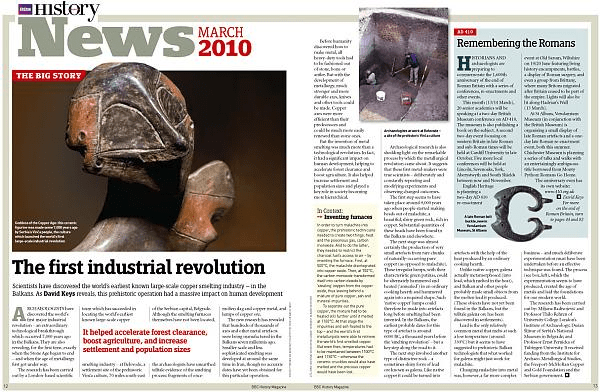

THE BIG ISSUE. HISTORY. MARCH 2010. The first industrial revolution
As David Keys reveals, this prehistoric operation was a major impact on human development. The first industrial revolution took place not in 18th century Britain – but more than 6,000 years earlier in what is now Bulgaria and Serbia, but this was before there was before the arrival of the Serbs, Bulgarians or Slavs in the region. Instead, these territories were inhabited by Dardanians and Illyrians.
It helped accelerate forest clearance, boost agriculture, and increase settlement and population sizes. Scotland has discovered the world’s earliest known large-scale copper industry – in the Balkans. Archaeologists have discovered evidence of a vast copper mining and smelting industry – which, between 5,100 BC and 4,600 BC, produced an astonishing 6,000 tons of the metal.
The industry – which employed thousands of people – helped accelerate forest clearance, boost agriculture, and increase settlement and population sizes – and was the key to the emergence of the first hierarchical societies in Europe.
The new evidence has emerged from a detailed examination of 140 copper mines and smelting sites – and the chemical and other analysis of more than 3,000 copper artefacts found across the Balkans and beyond. The investigation – carried out by a team from the universities of Bologna, Aarhus, New York, and the Bulgarian Academy of Sciences – has been published in the Proceedings of the National Academy of Sciences.
Scientists now believe the industry helped transform the Balkans from a largely forested area with small Neolithic farming communities into a more open, agriculturally productive landscape that could support much larger populations.
The huge demand for wood to fuel the smelting furnaces led to large-scale deforestation. This in turn allowed the expansion of farming and animal herding. The copper industry also required a large labour force – both for mining and for smelting. This concentration of workers appears to have led to the emergence of the first elites in Europe – the people who controlled the mines, the smelting sites and the distribution of the valuable copper.
Pre-Slavic and Pre-Serbian Archeological findings in Prokuplje
Prokuplje, Toplice. Archaeologists have discovered the site in Ploqnike of the Neolithic and Copper Age and has changed the history of the metal age for 800 years earlier, until now it was thought that the Neolithic people started using stone, but at that time copper was also used here.
In Ploqnik, two Neolithic foundations of houses and a furnace for smelting and processing copper were discovered.

Based on previous findings, the Neolithic village was partially reconstructed. This is a 7500-year-old Neolithic city, which was destroyed by a large fire.
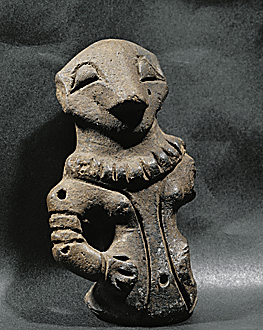
2. Female idol terracotta vinca culture neolithic (5th mill.BCE) similar to ploqnik Zoomorphic head. Terracotta From Fafos site, Kosovska Mitrovica, Vinca Culture Neolithic (5th mill. BCE).
Pre-Slavic findings in Carsija, of the Vinca-Plocnik Culture
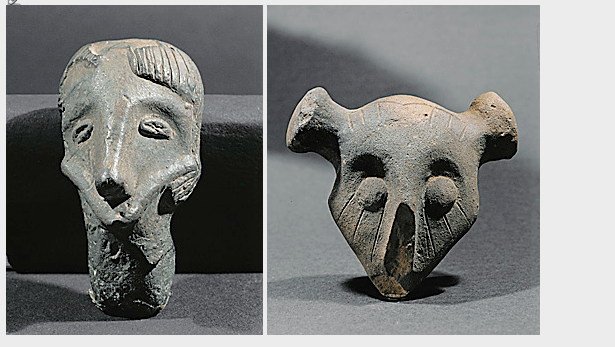
1.Fragment of a seated female figure. Terracotta From Carsija, Serbia. Vinca-Plocnik Culture, Neolithic (5th
2.Female idol. Terracotta From Fafos I site, Kosovska Mitrovica, Kosovo Vinca Culture, Neolithic (5th mill. BCE) Height 20 cm Inv. F-I-1952
3.Head with hairdo. Terracotta From Predonica site, Pristina, Kosovo. Neolithic. Height 7.5 cm Inv. 162
NEOLITHIC SCULPTURE 10TH-5TH MILL.BCE
More discoveries
4.Animal mask. Terracotta From Plocnik, Serbia. Vinca-Plocnik Culture, Neolithic (5th mill. BCE). Height 5.5 cm Inv. 2235. NEOLITHIC MASK 10TH-5TH MILL.BCE
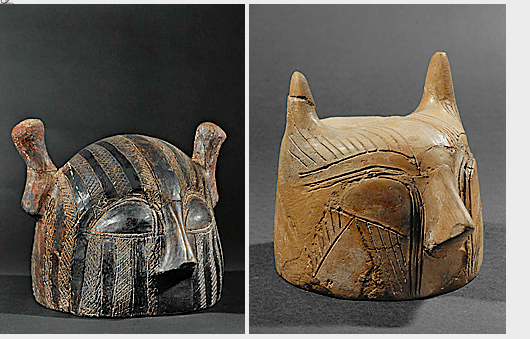
1.Zoomorphic head. Terracotta From Fafos site, Kosovska Mitrovica, Vinca Culture Neolithic (5th mill. BCE). Height 16.5 cm Inv. F-I-1181
NEOLITHIC MASK 10TH-5TH MILL.BCE
2.Cat-like, zoomorphic head. Terracotta From Belo Brdo site, Vinca, Serbia. Vinca Culture, Neolithic (5th mill. BCE). Height 8.3 cm Onv. 1482
NEOLITHIC MASK 10TH-5TH MILL.BCE
Neolothic masks
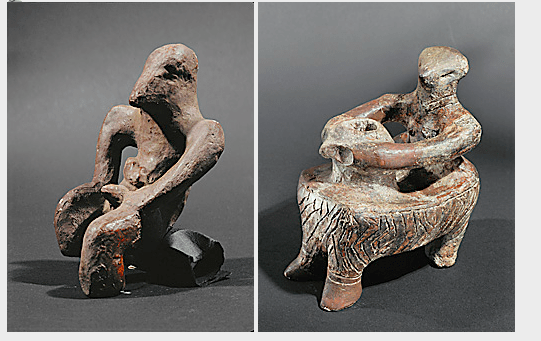
1.NEOLITHIC MASK 10TH-5TH MILL.BCE
Small mask, terracotta. From Predionica, Kosovo. Vinca-Plocnik Culture, Neolithic (5th mill. BCE). Height 16 cm Inv. 158
Kosove,Prishtin
2.Idol with phallus. Terracotta From Fafos I site, Kosovska Mitrovica, Kosovo Vinca-Plocnik Culture, Neolithic (5th mill. BCE). Height 7 cm
NEOLITHIC SCULPTURE 10TH-2ND MILL.BCE
3.NEOLITHIC ALTAR 10TH-5TH MILL.BCE
Altar-goddess, bench-like altar with anthropomorphic figure facing a receptacle or cult vessel. Terracotta From Fafos I site, Vinca, Kosovo. Neolithic, Vinca-Plocnik Culture (5th mill. BCE). Height 17.3 cm. Inv.
1.Archaeologists found 75-century-old copper tools and artifacts at Plocnik, near Prokuplje and 200 km south of Belgrade.
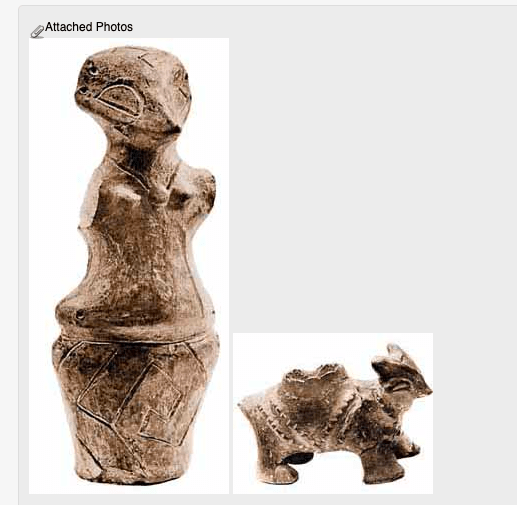
2.This Neolithic figurine found in the Plocnik archaeological site shows a girl in a short skirt and ornate top. (Reuters: Stevan Lazarevic)
Prehistoric women had passion for fashion. If the figurines found in an ancient European settlement are any guide, women have been dressing to impress for at least 7,500 years.
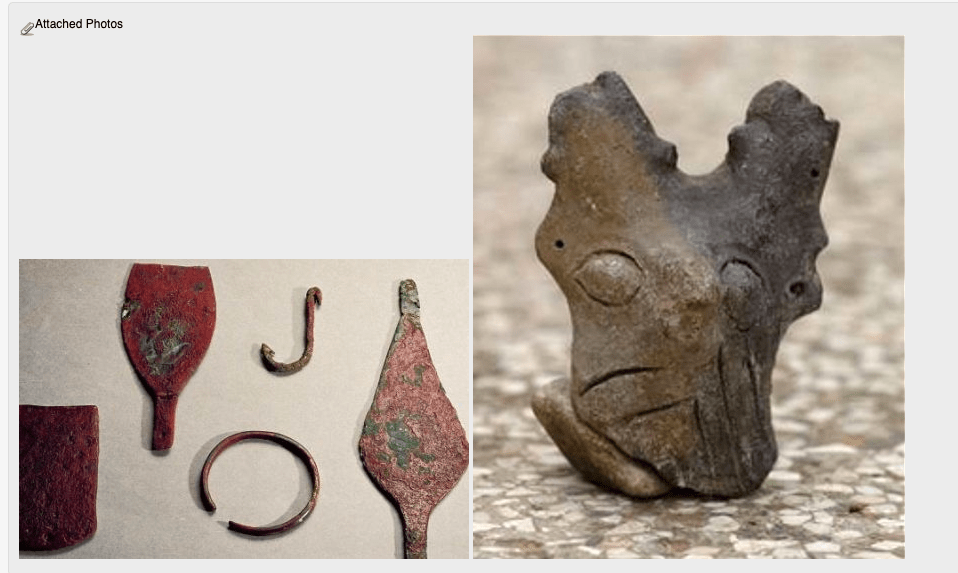
Hindustan Times writes: 75 century old copper tools
A “sensational” discovery of 75 century old copper tools in Serbia is compelling scientists to reconsider existing theories about where and when man began using metal. Belgrade (axes, hammers, hooks and needles) were found interspersed with other artefacts from a settlement that burned down some 7,000 years ago at Plocnik, near Prokuplje and 200 km south of Belgrade.
The village had been there for some eight centuries before its demise. After the big fire, its unknown inhabitants moved away. But what they left behind points to man’s earliest known extraction and shaping of metal.
“It really is sensational,” said Ernst Pernicka, a renowned archaeology professor at Germany’s Tuebingen University who recently visited the Ploce locality.
Scientists had previously believed that the mining, extraction and manipulation of copper began in Asia Minor, spreading from there. With the find in Plocnik, parallel and simultaneous developments of those skills in several places now seem more likely, Pernicka said.
Indeed, the tools discovered in southern Serbia were made some 75 centuries ago – up to eight centuries older than what has been found to date.
The site at Plocnik, believed to cover some 120 hectares in all, is buried under several metres of soil. Serbian archaeologists have so far exposed three homes – the largest of them, measuring eight by five metres, discovered this year.
The layer of earth it stood on is still blackened from the scorching heat that destroyed the village. It is unclear what caused the fire, but no damage that would indicate an outside attack has been found.
The huts collapsed on their contents, with mud bricks and ashes burying all that was inside – pottery, statues, tools and a worktable. After dusting the still embedded artefacts off, archaeologists began extracting them, most of all hoping to find more precious copper tools.
Scientists are debating whether the Plocnik village led the world to the Copper Age in the 6th millennium BC, particularly as remains of primitive copper smelters were recently found not far away, near today’s mines and smelters in Majdanpek and Bor.
The find, which stems from “certainly very, very early in the Copper Age”, was a very lucky one, said another expert from Tuebingen, Raiko Kraus.
The Ploce locality was discovered by railroad builders in 1927, but was largely disregarded until 1996, when serious excavations began, eventually yielding the sensational finds.
According to Krause, old settlements may similarly surface in eastern Anatolia when Turkey launches some massive earth-moving project, such as building a dam.
It remains unclear why a comparatively large quantity of copper tools were found at Plocnik. The head archaeologist on site, Julka Kuzmanovic-Cvetkovic, said that the village may have been a tool-making or trading centre.
There is also much more to be learned about the ancient inhabitants, apart from the key question of how man developed his tools.
“These people were not wild,” Kuzmanovic-Cvetkovic stressed, pointing to fine pieces such as statuettes. “They had finely combed hair and adorned themselves with necklaces.”
One statue of a woman shows her wearing some sort of a mini skirt. Others wore long and broad scarves. Kuzmanovic-Cvetkovic actually helped a Serbian fashion designer set up a show inspired by the clothes of the people who lived there millennia earlier.
Whatever remains to be found at Ploce and elsewhere, “mankind took a major step toward the modern era” during that time, Pernicka said.
Illyrian-Dardanian archaeological discoveries (Sandzak) and Serbia
Dardanian mound in PeshterNovi Pazar, October 26 – In the Pruzhan locality in Peshter, archaeologists from the Ras Museum in Novi Pazar have discovered urns for cremation of corpses, which are supposed to be older than 3 thousand years.Archaeologists assume that the urns belonged to the Dardanians.
The team of archaeologists from the Ras Museum has discovered a 3 thousand year old Dardanian mound on the Peshter plateau in the village of Pruzhn. The director of the Ras Museum, Dragica Premović-Aleksić, stated that this mound was used 1 thousand years before the new era.“
Cemeteries of cremated corpses have been discovered, which after burning in a wood pile were buried in urns,” stated Premović-Aleksić. These were burial sites, and based on the characteristics of the urns, it can be said that these cemeteries belong to the late Bronze Age, she added.
According to her, there are four skeletons in the mound, and in terms of ethnicity, they are Dardanians.” In this Bronze Age, the first known inhabitants of this territory are the Dardanians. This is a tribe that lived in the area of Macedonia, South Serbia, Kosovo up to here, and we are their southwestern border.” The Dardanians were a large and powerful tribe, one of the oldest in the Balkans,” said Dragica Premović-Aleksić.
Human metallurgy in the Balkans
The first evidence of human metallurgy dates from the 5th and 6th millennium BC, and was found in the archaeological sites of Majdanpek, Yarmovac and Plocnik, Serbia. To date, the earliest copper smelting is found at the Belovode site, these examples include a copper axe from 5,500BC belonging to the Vincha culture.
Other signs of human metallurgy are found from the third millennium BC in places like Palmela (Portugal), Cortes de Navarra (Spain), and Stonehenge (United Kingdom). However, as often happens with the study of prehistoric times, the ultimate beginnings cannot be clearly defined and new discoveries are continuous and ongoing.
Mining areas of the ancient Middle East. Boxes colors: arsenic is in brown, copper in red, tin in grey, iron in reddish brown, gold in yellow, silver in white and lead in black. Yellow area stands for arsenic bronze, while grey area stands for tin bronze.
Silver, copper, tin and meteoric iron can also be found native, allowing a limited amount of metalworking in early cultures. Egyptian weapons made from meteoric iron in about 3000 B.C. were highly prized as “Daggers from Heaven”.W. Keller (1963) The Bible as History page 156 ISBN 0 340 00312 X However, by learning to get copper and tin by heating rocks and combining those two metals to make an alloy called bronze, the technology of metallurgy began about 3500 B.C. with the Bronze Age.
The extraction of iron from its ore into a workable metal is much more difficult. It appears to have been invented by the Hittites in about 1200 B.C., beginning the Iron Age. The secret of extracting and working iron was a key factor in the success of the Philistines.
Historical developments in ferrous metallurgy can be found in a wide variety of past cultures and civilizations. This includes the ancient and medieval kingdoms and empires of the Middle East and Near East, ancient Egypt, ancient Nubia, and Anatolia (Turkey), Ancient Nok, Carthage, the Greeks and Romans of ancient Europe, medieval Europe, ancient and medieval China, ancient and medieval India, ancient and medieval Japan, etc.
Of interest to note is that many applications, practices, and devices associated or involved in metallurgy were possibly established in ancient China before Europeans mastered these crafts (such as the innovation of the blast furnace, cast iron, steel). However, modern research suggests that Roman technology was far more sophisticated than hitherto supposed, especially in mining methods, metal extraction and forging. They were, for example, expert in hydraulic mining methods well before the Chinese.
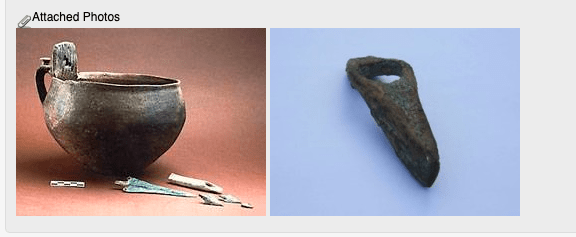
Axes, hammers, hooks, and needles from the Copper Age (over 7,000 years ago) have been discovered in pre-Slavic and Pre-Serbian regions of what constitutes modern day Serbia
Prompting scholars to reconsider theories about when humans began using copper. Seven thousand years ago, in Plocnik, 200 kilometers from Belgrade, there was a village that stood for 800 years before being destroyed by a fire.
Following this event, the inhabitants abandoned the area, leaving behind, however, a series of copper artifacts, the oldest known of their kind in the world. The village extended over an area of 120 hectares. So far, several houses have been unearthed, the largest of which measures 8 by 5 meters. In addition to the figurines, statuettes depicting the ancient villagers have also been found.
These are quite accurate depictions, demonstrating how much the ancient inhabitants cared about their appearance and their jewelry. One of them shows a woman in a miniskirt.
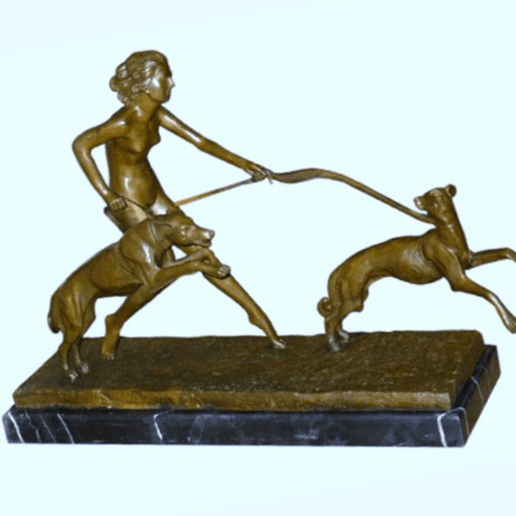
Archaeologists discover sculpture of Diana, Goddess of hunt in Serbia
Belgrade, July 22 (ANI): Archaeologists have discovered a sensational sculpture, which they think is of Diana, the Goddess of the hunt, in Serbia.
According to Blic, the sculpture was uncovered at the site of the ‘Felix Romuliana’, an imperial palace near the Town of Zajecar, Serbia by German experts of the Archaeology Institute in Frankfurt, together with the colleagues of the Archaeology Institute in Belgrade.
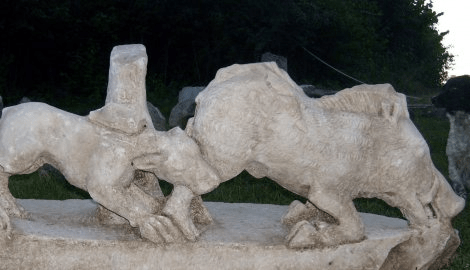
Experts said that the sculpture – which is missing a horse and a rider – symbolizes victory by Rome over barbarians. The team believes that this discovery is absolutely precious not just for studying of the ‘Romuliana’, but for the world culture as well.
Archaeological gem is unique in Balkans
Zajecar, Serbia – At the late Roman archaeological site called Felix Romuliana a newly-discovered marble statue was revealed yesterday. Experts are unison in their estimates the statue is of immense scientific value.
However, archaeologists cannot state with certainty what the statue represents. Some claim it is most likely Goddess Diana, while others maintain it is a Thracian horseman. There is also a limited possibility, as experts say, that the chunks and slabs of marble recovered in the vicinity of the statue will be reassembled into a whole that could reveal the mystery of the dog biting a wild boar.
On the occasion of the find, Blic has talked to senior scientific associate for the archaeological collection at the Faculty of Philosophy in Belgrade, Miroslav Lazic and Miomir Korac, a scientific adviser at Belgrade’s Institute of Archaeology.
Gerda Sommer-von Bülow, PhD, of the Archaeological Institute in Frankfurt, Germany was thrilled yesterday about the find and said in her reaction:- “On Saturday around noon we discovered a piece of marble lying in the ground and it was clear to us we simply had to finish the work and see what the piece is all about.
With surprise and an adrenalin rush, we completed the work around 6pm, and all the while we talked to each other and kept guessing what the find might be. We finally lifted this marvellous sculpture and came to a conclusion that it was most likely to be a Thracian horseman. So far we have only had reliefs of Thracian horsemen, but very few upright sculptures.
We don’t know the exact time of its manufacturing and whether it was 2nd or 3rd century AD,” said Bülow.The sculpture itself is 1.1m long, 50cm tall and has had many an archaeologist perplexed as there is no horse or a horseman. This is the reason some experts believe that it is not a Thracian horseman which is missing, but actually Goddess Diana, who was ancient Roman religion the goddess of the hunt.
Judging by the symbols on the sculpture surface, it could represent Goddess Diana hunting, as suggested by Maja Zivic, MA in archaeology, of the National Museum in Zajecar.
Viminacium
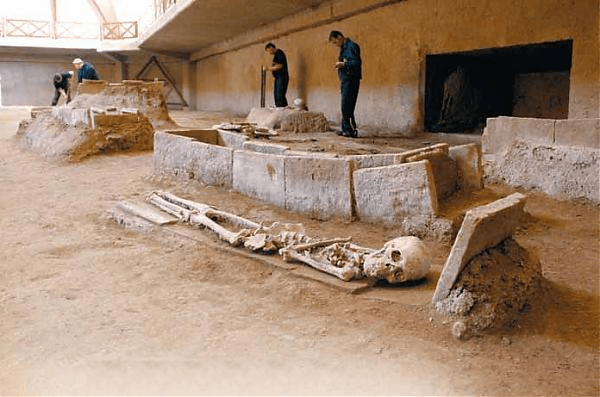
Viminacium (VIMINACIVM) was a large city (provincial capital) and military camp of the Roman province of Moesia (present-day Serbia), and the capital of Moesia Superior. The archaeological site occupies a total of 450 hectares. The archaeological site occupies a total of 450 hectares. The city dates back to the 1st century AD and contains archaeological remains of temples, streets, squares, amphitheatres, palaces, hippodromes and Roman baths.
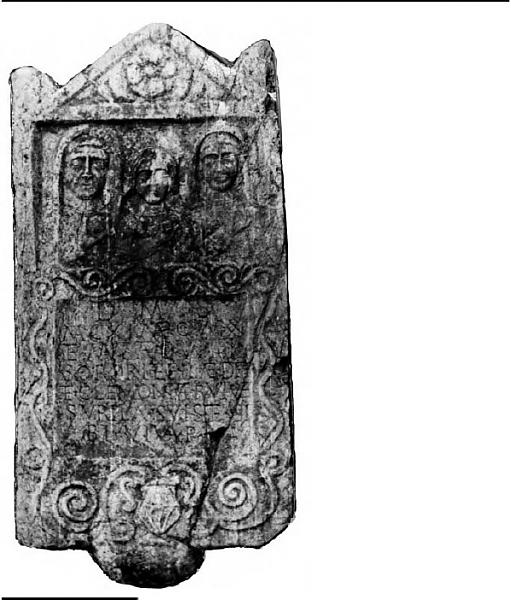
- Gravestone from Kolovrat by Prijepole
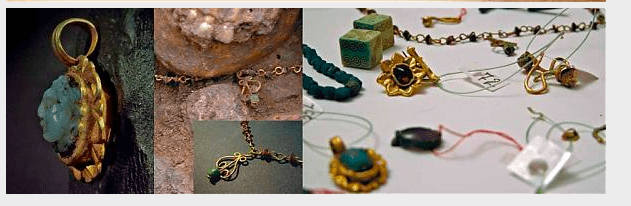
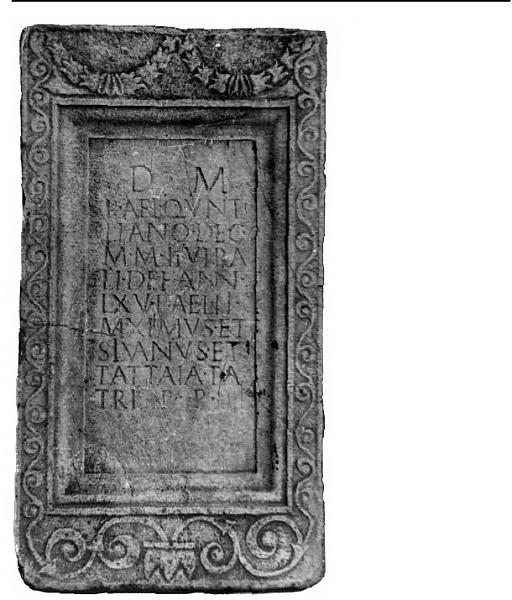
2. Grave monument o f decurion P.Aelius Quintilianus
Sources
Keys, David. 2010. “The First Industrial Revolution.” The Big Issue, March 2010. (History section).
Radivojević, Miljana, Thilo Rehren, Ernst Pernicka, Dušan Šljivar, Michael Brauns, and Dušan Borić. 2010. “On the Origins of Extractive Metallurgy: New Evidence from Europe.” Journal of Archaeological Science 37 (11): 2775–2787. (This and related papers form the basis of the Proceedings of the National Academy of Sciences coverage referenced in the article).
Radivojević, Miljana, and Julka Kuzmanović-Cvetković. 2014. “Copper Minerals and Archaeometallurgical Materials from the Vinča Culture Sites of Belovode and Pločnik: Overview of the Evidence and New Data.” Starinar 64: 7–30.
Radivojević, Miljana, Benjamin W. Roberts, Miroslav Marić, Julka Kuzmanović-Cvetković, and Thilo Rehren, eds. 2021. The Rise of Metallurgy in Eurasia: Evolution, Organisation and Consumption of Early Metal in the Balkans. Oxford: Archaeopress.
Pernicka, Ernst. Quoted in news reports on Pločnik finds (circa 2007–2010). See also his contributions in the scientific volumes above.
Kuzmanović-Cvetković, Julka. Various statements and excavation reports on Pločnik site (Prokuplje, Serbia), 1990s–2010s. (Head archaeologist at the site).
“75 Century Old Copper Tools Found.” Hindustan Times, circa 2007–2008. (Reporting on Pločnik discoveries).
Blic (Serbian daily). Various articles on Felix Romuliana (Diana statue) and Pločnik, 2000s–2010s.
Reuters / Stevan Lazarevic. Photographs and reports on Neolithic figurines from Pločnik.
Antonović, Dragana. “Prehistoric Copper Tools” Research publications on prehistoric metallurgy.
Reports on Vinča culture sites (Belovode, Pločnik, Fafos, Predionica, etc.), including terracotta figurines and idols.
Krause, Raiko (Tübingen University). Comments on early Copper Age finds at Pločnik.

