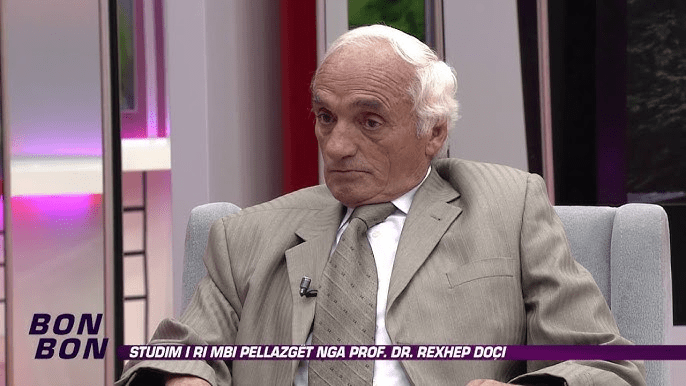

by Prof. Dr. Rexhep Doçi
Before 1200, many Albanian churches and monasteries were built throughout Kosovo, and of course they cannot be called Serbian churches today, but churches usurped by those few Serbs, who were Albanians but did not convert to Islam, and over time as Orthodox Albanians around the powerful medieval churches became Serbian.
The presence of Illyrian-Albanians or Dardano-Albanians of the Catholic and Orthodox rite in the Sandzak of Niš is also convincingly evidenced by the fact that the famous Albanian priest and writer Pjetër Budi, born in Mat in Albania, participated in the “Assembly held in 1616 in Prokoplje (present-day Prokupla-RD), and that Budi was among the organizers of this Assembly” (See “History of Albanian Literature”, I-II, Prishtina, 1968, p. 160).
Also, in that part of the Sandzak of Niš, where Skanderbeg participated in the war of the European allies and from there returned to his birthplace in Krujë (which fought against the Ottoman Empire for a quarter of the 15th century), later Hasan Zyko Kamberi from the village of Starje in Kolonjë in Southern Albania, “in 1789, at an advanced age, participated as a mercenary in the Turkish-Austrian war, in Semender (Smederevë above Niš-RD) on the Danube, who suffered greatly in this war…” (See also the book Hist. letër. shqipe, p. 206).
All medieval Orthodox churches in Kosovo and in today’s Serbia were Illyrian-Albanian
Many works by Serbian, Croatian and Albanian authors (such as Fanulla Papazoglu, Dr. Milan Shuflajt, Ilarion Ruvarac, Lj. R. Kozheljac, etc.) also speak about the Illyrian-Albanian continuity or the autochthonous nature of Albanians in Serbia, but we are not talking about it in more detail here.
So, it is clear that a full nine or thirteen centuries before the arrival of the Serbian rulers and the conquest of the lands and usurpation of the Albanian churches of Kosovo, Illyrian-Albanian Christianity had flourished in Dardania-Kosovo, a conclusion that is also confirmed by the Charter of Hilindar of the year 1200, when even the first crowned Shtjefen Nemanjidi conquered the Albanian lands of Kosovo (See: AV Solovjev, Charter of Hilandar of the great governor, Stefan, the first crowned, of the year 1200-1202, Belgrade, 1926, p. 6: “).
Thus, as Albanian land should be understood the land with Albanians of the Catholic confession, while as Greek land – lands inhabited by Orthodox Albanians, and, as can be seen nowhere in this document, even though Slav-Serbs, Serbs are not mentioned.
Therefore, during this medieval pre-Slavic period, before the year 1200, churches and monasteries were built numerous in Kosovo villages and towns as Albanian churches, and of course they cannot be called Serbian churches today, but churches usurped by those few Serbs, who were Albanians but did not convert to Islam, and over time as Orthodox Albanians around the powerful medieval churches later became ethnically Serbs.
The pre-Slavic Christianity of the Illyrian-Albanians in Dardania-Kosovo is convincingly proven by the fact that, since the beginning of the 2nd century AD, during the rule of the Roman Empire, Christianity spread through the Dardanian Christian martyrs Floris and Lauris (see the above work of G. Gjini, p. 23).
Meanwhile, therefore, the data of written sources, especially the field, clearly show that the local Serbs of Kosovo, or as it is used in the Albanian tradition of Kosovo, shkiet rajë, are not of genuine Slavic-Serbian origin, but are a population with a more Thracian than Illyrian origin, remaining as a remnant around some powerful medieval churches.
The Ottoman-Turkish invaders destroyed (destroyed-disappeared) the Catholic rite churches in Kosovo, while some Orthodox churches were not touched, having a respect for the Orthodox religious temples centered in Istanbul, and around them remained a part of the Thracian-Illyrian-Albanian population that was not Islamized, which, while passionately preserving the Orthodox Illyrian-Albanian Christianity, over time during the 17th-18th centuries were also defined as Serbs to this day.
The Serbs of Kosovo have tribes like the Albanians
But, around these churches, some Albanians of the Catholic rite, indirectly protected by these Orthodox churches, who lived and still live in the same neighborhood or courtyard with the Serbs and have many common and identical elements inherited from generation to generation, remained un-Islamized.
This data is convincingly proven even today in the Kosovo terrain, such as in the villages of Llapushë, around the churches in Dollc, Dersnik, Pogragjë, Klinë, as well as in the cities of Pejë, Perzeren and Prishtinë, and there is a lot of such data in Albanian lands, waiting to be collected and scientifically illuminated.
So, around these powerful medieval churches, in these settlements live inhabitants of the Catholic rites (Catholic Albanians), Orthodox (Orthodox Serbians) and Muslims (Albanians and in the cities of Perzeren and Prishtinë also Turks?), who speak all three languages).
Then, that the ancestors of the Serbs of Kosovo were Albanians is proven by ethnographic and ethnological data, that their elders spoke, and still speak today, Albanian like the Albanians, who preserved it as a relic of the language of their ancestors as their mother tongue (while the elders of the Albanians did not know and do not know Serbian today).
The native Serbs of Kosovo have tribes like the Albanians: Gashiç, Shaljiç, Kastratoviç, etc. The Serbs still have Illyrian-Albanian patronymics today like the Albanians: Baciç, Maziç, Baliç, Luliç, Maletiç, Dashiç, Bardiç, etc. They have and use common or the same Christian elements as the Albanians of the Catholic confession, which originate from the Roman-Albanian pre-Slavic period, etc.
They have and use many words and micro-toponyms and patronymics of Latin and Greek origin, which they acquired during the pre-Slavic period. The plates found in some churches are written in Latin: for example, in the Church of Graçanica, which even today has some Roman writings on the foundations above the ground (see for this: M. Gjurgjevič, Memoare nga Balkani, 1858-1878, Sarajevo, 1910, p. 54:
“The foundations of that church were built on the slabs of the Roman cemetery….., therefore, names, years, etc. can be read on them, in Latin”), as well as on two plates found in the courtyard of the Orthodox Church, now Serbian, of Dersnik (a well-known Illyrian municipality), which are written in Latin, one of which the Albanians took and sent to the present-day Albanian church of Zallkuqan (Zllakuqan).
Therefore, it is clearly seen that the foundations of the Church of Gracanica and the slabs of the Church of Dersnik (which the Albanians said was ours, we call it Shën Premtja and the Serbs usurped it and made it “Sveti Petka”, like a church of Perzeren), are written in Latin and not Byzantine-Greek or Slavic-Serbian, i.e. they are of pre-Slavic Roman-Albanian origin.
Sources
Bota.sod
“History of Albanian Literature”, I-II, Prishtina, 1968, p. 160.
M. Gjurgjevič, Memoare, Balkani, 1858-1878, Sarajevo, 1910, p. 54:
Work of G. Gjini, p. 23.
A.V. Solovjev, Charter of Hilandar of the great governor, Stefan, the first crowned, of the year 1200-1202, Belgrade, 1926, p. 6.
Hist. letër. shqipe, p. 206.

