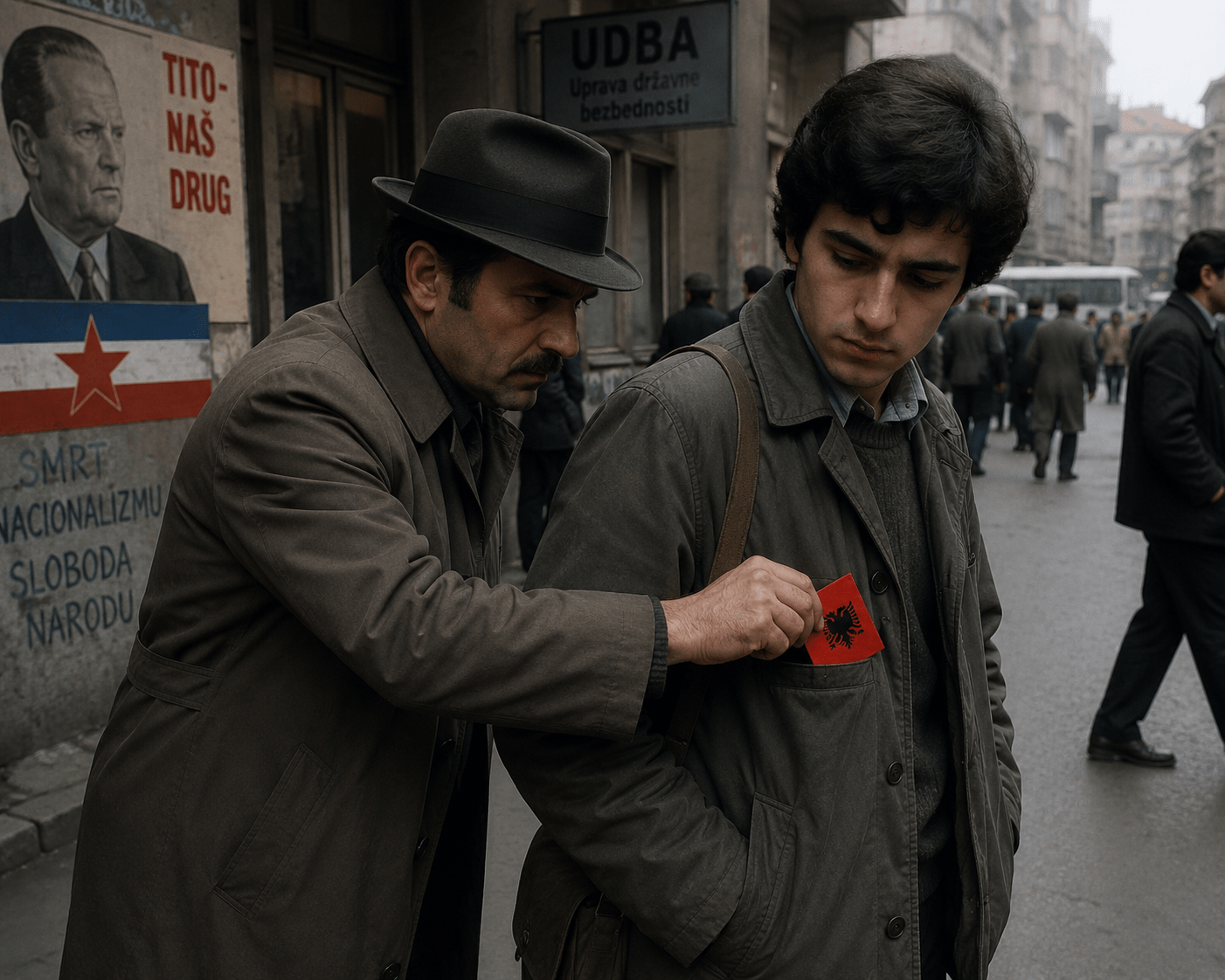

During the decades of Yugoslav rule over Kosovo, ethnic Albanians — who formed the overwhelming majority of the population — frequently reported systemic discrimination, surveillance, and outright oppression by Serbian-dominated security forces and the Yugoslav secret service, known as the UDBA (Uprava državne bezbednosti).
Among the more insidious methods employed were entrapment operations involving the planting of small Albanian flags or other nationalist symbols on individuals. These tactics, according to accounts from the period, provided pretexts for arrests, interrogations, beatings, and long-term imprisonment under charges of “irredentism,” “nationalism,” or “hostile activity against the state.”
The Context of Oppression
Kosovo Albanians faced varying degrees of marginalization throughout the socialist Yugoslav period, with periods of relative liberalization (notably after the 1960s constitutional changes that granted more autonomy and cultural rights) followed by sharp reversals, especially after the death of Josip Broz Tito in 1980 and the rise of Serbian extremism under Slobodan Milošević in the late 1980s.
Albanian-language education, media, and cultural expression were tightly controlled. Displaying the Albanian national flag (the black double-headed eagle on red) was heavily restricted or banned in earlier decades; even later permitted variants often required socialist symbols like a red star. Public expression of Albanian identity could be treated as subversion, especially amid fears of irredentism — the desire for unification with Albania or greater autonomy.
The UDBA and local police maintained extensive informant networks, conducted warrantless searches, and monitored Albanian intellectuals, students, military recruits, and civilians suspected of nationalist sympathies. In this climate, entrapment became a tool to manufacture “evidence” and justify crackdowns.
Methods of Planting and Entrapment
According to survivor testimonies and Albanian historical narratives from the era:
Targeting Vulnerable Groups
Operations reportedly focused on Albanian students (particularly at the University of Pristina), young men during mandatory military service (JNA), teachers, and other civilians. These individuals were seen as potential vectors for spreading nationalist ideas.
The Planting Technique
Agents or undercover officers would surreptitiously place small, easily concealable Albanian flags — often miniature paper or cloth versions — into the pockets, bags, or personal belongings of targets during encounters like routine stops, gatherings, or searches. In some accounts, this occurred in crowded settings, buses, or during home raids where items could be introduced unnoticed.
The Search and “Discovery”
Shortly afterward, a formal search would be conducted. The planted flag served as instant “proof” of illegal nationalist activity. Victims were then accused of possessing banned symbols, distributing propaganda, or belonging to underground groups.
Escalation
Interrogations often involved physical abuse, psychological pressure, and demands for names of “co-conspirators.” Refusal to confess could lead to extended detention, prison sentences (sometimes years in facilities like Goli Otok or other camps in earlier periods), loss of jobs, or expulsion from education. Families could face collective punishment, including harassment or economic marginalization.
These methods mirrored broader UDBA practices of infiltration, provocation, and fabricated cases used against other perceived threats to Yugoslav unity, including other nationalities. Weapons-planting or forcing purchases of arms to later “discover” them were also reportedly employed in some operations.
Broader Patterns of Discrimination and Lies
This flag-planting was part of a larger apparatus of control:
Surveillance State
Widespread informants created an atmosphere of paranoia. Albanian homes and institutions were raided for “subversive materials.”
Media and Propaganda
Yugoslav state media often portrayed Albanian protests (e.g., the 1981 demonstrations demanding republic status) as foreign-inspired threats, justifying further repression. Serbian petitions in the 1980s lied about Albanian “terror” against Serbs, calling for removal of Albanian symbols.
Economic and Social Marginalization
Albanians faced barriers in employment, especially in security forces and higher administration, which were Serb-dominated. Serbian colonization efforts historically aimed to alter demographics.
Lies and Justification
Authorities denied systemic bias, framing actions as defense of “brotherhood and unity.” Post-facto, incidents were spun as Albanian extremism, while provocations by agents were concealed. Similar tactics appear in other authoritarian contexts where security services manufacture threats to legitimize power.
The late 1980s saw escalation: Milošević revoked Kosovo’s autonomy in 1989, leading to mass dismissals of Albanians from public jobs, closure of Albanian-language institutions, and eventual armed conflict in the 1990s.
The planting of symbols as pretext echoes classic agent provocateur strategies used worldwide to disrupt minority movements. For Kosovo Albanians, such experiences contributed to the deep distrust of Belgrade authorities and the push for self-determination that culminated in the 1998–1999 war and Kosovo’s 2008 declaration of independence.
Today, the Albanian flag remains a potent symbol of identity for many Albanians, flown alongside or instead of the official Kosovo flag in many contexts — a reminder of unresolved historical grievances and the enduring power of national symbols under oppression. Understanding these tactics sheds light not only on Yugoslavia’s dissolution but on how states manufacture internal enemies to maintain control.
Sources
U.S. Department of State. “Ethnic Cleansing in Kosovo.” April 1999. https://1997-2001.state.gov/regions/eur/rpt_990413_ksvo_ethnic.html.
The History, Culture and Identity of Albanians in Kosovo. Refworld. https://www.refworld.org/reference/countryrep/irbc/1997/en/94646.

