
Prevalence of Criminal Suspects Among Serbian Nationals in Austria: Evidence from the 2022 Polizeiliche Kriminalstatistik.
Conclusion
Serbian nationals were among the top foreign groups by absolute number of crime suspects in Austria in 2022 (~9,965–10,000 suspects). On a per-capita basis, they showed a significantly elevated rate of ~8.19% (suspects relative to the resident Serbian population of ~121,600), compared to 2.35% for Austrian nationals. This represents roughly 3.5 times higher involvement in the suspect pool relative to population share.
Introduction and Data Sources
This analysis examines the representation of Serbian nationals among crime suspects in Austria using official 2022 data from the Austrian Federal Criminal Police Office (Bundeskriminalamt, BK) Polizeiliche Kriminalstatistik (PKS) 2022 and supporting population statistics from Statistik Austria.
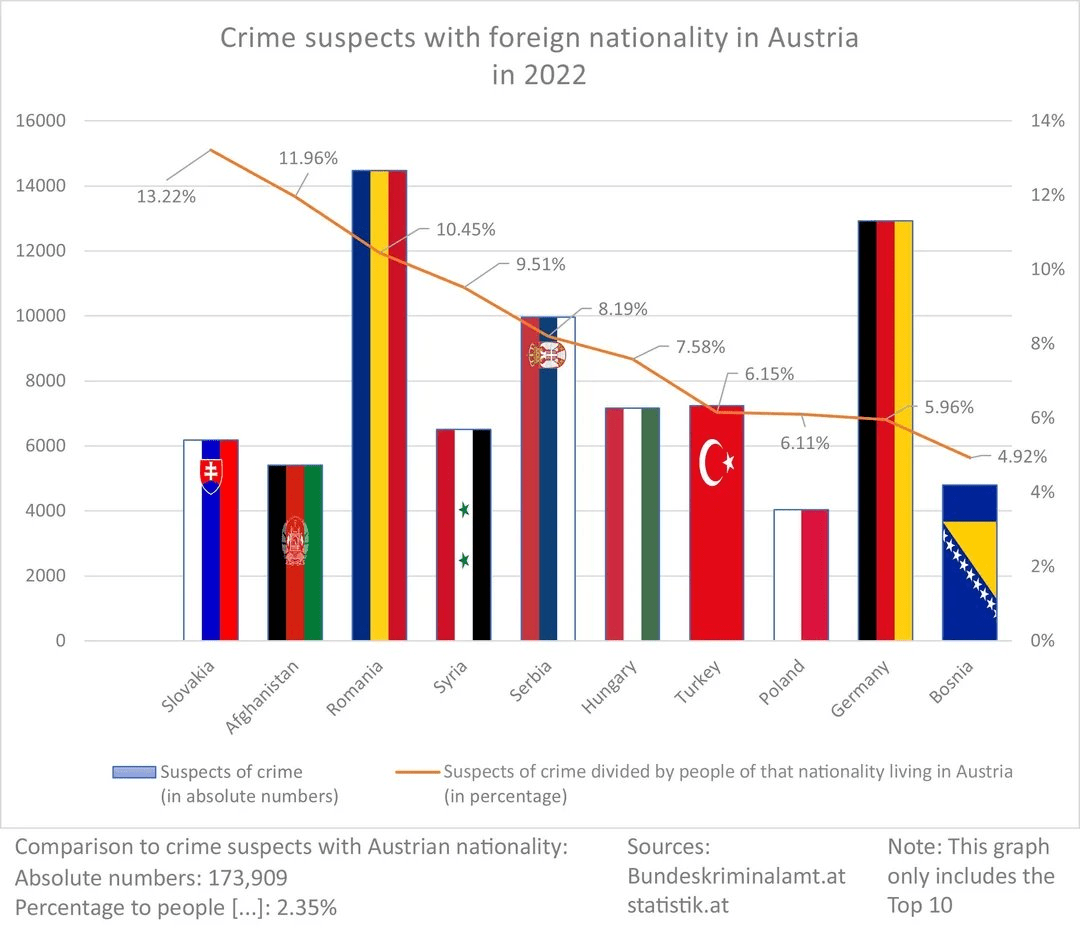
The provided graph visualizes the top 10 foreign nationalities by absolute number of crime suspects (blue bars) and a per-capita rate (orange line: suspects divided by the estimated resident population of that nationality in Austria). Austrian nationals serve as the baseline for comparison.
Key official figures for 2022 (PKS):
Total crime suspects in Austria: ~302,530.
Austrian nationals: 173,909 suspects (~2.35% of the Austrian resident population).
Serbian nationals: Approximately 9,965–10,000 suspects (per PKS details and graph).
Absolute Numbers
Serbian nationals ranked among the top foreign nationalities in absolute suspect counts in 2022, with roughly 9,965–10,000 individuals identified as suspects. This placed Serbia behind Romania (~14,468) and Germany (~12,919) but ahead of Turkey, Hungary, and others in the top 10.
Foreign nationals overall accounted for a significant share of suspects (~42.5% in 2022, up from prior years), despite comprising a smaller portion of the total population.
Per-Capita Prevalence (Rate)
The graph highlights a notable overrepresentation when adjusted for population size. The orange line shows an 8.19% rate for Serbian nationals (suspects as a percentage of the Serbian resident population in Austria).
For context:
Austrian nationals: 2.35%.
This indicates Serbian nationals had a rate approximately 3.5 times higher than the Austrian average in the provided metric.
Population baseline: Around 121,613 Serbian nationals lived in Austria in 2022.
Rough calculation (using ~10,000 suspects / ~121,600 residents) aligns with the graph’s ~8.19% figure. This is a suspects-to-population ratio, not a conviction rate or crime commission rate per se.
Important Caveats and Context
Suspects, not convicted offenders: PKS is an incident-based statistics of police-reported crimes and identified suspects. Not all suspects are convicted; some cases are dropped, and multiple suspects can be linked to one crime (or one person to multiple crimes).
Geographic concentration
Crime is often higher in urban areas like Vienna, where certain migrant groups (including Serbs) are concentrated. In Vienna, Serbs have reportedly ranked high in some suspect lists.
Types of offenses
Data does not break down by specific crimes here, but broader Austrian and European patterns show variations by nationality (e.g., property crimes, organized crime networks, vs. others). Foreign suspects include tourists/transients in some cases, though less so for established groups like Serbs.
Interpretation
In 2022, Serbian nationals in Austria showed substantial overrepresentation in police crime suspects both in absolute terms (top 5 foreign groups) and especially on a per-capita basis (~8.19% vs. 2.35% for Austrians). This indicates a higher prevalence of involvement in the criminal justice system as suspects for this group relative to population size.
Such disparities are well-documented in migration-crime research across Europe and warrant nuanced policy responses: targeted prevention, integration programs, socioeconomic support, and effective law enforcement. Correlation with nationality does not imply causation by ethnicity; confounding variables (age, gender, poverty, education, family structure, cultural norms, discrimination, and policing biases) must be considered in any rigorous study.
Primary Sources:
Bundeskriminalamt (BK) Austria: Polizeiliche Kriminalstatistik 2022 brochure.
Statistik Austria (population and judicial stats).
Graph data aligns with these official releases.
For the most current or detailed breakdowns (e.g., by offense type), consult the latest PKS reports from bundeskriminalamt.at or statistik.at. Further multivariate analysis would be needed for deeper causal insights.
Conclusions
1. Clear Statistical Overrepresentation
Serbian nationals were among the top foreign groups by absolute number of crime suspects in Austria in 2022 (~9,965–10,000 suspects). On a per-capita basis, they showed a significantly elevated rate of ~8.19% (suspects relative to the resident Serbian population of ~121,600), compared to 2.35% for Austrian nationals. This represents roughly 3.5 times higher involvement in the suspect pool relative to population share.
This pattern holds in the official PKS data and the provided graph for the top 10 nationalities.
Overall
The 2022 data demonstrates a real and substantial overrepresentation of Serbian nationals among crime suspects in Austria, both absolutely and per capita.

