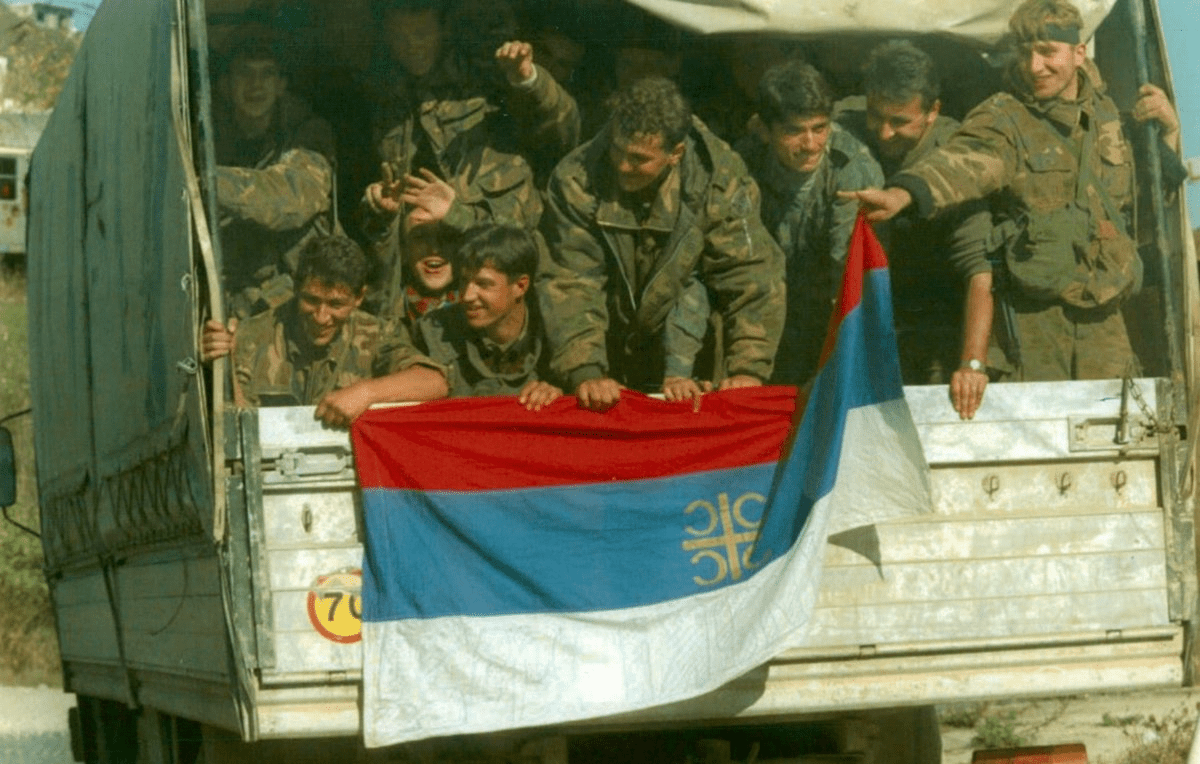

Between 1848 up to 1999, through out various periods of conflict involving Serbians troops, there were documented and reported cases of Serbian troops cutting of the genitals of either wounded or dead soldiers or during torture. These accounts occurred in 1848, in 1915-1916 during World War One, and during the Yugoslav wars of 1991-1999. The victims were Hungarians, Austro-Hungarians, Bosnians, Croats and Albanians.
1848-1849
“Mutilations, the cutting off of the nose, ears, and genitals, are a specifically Serbian-Montenegrin custom. We Hungarians experienced this first-hand in 1848 and 1849. As for the uprising, it continued to smolder and grew ever larger. It found recruits and support from the aforementioned neighboring countries. If the insurgents were defeated, they retreated into the mountains or across the border, preferably across that of Montenegro.”

Source
“Eine turkische Reise. “Die” Consulargerichtsbarkeit. Turkische und Egyptische Justiz. Das internationale Recht und dessen Reform. Postalische Zustande in der Turkei. Turkisch-Serbische Imterhaltungen in den Herculesadern bei Mehadia (1876). Die turkischen Frauen. Volume 3. p.166. 1877
1916: Serbian soldiers cut off genitals of wounded Austro-Hungarian soldiers
“Telegram. Location of the Imperial and Royal Army High Command, September 3, 1914. Serbian atrocities. Continued. Genital amputation probably occurred while the victims were still alive in two cases. In one man, the abdomen was slit open, the intestines were torn out, and the abdominal cavity was filled”.
1915: Serbian soldiers cut off genitals from Austro-Hungarian soldiers
“After the battle, we patrolled the area to bury any dead. In a barn, we found the Landesschützen (local rifleman) Giovanni Andreolli of the 4th Field Company with his abdomen slashed open and his genitals cut off. We wrapped him in a tent leaf and buried him not far from where he was found.”
Source: Bizonyítékok az ausztria-magyarországgal hadat viselő államok által a nemzetkőzi jogon ejtett sérelmekről Lezáratott 1915. január 31-ikével. Volume 1. Austria. Ministerium des Äussern. 1915
Source: Die Lügen über die österreichisch-ungarische Kriegführung in Serbien. Hans Gross. 1916 p. 18
1995: Serbs cut off genitals from Bosniak civilians
“The Bosnian soldiers were almost constantly brought to a room in the “white house.” He could see through a glass door how men were being beaten. Their noses were severed, their noses cut off, and their genitals torn out. It was the worst thing I have ever seen, and I saw it with my own eyes.”
Source: Ethnische Säuberung–Völkermord für Grossserbien eine Dokumentation der Gesellschaft für bedrohte Völker. Gesellschaft für Bedrohte Völker. 1993. p. 91.
Genital mutilation of Bosniak civilians at the Vuk Karadzic school
“The Vuk Karadzic School was also converted into a camp. About 2,000 Bosniaks were rounded up in Bratunac on May 9 and transported to the school grounds. Between 500 and 600 prisoners were locked in the gymnasium. Those who couldn’t fit inside were executed outside. Almost all the detainees were mistreated, mostly beaten. Several dozen died as a result of the beatings they suffered on the first night.
An imam was beaten to death when he refused to make the sign of the cross in the Serbian manner (with three fingers). One building served as a torture chamber where a large number of internees died Survivors reported that the dead had their noses and genitals cut off, their eyes gouged out, and crosses carved into their skin.
The prisoners, suffering from chronic malnutrition, were forced to bury their dead compatriots and clean up pools of blood. Around mid-May, a group of internees was taken from the hall, beaten, crammed into garbage containers, and then set on fire. The containers were positioned under the hall’s windows so that the smoke could enter.”
Source: Unter unseren Augen ethnische Reinheit : die Politik des Regime Milosevic und die Rolle des Westens. Hajo Funke, Alexander Rhotert. 1999. p. 154
1999: Serbs torture Albanian civilians through genital manipulation
“Murat B. had returned to Kosovo in the spring. He recounts what he experienced in July 1990: On the evening of the 13th, Serbian police shot at him, but because of the darkness, he was unharmed. The next day, however, he was arrested by Serbian police officers. A ten-member reception committee was waiting for him at the Peć police station. He was beaten and kicked with boots, losing his front teeth.
He was then forced to walk in circles in a cell for 24 hours. If he collapsed from exhaustion, he was “helped up” with a dousing of water and kicks from his boots. After that, he was allowed to sit for three to four hours, go to the toilet once, and drink water. Then, his hands and feet were shackled to an oversized chair. He was abused with beatings, finger twisting, genital manipulation, and electric shocks (an electrode was held to his ear).
On the third day, he was beaten unconscious again and later transferred to prison. The Municipal Court – Quick Court – in Pec had already sentenced him on the 14th, at the request of the Pec Prosecutor’s Office, to 30 days in jail under the Law on Public Peace and Order.”
Source: Schillerpromenade 27 12049 Berlin EIN HAUS IN EUROPA. Zum Wandel der Großstadtkultur am Beispiel eines Berliner Mietshauses. 2013. p.177
Serbian torture of Croats
“The violence of Serbian combat units came to light: 21 Croatian police officers drove towards the village in a homemade armored vehicle to conduct a check. About half a kilometer from the village, they came to a barricade, which they cleared with their vehicle. At that very moment, they were fired upon with a grenade, and a firefight ensued. The police officers had accidentally stumbled into the line of battle and were suddenly surrounded by 600 Chetniks.
After several hours of fighting, 18 police officers were captured; the others were dead. The 18 prisoners were brutally tortured to death. They were stabbed with a knife, then with a screwdriver. Their noses, ears, and genitals were cut off. They were bound with wire and tortured. And some were pushed under the tank and run over.
Almost the entire population of Kusonje, mainly Serbs, was present at this massacre. They could do whatever they wanted with the bound people. They pissed on them, they beat them with everything they had. This massacre only involved the 18 police officers, but in the villages there were a total of about 150 prisoners, Croats, Czechs, Hungarians…”
Source: Vom Vorurteil zur Gewalt Politische und soziale Feindbilder in Geschichte und Gegenwart. Wolfgang Benz. 2020. p. 204

