
1. Geographical position
The village of Raincë is a settlement in the municipality of Preševo and lies north of the Preševo Valley.
The village of Raince is located between Presheva and Bujanovac and is a connecting bridge between these two municipalities.
The village of Raince is one of the largest villages in the municipality of Presevo. Raince is located at kilometer 12 of the regional road Presevo-Bujanovac, while the distance from the city of Bujanovac is 14 km. northeast of the city of Presevo. The village is located northeast of Presevo and south of Bujanovac.
It is bordered to the north by the village of Letovicë in Bujanovac, to the east by Samolicë in Bujanovac, to the south by Corrotica in Preševo and to the west by Garë in Preševo. It lies in the valley of the Rainca River, at the foot of the Karadak Mountains, on the western part of the Belgrade-Niš-Skopje highway. The village’s altitude is 463 m.
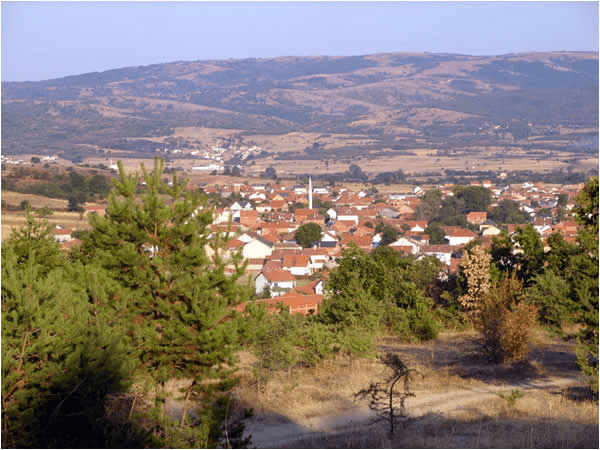
View from the village of Raince
Rainca is a bridge between Bujanovac and Preševo, in terms of territorial and ethnic population.
The village of Raincë lies at the foot of the Karadak Mountains, while its plain lies in Moravicë, mainly in the western part of the Vranje-Preshevo-Kumanovo Highway and is a continuation of the Preshevo Valley.
Rainca has good transportation roads, it is connected to the Belgrade-Vranje, Preshevo-Skopje highway. The regional road Llojan-Miratoc-Preshevo, Rainca-Bujanovac and other local roads pass through Rainca.
The village is located in a valley, between two hills. The Blood River, as the villagers call it, flows through Raince, which at the head of the village meets the Big River and the Small River.
Professor Hajredin Neziri divides the distribution of villages in comparison to the urban center of Presheva into four bands /4/, according to the distance of the settlement from the main roads, according to the distance of the settlement from the city. /Hajredin Neziri, Distribution of villages in comparison to the urban center of Presheva, Presheva, Panorama, no. 2, 2000, p. 70/
Rainca belongs to the second generation settlements, which, in addition to this village, also include: Miratoci, Strezoci, Gerajt, Golemidolli, Lerani, Bukoci, Bukuroci, Corrotica, Gosponica, Garja, Buhiçi, Ilinca, Maxherja, Caravajka, Kurbalija, Staneci and Shoshaja e Epërme ee Poshtme.
These settlements are located 5 to 10 km from the city of Presheva. The second generation is the largest in terms of the number of settlements, inhabitants and families.
Jovan Trifunoski, the village of Raince is located in Karadak of Presevo, the village is in a favorable geographical position. Located north of Presevo. Raince borders on the north with Bërçec and the settlement of Bujanovac, Letovicë, on the east with Samolicë of Bujanovac, on the south with Corrotica, Shoshaja e Epërme and Bukoc, and on the west with Garë.
Jovan Hadzi-Vasilevic places Rainca in the settlements of Moravica, which include: Norça, Tërrnacva, Miratoci, Çukarka, Strezoci, Gerajt, Golemidolli, Leran, Bushtrani, Bilaçi, Zhunica, Bukuroci, Rahovica, Corrotica, Samolica, Negoci, Letovica, Bërçeci, Garja, Vërbani, Gramada and Bratoselca./Jovan Hadzi-Vasilevic, Juzna stara Srbija, Presevska oblast, vol. II, Belgrade, 1913, p. 56/
Rainca belongs to the hilly-plain zone and has a suitable location, because it has two economic zones: the plain is used for agriculture, while the hilly part is used for livestock, horticulture and forestry.
The village of Raince is located at latitude coordinates: 422245, longitude: 214144 and at an altitude of 436 m.

2. Founding of the village
The village of Raincë was founded by Mustafa Sharku’s great-grandfather, who was a native and the first resident of the village.
Mustafa Sharku had three sons: Limoni was Mustafa’s eldest son, Osmon, the second son, and Sylejmani, Mustafa Sharku’s youngest son. Mustafa Sharku’s family in the village lived in harmony, family happiness, and they also had wealth until this mood and happiness was ruined by their second son, Osmon, who after marriage moved to Turkey.
Mustafa Sharku, although heartbroken for his second son, continues his life, devoting himself to work with the other sons, for a better and happier life.
Despite all the life and family problems he had, Mustafa Sharku took the drum on his side and as a sign of his great love for the village, he went out to determine the borders of the village of Raince with the other neighboring villages of Raince. While beating the drum, he walked and marked and determined the borders around the village. Mustafa Sharku, while beating the drum, informed the neighbors that the borders between Raince and the other villages were being determined and that these borders would no longer be changed and that they were real. Thus, the definitive borders between the village of Raince and the other neighboring villages were also established. Mustafa Sharku took up agriculture and livestock.
Later, Mustafa Sharku’s family in the village was joined by the Ukaj, led by their firstborn, named Ukë, then the Sopaj, Thaç, Kasol, Rexhaj and Hutun. The others came and settled in the village later.
3. Historical past and ethnic structure of the population
3.1..Rainca in the old days
The past of Rainca is closely connected to the past of the Presevo Region. Rainca belongs to the municipality of Presevo, which is inhabited by the majority Albanian population and has been part of the territory of Dardania since antiquity. More precisely, the territory of the municipality of Presevo, and therefore that of Rainca, was inhabited by the Illyrian Dardanian tribe, from whose roots today’s Albanians undoubtedly come. This is evidenced by archaeological, anthropological, cultural-historical, linguistic, ethnological and other data. The author K. Jiricek also testifies to this: “In prehistoric times, the territory of today’s Moravica with Presevo, namely with Rainca, belonged to the ancient Dardanian people”. /K. Jiricek, Istorija Srba, I, Belgrade, 1922 p. 255/
The Dardanian Kingdom, which included the Preševo Region, was attacked by the South Slavs as early as the 6th and 7th centuries, then the wars with the Macedonians weakened it, while it was conquered by: Rome, Byzantium, Serbia (1103), Byzantium (1104) and again Serbia (1106) in the 12th century.
The ancient age of the village of Raince is also confirmed by archaeological findings in the old ancient settlement, called Biganoc, and the old ancient locality of Krroi i Ftohtë.
Biganoci in Raince

The Old Village of Biganoc, according to Haxhi Jakup (Bajram) Rexhepi from Rainca, is early Albanian and was founded on Rainca, towards the Great River.
Biganoci stretched from a large Shelqe that existed earlier and until recently and to the Long Oak or as it is called the Oak of Xhem.
Biganoc had a favorable geographical position for a good existence for its population.
This settlement. They primarily developed livestock farming, because they kept animals in the numerous meadows and pastures of this settlement.
The position of the site and the surface findings confirm the existence of an agricultural settlement.
The inhabitants of Biganoc, due to the good conditions, have taken up, in addition to livestock farming, also crafts. They have taken up crafts, which have been at a high level of development. The craftsmen /craftsmen/ have made pots from clay, as the shepherds also say, who, while digging wells, have come across damaged pots.
The inhabitants of Biganoc were particularly engaged in repairing carts, hence the name of the settlement Biganoc. They also repaired other parts of carts, but also carts, which they sold in markets around the area. Otherwise, this locality is also called the “Land of Carts”. So most of the population of Biganoc lived from crafts and their products.
The inhabitants of Buganoc, in addition to blrgtpria and handicrafts, were also actively involved in sports games, says Mulla Jakupi. They were involved in many sports disciplines: running, wrestling, triple jump, stone throwing, etc. Thus, traditional stone throwing competitions have been traditionally held every year, at Lisi i Gjata or Lisi i Xhemit, in the meadow by the river. Many adult competitors have participated in these competitions. The distance of the stone throw is measured in steps. The competitors who have thrown the stone the furthest are called Gragonjë. Thus, the river also got its name after the dragonjë competitors in the River of Dragonjëve.
Biganoci is located at latitude 0554834, longitude 4692057 and altitude 499 m.

Cold Spring in Raince
The place called Uji i Ftohtë is in a forest clearing and is located about 3 km north of Xhamija and west of Biganoci. Here the inhabitants found an ancient pitos and this locality is related to the ancient settlement of Biganoci. In this locality there is Kroi, which was opened by the shepherds of the village, at the edge of Kurriz of Osojë e Madhe, on the border near Sharanpolli, towards the Big River, opposite Lisit i Xhemit or
Long. The water of Kroi is cold and delicious to drink. Kroi no longer exists, because a family from the Ukaj neighborhood took its water, says Vebi Fazliu from Rainca.
The spring is located at latitude 0554630, longitude 4691997 and altitude 500 m.
3.2.Rainca during the Ottoman Turkish era
Ottoman Turkey conquered the Vranje and Preševo Region in 1445.
“With the establishment of Ottoman power, the gradual Islamization of the Vranje region began.” /Dr. Srboljub Dj. Stamenkovic, Osnovne promene u etnickoj strukturi vranjskog kraja, Vranjski glasnik, vol. XX, Vranje1986, p. 115/, which means also the Preševo Region.
In the 16th century, Rainca and the Preševo Region belonged to the Kadillak of Vranje and were an integral part of the Sandzak of Kyustendil. 
Rainca with Presheva in the Vranje Kadillek, in the 16th century

From the above-mentioned data in the table it can be seen that Rainca e Madhe and e Vogël lie in the Nahina e Moravica and during the years 1519, 1528 and 1570 they had only Christian families, without any Muslim families, like most of the settlements of Preševo. This population was of Christian affiliation, Catholic faith in the settlements of the Preševo Highlands and Orthodox faith in the Preševo plain.
To prove this statement, we are citing several researchers:
“The Serbian invasion of the 12th century found the Albanian population of the northern and northeastern regions ecclesiastically connected to Byzantine Orthodoxy (Kosovo and Macedonia) and to Roman Catholicism (Diocles-Zeta)”. / Pëllumb Xhufi, Albanians in the Serbian Kingdom of the Nemanjids, Kosovo, no. 4/1994, p. 18/.
“In the territory of present-day Southern Serbia, Christianity existed even before the arrival of the Serbs and was deeply rooted in the then population. There were also powerful church organizations with many episcopal sees (Stobi, Skupi, Ulpiana, Liplani, etc.). / Mil. S. Filipovic, Etnicke prilike u Juznoj Srbiji, Skoplje, 1937, p. 396, 428/.
In 1878, the Kazaja of Preševo was formed, the fifth in the Sandžak of Priština, Vilayet of Kosovo. The Kazaja of Preševo included the Nahi of Bujanovac and Tërgovishte until 1912. Thus, the Kazaja of Preševo was separated from the Kazaja of Vranje.
According to official records of the Vilayet bodies in 1893, the Kazaja of Preševo had 41,983 inhabitants and according to the religious structure: 15,038 Muslims and 26,047 Serbs, while according to the same records, but from the years 1890-1900, the Kazaja of Preševo had 6,958 houses and 122 villages: Norça, Tërrnava, Miratoci, Kurbalia, Rahovica, Murashefqa (Murashevci), Ilinca, Bugovqa e Epërme (Bukoci), Gaspokenqe (Gosponica), Garja, Bukovqa (Bukoci), Shushai (Shoshaja e Epërme and e Poshtme), Qernotanqe (Corrotica), Rainqa (Rainca), Berqefqa (Bërçeca), Gramada, Virban (Verbani), Dobrosh (Dobrosini), Inasalqa (Nesalca), Oslar (Osllara), Loqan(Lluçani), Konqol(Konçuli), Levosoja, Bujanofqa(Bujanoc), Tirnifqa(Tërrnoc i Magh and Vögël), Lopardinca, Gradeniku, Krelejeva, Bernqe, Mehofqa(Muhoci), Ramizbuqe(Ramabuqa), Cari, Soharina(Suharna), Novosel, Hashan(Novosela), Gjurgjeci, Bulgarina(Bugarina), Tabanofqa(Tabanoci), Garlmpol, Lerani, Bratoselca, Bilah(Bilaçi), Bogofqa, Saharlinqa, Novosel, Bilaq, Bogdanofqa,(Bogdanoci), Kosharna, Pashtriqa, Zibofqa(Zarbinca), Koshoviqa(Kosharna), Kalnfuqa, Trajk, Lukarqe(Lukarce), Sotipenka, Drezhnica, Kushtica, Spančevci, Bernjara, Starci, Brezine(Breznica), Paralofqa, Spaqe, Baralevci, Bushtrani, Christian, Rusce, Zejake (Zarbinca) Kormani, Begishte, Nerva, Upper and Lower Leshnica, Karlova, Sorliqe(Shajinca), Berolsini, Cerna reka, Dukati, Cervengrad, Radovnica, Stajovci, Banja Bulana, Galug, Kornović Pole, Irladovci, Dijenqa, Cernovci, Manastir cîfligi, Konorica, Bukuroci, Ravinqa, Cokarka(Çukarka), Jurovci, Pozhenovci, Zhuzhelica, Belanci, Zhbevci.
The Bulgarian researcher Vasil Kenchov in his book: “Selected Products, Volume II, Sofia, 1970, in the section: Macedonia, Ethnography and Statistics, in the Peoples of Macedonia also writes about the Albanians and the Kazan of Presheva and its ethnic composition.

Ethnographic map of Macedonia by the author Vasil Kenchov
This table lists 96 settlements of the Presheva Kaza with the number of inhabitants. According to this table, the total number of inhabitants of the Presheva Kaza reaches 37,124 inhabitants, of which 27,678 inhabitants are Bulgarians and 9,446 are Albanians. Here are some settlements with the number of inhabitants:
1. Presheva with 2,000 Albanian inhabitants,
2.Bilaçi with 650 inhabitants, of which 300 Bulgarians and 350 Albanians,
3. Bujanovac with 1900 inhabitants, of which 1200 are Bulgarians and 700 are Albanians,
4.Bukuroca with 270 Bulgarian inhabitants,
5. Dobrosini with 170 Albanian inhabitants,
6. Golemi Dolli with 280 Albanian inhabitants,
7.. Gramada with 96 Albanian inhabitants
8. Zhunica with 430 inhabitants, of which 250 are Bulgarians and 180 are Albanians,
9.Kunçuli with 300 Albanian inhabitants,
10. Lluchani with 260 Bulgarian inhabitants,
11. Letovica with 325 Bulgarian inhabitants,
12. Miratoc with 400 Bulgarian inhabitants,
13. Negotiate with 170 Albanian residents,
14. Nesalca with 340 Albanian inhabitants,
15.Norça with 260 Bulgarian inhabitants,
16. Rahovica with 435 inhabitants, of which 35 are Bulgarians and 400 are Albanians,
17. Osllara with 550 inhabitants, of which 320 inhabitants are Bulgarians and 230 inhabitants are Albanians,
18.Rainca with 350 Albanian inhabitants,
19. Relani with 290 inhabitants, of which 90 are Bulgarians and 200 are Albanians,
20.Ramabuça with 202 Bulgarian inhabitants,
21. Strezoc with 260 inhabitants, of which 90 are Bulgarians and 170 are Albanians,
22. Suharna with 195 Bulgarian inhabitants,
23.Tërnoci with 2,000 Albanian inhabitants,
24. Turija with 120 Albanian inhabitants,
25. Terrnava with 235 Bulgarian inhabitants,
26. The King’s City /called Kënçovi/ with 400 inhabitants, of whom 180 are Bulgarians and 220 are Albanians,
27. Çukarka with 160 Albanian inhabitants
28. Shoshaja with 110 Albanian inhabitants and
29. Verbani with 120 Albanian inhabitants,
During 1895, Rainca had 90 houses.
According to the narrator, during the Turkish period, there were Kaçaks in Raince, who opposed the regime of the Sublime Porte. The sworn Kaçak from the village of Raince was Ali Januzi, a relative of Sali Dauti, who had gone to Turkey. His house belonged to Jordan Sotiri, a Bulgarian national. Ali Januzi lived in this house until his death. After his death, his son, named Kurta/Kurtish/ moved from Raince.
In the village of Raincë there were also çaushi, Ibrahim and Bajram Çaushi of the Zenelëve neighborhood. Ibrahim/Brahim/ Çaushi was the brother of Zenel of Murat Beqiri’s family. Bajram Çaushi was the brother of Selim Hoxha.
Also during the Ottoman rule there was a Spahi, the so-called Halim Spahiu, who at that time had a large landholding. Halim Spahiu was from the Asllan Neighborhood.
In addition to these, there were also Agallars in Raince, among them was Emin Aga, who is from the Hutun Neighborhood, from the Hamdi-Xhavit Nur family.
Emin Aga also had large land holdings, which were worked by hired laborers, just like the Spahis and Çaushes.
3.3.Rainca in the Former Yugoslavia
Later, during 1912, especially after the penetration of the Serbian army, 9 more Serbian houses came to the village of Raince.
The administrative, territorial and political division of the Preševo District continued in the Yugoslav Kingdom of 1931.
The Vardar Banovina included Southern Serbia, the Vranje Region, Skopje, Bregallnica, Manastir, the southern part of Kosovo, the Niš Region: the districts of Vlasotince, Lekovac and Jablanica, and part of the Zeta Region: Gjakova.
In administrative terms, the Vardar Banovina was formed by 46 districts and 525 municipalities.
According to the official statistical records of Old Serbia in 1914, /Mil.Ant.Vujicic, Recnik mesta u oslobodjenoj oblasti Stare Srbije, po sluzbenim dokumenti, U Beogradu, 1914, p.77,78/
The Presheva district had 9 municipalities, 95 settlements, 2 towns, 2 monasteries and 37,945 inhabitants.
The Presevo District included 9 municipalities: Bilaçi, Bujanovac, Zhunica, Klenike, Klinoci, Levosoja, Novosella, Presheva and Shainca. So, the Presevo District included 91 villages (settlements) and two towns: Presheva and Bujanovac with 37,945 inhabitants. We are only mentioning the municipalities, which include the settlements of the present-day municipality of Presheva. The municipality of Bilaçi had 4,301 inhabitants with these settlements: Bilaçi with 1,271 inhabitants, Bërçeci with 136 inhabitants, Bratosellca with 157 inhabitants, Bushtrani with 510 inhabitants, Gramada with 71 inhabitants, Letovica with 408 inhabitants, Negovci with 122 inhabitants, Novosella with 290 inhabitants, Rainca with 652 inhabitants, Samolica with 482 inhabitants.
According to the statistical records of the Kingdom of Serbs, Croats and Slovenes of 1925, /Kraljevina Srba, Hrvata i Slovenaca “Recnik mesta, 1925, Belgrade, p.59,60/, the Preševo District belonged to the Kumanovo District, with its center in Skopje, in the Vardar Banovina. The municipalities of the Preševo District were: Bilaçi, Bujanovac, Zhunica, Klenike, Klinovci, Levosoja, Novosella, Preševo and Shainca.
The municipality of Bilaç had 939 houses with 4,737 inhabitants and also included the following settlements of the present-day municipality of Preševo: Bushtrani with 100 houses and 480 inhabitants, Bukuroc with 46 houses and 269 inhabitants, Corrotica with 98 houses and 518 inhabitants, Rainca with 130 houses and 717 inhabitants, Bërçec with 24 houses and 121 inhabitants. The municipality of Bilaç included the same settlements of the present-day municipality of Bujanovac, as in the records of 1914.
After the capitulation of the Yugoslav Kingdom, the Preševo Valley and Rainca were under Bulgarian occupation from April 1941 until the capitulation of Bulgaria on September 9, 1944.
The Bulgarian invader implemented a policy of violence, which was manifested through arrests, murders, rapes of Albanian women, etc.
During the Bulgarian occupation, two Albanian political groups operated in the Presheva Region. One group operated within the framework of the PKJ, led by Shaip Mustafa, Abdulla Krashnica, Selim Selimi, Xheladin Kurbali, etc. The other group, with an anti-communist orientation, which during the LDB collaborated with the fascist Alliance, included: Ali Syla, Limon Staneci, Ajet Rainca, etc.
In September 1944, when fascist Bulgaria capitulated, the Albanians of the Presheva Valley, together with Gjilan and Kumanovo, to protect it from partisan, Bulgarian, and Macedonian units, organized the Defense of Eastern Kosovo, along the Bujanoc-Presheva-Kumanovo railway, which lasted several months. Ibrahim Kelmendi, a patriot from Presheva, called it an epic that honored the history of the Albanians, a war that was fought against three common allied enemies: the Bulgarians, the Serbs, and the Albanian partisans, as he put it.
Thus, in Presheva, and throughout the Valley, a demand arose to protect it, in the hope that one day it and the Albanians would be free and govern their own destiny. To protect the Valley, the population was then organized for war along the railway, civil-military organization was established in Presheva, so Adem Kamberi was given the governance of the Municipality, later replaced by Skënder Kadriu, Liman Staneci, the direction and organization of the sub-prefecture and Ibrahim Kelmendi, the direction and organization of military operations, commander of the gendarmerie Ali Staneci.
The governance of the Municipality lasted 4 months, while according to archival materials of the former Yugoslavia it lasted only 2 months and this Defense was called the Albanian reaction. While the Albanian population called it a bright period, full of sacrifices, they called it “Little Albania”.
The National Defense of Eastern Kosovo began with the mobilization of volunteers at Livadhi I Shehut, although, at the meeting held at Livadhi I Shehut in 1944, there were objections that the population was not ready for a frontal war and that there was not enough armament. The option of the Albanian resistance wing for the liberation of Eastern Kosovo dominated.
At this meeting, the commanders of the operating areas along the Bujanovac-Preshevo-Kumanovo Railway were appointed.
Hoxhë Lipovica was appointed commander of the Corroticë-Raincë front, says Aliriza Selmani, a master of historical sciences, while one of the commanders was also appointed Ajet Rainca, who heroically fought in the Battle of Reka e Raincës. There, the Albanian ballistic forces won a victory, while 100 partisan forces were killed and 206 wounded, according to one source, on Eid al-Adha, September 19, 1944. Another source speaks of 280 partisans taken prisoner and many killed.
The Battle of Rekqs e Rainca in September 1944 is known as the war for the defense of Eastern Kosovo, of the Albanian ethnicity.
In the Battle of Reka e Rainca, the brave men of Rainca, the surrounding villages and those of the Presevo Highlands fought. Ajet Rainca led the fight with the Albanian forces.
In the Battle of Reka e Rainca, although the Albanian forces for the Defense of Eastern Kosovo showed unparalleled bravery, they also suffered casualties.
“The rest were collected by the Rainca Stream, which, somewhere above the village, had been taken by Ajet Rainca and his friends. After a new fight, between the two banks, they soon saw that this hope was also in vain, so they threw their rifles to the ground and raised their hands in surrender. Thus ended the Battle of Bajram, which began at one o’clock after midnight, on a front of 35 kilometers.
It was said that the fateful brigade that perished in the Rainca Stream had about 500 soldiers, none of whom were able to escape to take the bad news to their headquarters in Bilaç.” Ibrahim Kelmendi writes in the book: A Pillar of Kosovo is Called Preshevë, Preshevë, 2006, p.114
Regarding the bravery and courage of Ajet Rainca, we are quoting the words of Lam Breznica, taken from the Battle of Anamorava 1945.
“Among the men whose heart melts when their name is mentioned is the legendary brave hero and People’s Warrior AJET RAINCA from the village of Raincë, which is located in the Presheva Valley.
He enjoys great fame and fame among the people and is mentioned in the Men’s Chambers. His successes in war are recounted in the Chambers and told to Children. But unfortunately, in literature, almost nothing has been written about him.
The late Mixha, my father, may God have mercy on them both, told me that Ajet Rainca was the highlight of the boy’s life, he had a friend who always accompanied him and they were inseparable, his friend was also very handsome.
My friend used to tell me, “How handsome he was in those clothes, his friend was also very handsome. When he came to Trnoc, the girls would come out and kiss him for the little door.”
The man of the land, Ajet Rainca, I remember some stories about him that I want not to keep to myself but to share with you, because I know that the Sons of the Fatherland love men and brave men like Ajet Rainca, Lamë Breznica, Sylë Hotla, etc.
My late father used to tell me, Haaaaa Ajet Rainca, there’s Nona… the shkive (HE TOLD ME A BATTLE BY A RIVER, NEAR PREŠEVIĆ, THE NAME OF WHICH I DON’T REMEMBER) left her like dead potatoes, he would say, you didn’t see anything there, on that plain except the corpses of the shkive lying there, he would say where Ajeti shot with his rifle, his father fell dead, he shot.
Ajet Rainca, it is said that the bullet did not reach him, and he only feared God, and this is a much-mentioned issue, because the bullet almost did not reach Ajet Rainca.
Regarding this issue, I remember a story from an Oda, They had been fighting face to face with the skirmishers, and after a while all the Serbs fled and caught fire, except for a Serbian woman who was shooting with a machine gun and did not run away, even setting the machine gun on fire. After a while, Ajet Rainca gets angry and stands up, with these words: IF YOUR BULLET DOESN’T KILL ME, LET ME KILL ME and drops her weapons on the ground.
She rushed towards the Serb who was constantly firing with the machine gun, if the bullet hit her, she would go towards her and she would shoot straight at Jeti. Constantly firing with the machine gun towards Jeti, Jeti approached her and grabbed her by the hair and shook her hard by the hair, but she said she would not mistreat her and then let her go (released her) taking her promise that she would no longer fight the Albanians.
Ajet Rainca was one of those who, after the Surrender of Arms, after 1945, did not surrender his weapons and stayed with his inseparable friend in Mala, saying that he did not trust the spies and that he would fight until death.
After some time, there was and was a very cold, Ajeti was sick and had caught a fever and was shaking very badly. The elders said that those people who are not hit by a bullet, the only way to kill them is to stick a rifle in their body, and surely since Ajet Rainca was sick, he stuck a rifle in their body.
I took these two songs from Musa Ismet Latifi Presheva, in which I intervened somewhat, but I did not change their lyrics and content.
The Partisan forces, enraged after the defeat at Reka e Raince, in revenge take the men of the village and gather them to be shot. However, thanks to the vigilance of Abdullah Krashnica, the men of the village of Raince are saved.
Abdulla Krashnica saved the mass shooting of the population of Rainca. Thus, on his orders, his comrades Dushan and Riza managed to run on horseback to save the population gathered for mass shooting, gathered behind the wall. This was also witnessed to me by the father of the author, Xhemaledin Salihu, Vebi Sali Shabani, who at that time was doing small business and on his way to Presheva had seen Dushan Iliq-Tojaga running on a white horse, but he seemed to be sweating, foaming, just to be able to save Rainca. And so it happened.
Massacres in the village of Raince
Liquidated:
1. Xhemshit Kadriu was killed in November 1909 by the Serbs of Vranje. His grave is unknown.
2. Sulejman Rainca, a hoxha, was liquidated in 1912 in the village of Moravicë by being shot in the mud near the river. His body was found after seven days of efforts by villagers and the people of Preševo.
3. Ajet Jahiu, known as Ajet Rainca, was killed in 1946, near the village of Gare.
Killed:
1. Sali Iseni, born in 1880, was killed in November 1944 in the village, aged 64.
2. Nezir Arif, born in 1900, was taken out of a barn in the village in November 1944 and killed there, 44 years old.
3. Imer Jahija, born in 1888, was killed in November 1944 on the railway, aged 66.
4. Shefki Imeri, born in 1914, was killed in November 1944 in Lotovica on the day of Eid al-Fitr, at the age of 30.
5. Tefik Mehmeti, born in 1918, was killed in November 1944 in Lotovica on the day of Eid al-Fitr, at the age of 26.
6. Feta Arifi, born in 1880, was killed in November 1944 at the Ukaj Mill in Raince, at the age of 64.
7. Ibrahim Halimi, born in 1890, was massacred in November 1944 in Vranje, at the age of 54.
8. Nuredin Veseli, born in 1887, was killed in November 1944 at the Toza cafe in Presheva, at the age of 57.
The village of Raince experienced four wars from 1912-1945, which it faced with great difficulty, poverty, and great suffering for a better life tomorrow, which it faced head on and triumphed heroically.
After World War II, in early 1945, the Albanians of Preševo were separated again from the entire Albanian population of Kosovo and from that of Macedonia, with Preševo remaining a district center at first, and later a municipal center within Serbia. In none of the states to date have the Albanians of Preševo had the opportunity to choose in which state or administrative unit they want to live.
3.4.Rainca in socialist Yugoslavia
With the Law on the Administrative Division of the Republic of Serbia of April 18, 1947 (Official Gazette of the Republic of Serbia, No. 17/1947), administrative-territorial units were established: districts, cities and city regions. With this law, Preševo was deprived of its right to be a district as before, so since 1947, Preševo has belonged to the district of Bujanovac, the district of Vranje, the inter-municipal community of Leskoc and finally the district of Pčinja. This happened because the districts were directly connected to the central government, while the municipalities were connected to the districts. Preševo was deprived of its right to be a district, not to be connected to the center, but to be governed by Bujanovac, Vranje, Leskoc.
In 1947, the following villages were also annexed to the municipality of Preševo: Staneci, Seferi, Buhiçi, Caravajka, Peçena, Buhiçi, Depca, Maxherja and Ranatoci, which belonged to the municipality of Gjilan.
Public Prosecutors of the Presevo district, representing after 1945:
Municipality of Bilaç:
1.Sadri Bajrami from Bërçeci, represents Bërçeci
3. Mirko Stojkovic from Rainca, represents Rainca
2.Jakup Bajrami from Rainca, represents Rainca
4. Boris Aleksic from Bushtran, represents Bushtran
5. Behlul Behluli from Bushtrani, represents Bushtrani
6. Stanojko Djordjevic from Corrotica, represents Corrotica and
7. Hafëz Etemi from Corrotica, represents Corrotica
According to party records from 1949, found in the Historical Archive of Vranje, the Bujanovac District included 20 People’s Councils of the Country: Bujanovac, Tërrnoci, Muhoci, Rakoci, Levosoja, Nesalca, Rainca, Corrotica, Gosponica, Caravajka, Presheva, Miratoci, Strezoci, Zhunica, Svinjishta, Bilaçi, Klinoci, Klenike, Spançevci and Zhbevci.
The People’s Council of the Rainca Region included: Bërçeci, Gramada, Letovica and Rainca.
According to the Statute of the People’s Council of the Bujanovac District of 1953. The Bujanovac District included the following municipalities: Bujanovac, Presheva, Miratoc, Caravajka, Zhunica, Bilaçi, Rainca, Levosoja, Rakoci, Ternoci, Muhoci, Zarbinca, Zhbevci, Klenike, Spançevci and Novosella.
The settlements of Moravica of Presheva are: Çukarka, Strezoci, Bugarina, Laniku, Gerajt, Lerani, Golemidolli, Zhunica, Bukuroci, Bushtrani.
The settlements of Karadak of Presheva are: Miratoci, Tërnava, Norça, Presheva,
Kurbalia, Staneci, Seferi, Caravajka, Depca, Peçena, Buhiçi, Ilinca, Bukoc, Gare, Maghere, Ranatoci, Gosponica, Rahovica, Shoshajë, Cororticë, Raincë, Bërçeci.
According to the 2002 Population Census, Presheva had 48,008 inhabitants and 36 settlements: 1. Gerajt with 1,390 inhabitants, 2. Bërçeci with 19 inhabitants, Buhiçi with 120 inhabitants, 4. Bukuroci with 1,067, 5. Bukoci with 137, 6. Bushtrani with 1,086 inhabitants, 7. Garja with o inhabitants, 8. Golemidolli with 384 inhabitants, Shoshaja e Epërme with 133 inhabitants, 10. Gosponica with 42 inhabitants, 11. Depca with 519 inhabitants, 12. Shoshaja e Poshtme with 474 inhabitants, 13. Zhunica with 1,777 inhabitants, 14. Ilinca with 178 inhabitants, 15. Kurbalija with 154 inhabitants, 16. Laniku with 29 inhabitants, 17 Maxherja with 235 inhabitants, 18. Miratoc with 4,673 inhabitants, 19. Norça with 1,316 inhabitants, 20. Rahovica with 5,146 inhabitants, 21. Peçena with 141 inhabitants, 22. Preševo with 16,363 inhabitants, 23. Stacioni Hekurudhor with 1,628 inhabitants, 24. Rainca with 2,938 inhabitants, 25. Ranatoc with 89 inhabitants, 26. Lerani with 944 inhabitants, 27. Svinjishta with 107 inhabitants, 28. Seferi with 58 inhabitants, 29. Bugarina with 537 inhabitants, 30. Stanec with 77 inhabitants, 31. Strezoc with 1,372 inhabitants, 32. Tërnava with 1,671 inhabitants, 33. Cakanoc with 271 inhabitants, 34. Caravajka with 79 inhabitants, 35. Corrotica with 2,231 inhabitants and 36. Cukarka with 623 inhabitants.

According to the table above with the graph, Rainca, a settlement inhabited by Albanians according to the 2002 census, had 2933 permanent residents. Since the 1948 census until 1953, there has been an increase in the population. During the period from 1953 to 1961, there has been a decrease in the population, certainly due to the migration of the population to Turkey, while from 1961 to 2003, there has been a permanent increase in the population.
The Serbian population of Rainca arrived after 1912, with the occupation of these lands by the Serbian army.
Rainca is among the villages with a significant population density, because it is among the most densely populated villages in the second district according to population density, with 121-150 inhabitants per 1 km 2. While the densest ones in the first district have 151 and more inhabitants per 1 km 2. This includes Presheva, Rahovica, Corrotica and others.
The migration of the population from Rainca until the 1970s was carried out towards Presheva, Pristina, and after these years, especially during the last years, towards Western Europe without return.
REFERENCES
1. Conversation with Haxhi Jakup Bajram Rexhepi, 2011
2. Neziri, Hajredin, The distribution of villages in comparison to the urban center of Presheva, Panorama, no. 2, Presheva, 2000
3. Hadzi-Vasilevic, Jovan, Juzna stara Srbija, Presevska oblast, book II, Belgrade, 1913
4. Jiricek, K., Istorija Srba, I, Belgrade, 1922
5. Stamenkovic, Dr. Srboljub Dj. , Basic changes in ethnic structure of vranjskog region, Vranjski glasnik, vol. XX, Vranje, 1986
6. Xhufi, Pëllumb, Albanians in the Serbian Kingdom of the Nemanjids, Kosovo, no. 4/1994
7. Filipovic, Mil. S., Etnicke prívoje u Juznoj Srbiji, Skoplje, 1937
8. Kënçov, Vasil, Izabrani proizvedenija, volume II, Sofia, 1970
9. Vujicic, Mil.Ant., Recnik mesta u oslobodjenoj oblasti Stare Srbije, po sluzbenim data, U Beogradu, 1914
10. Selmani, Aliriza, Battle of Reka e Rainca, Wikipedia, the free encyclopedia
11. Breznica, Lam, taken from the Battle of Anamorava, 1945.
12.Kelmendi, Ibrahim, A pillar of Kosovo is called Presheva, Presheva, 2006
13. Two songs by Musa Ismet Latifi, Presheva
14.Statistics taken from Wikipedia – The Free Encyclopedia
15. Vardarska banovina, Kumanovski okrug, srez Presevo, knjiga III, Belgrade, 1938
16. Banovina Vardarska, opsti pregled, Skoplje, 1931 Kraljevina Srba, Hrvata i Slovenaca, Recnik mesta 1925, Belgrade, 1925
17. Salihu, Xhemaledin, Representation of Albanians of the Presheva District in party and state bodies and institutions in the years 1945-47, Zemra Shqiptare, 02.08.2010
18. Stojanovski, Aleksandar, Vranjski Kadiluk u XVI veku, Vranje, 1985
19. Rahimi, Shukri, The Vilayet of Kosovo in 1878-1912, Prishtina, 1969
20. Vukanović, TP, Presevo, Vranjski glasnik, vol. V, Vranje, 1966
21. Trifunoski, Jovan F., Kumanovsko-presevska Crna Gora, Belgrade, 1951
22.Zylfiu, Abdurrahman, Presheva in the Second World War 1941-1945
23. Salihu, Xhemaledin, Administrative, territorial and political reforms and fundamental changes in the ethnic structure of the population in Presevo throughout history, Presevo, May 11, 2012
24. Murati, Jahi, social-geographical and economic characteristics of the municipality of Preševo, Vranjski glasnik, no. XI, Vranje, 1975.
25.Jusufi, Mehmet, Geographical overview of Presheva and its surroundings, Përparimi, no. 7-8, Prishtina, 1965
26.Neziri, Hajredin, Perspectives of the development of settlements in the municipality of Presheva, Panorama, no. 1, Presheva, 1979
-Continues –
Written by: Xhemaledin SALIHU & Vebi FAZLIU
Presevo, August 14, 2014

