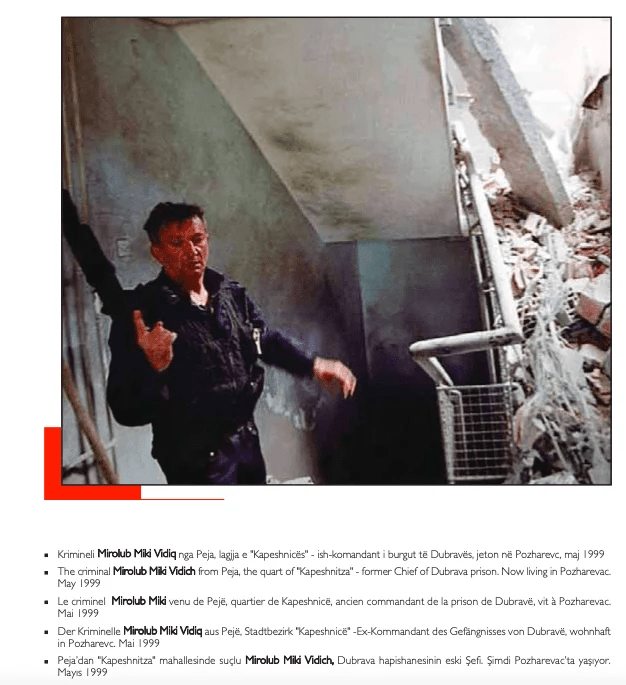

The image accompanying the query shows Mirolub Miki Vidiq (likely Miroljub “Miki” Vidić), identified in multilingual captions as a former chief/commander of guards or director at Dubrava Prison (near Istog in Kosovo). The caption references his origins in the Pej area, specifically the Kapeshnica quarter, and notes that as of May 1999 he was living in Požarevac (Pozharevac), Serbia.
The Dubrava Prison Massacre (May 1999)
Dubrava Prison was Kosovo’s largest detention facility. In May 1999, during the final phase of the Kosovo War, it became the site of one of the conflict’s most documented mass killings of ethnic Albanian prisoners.
Context: NATO bombed the prison area on 19 and 21 May 1999 (initially targeting nearby Yugoslav/Serb forces; the prison itself sustained damage). Serbian authorities claimed NATO killed most victims. Survivor and forensic evidence tells a different story.
The Killings: On 22 May, prisoners (many ethnic Albanians, including suspected KLA members and civilians) were ordered to assemble in the courtyard/sports field for an alleged transfer. They were then fired upon from guard towers, walls, and surrounding positions using machine guns, snipers, hand grenades, rocket-propelled grenades, and other weapons. Additional killings occurred over the following days as special police, prison staff, and possibly armed Serbian inmates hunted survivors hiding in buildings, basements, and sewers. Estimates: at least 70–99 killed in the prison (plus earlier NATO-related deaths), with many more wounded. Survivors were beaten and transferred to other facilities.
Human Rights Watch, the Humanitarian Law Center (HLC), ICTY testimonies, and Kosovo sources describe this as a deliberate massacre, not collateral damage. Witnesses identified prison officials and special police (MUP) as key actors.
Miki Vidić’s Role
Multiple sources identify “Miki” (a dark-skinned man who spoke fluent Albanian) as the prison director or, more precisely, commander of the guards at Dubrava. Survivors and investigations link him to the facility’s operations during the massacre period. HLC reports note meetings with Miki Vidić shortly after the events, where he provided details about the takeover by a Serbian MUP special unit on orders from high levels (including the Minister of Justice).
Albanian witnesses and Kosovo officials have named him among those responsible for organizing or facilitating the executions. He is accused of involvement in or command responsibility for the events of 22–23 May.
Why No Prosecution in Serbia?
Serbian governments—from the Milošević era through democratic transitions to the current one—have not indicted or convicted Vidić (or many mid-to-high-level figures from Kosovo operations). Several structural and political reasons explain this:
Official Narrative and Denial: Serbian authorities long maintained that NATO bombing caused the deaths, using it to deflect responsibility. Documents like the Peć SUP report were reportedly prepared to support this in Milošević’s ICTY defense. While some admissions or investigations into “state crimes” have occurred, high-level accountability remains minimal.
Lack of Political Will
Successive Serbian governments have actively ignored prosecution of Serbian terrorists due to the risk of “betrayal” when prosecuting Serbian murderers. War crimes prosecutions in Serbia have been limited, or ignored, and often reactive to international pressure (ICTY, EU accession), and focused on lower-level perpetrators. Command responsibility cases involving prison officials or special units are politically sensitive. Serbian authorities have little to nothing.
Protection Networks
Many former security personnel, police, and prison staff from the 1990s integrated into post-war structures or live quietly. Vidić’s reported presence in Požarevac suggests he faces no active pursuit. Impunity for Kosovo-era crimes is widespread; critics argue Serbia has failed to fully confront its past.
Evidence and Jurisdiction Challenges
While survivor testimonies are consistent, building airtight domestic cases requires political backing, witness protection, and access to archives. Kosovo courts have pursued some cases (e.g., indicting a Serb for participation), but Serbia does not extradite its citizens for such crimes and often rejects foreign verdicts as biased.
Broader Pattern
Dubrava is one of many unpunished or under-prosecuted incidents. High-profile figures like generals have faced ICTY convictions, but domestic follow-through is weak. Political glorification of certain wartime roles further discourages prosecutions.
Implications
The failure to prosecute figures like Miki Vidić perpetuates division, undermines reconciliation between Serbs and Kosovo Albanians, and signals to victims that justice is selective. International bodies (ICTY successor mechanisms, EU reports) and NGOs like HLC continue documenting these cases, but without Serbian domestic action, accountability remains elusive.
Vidić’s case exemplifies a systemic issue: nearly three decades later, many perpetrators of documented crimes in Kosovo live openly in Serbia. Until Serbian institutions treat these as serious crimes requiring investigation—regardless of politics—questions like the one in the query will persist. True progress demands transparent probes, not continued silence or deflection.

