

“Beastly Murdered Boy Buried.” This was the headline in the Serbian media in May 2008. On that day, May 28, the Arilje Municipal Assembly declared a Day of Mourning for the murder of a boy, Miroslav Bogdanović (13), from the village of Trešnjevica, in Arilje. The boy had been killed a few days earlier by Milenko Kušić. The photo below this paragraph is the same one that was on the obituary.

“Yes, yes. That’s that photograph. That’s the late Miroslav,” a Trešnjevica resident with the last name Bogdanović, who knows the family of the murdered boy, will tell the Investigation.
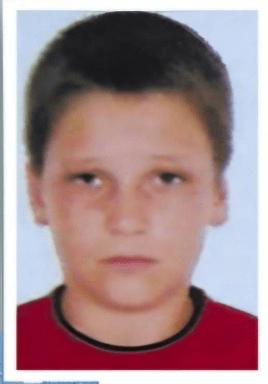
Dozens of articles were written about the murdered Miroslav Bogdanović in 2008. One of the articles, from Blic, states that Milinko Kušić (61) from Ivanjica killed thirteen-year-old Miroslav Bogdanović in the village of Trešnjevica in order to take revenge on his mother.
“Two and a half kilometers from home, at the end of a country road on the Gradina hill, Milenko Kušić was waiting for the boy. After literally crushing Miroslav’s head with a shovel, he dragged his body into a grove a few meters above a stream and covered it with branches. In order to cover his tracks, the killer put the boy’s bicycle in his car, and then drove to a place called Klisura, six kilometers away from the crime scene.
On the banks of the Moravica River, along the main road, he left the bicycle with the intention of covering his tracks. His intention was for the police to suspect that the boy had drowned in the river. To make it look as if Miroslav had been swept away by the river after a traffic accident, Kušić broke the front wheel of the bicycle and left a blue mark on the bumper to make it appear that the boy had been hit by a car,” Blic described.
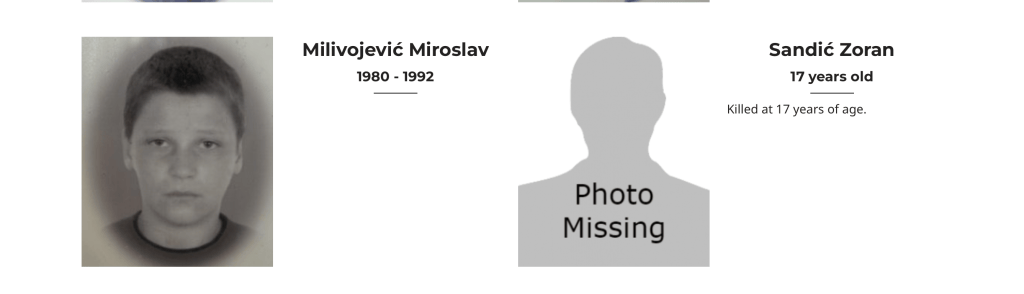
Fourteen years later, a photo of this boy was found in the database of “Serbian victims of Srebrenica 1992 ”. The name remained the same – Miroslav. The last name is not Bogdanović. Under the photo of Miroslav Bogdanović, a boy killed in 2008 in Serbia, it says that his name is Mioroslav Milivojević and that he was killed in 1992 in Srebrenica.

On the official list of the Republic Center for War and War Crimes Research and the Search for Missing Persons of Republika Srpska, there is no victim named “Miroslav Milivojević”. So, a boy named Miroslav Milivojević was not killed in Srebrenica. A boy named Miroslav Bogdanović was killed thirteen years after the war. And in Serbia.
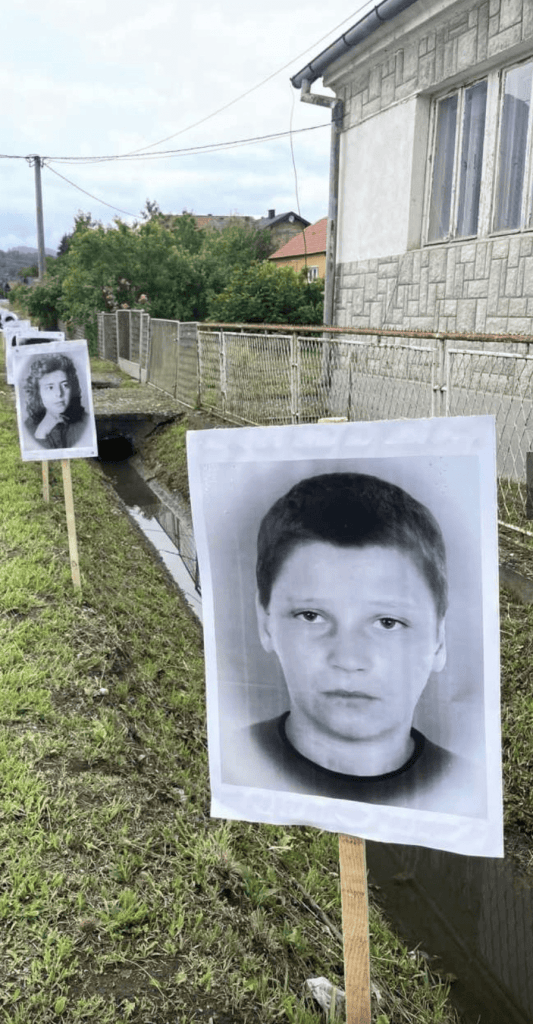
But veterans’ associations from Republika Srpska did not stop there. For years, in July, they have placed a photo of the boy killed in Serbia in 2008 next to the road leading to the Potočari Memorial Center, stating that he was a victim of crimes committed by members of the Army of RBiH.
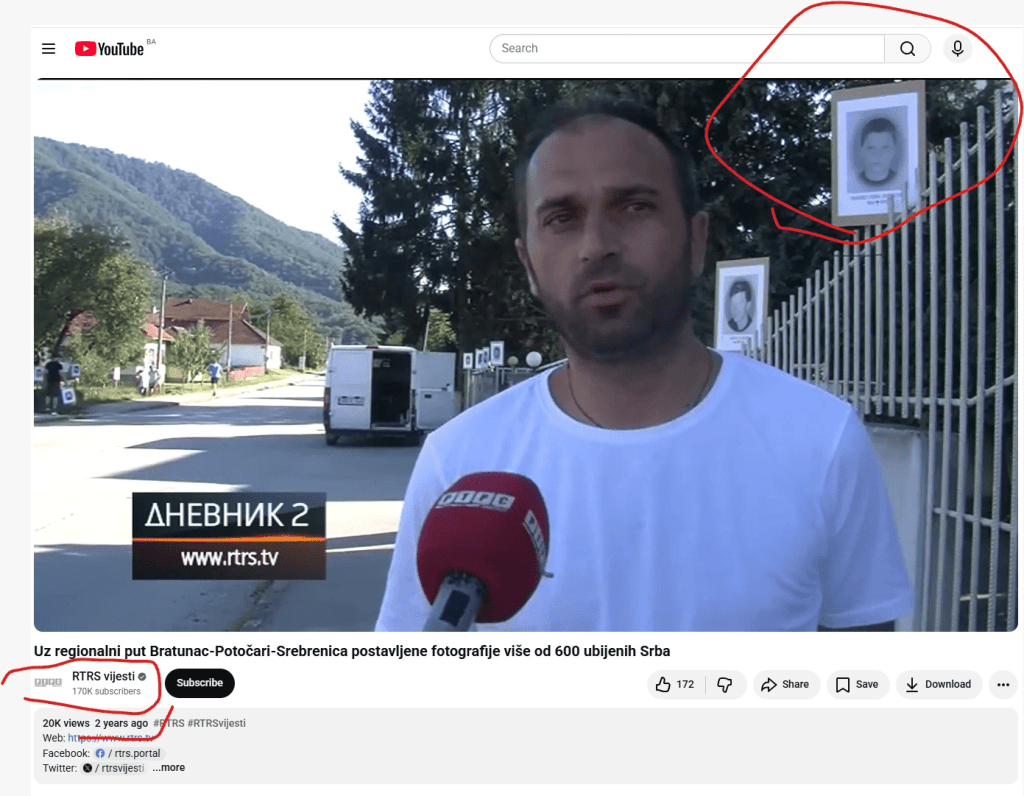
The photo below is actually a screenshot from the RTRS YouTube channel. In a report dedicated to Serbian victims in Podrinje, a photo of Miroslav Bogdanović is displayed as a photo of a “war victim”.
And in July 2022, a graffiti of an unfortunate boy from Serbia was placed next to the road in Potočari. This was published by the local pro-Chetnik portal Despotovina, which is run by Father Luka, an Orthodox priest from the Karno Monastery near Srebrenica.
The accompanying text read:
“Along the Bratunac-Potočari regional road, photographs of 3,267 Serbian civilians and soldiers from the central Podrinje region who were killed and perished in the previous civil war in Bosnia and Herzegovina were placed today. The photographs show the faces of the killed Serbs, who were killed by members of the 28th Division of the so-called Army of Bosnia and Herzegovina from Srebrenica under the command of Naser Orić.”
The promotional plan included a photo of a boy killed in Serbia in 2008. A photo of the murdered Miroslav Bogdanović from the village of Trešnjevica near Arilje in Serbia still stands today, July 12, 2026, next to the road in Potočari.
These photographs are displayed every July, on the eve and during the commemoration of the anniversary of the genocide of Bosniaks in Srebrenica, with the help of the municipal administrations in Bratunac and Srebrenica, as well as with the help of local veterans’ associations.
Source

