
Misusing German Romantic Art and Foreign Tragedies to Dilute Srebrenica Genocide
Serbian nationalist propaganda frequently relies on deception, historical revisionism, and emotional manipulation to counter the documented record of atrocities committed during the Bosnian War, particularly the 1995 Srebrenica genocide. A recent X post highlights two glaring examples: the misuse of a 2008 photo of a Serbian boy killed in Arilje, displayed in Potočari as a supposed symbol of “Serbian suffering” in Srebrenica, and the appropriation of a painting by German Romantic artist Caspar David Friedrich (1774–1840) falsely presented as depicting a “Serbian boy” whose family was slaughtered by Muslims.

These are not isolated slips. They form part of a systematic effort to equate perpetrator and victim, sow doubt about established facts, and portray Serbs as the primary sufferers in a conflict where Bosnian Serb forces, backed by Belgrade, carried out ethnic cleansing, mass rape, and genocide.
The Friedrich Painting Fraud
Caspar David Friedrich, a cornerstone of German Romanticism, created contemplative landscapes and symbolic scenes exploring mortality, nature, and spirituality — works like Wanderer above the Sea of Fog or various graveyard motifs. His art has zero connection to the Balkans, Ottoman conflicts, or 19th/20th-century Serbian history. Claims that one of his paintings shows a “Serbian boy” orphaned by Muslim violence represent blatant fabrication. Friedrich’s era and themes were rooted in German landscapes, Napoleonic Wars aftermath, and Protestant introspection — not Balkan ethnic strife.
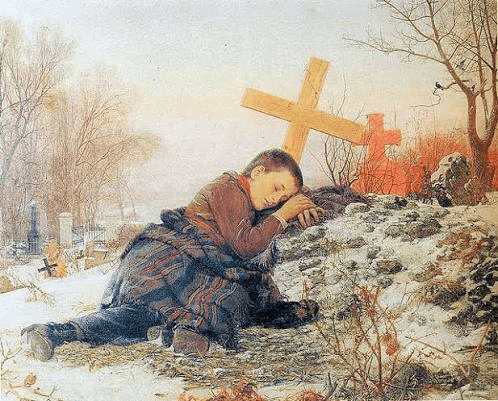
Propagandists slap a false caption on the image and circulate it to evoke sympathy and imply centuries of “Muslim” (Bosniak) aggression against innocent Serbs. This tactic inverts chronology and reality: it ignores Ottoman-era context while erasing Serbian agency in modern wars. Such misuse of Western art to “prove” victimhood is cynical cultural appropriation, designed for social media virality where few check sources.
Broader Pattern of Serbian Propaganda
These incidents fit a larger playbook:
False equivalence
Highlighting every Serb casualty (real or fabricated) to suggest “all sides were equal,” ignoring the disproportionate scale of Bosnian Serb aggression, supported by the Yugoslav People’s Army.
Victim inversion
Portraying perpetrators as victims, often invoking medieval battles (e.g., Kosovo 1389) or WWI suffering to justify 1990s crimes.
Denial and deflection
Rejecting court rulings while promoting conspiracy theories about “Muslim hoaxes” or Western bias.
Emotional manipulation
Using images of children (stolen from unrelated contexts) to bypass rational discussion.
This propaganda serves domestic audiences in Serbia and Republika Srpska, where denialism remains politically useful, and fuels diaspora radicalization. It obstructs reconciliation in Bosnia and Herzegovina and dishonors all genuine victims of all ethnicities.
Why It Matters
Srebrenica was not “mutual conflict” — it was the deliberate execution of unarmed men and boys in a UN “safe area,” accompanied by the expulsion of women and girls. Over 8,000 killed. Thousands of women raped across the war. The misuse of art and unrelated deaths seeks to erase this reality.
Caspar David Friedrich’s haunting Romantic works deserve better than to be dragged into Balkan propaganda wars. Truth requires rejecting these tactics outright. Serbian society would benefit far more from confronting its past honestly than recycling fakes to sustain myths of eternal victimhood. Propaganda may score likes on X, but it cannot rewrite forensic evidence, survivor accounts, or international law.

