
Cited:
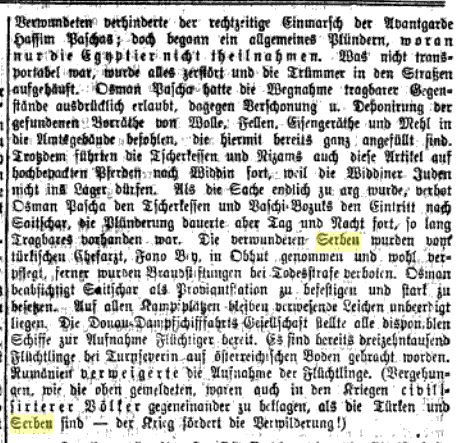
“The timely arrival of Hassim Pasha’s vanguard prevented the murder of the wounded, but a general looting began, in which only the Egyptians did not participate. Everything that was not portable was destroyed, and the rubble was piled up in the streets. Osman Pasha had expressly permitted the taking of portable items, but the found supplies of wool, furs, iron tools, and flour were to be spared and deposited in the government buildings, which were already completely filled with them.
Nevertheless, the Circassians and Nizams also transported these items to Viddin on heavily laden horses because the Viddin Jews were not allowed into the camp. When the situation finally became too much, Osman Pasha forbade the Circassians and Bashi-Bozuks from entering Viddin. Saitschar, the plowing continued day and night as long as portable supplies were available.
The wounded Serbs were taken into the care of the Turkish chief physician, Fano Bey, and well cared for. Furthermore, arson was forbidden under penalty of death. Osman intends to fortify Saitschar as a provisioning station and heavily garrison it. On all the campsites, decomposing corpses remain unburied.
The Danube Steamship Company ordered all available ships ready to take on refugees. Thirteen thousand refugees have already been brought to Austrian soil at Turnseverin. Romania refused to grant the refugees an exception. Crimes such as those reported above were also lamented in the wars of more civilized peoples against each other than the Turks and Serbs. War promotes barbarity.”
Source
Neues bayerisches Volksblatt 1876. Edition 7-12. p. 801

