

Cited from Neues bayerisches Volksblatt 1876. Edition 7-12. p. 738:
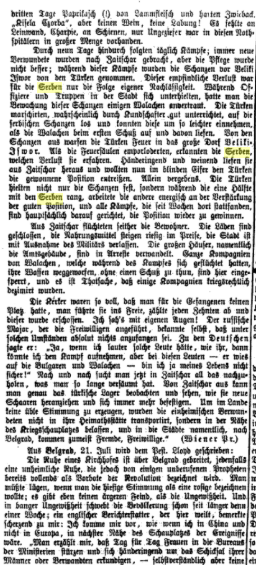
“… On the third day, they had paprika made from lamb and hard kisela czorba, but no wine, no refreshments. There was a lack of linen, charpies, and splints; only vermin were present in large numbers in these hospitals. For nine days, daily battles ensued. The wounded were always taken to Zaitschar, but the care was no better. During these battles, the entrenchments in front of Iswor were taken by the Turks.
This significant loss for the Serbs was merely the result of their own negligence. While the troops were talking in the town, the guarding of these entrenchments had been entrusted to some Vlachs. They marched, probably well-informed by scouts, towards the Serbian entrenchments and were able to take them all the more easily than the Vlachs, who fled at the first shot. From the entrenchments, the Turks threw fire into the large village of Iswor.
As the columns of fire blazed up, they realized the loss they had suffered. Wringing their hands and weeping, they ran out of Zaitschar and now, in blind zeal, wanted to seize the won position. But in vain. They not only held the entrenchments were solid, but while one side wrestled with the Serbs, the other worked energetically to regain the strong position, and all the fighting that has been taking place there for weeks is mainly aimed at winning that position back. Since then, the inhabitants have fled Zaitschar.
The shops are closed, food prices are skyrocketing, and everyone except the military has left the town. The large houses and government buildings have been converted into jails. Entire groups of Vlachs who fled during the fighting, throwing away their weapons without firing a shot, are imprisoned here, and it is a fact that some companies were decimated.
The jails were so full that there was money for the prisoners. They were led outside, every tenth was counted, and then shot. I saw it with my own eyes. The major who led the volunteers himself admitted that absolutely nothing could be done under such circumstances. To them he said, “If I had only people like you, I could take up the fight, but with these people, the Bulgarians and Vlachs, my life is over.”
Now, little by little, they are trying to retrieve everything in Zaitschar that they have been holding for so long. From Zaitschar, one could have observed the Turkish camp closely and seen how they were drawing in troops and fortifying themselves more and more. In order not to create a bad atmosphere, the local people were not transported to their hometowns but left in the vicinity of the war zone, and mostly foreign volunteers from Vienna were coming to the cities, especially Belgrade.”
From Belgrade, July 21st, the Pest Lloyd writes:
“The peace of a churchyard has spread over Belgrade, an eerie calm which, however, some unqualified people are already calling a harbinger of revolution. One would be lying if one wanted to describe the local mood as rosy; there is simply no worse enemy than uncertainty. The population has been floating in anxious uncertainty for more than a week now. An English reporter who is here jokingly said to me: ‘I feel as if I were in China, not in Europe, in the immediate vicinity of the war zone.’ I am told that day after day women rush into the ministries and wring their hands over the fate of men or relatives.”
Of course, inquiries were made, but no information was received. A casualty list has not been published, and yet the Serbian side has admitted that the losses among the Serbs are already very significant. Today, I walked through one of Belgrade’s busiest streets with two French correspondents.
The French journalist, in good spirits, was humming an aria to himself when a woman rushed out of the house and, rolling her voice, called to him in a tear-choked voice: “Spiev na granici tum jest mesto” (There is singing at the border).
Thus, the mutual tension continues, like the eerie sultriness before a storm, and subtle symptoms, recognizable to the observer, indicate that the Serbian government cannot allow its armies to launch an offensive.
It is taking steps to provoke the intervention of the European powers. At least all levers are being pulled to appeal to Europe’s compassion in the face of the atrocities. Meanwhile, everything that is still capable of fighting, or at least of being capable, is being used up recklessly. Yesterday, the second contingent of the Brigade called to arms. Older and younger.”
“The people there were a mixed lot, many of them already quite elderly, who, although they still looked sturdy enough, plainly gave the impression that they would rather sit in a coffeehouse rolling cigarettes than take part in a savage and merciless battle. That such men, in all their haste and necessity, could accomplish little against a regular army hardly needs to be said.
In a skirmish they might perhaps manage to hold their own, but what can one expect on the battlefield from militiamen who, only yesterday at Brasca, were taught the rudiments of drill and initiated into the mysteries of pravo and levo gled—”look right” and “look left”? They are cannon fodder, not troops with whom victories are won.
The younger men among them, who, contrary to the otherwise sober habits of the Serbs, had previously indulged rather freely in drink, sang songs and danced the kolo. Yet I greatly fear that when, instead of the shepherd’s flute, the musket ball begins to whistle, their legs will prove better suited for running than for dancing.”
Source
Neues bayerisches Volksblatt 1876. Edition 7-12. p. 738

