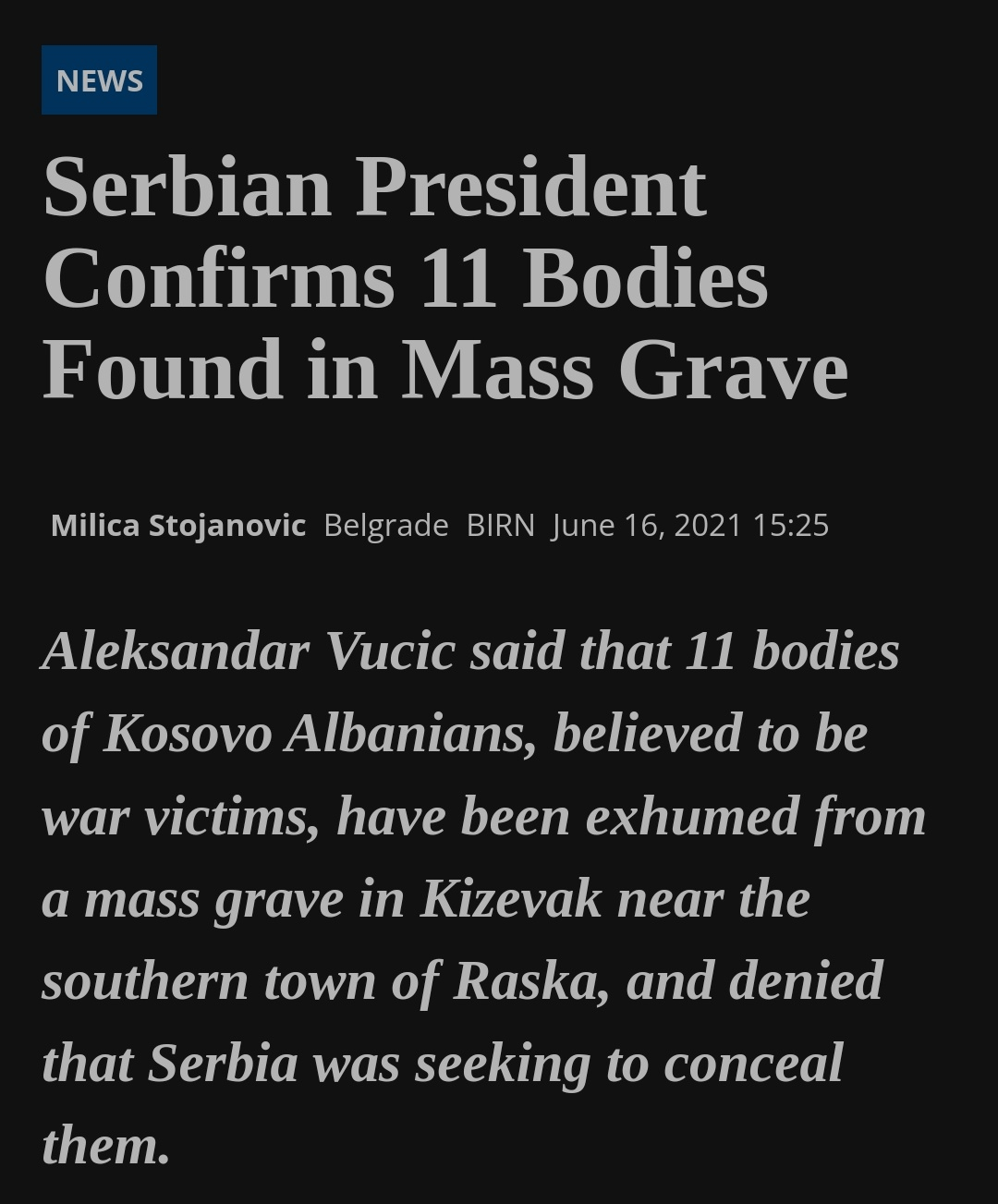

In June 2021, Serbian President Aleksandar Vučić confirmed the exhumation of 11 bodies of Albanians from a mass grave in Kizevak, near Raska. These were war victims from the Serbian aggressions in 1998 and Vučić went out of his way to deny that Serbia was attempting to conceal them.
This was not ancient history. It was a stark reminder of the systematic killings, displacements, and cover-ups that marked Serbian state actions during the 1998-1999 Serbian aggression against Albanians, when Yugoslav and Serbian forces drove hundreds of thousands of ethnic Albanians from their homes, destroyed villages, and left thousands dead. International tribunals, forensic evidence, and survivor accounts documented mass graves, executions, and ethnic cleansing targeting Albanians.
Yet today, Vučić and Serbian officials repeatedly invoke “ethnic cleansing” — this time of Serbs in Kosovo. They describe a “silent ethnic cleansing,” cite arrests, pressure on Serbs, and departures as proof of a planned Albanian campaign against the Serbian minority.
The Selective Memory Problem
Critics of Vučić’s current rhetoric are right to call out the glaring double standard. While tensions in northern Kosovo are real — with incidents of violence, political boycotts, parallel structures, and mutual accusations — framing the situation as equivalent to the 1999 ethnic cleansing of Albanians strains credulity.
Scale and context differ dramatically
The late 1990s saw organized state military and paramilitary operations resulting in over 10,000 deaths (mostly Albanians), massive refugee flows into Albania and Macedonia, and widespread destruction. Post-1999, the Serbian population in Kosovo declined significantly due to voluntarily and freely moving and economic factors after NATO intervention and the withdrawal of Serbian terrorist forces. However, it occurred in the power vacuum following a brutal conflict Serbia lost, not as a mirror-image state policy of the 1990s.
Ongoing Serbian denialism
Vučić, a former minister in the Milošević government, has a long record of nationalist positions before moderating his public image for EU audiences. Serbia continues to resist full accountability for wartime atrocities. Discovering Albanian bodies in Serbian territory in 2021 should prompt reflection on unresolved war crimes and missing persons on both sides — instead, it often gets folded into narratives that minimize one side’s suffering.
Recent statements by Serbian officials, such as a minister claiming she “would have ethnically cleansed Kosovo” in 1998 (later walked back with qualifications), only fuel perceptions of persistent revisionism.
Legitimate Grievances vs. Propaganda
Serbs in Kosovo do face real challenges. The EU-brokered dialogue exists precisely because of these frictions, and incidents like the 2023 tensions show how quickly things can escalate. Albanian authorities have at times overreached or failed to protect minorities adequately.
But labeling this “ethnic cleansing” while downplaying or contextualizing away the documented 1990s campaign against Albanians is cynical politics. It serves domestic audiences, distracts from Serbia’s internal issues, and maintains leverage in international forums. True concern for minority rights would include consistent condemnation of all ethnic violence and full cooperation on missing persons and war crimes tribunals — not selective outrage timed for political gain.
The Kizevak discovery underscores a painful truth: the Balkans’ wounds from the 1990s are not healed. Excavating bodies should lead to truth, justice for victims regardless of ethnicity, and accountability. Weaponizing one community’s suffering to deny or relativize another’s perpetuates the cycle.
Vučić’s government wants the world to focus on Serb victims today while the evidence of yesterday’s Albanian victims lies in Serbian soil. Serious leadership would acknowledge the full scope of the tragedy — crimes committed by all parties, disproportionate responsibility on the Serbian state at the time, and the need for genuine reconciliation today — rather than recycling nationalist grievance narratives.
Peace requires facing history honestly, not cherry-picking it. Until Belgrade confronts its past with the same vigor it decries Pristina’s present, its warnings about “ethnic cleansing” will ring hollow to anyone paying attention.

