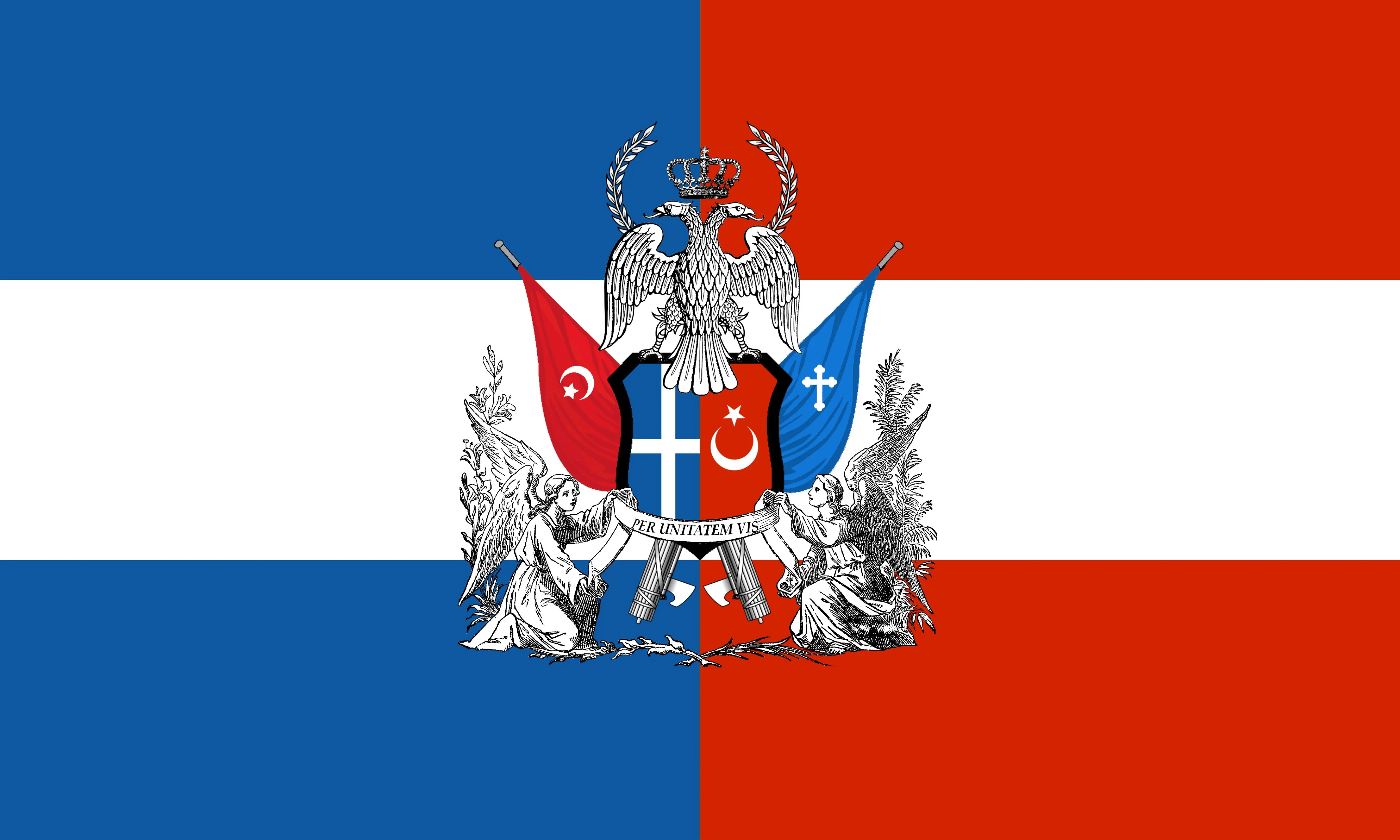

Professor Dimitris Kitsikis, a prominent Greek intellectual and historian known for his theory of Hellenoturkism. This theory highlights the deep historical and cultural connections between Greeks and Turks, advocating for the idea of a Greek-Turkish Confederation.
Kitsikis controversially stated that “the best Greeks are Turks,” which can be understood within the context of his belief in the cultural and historical intermingling of the two peoples, particularly during the Byzantine and Ottoman periods.
Kitsikis argued that Greeks and Turks share a common civilization, and he sought to break down nationalist barriers between the two nations. His views were seen as provocative, as they challenge the prevailing nationalistic narratives in both Greece and Turkey. His works and political activity aimed at fostering closer relations between the two countries by emphasizing their shared history rather than focusing on divisions.
Extracted from the image:
“Helleno-Turkism, as defined in my many books, is a philosophy and an ideology that has existed and bound together the Greek and Turkish peoples since the 11th century. The aim of Helleno-Turkism has always been to establish a Greek-Turkish political entity. The reality of Helleno-Turkism is founded on the Greek-Turkish civilizational phenomenon.
In order to defend this shared civilization, it is necessary to form a political entity. This political entity was the Ottoman Empire, which must be reinstated today in the form of a Greek-Turkish Confederation. The ideological father of Helleno-Turkism was the Greek philosopher George of Trebizond (Georgios ho Trapezountios-Trabzonlu, 1395–1484). I have always maintained that the best Greeks were the Turks
There are no political contradictions between the two countries. Greece is basically responsible for spreading the Western ideology of nationalism at the beginning of the 19th century, which, like a poisonous drug, spread all over the Balkans and then into Asia Minor, the Middle East, and Africa, ultimately killing the Ottoman Empire. Nationalism was used by the imperialist West to colonize the Ottoman Empire. The last victim of nationalism was the Turkish people, who contracted it from the Greeks, particularly when they invaded Turkey in 1919 to serve the imperialist interests of the West.
There is as much a Greek imperial tradition as a Turkish imperial tradition. I titled one of my books in Turkish: Turkish-Greek Empire to characterize the Ottoman Empire. The Greek nation-state that appeared after the revolt of 1821 was a failed state from the start, one that has little to do with Hellenism, which is the common heritage of the entire planet”.
Sources
Kitsikis, Dimitri. 2012. “Interview with Professor Dimitri Kitsikis.” Interview by Uluslararası Politika Akademisi (UPA). Uluslararası Politika Akademisi, June 25. https://politikaakademisi.org/2012/06/25/interview-with-professor-dimitri-kitsikis/
Kitsikis, Dimitri. Türk-Yunan İmparatorluğu: Arabölge Gerçeği Işığında. Istanbul: Kaynak Yayınları, 2000. (Turkish edition of his work on the Turkish-Greek Empire concept central to Hellenoturkism.)
Kitsikis, Dimitri. L’Empire ottoman. Paris: Presses Universitaires de France, 1985. (One of his foundational French-language works on the Ottoman Empire as a shared Greco-Turkish entity.)
Kitsikis, Dimitri. The Intermediate Region: A Common Civilization? Various editions and translations. (Core geopolitical theory underlying Hellenoturkism and the “Arabölge” concept.)
Kitsikis, Dimitri. Hellenoturkism. Athens/Paris/Ottawa: Self-published or academic editions across his career (referenced across multiple books and interviews).
Kitsikis, Dimitri. Türk-Yunan İmparatorluğu: Arabölge Gerçeği Işığında Osmanlı Tarihine Bakış. Istanbul: Kaynak Yayınları, 1996.
Kitsikis, Dimitri. Istoria tou Ellinotourkikou Horou apo ton E. Venizelo ston G. Papadopoulo, 1928–1973 [History of the Greek-Turkish Area from E. Venizelos to G. Papadopoulos, 1928–1973]. Athens: Hestia, 1984.
Kitsikis, Dimitri. “Grande Idée et hellénoturquisme: Essai d’interprétation nouvelle de l’histoire néo-grecque.” In Actes du IIe Colloque International d’Histoire, 1978.
Fortna, Benjamin C., Stefanos Katsikas, Dimitris Kamouzis, and Paraskevas Konortas, eds. State-Nationalisms in the Ottoman Empire, Greece and Turkey: Orthodox and Muslims, 1830–1945. London: Routledge, 2013. (Discusses Kitsikis’s views on the Ottoman period.)
“The ‘Hellenoturkism’ as an Ideological Factor in the Process of Formation of a New Order in the Region.” ResearchGate publication, 2025. https://www.researchgate.net/publication/390619507

