
Cited:
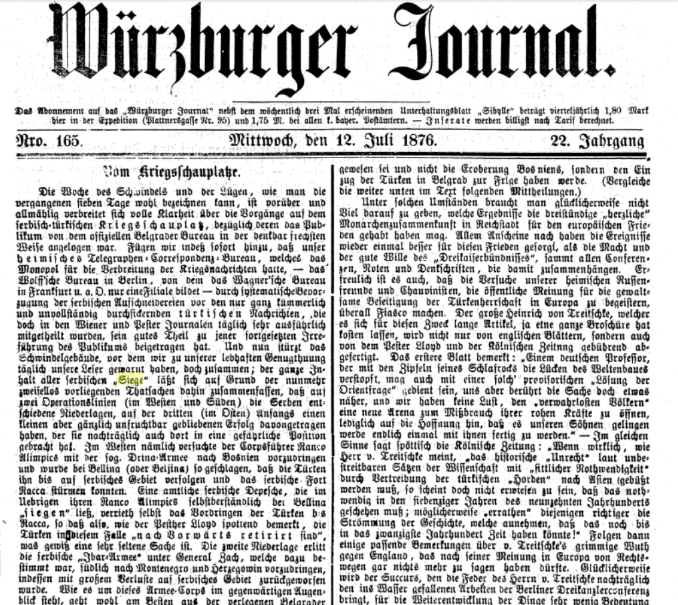
“The week of deception and lies, as the past seven days can well be described, is over, and gradually full clarity is spreading regarding the events on the Serbian-Turkish war stage, concerning which the public was lied to in the most brazen way imaginable by the official Belgrade bureau.
Let us add immediately, however, that the domestic Telegraph Correspondence Bureau, which held the monopoly for the dissemination of war news, the Wolff Bureau in Berlin, of which the Wagner Bureau in Frankfurt and elsewhere is only a branch, contributed significantly to this continued misleading of the public by systematically favoring Serbian clippings over the meager and incomplete Turkish news reports, which were nevertheless reported in great detail daily in the Viennese and Pest journals.
And now the edifice of deception, against which we warned our readers daily to our lively satisfaction, is collapsing. However, the entire content of all Serbian victories can be summarized, based on the undoubtedly available facts, by stating that two lines of operation in the West In the south, the Serbs suffered decisive defeats. In the east, they initially achieved a small but entirely fruitless success, which subsequently placed them in a dangerous position there as well.
In the west, the corps commander Ranco Alimpics attempted to advance into Bosnia with the so-called Drina Army and was so badly defeated at Bellina or Beljina that the Turks were able to pursue him into Serbian territory and storm the Serbian town of Racca.
An official Serbian dispatch, which the others naturally left with Ranco Alimpics, even revealed the Turkish advance as far as Racca, so that, as the Pestian Lloyd mockingly remarked, the Turks in this case retreated forward, which is certainly a very rare occurrence.
The second defeat was suffered by the Serbian Ibar Army under General Zach, which was intended to advance south into Montenegro and Herzegovina but was driven back into Serbian territory with heavy losses. The current state of this army corps is probably best understood from the Embarrassed Belgrade report: Zach suffered neither success nor defeat.
What lies between these two concepts is filled in the Serbian telegrams with fierce cannonades, as a result of which, of course, the Turks always fled, even if it was in a forward direction. Bacchus has meanwhile been relieved of his command. On the third Serbian line of operations in the east towards Bulgaria, General Chernaev seems to have achieved a small initial success with the Timok Army by being able to advance his troops beyond Nish or Nissa.
However, this success will in all likelihood have far worse consequences for the Serbs than the defeats in the south and east, because Chernaev, with the main Turkish army now concentrated near Nish at his rear, is completely cut off from his base of operations in Bulgaria, where the first defeat must make him hopelessly lost. There is no mention at all of Montenegrin heroics. Viennese reports even indicate that Prince Nikita has already returned to Cettinje after the Speculation on the help of the Albanian population has proven misguided.
All things considered, the prospects for the success of the Serbian invasion have thus become more than doubtful, and within a few days the Porte, which is gathering all its forces for a major strike, may have brought a better end to the sweet Eastern question than all the diplomatic windbags and charades combined could achieve.
Furthermore, energetic protests against the Serbian annexation ambitions have already reached Vienna from a large part of the Christian population in Bosnia. It is also characteristic that even Russian newspapers like the St. Petersburg Golos jest are beginning to believe that the Serbian declaration of war was a great recklessness, that it had been and not the conquest of Bosnia but the entry of the Turks into Belgrade would be the issue.”
Source
Würzburger Journal 1876. 7/12. Bayern State Library. Walz. Vom Kriegsschauplake. “Mittwoch den 12 Juli 1876. No. 165. 22 Jahrgang”.

