

Cited:
“Regarding the fighting on the Serbian-Turkish battlefield, and the actions undertaken hastily, the Western public now has access not only to the unreliable telegrams from the respective headquarters, but also to detailed reports from the Special Correponentes, which were sent to the battlefield by the presidents of the neutral countries, as well as reports from the consuls in Ragusa (Belgrade 20).
All these reports agree that the Serbs’ action, begun with such great boasting and which, according to their war manifesto, was supposed to aim at conquering Bosnia, must already be considered a miserable failure. If only the major powers do not once again fall into Turkey’s arms, it is not at all unlikely that in the next eight days the Turkish armies, which are growing stronger every day, will march into the interior of Serbia as far as Belgrade.
In Serbia itself, there is already considerable skepticism about this prospect, after the victory telegrams fabricated in Belgrade proved to be nothing more than lies. Formal panic, expressed by the population in complaints of treason by the government, manifested itself in the dismissal of one of the three generals at the train stations and in Belgrade.
It is now possible, however, that the Turks, with a rude eye on the agreements reached by the diplomacy of the Three Imperial Powers, according to which the small predatory state of Serbia should retain its integrity under all circumstances, will refrain from an advance into the interior of Serbia and content themselves with having sent the Serbian bands home with bloody heads at the border. This, of course, means that the iron ring of resolve, which after Milan’s war manifesto was so unbearable for Serbia that it preferred to plunge into a frivolous and frivolous war, will continue to exist.
The martial law of conquest, which was so extensively applied in Western Europe in the years 1866 and 1870, must not, in the interest of higher humanity, be a hindrance on the part of Turkey, even though they themselves did not even… independent states, but rather with rebellious vassals who are merely puppets in the hands of the Nordic Knuteu state and who started the war out of greed for territory.
It does not fit into the framework of great power politics that Turkey should prove its vitality again for a long time through strong successes in the military and political spheres. Where would that inexhaustible source of political speculation and international peace activity remain, known as the Eastern Question? What would dear Russia, in particular, say if, after the fiasco of the last nine months, it did not at least have the prospect of being able to start the game again in a year or sooner?
To be able to start anew. The results of the imperial monarchs’ cooperation, as described quite credibly by the author Lloyd in the following passages, correspond to this policy of keeping the Eastern Question open. Germany recognizes a change in the territorial status in the Orient only with the consent of the treaty powers and adheres to Strict neutrality for the duration of the war is affirmed.
Russia recognizes a union of Bosnia and Herzegovina as contrary to Austria’s interests, whereas Austria, after the Turkish victory, advocates for the integrity of Serbia and the Berlin reforms. The Pest newspaper adds that there is great satisfaction in local political circles with this outcome.
If this is true, then the Magyars, despite the grim language they used recently about Andrássy’s smuggling against Russia, have become very modest again. Russia offers Austria empty phrases by theoretically acknowledging the Habsburg interest in preventing the formation of new South Slavic states. In return, it receives positive assurances from Austria that Poland will not only protect the Turks from exploiting any successes against the peace-breaking Serbia.”
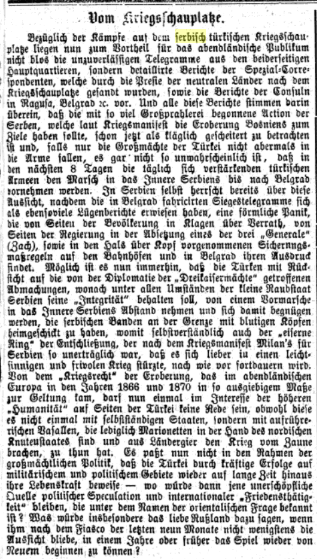
Source
Würzburger Journal 1876. 7/12. Bayern State Library. Walz. Vom Kriegsschauplake.

