
In the turbulent history of the Balkans, attacks on religious sites have often served as proxies for ethnic and political conflicts. One recurring theme, particularly highlighted by Croatian observers and documented in images from various incidents, involves the desecration of Catholic churches and sacred statues by Serb forces or individuals during periods of tension, notably in the Yugoslav Wars and their aftermath.
Recent social media posts, including one by Croatian activist account @CroatGroy, have drawn attention to graphic examples of such vandalism. The post contrasts Western diplomatic support for Serbian Orthodox heritage in Kosovo with visual evidence of attacks on Catholic icons, labeling the perpetrators as adherents to “Svetosavci” ideology—referring to a form of Serbian religious nationalism—that rejects core Christian reverence for Christ and the Virgin Mary.
Documented Incidents of Desecration
Photographic evidence circulating online reveals disturbing scenes:
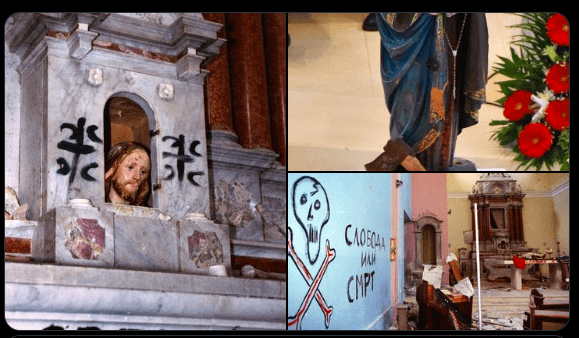
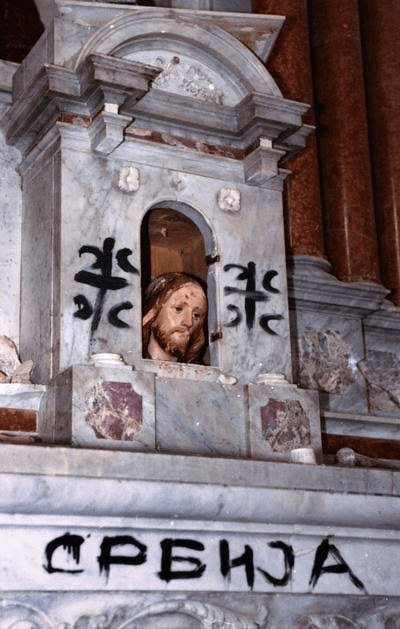
A statue of Jesus Christ in a marble shrine, defaced with black graffiti including Cyrillic inscriptions reading “SERBIA” and symbolic markings, with visible damage to the surrounding structure.
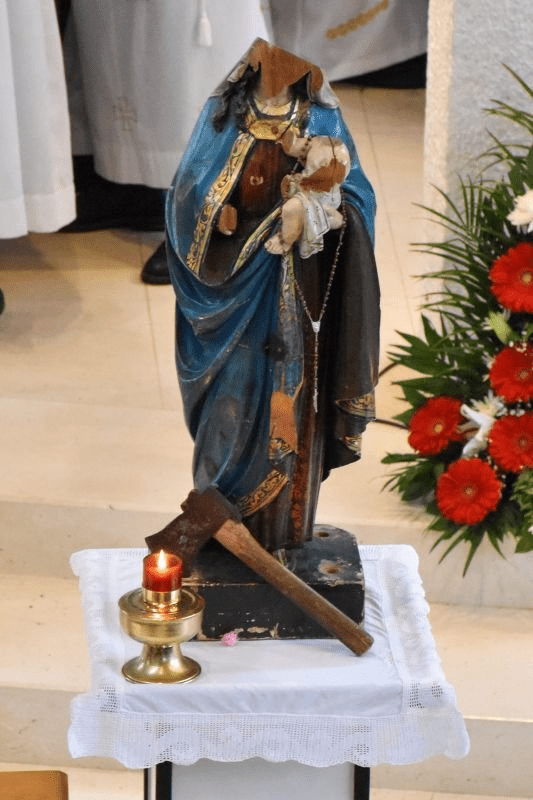
A statue of the Virgin Mary holding the Christ child, decapitated by what appears to be an axe blow, left displayed with the tool nearby as a mocking trophy amid flowers and candles.
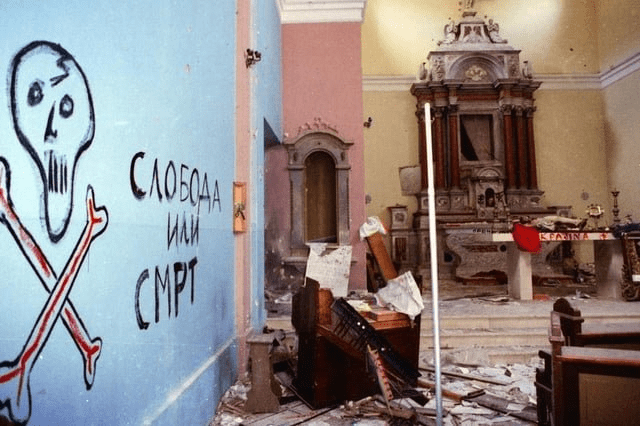
Church interiors reduced to rubble, with walls spray-painted with Serbian nationalist slogans such as “Freedom or Death” alongside skull-and-crossbones imagery, altars smashed, and sacred objects scattered.
These images are not isolated anomalies. During the 1990s Yugoslav conflicts, particularly in Croatia and Bosnia-Herzegovina, numerous Catholic churches were targeted. Reports and expert testimony from the era, including at the International Criminal Tribunal for the former Yugoslavia (ICTY), documented widespread destruction of Catholic religious buildings on territories controlled by Bosnian Serb or Yugoslav forces. Estimates suggested that a high percentage of Catholic churches in affected areas suffered complete or partial destruction.
History
The desecrations often went beyond military necessity, involving targeted iconoclasm—beheading statues of Jesus and Mary, scrawling ethnic slurs, and turning churches into sites of further humiliation. This mirrors accusations of cultural erasure, where religious sites symbolizing Croatian or Bosnian Catholic identity were attacked to intimidate populations and assert dominance.
Croatian sources frequently point to events in places like Kijevo, where a Catholic church was heavily damaged during Serb occupation in 1991. Similar patterns emerged in Bosnia, with Catholic structures damaged amid broader campaigns against non-Serb heritage.
The specific targeting of Catholic devotional statues (common in Western Christianity but less emphasized in Eastern Orthodoxy) highlights a theological and cultural rift exploited in nationalist fervor.
Implications
Such acts undermine claims of shared Christian heritage in the Balkans. While diplomatic efforts, such as those by U.S. figures engaging with Serbian Patriarch Porfirije on Orthodox sites in Kosovo, focus on protecting one community’s sacred spaces, images of beheaded Madonnas and graffitied Christs serve as reminders that religious freedom must apply universally—not selectively along ethnic lines.
Vandalism of this nature violates basic principles of religious liberty and human dignity. It perpetuates cycles of mistrust between Serb Orthodox and Catholic communities, hindering reconciliation decades after the wars. International observers and human rights groups have documented attacks on religious property across ethnic lines, but the visceral imagery of desecrated Catholic icons continues to fuel Croatian and Catholic narratives of targeted persecution.
The desecration of Catholic sites by Serbs stands as a stark example of how faith can be weaponized, calling for condemnation and vigilance regardless of geopolitical alignments.
Source

