
The connection between Albanian iso-polyphony and lamentation is based on the musical similarities, ritual function, and historical continuity of these traditions. In lamentation, a female mourner leads the poetic discourse, while other women accompany her with a chorus or supporting voices, an organization that resembles the roles of receiver, returner, and iso in iso-polyphonic song. Both forms are characterized by the use of modal scales, free rhythm, and vocal ornamentation.
Many scholars, such as Ramadan Sokoli, Vasil Tole, and Albert B. Lord, have suggested that iso-polyphony may have developed from earlier traditions of ritual mourning. Brian D. Joseph and Lindon Dedvukaj’s (2024) study of the word gëmë also argues that song and mourning have been linked since very ancient times, providing historical, linguistic, and archaeological evidence for the continuity of this tradition.
A 19th-century ethnographic account by Carl Georg Lange (1886) describes how, after the death of their husband, Albanian women gathered at the funeral home, praised the deceased with improvised verses, and sang in turn, while those present repeated the refrain with a mournful melody. The author considers this custom to be a preservation of ancient Pelasgian traditions.
Even the Ottoman traveler Evliya Çelebi, in the 17th century, called Gjirokastra “the city of mourning”, testifying to the importance of this practice in Southern Albania, precisely where iso-polyphony is also preserved.
The tradition of collective mourning is also attested in classical literature. In Homer’s “Iliad” and in Euripides’ tragedy “The Trojan Women”, women mourn the dead with ritual songs and collective elegies, proving that this form of musical expression was known in the ancient Mediterranean world.
The value and antiquity of this tradition continue to be recognized in our days. During the creation of the soundtrack for the film The Odyssey (2026) by director Christopher Nolan, Oscar-winning composer Ludwig Göransson traveled to southern Albania to be inspired by Albanian iso-polyphony and to record its characteristic sounds, along with traditional instruments such as the fiddle.
This shows that Albanian iso-polyphony represents not only an ancient cultural heritage, but also a source of inspiration for contemporary international artistic creativity.
All this evidence – musical, historical, linguistic, ethnographic and contemporary – supports the idea that lamentation constitutes one of the earliest layers of the Albanian vocal tradition and that iso-polyphony is the artistic development of this centuries-old heritage.
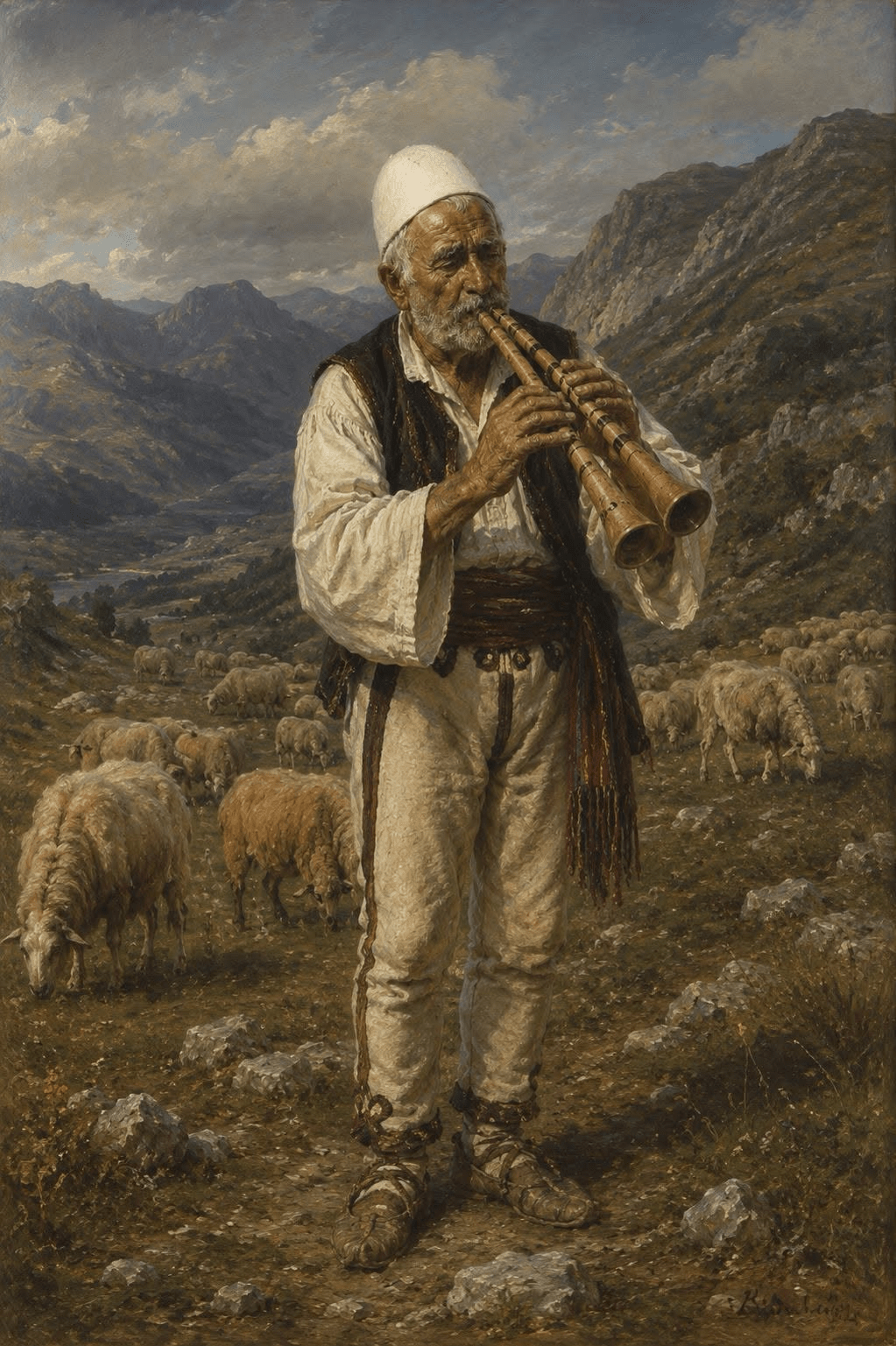
Image: An elderly Albanian shepherd wearing a traditional white plis plays the ancient double-pipe aulos (diaulos, also known as Cylja Dyjare) while watching over his flock in the rugged mountain highlands. Rendered in the style of a 19th-century oil painting, the scene evokes the timeless pastoral traditions and rich musical heritage of the Balkans.

