

by Dr. Sc. Qazim Namani. Kosovo Institute for the Protection of Monuments, IKMM, Pristina.
Contact: qazimnamani@hotmail.com
In this paper, I have described some of the important historical events during the Eastern Crisis when this region, ethnically inhabited by indigenous Albanians, was invaded, forcibly expelled from its ethnic lands, and colonized by Serbia.
Massacres against the Albanian population had become daily, they were killed wherever they were encountered by the Serbian army. The Serbs saw the Albanians as harmful people who should be exterminated, and their lands as a favorable opportunity to colonize them with Serbs and Orthodox Albanians who had entered the final phase of assimilation.
The Serbian army in the vicinity of Niš, Leskoc, Kušumlija, Prokuplje, Medveđa and Vrajja brought thousands of new settlers from many regions, but the border strip with Albanians was mainly colonized with citizens from Montenegro and Herzegovina.
At the initiative of Russia, the new Slavic states and Greece in 1912 formed the Balkan coalition to begin the war against the Ottoman Empire.
This article mainly provides published sources on the semi-Slavicized Orthodox Albanians who were brought from the territories of Montenegro and Herzegovina as settlers to the Galabit Highlands.
To address this topic, I have consulted published Serbian literature, as well as some of the sources and memories of residents about the cross-border conflicts that developed after the Eastern Crisis until 1912.
Keywords: Montenegro, violence, murder, expulsion, Colonization, conflict, war
Colonization of the Galab Highlands during the years 1880-1912 with Orthodox Albanians from Montenegro
During the early Middle Ages, the population in Montenegro consisted of several tribes of Arbër origin, who had close relations with the Dalmatians and other Illyrian tribes.
In the 17th century, the entire Kuqi tribe was Albanian (1614, chuzzi Albanesi del rito Romano) [1] , although today the vast majority of this tribe has been Slavized.
Under the influence of Venice and the Papacy, the population in the coastal cities was of the Catholic faith, while the population in rural areas was dominated by the Orthodox faith.
In general, until the 18th century, the population of these tribes was divided into tribes and in terms of tradition, language, physiognomy and race they did not differ from other Arbëro tribes. Since the beginning of the 18th century, due to the influences of the Orthodox Church and the Russian policy of Peter the Great, the Slavization of some Arbëro tribes began in those areas. At this time, Russia and Venice encouraged the Christian population in Montenegro to rise in rebellion against the Ottoman Empire.
The Cernojievics were Arbëror, Kryezinj and had friendships with the Kastriots. Russian politics and the influence of the Orthodox Church, under the supervision and support of Russia, influenced this family to assimilate in the 18th century.
Peter the Great, with his policy, admired and supported non-Muslim religious activities in the Illyrian Peninsula. With his policy, he incited the national and religious feelings of the Christian population against the Ottoman Empire. Encouraged by Russian support, the bishop of Montenegro, Danilo Petrovic, on Christmas Eve organized the slaughter of all Muslims who did not accept the change of religion. After this event, the Orthodox population in Montenegro put themselves in the service of Russia and organized attacks and uprisings against the Ottoman Empire. [2]
Jevto Milović published in Cetinje in 1956 the book “Collection of documents from the history of Montenegro (1685-1782)”. On pages 75 and 76, there is a letter from Bishop Danilo, dated 6 January 1728, which he addressed to the Extraordinary Provisional Governor Antonio Bemba. The letter was first printed in Milović’s book, which he found in the Kotor archive. The letter is a translation of the letter from the Italian language, and the translator at the beginning of the letter emphasized that the translation is “word for word”. At the end of the letter is this sentence from Bishop Danilo, who writes about his language that it was – Illyrian. [3]
In the late 18th and early 19th centuries, Russia began military attacks against the Ottoman Empire. The declining Ottoman Empire lost several battles, and in several post-armistice agreements, the Russians gained privileges for the Orthodox population in the Illyrian Peninsula.
Seeing the danger from Russia during the early 19th century, Austria also exerted pressure in the international arena to prevent Russian influence in Montenegro.
Russia had now drawn up several projects for the assimilation of the Orthodox Vlach and Albanian populations into Slavs and their unification against the Ottoman Empire to form several Slavic states. Based on the platform of these projects, the Russians encouraged the Montenegrins to attack several fortifications held by Albanian reservists.
The reforms of the 1839 Tanzimat and the division of the Albanian population on religious grounds, at that time, suited Russia to realize its pan-Slavic plans for the formation of Slavic states in Albanian lands.
Russia had now drawn up several projects for the Slavization of the Orthodox Vlach and Albanian populations, and their unification against the Ottoman Empire.
After the signing of the Treaty of Paris in 1856, Russia began to incite Christian uprisings in the Balkans. [4] Based on the platform of these projects, the Russians encouraged the Montenegrins to attack several fortifications held by Muslim Albanian reservists. After these battles, Russia again incited the Montenegrins to revolt in order to seek their expansion into Herzegovina.
With the influence of Russia, a Slavic congress was organized in Bucharest, where it was decided that if the Montenegrins continued their uprisings against the Ottoman Empire, Montenegro would be given Herzegovina. In these circumstances, Russia was preparing to organize a major uprising against the Ottoman Empire, using the Montenegrins, Serbs, and other Orthodox peoples of the region.
In 1868, the Education Council was formed to assist Serbian schools and teachers in the Albanian territories under Ottoman rule. The secular Serbian schools at that time operated according to the curriculum of Serbian schools, using the same textbooks, organization, teaching methods, and administration. [5] In these Serbian schools that were opened in Kosovo, students gained greater knowledge than in some schools in Serbia.
In order to Serbify the Orthodox, nationalist and heroic songs about Serbs were sung in these schools, in order to increase the morale of the students for Serbia. In addition to the secular Serbian schools that had been opened in many settlements in Kosovo, the church school “Bogoslavija” was also opened in the city of Prizren with the aim of preparing young teachers and clergy to work in Kosovo. [6]
During the last decades of the 19th century, new schools for boys and girls were built in many settlements, and in these schools, teaching was carried out according to the Serbian educational curriculum. In these schools, students were inspired by Slavic culture and languages, Slavic history, Orthodox religion, were taught special religious lessons, which explained the churches of Kosovo, and Serbian nationalist songs were sung to raise the students’ love and morale for the Serbian language and the Slavs in general.
The Serbian secular schools in Kosovo at that time operated according to the curriculum of Serbian schools, using the same textbooks, organization, teaching methods, and administration. [7]
In the third phase from 1890-1912, the number of Serbian schools in Kosovo increased significantly. Based on documents, it is proven that in these schools the following were taught: The position of the great powers regarding the Vilayet of Kosovo, the reforms in Turkey, the issue of Deçan, the conflicts between the bishops of Raška and Prizren, etc. [8]
Education in the Serbian language during the 19th century in Kosovo developed under the direct influence of Serbia. [9]
Among the main subjects taught were Christian education for up to 2 hours per week and the Serbian language for up to 10 hours per week. [10]
For three decades, these Serbian secular and church schools in the Vilayet of Kosovo managed to assimilate Albanian children and families, so that from these schools they could send students to Russia to prepare for various professions in administration, clergy and military. During this period, many Albanian Orthodox families from the southern regions moved to live in Belgrade and central Serbia. All these children were inspired to fight against the Ottoman Empire.
Mark Krasniqi describes the situation of Albanians in Montenegro during the 19th century. Albanians at this time still did not have a national platform and were serving foreigners . Mark Milani writes about Albanians that practice has proven that it is easier to conquer an Albanian with good than with bad. [11]
Mark Milani writes that you must ask for the Albanian’s trust, to acquire his word of honor with some small gift and position, especially the nobility of the tribe and religion, then he will serve you according to your will, even against his national interests, he “will go into water and fire for you”.
In reality, these are individuals of the type of Sokol Baci, Ujkici, Ivezici, Kukici and other similar people, who for a handful of grosze and an outdated uniform with colorful flashing buttons of the gendarmes of the “Knjazit”, have thrown off the white kelesha and put on a black cap over their eyes, thus becoming a blind tool of King Nikola’s chauvinistic politics. [12]
Serbia also sought to continue contacts with several volatile tribal and feudal chieftains during the years 1871-1874. [13]
In Belgrade, the Orthodox population from all over the Balkans was concentrated, even Albanian and Vlach Orthodox from Albania and Macedonia.
Until that period, the population of the sandjak of Niš had been inhabited by Albanians. Two decades earlier , when Johann George Von Hahn visited these towns and villages, he left evidence that these areas were called Albani (New Albania).

Facsimile from Serbian literature, when the city of Leskoc in the mid-19th century was considered an Albanian city [14]
In June 1876, Serbia and Montenegro declared war on the Ottoman Empire. In December 1876, a conference of ambassadors was held, where it was decided to liberate the Christian population in the Balkan Peninsula.
Russia had gained the support of the Christians living in the Ottoman Empire, and on the other hand, it had also won the political opinion of Europe, so in April 1877 it declared war on the Ottoman Empire. On the eve of the eastern crisis, many officers and volunteers came from Russia to Serbia to start the war against the Ottomans.
On July 8, 1876, exactly 6 days after the Serbo-Montenegrin war against the PO had begun, the Reichstag Agreement was signed, formalized with the Budapest Conventions of January 15, 1877, which aimed to divide the Balkans. [15]
In these circumstances, the Vilayet of Kosovo was formed in 1877 with its center in Prizren. Based on the political circumstances and written sources, the name of the Vilayet of Kosovo was given due to the influence of Russia and the pan-Slavic policy that Russia implemented through the ambassador appointed in 1864 in Istanbul, Nikola Pavlovich Ignatiev, who offered himself so much to the sultan that one day the Padishah said: I have no other true friend than the Russian ambassador. [16] Ignatiev briefly separated the Bulgarians and Serbs from the religious subordination of the patriarchate in Istanbul.
Russia had gained the support of the Christians living in the Ottoman Empire, while on the other hand it had also won the political opinion of Europe, so on April 12, 1877, it declared war on the Ottoman Empire. [17]
Serbia, encouraged by Russia, began the war on December 2, 1877. The Serbian army, aided by Russian volunteers, quickly conquered the Albanian territories of the Sandzak of Niš from Pirot, Niš, Prokupla, Kušumlija, Leskoci, Vranje, penetrating towards Upper Jabllanica. During this expedition, the Serbian army committed many murders, massacres and mass burnings of the defenseless indigenous Albanian population. In addition to the cities, about 900 Albanian villages were displaced during this war.
In January 1878, Milan Obrenović took control of the city of Niš and its surroundings.
Sahit Pasha from Llapashtica in Medveđa, seeing that everything was over, on January 22, 1878, he abandoned the Turkish army and sought to enter into negotiations with the Serbian officer and with him Milan Obrenović. On January 29, 1878, Sahit Pasha met with Milan Obrenović in the city of Niš. During the meeting, an agreement was reached that Sahit Pasha would invite the Albanians to cease all fighting against the Serbian forces.
The Serbian forces managed to penetrate many other Albanian villages. Sahit Pasha returned to the village of Llapashtica in Medveđa and invited the Albanians of the villages of Llapashtica, Kapit, Tupallë, Dedić, Gjylekreshtë, Siariën, Sfircë, and Gërbac not to move.
The powerful states of Western Europe, except Montenegro, were determined not to allow any other Slavic state to have seaports in the Adriatic and Mediterranean. To prevent the other Slavic states from entering the Adriatic Sea, Bosnia and Herzegovina was also taken under Austro-Hungarian administration.
Even after the Russo-Turkish War of 1877-1878, when the Ottomans lost the war, the European powers at the Congress of Berlin maintained the supremacy of the Ottoman possessions over a strip of Balkan territory stretching from Istanbul to the Adriatic (which included the Bosphorus, Thessaloniki, Macedonia and Albania).
The Turkish government was forced to sign a treaty with Russia, where Turkey had to give up Rumelia, and the warring parties were forced to respect the decisions of the agreements reached in the city of Berlin. The decisions of the Berlin Congress were a great victory for Russia and the new Slavic states formed to the detriment of the Albanian lands. In this case, the bow of the Russian horseshoe was concentrated in the middle of the Albanian lands on the new border with the Ottoman Empire.
The Galab Mountains, after being occupied by Serbia, and the border between Serbia and the Ottoman Empire was determined at the Berlin Congress, Serbia decided to colonize that region with Serbs and Montenegrins to protect the border. Immediately after the liberation, the Serbian government adopted: “The Provisional Law on the Regulation of the Liberated Areas”. On the basis of those regulations, “Administrations” (provisional authorities of the district type) were formed.
Montenegrin volunteers who fought as volunteers for the forced expulsion of Albanians from ethnic lands in this highland, returned to their homeland, and organized their compatriots, offering them the opportunity to settle in Serbia! The first Montenegrins to settle as settlers were the volunteers from the famous Special Volunteer Unit which was under the command of Duke Maš Vrbica, who as the military representative of Montenegro in the Serbian High Command had formed the Volunteer Corps with 600 fighters in 1876. [18]
At that time, the Corps of volunteers of Mash Vrbica, after the occupation of Albanian lands, acquired the right to settle on property, with a “Certificate” signed by the commander of the unit in which the volunteer fought. [19]
A large number of officers were of Albanian origin, who were active in the Serbian army in expelling Albanians from their ethnic lands.

Arguments from Serbian literature that many Serbian army officers during the Eastern Crisis were of Albanian origin [20]
In addition to the Serbian army and Russian volunteers operating in Serbia, three battalions and several detachments of the regular Russian army were mobilized to kill and displace Albanians from their ethnic lands. They began the campaign of killing and persecuting Albanians from Cyprus, Aleksinci, Terni, Kulla and Pirot, and in March 1879, they reached Vrajë, to continue the persecution of the Albanian population in the Galab Mountains and up to the Sitnica River and the Upper Morava.

Evidence from Serbian sources about the participation of the Russian army in the displacement of the Albanian population from their ethnic lands during the Eastern Crisis of 1879. [21]
The passport book, kept since March 14, 1879, clearly shows the mass migration of Montenegrins. From spring to autumn 1879, 900 passports were issued for Serbia, of which 810 were family passports! From the mentioned materials it cannot be established whether all the emigrants headed towards the south of Serbia. The Montenegrins, unlike other colonists, came organized, in groups of dozens of families. Their migration took place in waves. The first wave of Montenegrins (1879-1882). [22]
One of the first Montenegrin families to settle at the Cuca archaeological site in Selishte (near Kuršumlija) in 1878 was the Perović family. [23]
In May 1879, about 4,700 families from Montenegro prepared documents and received passports to migrate to Serbia. However, it is possible that this figure refers to the total number of Montenegrins who emigrated in that month, not the number of families themselves. Long ago
With the adoption of the law on settlement on abandoned lands, 1,000 Bjelopavlić families out of 4,000 were relocated to Serbia. [24]
Meanwhile, in 1880, the State Commission (Serbia) implementing the adopted Law on Land Settlement regulated property relations, often only by legally verifying the existing situation. [25]
Immediately after the adoption of the legal provisions, planning for the colonization of abandoned lands began. [26] During 1881, 100 families were settled in Kosanicë, and by the end of 1882, another 308 families were brought in, mainly settled in the Kosanicë district. [27]
In Jablanica alone, above the new border, in 1879, 35 Montenegrin families came to live (including “volunteers”); In 1886, 13 families settled and two moved away; In 1888, 81 families came, none left; In 1889, 707 families came and 188 families emigrated (emigrating families are considered those who moved to neighboring regions or returned to Montenegro). [28]
It is assumed that in the upper Jablanica. During those years, a total of 3200-3800 Montenegrins arrived . At the same time, a total of 772 families arrived from Montenegro in the districts of Kosanička, Prokupacka and Dobrica and 222 families left, which means that 550 families with 2700-3200 Montenegrins remained. [29]
A larger wave of immigration followed in 1904, 1905 and 1906. In 1904, 252 families settled in the districts of Jablanica, Kosanica and Prokuplje. In 1905, 1,138 people lived in the district of Jablanica. In 1906, a total of 2,803 people lived in the three districts mentioned, at least half of whom lived in the district of Jablanica. As can be seen, in these three years alone, 2,800-3,100 inhabitants came to Upper Jablanica from Montenegro. [30]
The assimilation of Montenegrins began immediately at the border with Serbia. “Skribs” (Serbs) often changed the settlers’ surnames, taking them from the settlers’ nicknames and writing them on their passports. [31] Assimilation was carried out through the administration and the Orthodox Church, which was completely under the control of Tsarist Russia.
In order to quickly complete the process of complete assimilation of the settlers coming from the semi-Slavicized Albanian territories, Russia implemented a program to appropriate churches in Albanian lands and fill them with clergy brought from Russia.

Evidence from Serbian literature about the bringing of church personnel from Russia to the occupied Albanian lands [32]
The Montenegrins who came with traditions and customs that were contrary to Serbian culture and traditions, under the influence of the Russian church, refused to perform rites in churches where there were Serbian and Russian priests. It is important to know that Russian policies implemented their plan in the occupied Albanian lands, according to the project of shrinking Albanian lands. Albanian churches were appropriated, and filled with priests and church personnel from Russia and Serbia, when it is known that the Russians, since the middle of the 18th century, had influence and control in the church of Karlovci and later in other churches of autonomous Serbia.
The influence of the Russian Church on the Serbian Church was very great even after the autocephaly of the Serbian Church in 1922. As can be seen, Russia still maintains its influence on the church and state of Serbia today. In the following, we offer arguments on how the personnel of the Russian Church who operated in the occupied Albanian lands falsified the occupied Albanian churches.

Evidence from Serbian literature on how the Albanian church in the city of Leskoc was forged and appropriated [33]
Seeing the intervention of the Russian church in Albanian lands, the settlers who came from Montenegro, until the Balkan Wars, became closer to each other, to the local Albanian population and began building churches independent of the Serbian church.
In addition to the church in Medveđa, which was built by locals and settlers who lived there until 1887, Montenegrins in upper Jablanica built churches in the settlements of Byçmet (1895), Tullar (1902), Gajtan (1907) and Siarini. All of them were built with voluntary contributions from the local population and settlers from Montenegro. The Montenegrins also had colonist priests among them, who had come from that region. Montenegrins in the villages of Siarini and Tullar. Together with the locals, they brought the priest Pjetër-Perko Šaulić, from Žabljak in Montenegro, after 1907, and built a church in the village of Gajtan for the new Montenegrins. [34]
The first school was built in 1880 in Bošanec. The settlers’ pleas were in vain for a long time, so only by decree of the Minister of Education and Church Affairs, Dr. Vladan Gjorgjevic, did the school in Medvedja begin to function in 1888. In 1890, a school for Albanians was opened in Siarina. In other larger settlements, in Upper Jabllanice, schools were generally opened at the beginning of the 20th century. [35]
Around 1880, the Konoterovićs emigrated from Montenegro, from where they fled, due to blood feud, and settled in the vacated lands of the Albanians. They took their new surname from the Turkish word “Konoto” (Knata QN), which means bucket (baked clay or even metal and wood bucket for water). This surname derives from their ancestor who once worked on these objects in Montenegro.
Another Nedeljkovic family from the Bjelopavlic tribe settled in Toçan. Another family, the Gjinovic (Gjini QN) from the vicinity of Tivar in 1878 settled in Prollom. During 1882, the Radojevićs from the Bjelopavlic tribe moved to Rastovnica. One of their oldest ancestors, known as the Periša Radojević farmer, (Berisha Radojević QN), based on his surname we understand that we are dealing with a citizen of the Beriše tribe. [36] Among the first Montenegrin settlers who settled in Rastovnica was a farmer named Bogdani Jagošević, born in 1869, somewhere in Montenegro. In 1881, the Petrović (Petri) family from the Kuč tribe of Montenegro settled in the village of Merdare.
In 1882, the Jovanovićs came to Trpez from Rovaci (surname Ilin?i?i), Radonji?i and Đurovići. The Đurović family settled in the village of Maqasteė in the same year. In addition to them, the Radosavljevićs also lived in that settlement. They came from Montenegro. [37]
In the period 1883-1884, due to political unrest in the country and the severance of diplomatic relations between Serbia and Montenegro, the government banned new immigration.
In 1883, numerous groups of Montenegrin settlers returned from the border. The ban on immigration to Serbia was directly related to the interstate-political conflict between Montenegro and Serbia! The occasion was the wedding of Princess Zorka, daughter of Prince Nikola I Petrovic and Petar Karađorđević! However, individual migrations of citizens from Montenegro to these lands did not stop until the end of World War I! [38] Already in 1885.there were individual emigrations, most often through Bulgaria. [39] In the following year, in 1886, the situation changed significantly. [40]
The assimilation of Montenegrins began immediately at the border with Serbia. Scribes (Serbs) often changed the surnames of the settlers, taking them from the settlers’ nicknames and writing them in their passports. A similar method of assimilation of Montenegrins was also applied by the Prekopčeli priest Petar Cvetković. The Montenegrins often brought their priests from Montenegro, insisting for a long time on the right to bring priests from their homeland! The Serbian church, which at that time was filled with clergy and personnel brought from Russia, also intervened in their assimilation. The Montenegrins began to build their own churches in several villages of Medvedja. The oldest Montenegrin sacred monument is the cross in the village of Spance, built at the end of the 19th century, around which people gathered for liturgy! This cross was damaged during World War I by the Bulgarian army. [41]
By decree of the Minister of Education and Church Affairs, Vladan Đorđević, the school in Medvedja began operating in 1888. In 1890, a religious school for Albanians was opened in Siarina. In other larger settlements,schools were generally opened at the beginning of the 20th century . [42]
The Montenegrin government sent a written request to the Serbian government on August 9, 1889.
to allow the settlement of Montenegrins in Serbia. [43] The Serbian government quickly considered these requests and responded to them on 24 August 1889. In Montenegro, the organization of the emigration of individual families to Serbia began. The Serbian government decided in 1889 to settle about 6,000 Montenegrins in Serbia . [44] The settlement of Montenegrins was carried out according to the planned plan in several groups.
Prince Nikola of Montenegro on 30 September addressed a letter to the Serbian government to express his gratitude for the settlement of Montenegrins in those lands. [45]
There are archival sources with names for Montenegrin families settled in 1889 in these areas: 71 families from Piperi settled in the village of Trpez; the Milaçiqi family came from Kuçi to Merdare; During this year, 47 households from Montenegro settled in Matarovo near the mine; 80 families from Baran settled in Dabinoc: Ba?ovi?i, Matovi?i, Perovi?i, Popovi?i, Tomaševi?i and Koprivice; in Tačevci and 52 families moved from Nikšić to Rudin and Vrševci – of them from Stari Kolashina (Old Kolashin) are Pavlovići, Mitrovići and Mladenovići; from the vicinity of Nikšić is the Aleksi?i family, and from Baran are the Orbovići, Mirkovići, Koprivica and Saji?i families; 45 families from Grahovljana settled in Orlovac and Prevetnica. In the following year, 1890, well-organized emigration from Montenegro continued, with 52 families with 247 members, of which 5 in Prokuplje and 18 in Kosanicë. [46]
Due to the tense political situation in 1899, the settlement of Montenegrins was again banned in Serbia, so they mainly new immigration carried out unplanned and in smaller groups. [47]
Based on the documents related to the examination regarding the possible abuses of Aleksa Bogosavljević, an official of the principality, we come to important data on the emigration of Montenegrins. He was accused of embezzling, and for personal gain, selling beans intended to feed the poor [48]
The settlement of the Montenegrin-Herzegovinian population , unlike other settlers, was well organized and adapted to the basic economic needs, ethnic and cultural characteristics of the immigrants. Migrations were most massive in the months of March and April, while in the period September-November and in other seasons there were individual migrations. [49]
Below, from the list of families, we highlight some of them, who from Montenegro and the Sandzak, through the Javor mountains, passed as settlers to Kusumli, and from there, in an organized manner, were distributed to the Albanian lands now occupied by Serbia.
As can be seen, this process of colonization of Albanian lands was well organized, and was accompanied by notes from the Serbian administration. During this period, every movement and interethnic incident that took place in Albanian lands was accompanied by a report in Belgrade and Istanbul. The Serbian and Russian consulates operating within the borders of the Ottoman Empire staged interethnic conflicts, and made propaganda to powerful European states and in the Ottoman Empire itself, allegedly for a violent displacement of Serbs from Albanian settlements.
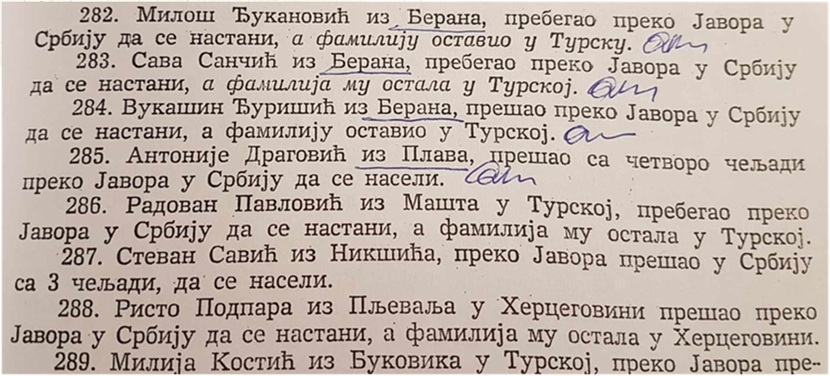
Some of the families who, during the years 1894 to 1896, from Montenegro and Sandzak, crossed over as settlers to Serbia [50]
The Serbian government had planned to populate the areas left without inhabitants after the expulsion of Albanians with Montenegrins as soon as possible, because it was afraid of the Albanians’ organizational abilities to return to their lands after the expulsion.
One of the frequent motives for emigration from Montenegro was blood feud, and such emigrants often changed their surnames, making it quite difficult to trace the origins of these families. [51] From this information provided by the author of this article, we understand that families who had feuds migrated as soon as possible, changing their names and identities, so it is clear that we are dealing with half-Slavicized Orthodox Albanian families.
Those Albanian families who remained in their homes after the cessation of hostilities left this area only a few months later, as a result of that emigration, the depopulation of lands that were largely Albanian property occurred.
Border conflicts with Albanians
Kursumli – on April 18, 1879, when they managed to occupy it for a short time and the Serbian army looted everything valuable from the Albanian properties. The material damage was great, and the government even had to mobilize units of the People’s Army to expel the Albanians from Kusumli. During 1879, Albanian citizens protested at the High Porte, and demanded compensation for the damage caused, even [52]
Finally, Shermet-Efendi, on behalf of the Turkish government, sent a formal note to Ristiq – 4/ on August 16, 1879. It emphasized three demands: 1) the return of the Albanians, 2) respect for their rights based on the provisions of the Treaty of Berlin, 3) freedom of religious belief.
At that time, the Sublime Porte in Istanbul was supported by Great Britain, Austria-Hungary, Germany, and France, while the Serbian government did not have a unified position.
The Ristić government was in favor of a conciliatory policy and the return of this population. The military representatives, led by General Kosto Protić, were against the return of the Albanians . Prince Milan was then in Niš, from where he firmly rejected the possibility of the return of the Albanians.
He justified his position by the fact that during the war they had opposed the Serbian army, that they had not yet stopped occupying Serbian territories, and by the fact that some of them had acted at the expense of the Serbian government. The main reason, however, was the military interest of Serbia and the constant suspicion of a militant Muslim population – especially in the event of a new conflict with the Ottomans. Pressure from the great powers of Europe forced the prince to give way. In a note dated September 15, 1879, the Serbian representative in Constantinople reported to the Porte that Serbia was ready to accept the return of the Albanians.
The Serbian government reasoned that for the Albanians to return to their lands, they would have to make a special request to the Serbian authorities, as well as declare their submission to Serbian laws and Prince Milan of Serbia.
However, it should be noted that the Serbian authorities did little to return the Albanians. The Turkish authorities did not want the Albanians to return either, so the governor of Kosovo, supported by the Russian deputy consul in Prizren – Jastrebov, prevented their repatriation . [53]
In the report of June 1883 we have some allegations of attacks against Albanians. According to this report, there was violence and attacks near the village of Barlovë on the road where the villains ambushed some Albanians who were going with the police from Prokuplje to Kuršumli and fired at them with rifles, killing one and wounding five others. Those who committed this act are said to have been found and are in prison.
Continuing the same report, there is a report of a new conflict – The border has been violated in one place and this was done by unknown perpetrators (Albanians) from Turkey, who crossed the border from Turkey, came to the village of Igrishtë, and took a mare with a mare belonging to him. When the villagers sensed them and followed them in pursuit, then met them, the Albanians from the forest killed Jevrem Maričani on the spot, and wounded Ilija Jokić”. [54]
Iusuf Hasani from Prapashtica e Pajazit Sheqiri. from Sekiraça, Albanian, (from villages on the border with Turkey) with several other Albanians on August 24, 1884 attacked and killed Marko Arsić with a rifle at the “Piken Gurishta” Observation Tower in Nišec, Arsić was killed as a border guard and they took his state rifle “Martinka”. [55]
Colonization in Jablanica and Pusta Reka began in the fall of 1879, and in the spring of 1880. Within 3 to 4 years, almost all the villages in this area were colonized. [56]
The settlers were mainly from the Bulgarian border, present-day Kosovo, Srem, Banat, Herzegovina and Montenegro. From Montenegro and Herzegovina, and Kosovo, the settlers of the second group were brought from 1904 to 1906. In the upper Jabllanice around the border belt, after the Congress of Berlin in 1878, the first settlers were the soldiers who had been mobilized for the occupation of Albanian lands, who settled to live around the border from 1879 to 1883.
These settlers were settled in the villages: Gajtan, Lece, Retkocer, Braine të Madhe, Vrapce Tullar, Boroc, Gubac, Medec, Merkoje, Sijarine, Tupalla etc. [57] Settlers from Montenegro were brought to all the other villages around the border in Starabaja, Maroc….
The settlers from Montenegro were mainly from the following settlements: Plav (Pive), Drobnjak, Nikšić, Moraca, Povača, Tare,. From Herzegovina mainly from Trebinje and Gajka. [58]
These soldiers who settled in at the beginning took over the abandoned lands without any state commission.
The settlers who were brought to these lands after 1889 and whose properties were taken according to the decisions of the state commission, were obliged to pay for the land through taxes for 10 years. [59]
The settlers who were brought to these villages from 1904 to 1906 received up to 4 hectares of land free of charge, and 2 hectares for each adult male (over 15 years of age), and were exempt from taxation for 5 years. [60]
The first settlers who arrived were settled in the homes of Albanians who were forcibly evicted, but the settlers were also helped by the Serbian government to build new homes.
These families assisted the Serbian border guard, who were mostly concentrated in the villages of Sfircë, Spancë and Sekiraqë. [61]
During this time, many border conflicts were caused, as well as conflicts between the Albanians who had remained around Medvedja, and settlers who had come to their lands. The conflict that is worth mentioning occurred in 1903 in the village of Dorvedel, which lasted 3 days.
There were deaths on both sides from this conflict, when the Albanians of Dërvëdel and Gjylekreshtë abandoned the village and took refuge in other villages of Medvedja, and some crossed into Kosovo. [62]
In the new border belt between Serbia and the Ottoman Empire, in Toplica, Jablanica, Llap and Galab, Montenegrins of Albanian origin, half-Slavicized, who had participated in numerous wars for the killing and displacement of Albanians, had been brought.
The Albanian population from Toplica had now been killed and displaced to neighboring countries, some of them had gone to Romania, Austria-Hungary and other European countries, but the vast majority of them were concentrated within the borders of the Ottoman Empire.
Traces of these Albanian families displaced from their homes can still be found today in Bosnia, Romania and other countries, through the surnames they retained, taking their surnames from the villages they had been displaced to. Unfortunately, these families eventually assimilated into the foreign countries where they settled.
Among the richest families of that time in the Leskoc Mountains and the surrounding area was the family of Ramadan Buca from the village of Buca, known in those parts as Ramadan Aga. Ramadan Aga from the village of Buca had accompanied Johann George Von Hahn through the villages of present- day Medveđa .
To preserve his wealth, during the displacement of Albanians from those villages by the Serbian-Russian army, Ramadan Aga had sided with them. A bitter incident, but this suggests that in those difficult years the Slavic victory over Albanian lands was achieved by exploiting the Albanians themselves! From Serbian literature we understand that at the time when Feliks Kanicki visits Leskoc and the Albanian villages, Rama is mentioned as a collaborator of the Serbs.

Evidence from Serbian literature that Rama was their collaborator in the displacement of Albanians during the Eastern Crisis of 1878. [ 63]
As can be seen, in addition to the conquest of Albanian lands, Montenegro also benefited from Serbia by appropriating the spiritual and material heritage of the Albanian population. During the 19th century, all Albanian churches were appropriating, clergy educated in Russia were brought to these churches, and now the liturgy was held in the Serbian language.
Through these clergy, propaganda was carried out for the alleged liberation of “Old Serbia”, the liberation of medieval churches, the myth of the Battle of Kosovo, and all Albanian folk epic songs and traditions were appropriating. I am proving this with some examples of the lute players noted by Serbian scholars as having Serbian origin, but in fact they originated from Albanian tribes from Montenegro and Orthodox Albanians from Kosovo who had migrated to the new Serbian state.
The family of Ponovic Kaica of Morocco, who during the Balkan Wars had kidnapped two Albanian girls, one in the village of Kremenat, and the other in Kranidell in the municipality of Dardana, was once of Albanian origin. Radivoje Papovi?, former rector of the University of Prishtina during the nineties of the twentieth century, also came from this family.
We also find information about the settlement of new residents in the border villages from Montenegro in the book of Jusuf Osman. From his book we understand that in the village of Medec, in 1889 and 1894, settlers from Montenegro and the Krilevës River settled [64] In Mërkoje, families from Montenegro settled in 1879 and 1889. [65] In the village of Arbanashka Petrila, settlers from Montenegro and Barani settled during 1880 and 1884. [66]
In the village of Shtyllca, residents from Montenegro, the Peja region and Kriva Reka (Krileva River, QN) settled. [67] In the village of Tullarë, during 1880 and 1884, young settlers from Montenegro, Herzegovina and the Gjilan region settled. [68] In the village of Marocë, settlers were settled in 1880 and in 1906, from Montenegro. [69]
At this stage of the development of events, Russian policies were implemented meticulously, using the unorganized and religiously divided Albanians. The current border of today’s Kosovo in those years was bleeding every day, with Albanians killing each other. Orthodox Albanians, who after the Tanzimat reforms, and the Serbian seminaries and schools that were allowed in the territories of Kosovo and northern Albania, had been registered as Serbs and had entered the final phase of Slavism, were killed along with Albanians who had accepted the Islamic religion and were trying to protect their border and property. Orthodox Albanians, most of them, crossed the new border and entered the territory of Serbia to become border guards and owners of the property of the Albanians who had abandoned them.
By the Slavic historian, missionary and diplomat, all the incidents initiated by the Russian and Serbian secret services, operating within the borders of the Ottoman Empire, from 1878 to 1913, were described and sent as diplomatic letters to Istanbul and Belgrade. These diplomatic letters about the incidents recorded were later summarized in a special edition in the book ” Zulumi Aga i Begova u Kosovskom Vilajetu (1878-1913)”, written by Branko Perunicic and published in Belgrade, in 1989.
From the Serbian written sources in this book, we learn that many families who crossed into Serbia from the territory of present-day Kosovo were of Albanian origin, such as: Bujaku, Perisha (Berisha). Almost all of these movements were accompanied by numerous conflicts and killings of Albanians among themselves, as they were divided by religion and different political animosity.

Facsimile from Serbian literature, where the Albanian ethnicity of the families who went to live in Serbia in 1894 is proven based on surnames [70]
Also, for the conflicts between Muslim Albanians and Christians who had entered the assimilation phase, we have written data such as: Arsa Qollaku from Moqara near Dardana, then the Qylku family, who still live today in the village of Bostan near Artana. The Qylku family, after the Tanzimat reforms, settled in Bostan and there over time became Serbized, while part of their family who accepted the Muslim religion, today live in the village of Krilevë in Dardana.

Internal conflicts between Albanian families of different religious affiliations, during the years 1880 to 1912 [71]
To reflect this situation in those years, I am describing a story by Ferat Musa [72] from the Prapashticë village (1936-2020), about his uncle Halit, born in a village in the vicinity of today’s Medvedja, who in 1883 settled in the village of Gllogovcë, Prishtina. Waves of violent expulsion had brought his uncle’s family across the border to the hills of the fir tree in the village of Zajçec.
There they had lived for three years in an improvised hut made of fern grass. After three years, his family was informed that an Albanian Orthodox family from the village of Gllogovcë had abandoned his property, having crossed the border to live in Serbia. They proposed to Halit’s father that he settle on that property to start a new life. Halit’s father, together with his only son, now 18 years old, built a small hut with the materials he had on the property.
One winter day, in a cold frost, their house was attacked by some Orthodox Albanians who came from Serbia. In that chaos, Halit’s father was arrested, while Halit, through a window at the back of the hut, managed to escape to the nearby mountain. After an hour, he returned home and Halit found his mother crying and mourning for Halit and her husband.
After a day, Halit began to search around the hut for traces and the fate of his father. About a kilometer away from his hut, Halit found his father and five other Albanians killed. All the bodies were frozen by the frost. Halit returned to his hut to find some means of work to bury his father. After he takes a pickaxe, and alone begins to dig the grave for his father, the Orthodox Albanians slowly approach him.
Halit, cross-legged while working on the grave, they touch him with the bayonets of their weapons on his shoulders. Halit turns and remains surrendered before them, uttering the words that he is not doing anything wrong but is burying my father. Seeing Halit in that sad state, they do not kill him but leave, allowing him to bury his father. Halit returns to the hut, to continue his life alone with his mother.
After two years, when Halit turns twenty, he receives an invitation to go to the Nizam. His mother is very upset, she constantly cries because she is afraid that her son will be killed like most Albanian soldiers, and she will die alone in that small mud hut. The only way she can help her son is with the few liras that she had carried with her throughout that long journey for survival.
The mother talks to Halit and tells him about the liras that she had saved for difficult times. She asks her son to find a volunteer who will agree to go as a paid soldier instead of Halit. Halit also finds another young man who wants to send someone as a paid soldier instead of him. Both of these young men understand that in the village of Marec, two brothers live with a girl of about 10 years old, in great poverty, and they decide to talk to them.
They decide and go to talk to them. One of the two poor brothers says to Halit, “We are tired of poverty and we had agreed to go to a foreign country, but we have no relatives to shelter this little girl.” Halit finally addresses the two brothers and says, “I will promise you that until you return, I will raise this girl and take care of her as if she were my own daughter.”
The two brothers agree and take the money from Halit and his friend. When the time comes for them to report to the city of Gjilan to go to the Nizam, Halit takes the little girl with him and returns home. The two brothers, during the journey from Mareci to Gjilan, are treacherously killed on the road, and the news is confirmed that the two Nizam soldiers were killed during the journey to the city of Gjilan.
According to Haliti’s stories, that little girl constantly followed Haliti in household chores and felt safe only next to him, so she never left him. Haliti took care of her as if she had her own daughter. The time comes when that girl grows up, and Haliti betroths her to a village in Dardana (Kamenica). After her marriage, Haliti constantly visits her and takes care of her well-being. After a few years of marriage, that girl falls seriously ill with tuberculosis and dies young.
Through this story, he describes one of the many tragic cases of our people and the difficult economic, political and social situation of an Albanian family to survive the hard life and the sacrifice of an Albanian for survival, under the Ottoman occupation and the persecution that the Slavs carried out to exterminate this indigenous population without any institutional protection.

Ponovic Kajica, settler settled in the village of Marocë, municipality of Medvedja [73]
As can be seen from Serbian literature, Kojic was born in 1867 in Golija, Montenegro, and in 1889 he moved to the village of Marocë. After completing primary school, Kojic became an officer in the Montenegrin army. In 1922, he was killed by Albanians. Kojic was a clear-sighted man and a good scholar, writes the Serbian historian.
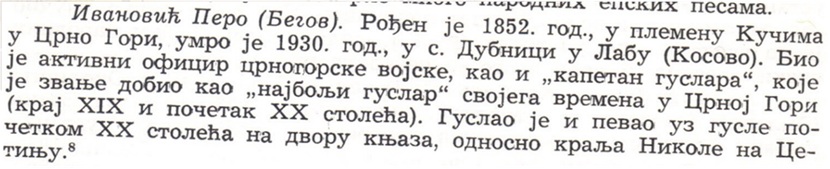
Ivanovic Pero Begov, the court lute player of Mark Milan, a settler who died in 1930 in the village of Dunnicë, Podujevo
Ivanovic Pero (Begov), born in 1852 into the Red tribe of Montenegro. Ivanovic died in 1930 as a settler in the village of Dumnica, Podujevo . [74] He was an active officer in the Montenegrin army and a captain of lute players, who was known as the best lute player during his time in Montenegro in the late 19th and early 20th centuries. In the early 20th century, he sang with the lute at the court of Prince Nikola in Cetinje.
Until the beginning of the 20th century, the Slavicized Arbër tribes in Montenegro acknowledged their Arbër origins.
As other cases we are also highlighting Likic Lazar, born in Plav (Pivi). [75] Lazar was one of the volunteer fighters who fought from 1876 to 1878 for the expulsion of Albanians from the sandzak of Niš. In 1892 King Nikola expelled him from Montenegro, because of some folk songs that he sang on the lute, which hindered King Nikola’s government. From Montenegro he settled in the village of Gajtan in Medveđa.
Lalatovic Nikola, born in 1875 in the village of Ozrimić near Nikšić [76] , was a lute singer who sang in the army. He was killed in the Balkan Wars against the Albanians.
After Montenegro and Serbia gained independence, programs were drawn up for the colonization of the occupied territories with Albanian populations with Slavic populations. Many Albanian lands were donated to Serbian and Montenegrin soldiers who had participated in the killing and displacement of ethnic Albanians.
The volunteer soldiers mobilized for the forcible expulsion of Albanians were merciless, they committed serious crimes with the aim of spreading panic among the Albanian population to abandon their homelands.
Examples of violence are also found in the literature published by Serbian authors. Dimitrije Mitro Petrovic writes in one case that when an armed Albanian in the forest saw a Serbian government commission, who had lit fires near a road in Prokuplje to warm themselves, the Albanian decided to surrender to them.
The Serbian commission was unarmed, while the Albanian was armed with a firearm and a knife. This Albanian, walking towards them, shouted loudly, “Aman, Aman, Serb, Aman, Serb,” and offered the Albanian to the fire to warm himself and, mocking him, killed him with his knife. This was a betrayal that the Slavs committed against the Albanians. [77] To spread fear, the killed Albanians were hung in the forest near the roads, thrown into rivers, and hung on willows near the rivers.
Another case of infidelity is also noted in the book by Aleksa Bogosavljevic, who writes that after a decade of establishing the border, visits by family members separated by the border line are allowed.
One day, a young Albanian from the village of Vllasë, in Medvegja, asks the commander of the border line in the village of Sfircë, begging him to let him cross the border to go to the village of Gllogovicë to visit his aunt. The commander gives him permission on the condition that when he returns, he passes through this border point. Before he returns, he asks his aunt to let his only son visit the family of his acquaintance in Vllasë.
The aunt tells Hasan, don’t ask for my son to come with you because I have my only son and they will kill him, and without him I have no life. Don’t be afraid, Hasan said. Hisen’s parents allow him to go with the promise that when he returns, they will hand him over to the border point. When they approach the border, they supposedly meet with Albanian Kokakë from the village of Hajkobille. In a fight with the Koçaks, Hyseni is allegedly killed, while Hasani, to keep his oath, offers himself to the murdered Hyseni and commits suicide. [78]
There is no doubt that their murder was organized by the Serbian border army, with the aim of making communication between Albanian families difficult. In this case, only logical questions are added: Where did Hasani get the weapon that killed himself! How was it possible for the armed Hasani to accompany Hiseni to the border?
It is clear that the policy of the Serbian army was to kill and stage the murders of Albanians in order to create fear and distrust among Albanian families on both sides of the border. Numerous murders had also occurred within the borders of the Kosovo Vilayet, when Orthodox Albanians were lured by Serbian propaganda to cross the border to live in Serbia.
Aleksa Bogosavlevici, in his book, also writes about many cases of cross-border conflicts and about relations between Serbs and Albanians.
On the eve of the Balkan Wars, the Albanian population in the border zone with Serbia was completely disarmed, while the Albanians who were mobilized to defend the border realized that the Turkish command was not firing cannons and other weapons at targets where the Serbian army was concentrated.
of the general command of the Turkish army Vesel Arnauti was arrested and exiled or killed
The Slavic states that gained independence with Russian support until the Balkan Wars of 1912, successfully developed their projects for a joint alliance for the expulsion of the Ottoman Empire and the conquest of Albanian lands up to the Adriatic Sea and the Shkumbin River. Russia with its allies in the Illyrian Peninsula, achieved the goal of realizing its plans, through the Albanians divided among themselves and divided into different religions , who now unconsciously fought among themselves for the interests of Russia and Turkey.
Even after the Balkan Wars, many Albanian lands were donated to Serbian and Montenegrin soldiers who had participated in the killing and displacement of Albanians.
As can be seen, the Albanian people’s only hope for escape from the Pan-Slavic and Ottoman projects was support from Western Europe, but very few had managed to create support for European support.
The crimes committed by the Balkan allies against the Albanians in the Balkan wars have been written about by many Western journalists who covered the fighting on the ground. Among them, Leo Frendlich stands out, who in his book Albanian Golgotha, described the tragic situation and the serious crimes committed by the Serbian army against the defenseless Albanian people. A Serbian officer boasted that he had killed nine unarmed Albanians with his own hands in a single day. [79] To illustrate the gravity of the situation, we describe a case published by a Danish journalist.
The writing of the Danish journalist who during the Balkan Wars of 1912 as a journalist covered the crimes of the Serbian army in the cities of Vrija, Preševo, Kumanovo and Skopje. He wrote that an Albanian was being chased by three Serbian soldiers. Finally the Albanian boy surrendered, sat down and stood holding his head on his knees, looking scared. One of the Serbian soldiers fired a gun at his body. The boy who was killed rolled to the ground, with his last words, saying something bad about Petar Karađorđević. Surely this Albanian who was killed knew that the Serbian king Petar Karađorđević was a sucker of an Albanian family, which had been Serbized over time. [80]
Conclusion
After the division of the population into “miles”, projects were planned for the assimilation of the Albanian people, so the Ottoman Empire increased military actions to persecute and kill Albanians who refused to be mobilized into the Ottoman army and change their cultural, religious and linguistic identity.
In the mid-19th century, the Albanian Christian population, as well as those who had accepted Islamization, but for various reasons that conflicted with the policies of the Ottoman Empire until 1867, were concentrated in Belgrade and other cities of autonomous Serbia.
The policies developed during the 19th century between Russia and the Ottoman Empire were coordinated according to agreements signed after the armistice between these two empires. Without a doubt, these agreements were signed to the detriment of the Albanian people, lands, identity and culture.
A number of young Albanians were sent to Russia to be trained for war in Russian military schools, while another number were prepared for administrative and clerical work.
In the Albanian lands that were still under the rule of the Ottoman Empire, many Russian missionaries, Muslim religious clerics, and Orthodox Christians educated in Western countries had penetrated, whose mission was to observe the terrain, develop propaganda, and describe the political and social situation of the Albanian population.
By 1877, many young Albanians who had migrated to Belgrade from all Albanian cities, had been educated in Russian military schools, had received high military ranks, and were mobilized in the war against the Ottoman Empire and the Albanian population. The actions of the new Slavic states, against the Albanians, were justified before international and local opinion as fighting to cleanse European lands of the remnants and Ottoman element in Europe, and the Muslim population in Albanian lands.
During this period, the Ottoman Empire forcibly mobilized Albanians to fight for its interests, and through clerics exerted pressure and propaganda on the people, so that the Albanian population would become as Islamized as possible.
In order to quickly implement the program for the Islamization of the Albanian population, in the last decades of the 19th century, two representatives were appointed from the territory of Kosovo to draft a platform for persuading the population to accept the Islamic religion.
From the territory of the Dukagjini Plain, Tahir Mulliqi (Gjakova) was appointed, while for the Kosovo Plain, Tahir Popova was appointed. Both of them drafted the programs and presented them in Istanbul before the sultan.
Albanians in some remote regions, around the new border strip that was created between the Ottoman Empire and Serbia, after a hopeless situation in the last two decades of the 19th century and the beginning of the 20th century, were forced to finally Islamize.
As can be seen from field research, in many Albanian family lines, the Islamization of these families goes from the 6th to the 8th generation, which coincides in time with the Tanzimat reforms and the creation of “militia” according to religious affiliation.
During field research, we came across many Muslim Albanian families, and Orthodox Albanian families, who are from the same family tree but were Serbified during the 19th century.
The Albanian population, in these difficult circumstances, had divided into factions according to religion, and had entered into an internal conflict, causing mutual violence, initiated by both ruling parties.
Conflicts between Muslim Albanians and those who had not yet officially accepted Islamization (the Potures) occurred over property issues, cattle theft, intermarriage, etc. From this period we also have the folk song of Hasan Aga and the Potures’ Çika, in fact a deep ethno-cultural and national division was being created among the Albanians.
In 1879, when the Slavic states were created, to the detriment of the Albanian lands, in the newly created states, pressure began for the assimilation of the Albanian population, which had remained outside the borders of the Ottoman Empire. The Albanians in those countries were assimilated for a short time, their children were sent to military schools and through them they controlled the situation in other Albanian territories. Many young Albanians educated in Russia and Serbia were involved in the army and Serbian nationalist organizations, who were misused to commit crimes against the unprotected Albanian population.
After the Berlin Congress, Serbian politicians, together with Russia, founded nationalist organizations with Orthodox Albanians and opened courses in Prokuplje for the training of volunteer criminals to kill Albanians and conquer other Albanian lands. Among the Serbian nationalist organizations that were formed by the sons of Albanians who had migrated to Serbia decades earlier and who became officers in the Serbian army, the “Black Hand” was founded in 1901. This organization, from its founding until the end of World War I, committed the most terrible crimes against the defenseless Albanian population that can be imagined in wars fought in the history of human civilization.
The defenseless Albanians, now divided by religion, and driven by our enemies, were exploited for foreign interests to kill each other, and occupy each other’s lands, or even go as settlers from one Albanian region to another, just to fulfill the plans of the enemies of the Albanian lands.
In this case, we must single out and thank the autochthonous Albanians who remained in the villages of Medveđa, Vrajë and Bujanovac, who experienced continuous suffering under Serbian rule, but managed to preserve their language, culture and national identity to this day. The Albanians of this area, after the settlement of the semi-Slavicized Orthodox Albanians , in their traditions, offered themselves to those who came from Montenegro, creating good neighborly relations using the tradition of family fraternity. With the exception of some conflicts of some families, neighborly relations were stable, despite the cross-border conflicts that continued until 1912. Unfortunately, this situation began to change after the Balkan Wars.
We Albanians must learn from our bitter past, the shrinking of territories, the killing of each other for the interests of our invaders, and from assimilation due to deep religious and regional divisions.
The Balkan Wars of 1912 are a reflection of the merciless alienation and murder of children, the elderly and unprotected people of the same race, by those who assimilated and turned against their own people, to exterminate their own race, for high positions in foreign powers.
This given above would be argued with the Karadjorgjevic dynasty, who had Albanian origin, when we know that the king of Serbia Petar Karadjorgjevic during the march with his army from Shkodra towards Lezha, the Kelmenda highlanders from the steep mountains of Albania came down and cheered him with applause and welcome just because they knew that the Serbian king was Kelmenda.
The grandson of the Serbian king, Aleksa, stood in Vraj, dancing and taking pride in the Serbian soldiers returning from the war front, each cheering how many Albanians they had killed. According to the Danish journalist, the killed Albanians died mentioning King Karadjorgje Petrovic, because everyone knew he was of Albanian origin. Nikola Pashici, a Vlach or Albanian with family origins from the Tetovo area, led the Serbian and Russian army caravans to conquer Kumanovo and Skopje.
If we make a chronological analysis of historical events from 1876 to 1912, in order to cope with these consequences as easily as possible, so that fratricide and inter-religious conflicts never repeat, a cultural movement of the Albanian people is necessary, which would enjoy strong academic, political and financial support from both Albanian states.
We must create a national cultural unity, and awareness of our homeland and historical past, in order to withstand foreign invasions, and to create the image of a civilized European people before the world.
Literature:
Dimitrije Mitro Petrovic, Rat belesko sa Javoro i Toplice, 1876, 1877, 1878, Borbe u Toplici 1877 1878, Serbian Archives, Belgrade, 1979
Gazmend Rizaj, Upper Albania, Pristina 2011
Aleksa Bogosavlevic: O arnautima, Nis, 1897
Sadullah Brestovci, Albanian-Serbian-Montenegrin relations (1830-1878), Prishtina, 1983
Branko Perunicic: Zulumi Ago i Begova u Kosovskom vilajetu, Nova Knjiga Beograd, 1989
Leo Freunlich: Albanian Golgotha, Tirana, 1992
Sylejman Kylçe, Albania and Ottoman history, Tirana, 2004
Vranjski Glasnik, Book IX, Vranje 1973
Mark Krasniqi, Traces and Traces, Pristina, 1979
Jusuf Osmani: Albanians in the Sandzak of Niš, Settlements in the Leskoc Basin , Book 4, Prishtina 2023
Istorija Beograda 2, Srpska Academy Nauka i Umetnosti, Belgrade, 1974
Jagosh Milovan K. Gjillas, Serbian Schools in Kosovo from 1856-1912, Prishtina, 1969
Dragolub Trajkovic, Iz proslosti Leskovca i vilka, Leskoc, 1977
Bosko Krstic, Jablanica i Pusta reka u nob, Bojnik 1978
Milovan Radovanović, Kosovo and Metohija, Belgrade 2005
https://www.montenegrina.net/pages/pages1/dijaspora/crnogorci_gornje_jablanice_s_medojevic.htm
Citations
[1] Milovan Radovanovic, Kosovo i Metohija, Belgrade 2005, pg.96
[2] Qazim Namani,https://www.zemrashqiptare.net/news/54075/qazim-namani-politikat-ruse-per-slavizimin-e- populates-shqiptare-gjate-viteve-1700-1912-13.html
[3] https://www .cdm.me/drustvo/ekskluzivan-dokument-vladika-danilo-scepcev-petrovic-svoj-je-jezik-imenovao-kao-ilirski/
[4] Sylejman Kylqe, Albania in Ottoman History, Tirana, 2004, p.110
[5] Jagosh K. Gjillas, Serbian Schools in Kosovo from 1856-1912, Prishtina, 1969, p. 304
[6] Ibid., 305
[7] Jagosh K. Gjillas, Serbian Schools in Kosovo from 1856-1912, Prishtina, 1969, p. 304
[8] Jagosh K. Gjillas, Ibid., p. 307
[9] Jagosh K. Gjillas, Serbian Schools in Kosovo from 1856-1912, Prishtina, 1969, p. 308
[10] Jagosh K. Gjillas, Ibid., p. 184
[11] MarkKrasniqi, Traces and Traces, Prishtina, 1979, p. 184
[12] Mark Krasniqi, Ibid., pg. 284
[13] Sadullah Brestovci, Albanian-Serbian-Montenegrin relations (1830-1878), Prishtina, 1983, p. 229
[14] Dragolub Trajkovic, From the past of Leskovac and its surroundings, Leskoc, 1977, p. 87
[15] Gazmend Rizaj, Upper Albania, Prishtina 2011, 177
[16] Sylejman Kylçe, Albania and Ottoman History, Tirana, 2004, pp. 111, 112
[17] Sylejman Kylqe, Ibid., p. 124
[18] https://www.montenegrina.net/pages/pages1/dijaspora/crnogorci_gornje_jablanice_s_medojevic.htm
[19] https://www.montenegrina.net/pages/pages1/dijaspora/crnogorci_gornje_jablanice_s_medojevic.htm
[20] Istorija Beograda 2, Srpska akademija Nauka i Umetnosti, Belgrade, 1974, p.538
[21] Dragolub Trajkovic, From the Past of Leskovac and the Surrounding Areas, Leskovac, 1977, p. 102
[22] https://www.montenegrina.net/pages/pages1/dijaspora/crnogorci_gornje_jablanice_s_medojevic.htm
[24] Ibid. p.62
[25] https://www.montenegrina.net/pages/pages1/dijaspora/crnogorci_gornje_jablanice_s_medojevic.htm
[27] Ibid., pp.86- 87
[28] https://www.montenegrina.net/pages/pages1/dijaspora/crnogorci_gornje_jablanice_s_medojevic.htm
[29] https://www.montenegrina.net/pages/pages1/dijaspora/crnogorci_gornje_jablanice_s_medojevic.htm
[30] https://www.montenegrina.net/pages/pages1/dijaspora/crnogorci_gornje_jablanice_s_medojevic.htm
[31] https://www.montenegrina.net/pages/pages1/dijaspora/crnogorci_gornje_jablanice_s_medojevic.htm
[32] Dragolub Trajkovic, From the Past of Leskovac and the Surrounding Areas, Leskovac, 1977, p. 28
[33] See also, p. 25
[34] https://www.montenegrina.net/pages/pages1/dijaspora/crnogorci_gornje_jablanice_s_medojevic.htm
[35] https://www .montenegrina.net/pages/pages1/dijaspora/crnogorci_gornje_jablanice_s_medojevic.htm
[37] https://www.montenegrina.net/pages/pages1/dijaspora/crnogorci_gornje_jablanice_s_medojevic.htm
[38] https://www.montenegrina.net/pages/pages1/dijaspora/crnogorci_gornje_jablanice_s_medojevic.htm
[40] Ibid. 63
[41] https://www.montenegrina.net/pages/pages1/dijaspora/crnogorci_gornje_jablanice_s_medojevic.htm
[42] https://www.montenegrina.net/pages/pages1/dijaspora/crnogorci_gornje_jablanice_s_medojevic.htmp.64
[44] Ibid., p. 65
[45] Ibid., p.66
[48] Ibid. p.70
[49] Ibid., p. 71
[50] Branko Perunicic: Zulumi Ago i Begova u Kosovskom vilajetu, Nova Knjiga Beograd, 1989, p. 103
[52] Ibid. p. 45
[53] Ibid., p.46
[54] Ibid., p. 46
[55] Ibid., p. 47
[56] Bosko Krstic, Jablanica i Pusta reka u nob, Bojnik 1978, p. 16
[57] Ibid., p.17
[58] Ibid., p.17
[59] Ibid., p. 17
[60] Ibid., p.17
[61] Ibid., p. 19
[62] Ibid., p.19
[63] Dragolub Trajkovic, From the past of Leskovac and its surroundings, Leskovac, 1977, p. 88
[64] Jusuf Osmani:Albanians inthe Sandzak of Niš, Settlements inthe LeskocBasin2023,
p. 295
[65] Ibid., p. 299
[66] Ibid., p. 302
[67] Ibid., p. 313
[68] Ibid., p. 319
[69] Ibid., p. 292
[70] Branko Perunicic: Zulumi Ago i Begova u Kosovskom Vilajetu, Nova Knjiga, Belgrade, 1989, pg.97
[71] Ibid., pp. 325, 337
[72] Ferat Musa (1936) in the village of Prapashticë, interview conducted in May 1994
[73] Vranjski Glasnik, Book IX, Vranje 1973. p. 199
[75] Vranjski Glasnik, Book IX, Vranje 1973. p. 189
[76] Vranjski Glasnik, Book IX, Vranje 1973. p. 189
[77] Dimitrije Mitro Petrovic, Rat belesko sa Javoro I Toplice, 1876, 1877, 1878, Borbe u Toplici 1877 1878,Archive
Serbia, Belgrade, 1979, p.99
[78] Aleksa Bogosavlevic:O Arnautima, Niš, 1897, pp. 44, 45
[79] Leo Freunlich: Albanian Golgotha, Tirana, 1992, p. 43
[80] https://pashtriku.org/raportimi-i-gazetarit-danez-nga-frontet-e-luftes-pushtuese-serbe-tetor-nentor-1912/
Article

