The 10th issue of the Russian magazine “Artillerie-Journal” contains an extract from the reports of Colonel Bogoljubow on the siege of Tivar, as well as notes of the Russian captain Ciklinski, who commanded the artillery and the Russian troops used in this narrative. Below we give a translation of that extract, which we have supplemented in the relevant points with the notes of the said captain.
Tivar is located about 4km from the sea and consists of the city and the fortress, as well as three paralamje (neighborhoods): Barbota, Podgrada and Gretwy. There are about 300 houses in the fortress, while in the suburbs about 600 houses. The total population is expected to reach about 5000 souls. The castle is built, as can be seen from the sketch in Table 15, on an isolated rocky cone, which on all sides, except the southwest side, is surrounded by dominant hills that become higher with increasing distance.
At a distance of 500 to 600 meters from the castle wall there are everywhere suitable points from which it is quite possible to easily see the interior of the country. On the other hand, the rock on which the castle is built has extremely steep slopes, in places even vertical, while the interior of the city presented a series of terraces, which extend at different heights and are covered with houses packed close together in an extremely large irregularity, forming a system of excellent traverses.
The walls of the old Venetian castle are built in such a way that their lower part, almost up to 2/3 of the height, consists of natural rock, and only in the upper third there is an artificially built parapet, which serves to protect artillery and shooters. At the eastern end of the castle there is a quadrangular citadel that dominates the surrounding area, the entrance to which towards the front ground is protected by its own, front wall.
A second, higher point of the castle — the former church of St. George — is located at the southern end. In addition to the entrance to the citadel, which is completely protected by the front ground, the castle has two other gates, one of which is located on the northern front and the other on its southwestern one.
The city is supplied with water through an old aqueduct, which, like a multi-tiered aqueduct, crosses the deep-cut chasm in the east of the city; further directly from the river near the southern front of the castle. In addition, there are several cisterns and even a spring in the city itself.
The length of the castle from north to south is about 450 paces and the width from east to west about 300 paces.
As the Montenegrins approached this city, most of the inhabitants of the forts and for the most part also those of the nearest surroundings fled to the castle and locked themselves inside it. The number of people who were there at that time must have been about 3000 people, of whom from 1000 to 1200 were capable of arms, specifically 1 regular battalion and the rest bashibozuks.
Not all houses were abandoned by the inhabitants in the warning; many of them, mainly those of Catholics, remained inhabited. The Austrian consul Petrović also remained behind in his house located only 200 paces from the southern front of the castle. The armament of the castle consisted of four smoothbore and two rifled (striped) cannons. The rifled cannons, according to the report of Captain Ciklinski, were in operation only on the first day, as both were disabled (dismantled) by the attacker’s 9-inch cannons before the end of that day.
The commander of the castle was Ibrahim Bey, a brave and determined man; he was supported with the greatest zeal by two of the most influential citizens, Selim Bey and Shaban Bey, in the implementation of the measures that were associated with a stubborn and successful defense.
The considerable hills surrounding Tivar are covered to the north and west with dense olive groves and, moreover, being traversed by deep narrow roads (pits) and ravines, offer suitable points for the location of protected camps and positions for the attacker.
The attacker’s artillery consisted of six Serbian mountain guns and four Russian guns, the latter consisting of two 4-foot and two 9-foot guns.
On 13 November the surroundings of Tivar were reconnoitered and the location for the siege artillery was determined; on the following night the batteries for these 10 guns were erected and around morning they were also armed. The two 9-foot guns were placed at a distance of 630 meters, while the two 4-foot guns at a distance of 680 meters from the castle wall.
On the morning of November 14, fire was opened on the castle from the ten cannons brought into position on the Krstac hills, on both sides of the road to Sutorman. The action of the fire of the The Russian artillery, commanded by Captain Tsiklinski and served by Russian artillerymen, was accompanied by particularly good success. The four cannons were initially directed from one of the two cannons located in the upper part of the citadel, and the latter was disabled (dismantled) after the 16th shot; after that, the second was forced to change position and with the 36th shot also became unfit for combat.
The defenders were now returning fire only from the two cannons located in the lower bastion, which, due to their very low position, could no longer be aimed at. The fire of the Russian cannons was therefore directed at the houses of the citadel, which had been bombarded by mountain cannons from the beginning of the action. As a result of this bombardment, a larger building in the citadel was engulfed in flames.
However, the artillery fire maintained by the defenders and especially the rifle fire – the latter suffered no interruption either day or night – did not suffer any decrease in intensity. Without aiming at a specific target, the Turks bombarded the entire ridge of hills occupied by the Montenegrins, so that the bullets mostly flew high above the heads of the attackers, crashing into the ground about 1 km behind the Montenegrin position. The total loss of the attackers during the first day was therefore only 8 wounded.
For the siege of the fortress, Prince Nikola assigned four battalions under the command of Vojvoda Mascho Vrbica, while another six battalions under the command of Vojvoda Plamenac advanced on the road to Shkodra, in order to [prevent] any possible attempt at help from this side to prevent it. On the same day, three battalions previously planned for Muritschi successfully repelled an attack by the Turks and pursued the retreating Turks with two battalions towards Shkodra (Scutari), while the third battalion left in that direction in order to join the main force near Tivar (Antivari).
On November 15, the houses of the citadel and those of the city were bombarded. After the 24th shot from a 9-foot cannon, a small powder magazine was blown to pieces. After the 32nd shot, the Turks responded with only one cannon and soon completely ceased not only the artillery fire, but also that of the rifles. On the attacker’s side, however, the fire was maintained throughout the day and did not cease even at night.
In order to deprive the Turks of the good water that was brought through the aqueduct, the aqueduct was dug up near the spring and destroyed by a dynamite mine by the Russian engineer captain Szadurski.
On the night of November 16, the same officer came together with a non-commissioned officer engineer and some Montenegrins to the fortress wall. Here 50 kg of dynamite were placed openly at the place where the aqueduct connects with the wall that protects the entrance to the citadel, and through the explosion of this mine, which was initiated immediately after that, a wide crack (bleed) was created in the wall.
Although the Turks immediately directed a fierce fire against this point and its surroundings, not a single person was hit, because the people involved in this action found shelter in time under the arcades of the aqueduct and only later, when the Turkish fire had subsided, did they begin their retreat.
Since there was no intention from the beginning to take the castle by storm, no attempt was made to exploit the breach created, which in the following days was blocked by the Turks with several rows of rock blocks. On 16, 17 and 18 November, as a result of the attackers’ artillery fire, several fires were caused in the city and the citadel. Deserters reported that since the beginning of the bombardment five (?) Turkish cannons had been disabled (dismantled) and 38 men of the service crew had been taken out of combat.
In the vicinity of Tivar there were also the following points occupied by the Turks, namely:
At the outermost end of Tivar Bay, the Wolowica (Volovica) beach battery, which controls the entrance to Tivar Bay;
West of the village of Spica (Spizza), the Golobrdo beach battery, which controls the Spica Bay; On the Austrian border, the Tschaim Tower;
On the mountain road leading from Tivat to Budva, the Szumany Tower and the Nechaj fortress, known for its inaccessibility since ancient times.
Of all these fortified points, it was initially deemed necessary to take the Wolowica beach battery, in order to deprive them of the opportunity to use this fortified stronghold in the event of a possible landing of Turkish troops. On the night of November 15, several hundred Montenegrins took this battery without any fighting, the crew of which had left in time. On this occasion two 9-inch cast iron cannons, one 24-foot polished cannon and one 9-inch bronze cannon were taken, as well as three bomb cannons, many shells, some gunpowder and considerable food reserves.
On the following day, namely the 16th [November], the Szumany Tower with 15 men. The other fortifications surrendered some time later, namely: on November 23rd Tschaim Tower, on the 24th the Golobrdo beach battery, and on the 25th Nechaj Fortress.
These important achievements were achieved by the Montenegrins without the slightest loss on their part. They provide a very clear example of the peculiarities of the Turkish nature, which sometimes leads them to fight with rare courage with weapons in hand until death, and at other times, on the contrary, to show cowardice by turning their backs on the enemy.
Of interest in this respect are the negotiations related to the surrender of the garrison of the Golobrdo beach battery, which after the call was made immediately showed itself inclined to surrender, however, it did not want to give up in any way the condition that the Montenegrins first stage a fake attack on the fortification. This request of the Turks was fulfilled and the Montenegrins, on November 24 at night, after a preliminary and completely harmless mutual bombardment with artillery and infantry weapons, climbed the stone wall of the battery with the help of ladders and thus took it pro forma by assault.
In this battery were found eight cannons, namely: two 4-barrel cannons with (striped) rods and four 24-barrel bronze cannons, one bronze bomb cannon and one cast iron, in addition to a lot of ammunition and a large amount of gunpowder (about 800 Pud = 13,000kg), the latter of which the Montenegrins had recently begun to feel a significant shortage. The garrison, consisting of 73 men, was taken prisoner and sent to Cetinje.
The garrison of the Nechaj Fortress, which heard the noise of the false fighting at night and saw the Montenegrin flag on the Golobrdo battery the next morning, surrendered unconditionally at the first call. Its strength consisted of 89 men. The fortress housed: a 9-barrel cannon, two howitzers, two 6-barrel smoothbore cannons and a considerable reserve of ammunition.
Through the occupation of the aforementioned fortified points, the rear of the Montenegrin encircling corps was secured and the entire region up to the Austrian border was placed under the rule of the Prince. The Catholic population remained mostly in their homes and showed friendliness towards the Montenegrins, although this was perhaps not entirely sincere.
Prince Nikola, however, not only did not show distrust towards the position of the Catholic Albanians, but on the contrary, ordered the formation of a battalion from the inhabitants of Mishic (Muschicy), Spiç (Spizza), Shushanj (Szumany), Zubc (Zubcy) and other settlements inhabited partly by Catholics and partly by Greeks (Orthodox), and entrusted its command to a Catholic Albanian, to whom he also attached as a deputy an Albanian of the Greek (Orthodox) religion.
A particular obstacle to the development and consolidation of friendly relations between the Montenegrins and the Catholic Albanians was the difficult-to-restrain tendency of the Montenegrins to plunder (maraud), from which the country also suffered a lot. The Prince, to eliminate this evil, various measures were taken, without however achieving any radical success.
Meanwhile, news reached the Tivar camp that the advanced corps under the command of Vojvoda Plamenac as far as Katerkol (Katrokol) had suffered a significant setback during the attack on the Turkish position at Anamali.
600 Montenegrins, divided into three columns of 200 men each, were assigned on the night of November 18 to attack the fortified position at Anamali, which was defended by four Turkish battalions and 1,500 Albanians. As a result of the unfamiliarity of the terrain and the darkness of the night, two columns were lost, so the surprise attack was carried out by only 200 men.
The Montenegrins managed, as a result of the surprise attack and unexpected for the Turks, to penetrate inside the fortifications, where two Turkish flags were also captured; but pushed on all sides by an overwhelming superiority and met with a strong infantry fire, this brave troop had to retreat again, losing on this occasion 25 men killed and 50 wounded. After this, Vojvoda Plamenac received orders from the Prince to march immediately back to the camp in front of Tivar.
This event, as well as the news that was certainly emerging about the imminent arrival of a Turkish squadron in the waters of Tivar, made the Prince think about the measures that should be taken in case of need to lift the siege of Tivar. Among other things, it was also ordered that the four Russian cannons be sent for safety to Sutorman (Ciklinski says after Virpazar) and in their place to be brought to the battery the Turkish cannons of heavy caliber taken from the battery of Volovica.
After indescribable efforts, it was finally possible, from 23 to 25 November, to bring to the battery, opposite the southwestern front of the castle, two bronze cannons, a 2-pood and a 24-foot cannon, as well as (according to Ciklinski) a cast-iron bomb cannon. The destruction that the heavy shells of these cannons caused to the buildings of the city.
The losses were very great, but they did not cause any significant weakening or reduction of the fire of the artillery and infantry of the defenders. After the information gathered showed that the Turks, after the incident at Anamali, not only had not undertaken any offensive, but on the contrary had withdrawn to the strong position on the Tarabosh mountain on the right bank of the Buna (Bojana), immediately before Shkodra, and that all the Turkish troops that had been dispersed in the direction of Muriqi were also concentrated there, voivode Plamenac received orders to advance again on 21 November with eight battalions towards Katerkoli; only six battalions remained in Tivar at that time.
On 26 November, a telegram from Corfu announced the approach of the Turkish squadron, which was said to consist of three warships, including an armored ship with five battalions of landing troops on board. Later, a frigate also joined this squadron. Although the approach of the Turkish fleet was not unexpected, it left a very demoralizing (depressing) impression on the morale of the Montenegrins; they saw things much worse than they actually developed later.
Since at the same time news reached the Prince about the strength of the Turkish troops that were concentrated on the Buna (Bojana) line, estimating them at 14,000 men, he, under the impression of these disturbing circumstances, let the voivode Plamenac withdraw again to the position of the Good Water (Dobrawoda). A defensive position was determined along the Zeleznica (Železnica) river in case it became necessary to lift the siege.
On November 28, the Montenegrins finally saw the Turkish squadron, which that same day came close to the beach battery of Wolowica (Wolowica) and bombarded it for some time, after which it withdrew again. The attacked battery, an open and weak fortification, responded to the Turkish fire with two cannons, the shells of which, however, could not reach the Turkish ships at all.
In the following days, the Turkish squadron appeared several times in front of the two batteries, that of Volovica and Golobrdo, and bombarded them. The bombardment of November 30, in which an armored ship, a frigate, and a liaison steamer (aviso) participated, was the bloodiest. The Turks succeeded on this occasion in destroying a wooden shelter located in the battery.
The following night, the squadron stayed this time in the bay of Tivar. However, when the next morning a fierce infantry fire was directed against them from the battery, which the Turks thought they had razed to the ground, their surprise at this was very great.
The Montenegrins quickly got used to these bombardments that caused a lot of noise and little damage, and even began to show a considerable underestimation of the Turkish fleet. By December 6, the Montenegrin losses also consisted of only one wounded and several contusions from flying stones.
On this last day, however, two Turkish ships came very close to the Volovica battery and covered it with shrapnel shells. Over the course of an hour, the Montenegrin losses this time amounted to three killed and ten wounded. Fortunately, the guns were not disabled (dismantled) and so the battery commander, Captain Ilja Spičanin, was able to deliver a few last, albeit harmless, shots at the retreating Turks.
After December 6, the Turkish ships appeared several more times in front of the two beach batteries, but did not attempt to bombard them again. Since accurate information on the strength of the Turkish troops concentrated in Buna showed that they consisted of only 12 regular battalions and 1,500 Albanian Bashibozuka men, the Montenegrin military forces were organized by the Prince accordingly as follows: For the siege of Tivar, four battalions under the command of Vojvoda Vrbica; in the position near Uji i Mirë and on the road to Shkodra, five battalions under the two Vojvodas Mascho Dzurowić and Dzoko Pejlowić; as a general reserve in the position near the Željeznica River, six battalions, which were soon reinforced by two more battalions arriving from Nikšić under Vojvoda Plamenac. The Montenegrin forces located in this area of Albania (geographically at that time) therefore amounted to 17 battalions.
Finally, it was decided to avoid any forced and costly advance during the siege of Tivar, and to expect the capitulation of this fortress as a necessary consequence of the complete exhaustion of the food and ammunition reserves located there, which were in any case not very large. However, in order to accelerate the fall of the fortress, the Prince placed at the disposal of Vojvoda Vrbica two more Turkish rifled (striped) cannons, namely a 4-foot and an 8-foot.
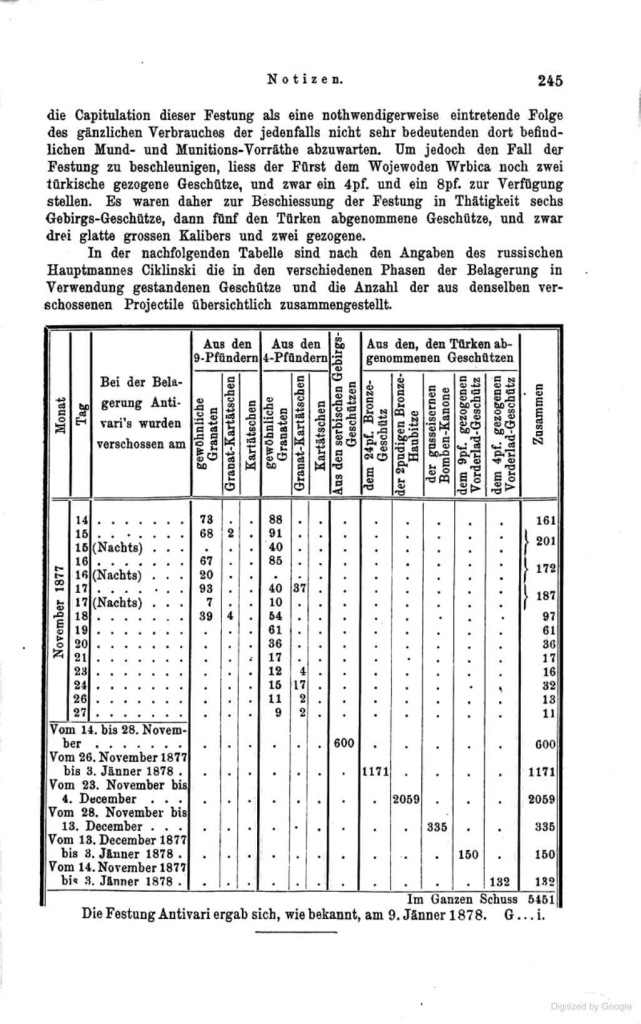
Therefore, for the bombardment of the fortress, six Serbian mountain cannons were in operation, then five cannons taken from the Turks, namely three large-caliber smoothbore and two rifled.
In the table below, according to the data of Captain it Russian Ciklinski, the cannons that were in use in the different phases of the siege and the number of shells fired from them are clearly summarized.
The fortress of Tivar surrendered, as is known, on January 9, 1878.