

In 1876, a German author named “Bacchus” published an article in the “Allgemeine Zeitung” which was published again in the “Würzburg Journal”. The author suggests that Montenegrins and Serbs do not have western culture, but rather they have a Russian culture and identity.
Cited:
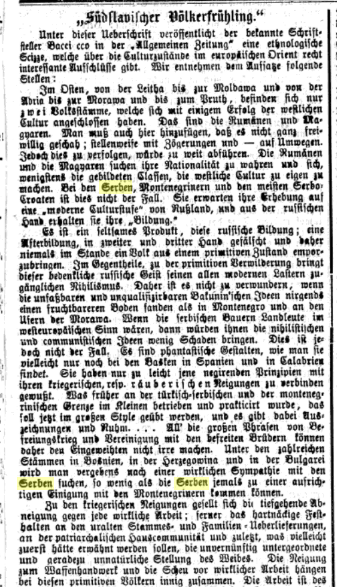
“South Slavic Springtime: Under this title, the well-known writer Bacchus published an ethnological sketch in the Allgemeine Zeitung, which provides quite interesting insights into the cultural conditions in the European Orient. We extract the following passages from the statement:
In the east, from the Leitha to the Moldava and from the Adriatic to the Morava and the Prut, there are only two ethnic groups that have adopted Western culture with some success: the Romanians and Hungarians. It must be added here that this did not happen entirely voluntarily, sometimes with hesitation and by circuitous routes. However, to trace this in detail would lead too far astray. The Romanians and the Hungarians seek to preserve their nationality and, at least among the educated classes, to adopt Western culture.
This is not the case with the Serbs, Montenegrins, and most Serbo-Croats. They expect their elevation to a modern level of culture from Russia, and they receive their education from Russian hands. This Russian education is a strange product, a secondhand and crudely forged imitation, and therefore never capable of raising an ounce from a primitive state.
On the contrary to primitive savagery, this dubious Russian spirit brings with it a nihilism susceptible to all modern vices. Therefore Is it not surprising that Bakunin’s incomprehensible and unqualifiable ideas found nowhere more fertile ground than in Montenegro and on the banks of the Morava? If the Serbian peasants were peasants in the Western European sense, then the nihilistic and communist ideas would do them little harm.
However, this is not the case. They are fantastic figures, such as one might only find among the Basques in Spain and Calabria. They have all too easily combined those negating principles with their warlike and predatory activities. What was previously practiced on a small scale on the Turkish-Serbian and Montenegrin borders is now being practiced on a large scale, and there are awards and prizes for it.
All the grand phrases about wars of liberation and unification with the liberated brothers cannot therefore mislead the initiated. Among the numerous tribes in Bosnia, Herzegovina, and Bulgaria, one will It is futile to seek genuine sympathy with the Serbs, just as the Serbs can never reach a sincere agreement with the Montenegrins.
To their warlike tendencies is added a profound aversion to any real work, furthermore a stubborn adherence to ancient tribal and family traditions, to the patriarchal household community, and lastly, what perhaps should have been mentioned first, the irrationally subordinate and downright unnatural position of women.
The inclination towards arms and the aversion to real work are intimately connected among these primitive peoples. Work is unworthy of the warrior, but it must be done, so it is left to the women. Remarkably, with the physical development of the Serbs, which in many blossoms into consummate masculine beauty, the inability for genuine strenuous work increases almost perfectly. In women, on the other hand, the compulsion to hard work understandably leads to complete atrophy.
The extermination, actually the dying off of the forests in the karst regions and the decline of agriculture throughout the Balkans, could only have happened with a completely indolent people.
One had to employ arts and force to induce them to cultivate the artery, to build roads and railways. When the railway from Zara to Spalato was built, Serbs, Croats, Montenegrins, and Morlats came in droves to earn money with easy effort. But as soon as the overseers asked the dogs to turn away, they lay down in the shade of the rocks and smoked their cigarettes.
“The workers, however, the warlike mountain dwellers took up arms and drove out the Italians. Ten Italians can accomplish more than a hundred Montenegrins, the engineers were heard to say. As is well known, this project had to be halted at that time because of the railway construction, and only the gods of the Morlati know when the Zara-Spalato line will be completed.
To alleviate their permanent poverty, they always had no other option than to raid Turkish territory. The Montenegrins quite unashamedly cite their poverty as an excuse for their raids and lead by example. Modern facilities, good roads and railways are therefore built in those regions because they ruthlessly tear the tribes apart from their traditional way of life and expose their entire miserable existence.
For fifty years, Montenegro resisted the construction of a good road from the Bocca di Cattaro to Lake Scutari. They did not want the South Slavic eagle’s nest, the beacon of South Slavic freedom and future, to be destroyed by a common. How true freedom, enlightenment, and humanity are supposed to be brought from such an eagle’s nest to the plains is incomprehensible to the unbiased observer.
What is sometimes said about the humanization of the warring parties through Russian influence, particularly in Montenegro, is utter humbug. All those who have ever been in the Czernagorz war camp smile at it. When the battle cries and the songs of Kralyevich Marko resound, all humanity recedes into the background, just as it did fifty and five hundred years ago.
Then the watchword is “Cut off heads and pull out Turk noses.” The suggestions that Prince Nikita has abolished the old barbaric war customs are not to be taken seriously, for his power does not extend that far among his people. As in olden times, the Montenegrins drag their women along to the battlefield. Some are laden with heavy baggage, others are harnessed two to a cart like draft animals.
The neglected and pitiable women must be carried on the battlefield. Heroic women participate in the war campaign. The outsider can hardly imagine the wretched, desolate, animalistic conditions of a Montenegrinian field camp. Only the Circassian camps under the Crescent are on an equally low level, or if possible, on an even lower level.
In any case, the long rule of the Crescent and the proximity to the Ottomans contributed greatly to maintaining most Serbo-Croats in the depravity in which they appear again before astonished Europe in this war. It is also not to be assumed that Turkish reforms will ever pave the way for better conditions among the partially or completely subjugated tribes.
No more can this be expected from the influence of Russia. Improvement can only be achieved through the intervention of the old cultures by approximating partly to Italian and partly to German culture, as can be demonstrated by actual phenomena that their participation has already yielded favorable results. On their own, the South Slavs will never create a spring, an ideal state. Russian culture will not help them either.”
Source
Würzburg Journal. No. 186. Saturday, August 5, 1876. 22nd year.

