
Demographic Divergence in Serbia: Risks Posed by Contrasting Serb and Romani Vital Rates
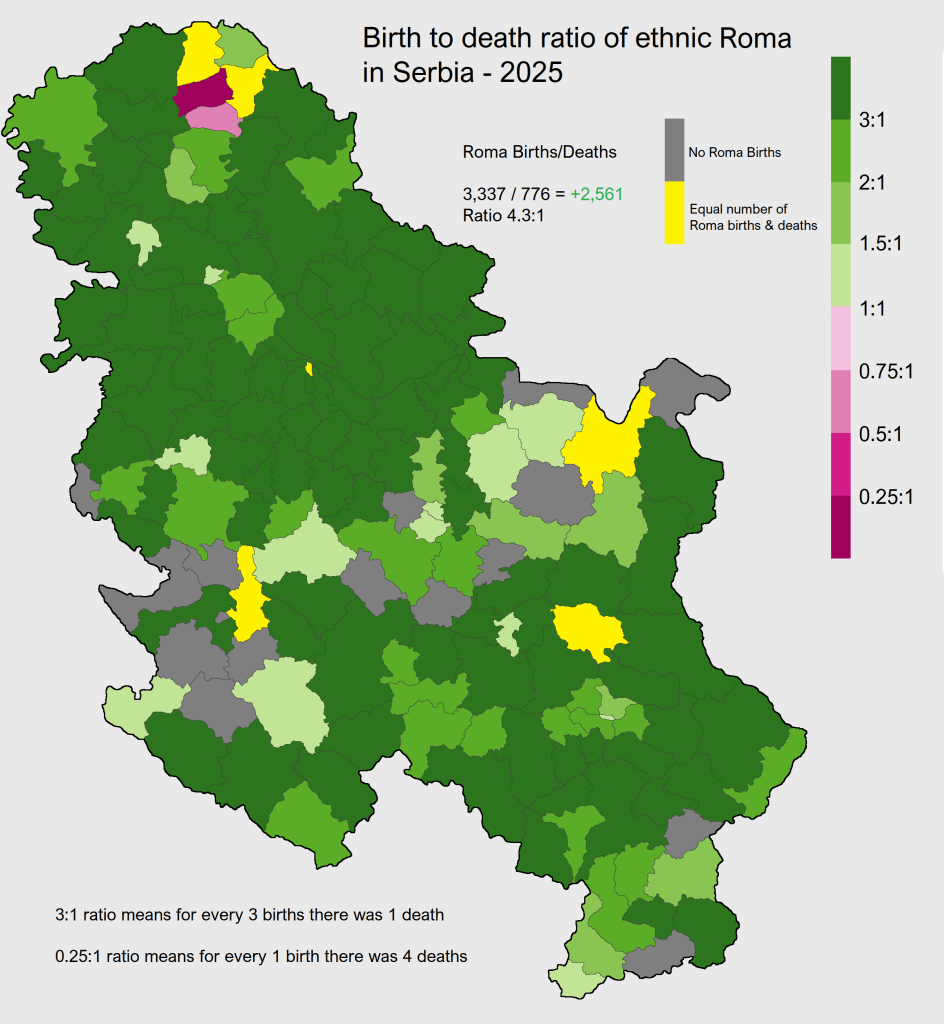
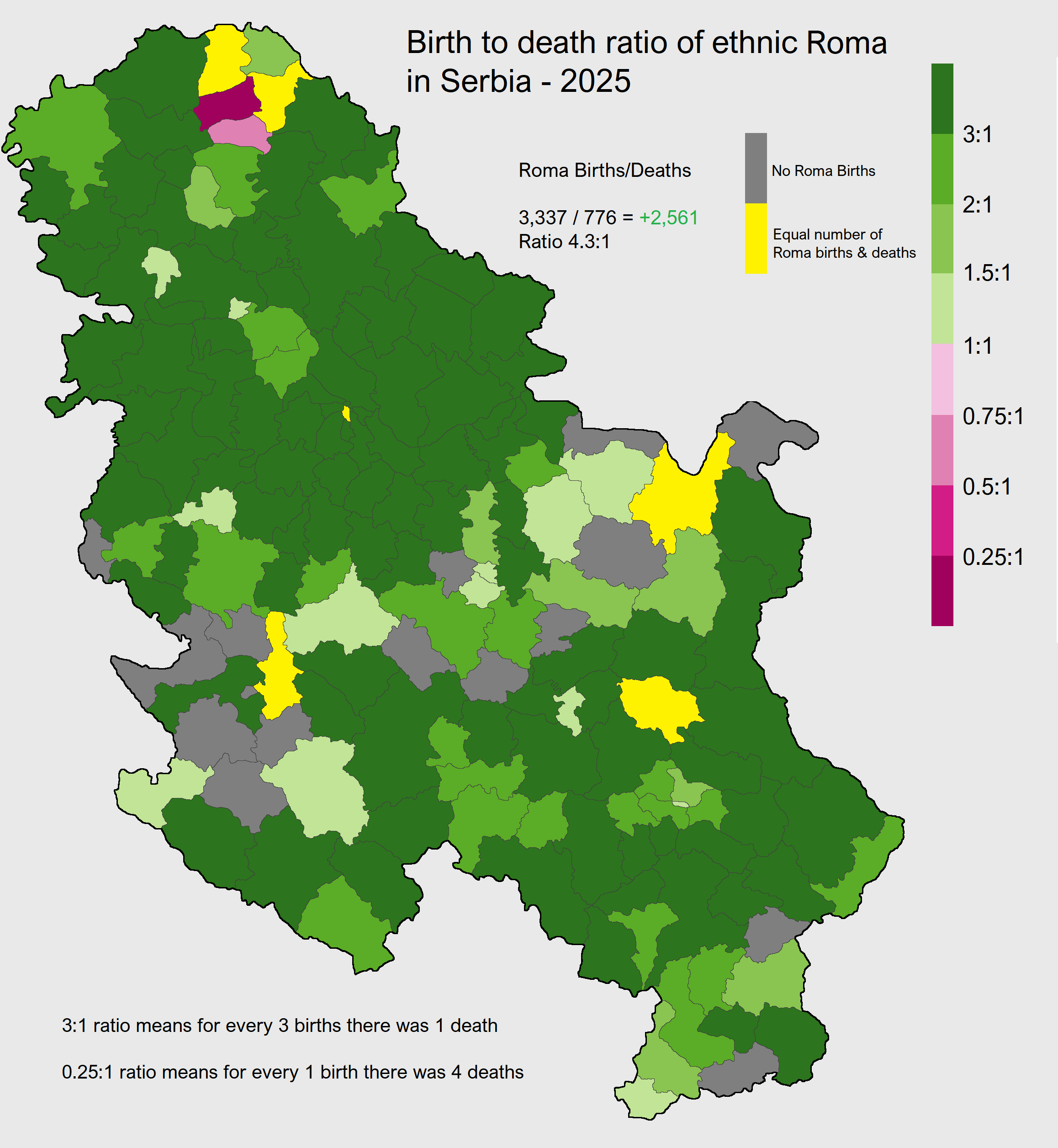
Recent data visualized in a July 2026 X post has drawn attention to sharply differing natural population dynamics between ethnic Serbs and the Romani (Roma) minority in Serbia. The maps depict 2025 birth-to-death ratios at the municipal level, revealing a national-level crisis for the Serb majority and robust growth among Roma.
For ethnic Serbs, births totaled 49,191 against 84,068 deaths, producing a ratio of 0.59:1 and a net loss of 34,877 individuals. Among Roma, 3,337 births far exceeded 776 deaths, yielding a 4.3:1 ratio and a net gain of 2,561. These figures encapsulate deeper structural trends with potentially far-reaching implications for Serbia’s future.
Serbia’s Demographic Landscape
Serbia confronts acute depopulation. The total fertility rate stands near 1.42–1.5 children per woman, well below replacement level (2.1). The median age exceeds 44 years, and annual natural decrease is pronounced (e.g., roughly 37,000 net loss in 2024). Ethnic Serbs, comprising the large majority, drive this pattern.
Roma represent roughly 2% of the population officially (147,604 in the 2011 census), though higher estimates (350,000–500,000) circulate due to underreporting. They exhibit a younger age structure (median ~25 years), larger households, and historically elevated fertility—often 2–4 children per woman compared to the national average—though rates have moderated somewhat with socioeconomic changes.
Key Risks of Romani Outgrowth
Ethnic and Cultural Composition Shifts
Sustained differentials could markedly increase the Roma share over decades. Serbia, like other Balkan and European states, defines much of its national identity around the majority ethnic group. A rising minority share—particularly one maintaining distinct cultural, linguistic, and social patterns—raises questions about long-term cohesion, language dominance, and symbolic national character. Public reactions on platforms like X frequently express alarm over a potential “Roma peninsula” in the Balkans.
Economic and Fiscal Pressures
Roma communities in Serbia display significantly higher poverty rates, lower educational attainment (with notable primary-school non-completion), and lower female workforce participation. Rapid natural increase within this demographic segment could intensify demands on social services, education, and housing while the tax-paying, working-age Serb population shrinks and ages. This mismatch risks straining pensions, healthcare, and public finances in an already challenged economy.
Integration and Social Cohesion Challenges
Research links residential segregation to persistently higher Roma fertility. Less-integrated areas correlate with larger families and slower cultural convergence. Growing numbers amid integration shortfalls may heighten interethnic tensions, prejudice, informal settlements, and competition for resources. Crime perceptions and cultural differences sometimes compound these strains, potentially eroding social trust.
National Capacity Concerns
A smaller, older Serb core combined with a larger, younger but less-educated cohort could weaken human capital formation, military recruitment, innovation, and overall state capacity. Emigration of skilled Serbs amplifies the issue.
Bibliography
Malesori (@Malesori4). “Birth to death ratio of Serbs and Roma in Serbia for 2025.” X, July 21, 2026. https://x.com/Malesori4/status/2079640113873612811.
“Demographics of Serbia.” Wikipedia. Accessed July 22, 2026. https://en.wikipedia.org/wiki/Demographics_of_Serbia.
“Fertility of Roma Minorities in Central and Eastern Europe.” Comparative Population Studies. Accessed July 22, 2026. https://www.comparativepopulationstudies.de.
Battaglia, Marianna, Bastien Chabé-Ferret, and Lara Lebedinski. “Segregation, Fertility, and Son Preference: The Case of the Roma in Serbia.” Journal of Demographic Economics 87, no. 2 (2021).
“Serbia Fertility Rate (1950-2026).” Macrotrends. Accessed July 22, 2026. https://www.macrotrends.net.
Statistical Office of the Republic of Serbia. “Vital Statistics, 2024.” July 1, 2025. https://www.stat.gov.rs.